PART 1
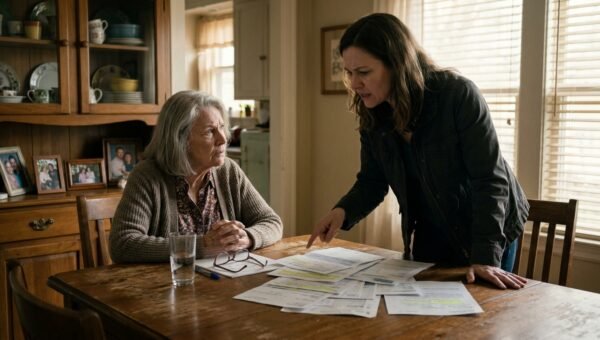
Clara Mae Henderson lived next door to me for twenty-two years, and in all that time, I never saw a single visitor walk up her porch steps.
She was eighty-two when she died quietly in her sleep last November. The county coroner took three days to find her because she had no living kin, no executor, and nobody listed on her emergency forms. When the county finally processed the estate through probate, the small wood-frame house went straight to a tax and property auction on the courthouse steps.
I live on a modest pension and some savings I put away after thirty years of bookkeeping for the county school board. Clara’s property bordered my garden on Elm Creek Road, a quiet stretch of unincorporated land outside Bloomington, Indiana. I knew the house was dated and had bad plumbing, but the lot was nearly two acres. At the auction, bidding was thin. I put in my maximum and ended up buying the house for $187,000.
My plan was simple. I wanted to clean the place out, fix the water heater, repaint the siding, and rent it to a nice young family to supplement my retirement income.
The front door opened with a heavy groan the first Monday in December. The house smelled of old linoleum, peppermint tea, and dry rot. Clara had lived like a woman caught in 1974. There was floral wallpaper curling at the baseboards, stacks of religious pamphlets on the coffee table, and an old console television that probably had not worked since the Gulf War.
By Wednesday afternoon, I had cleared three pickup loads of old coats, yellowed newspapers, and cracked Tupperware. Around two o’clock, I started on the kitchen.
In the back corner of the utility pantry sat a heavy, chest-style Sears Coldspot freezer from the early eighties. It had a thick padlock clasp screwed into the latch, though the padlock itself was hanging unlatched on the hasp. The motor hummed with a low, vibrating rattle that shook the floorboards.
I pulled the heavy lid up. A dense cloud of frosty air rolled over my hands. Inside, on the upper wire baskets, were frozen dinners from five years ago, bags of freezer-burned green beans, and three tubs of vanilla ice cream turned to solid ice rock.
Beneath the wire baskets was a false bottom made of sheet metal, cut to fit the freezer floor. When I lifted the metal sheet with a flathead screwdriver, I expected to see copper coils or maybe an extra layer of insulation.
Instead, there were neat rows of heavy manila envelopes stacked inside waterproof zip-top pouches, chilled stone cold against the bottom metal plate.
I picked up the first envelope. It was labeled in crisp black ink with a date: October 14, 1999.
I sat down on an overturned milk crate right there on the pantry floor, pulled down my work gloves, and broke the paper seal.
Inside was a stack of crisp, uncirculated one-hundred-dollar bills wrapped in a brown paper bank band. Exactly fifty bills. Five thousand dollars in cash.
Behind the money was a single Polaroid photograph.
It showed a little boy, maybe four years old, with dark curls and a light blue winter coat, sitting on a wooden bench outside what looked like an old roadside gas station. The photo was clean, clear, and dated on the lower white border in the same neat handwriting.
My hands started shaking. I set the photo down and opened the next envelope.
Dated March 3, 2000. Another five thousand dollars in banded cash, and another Polaroid of a little girl with pigtails holding a plastic red cup on a front porch.
I counted them one by one, pulling them out of the cold frost.
There were forty-seven identical envelopes in total. The dates stretched across twenty-three years, starting in the late nineties and ending just fourteen months before Clara died. In every single envelope, there was five thousand dollars in cash and a photograph of a child between three and six years old. Boys, girls, different clothes, different backgrounds, but all photographed in candid, unsuspecting poses.
Two hundred and thirty-five thousand dollars in cash, sitting on the bottom of a freezer belonging to a church lady who clipped coupons from the Sunday paper.
I did not touch the money again. I took my phone out of my pocket, walked out onto the front porch into the cold winter air, and called the sheriff’s department.
PART 2
Two county deputies arrived within twenty minutes. Once they saw the rows of cash and the photographs laid out on Clara’s kitchen table, they stepped outside and called the state police and the regional major crimes task force.
By four in the afternoon, my quiet driveway was packed with four unmarked cruisers and a mobile crime scene unit.
The lead investigator was Detective Marcus Vance, a tall man in his late forties with tired eyes and a brown jacket. He sat down across from me at Clara’s kitchen table while two technicians in blue nitrile gloves cataloged the envelopes, taking high-resolution digital photographs of every single Polaroid.
Detective Vance asked me about my relationship with Clara. I told him the honest truth. We were polite neighbors. She waved from her garden. I shoveled her driveway when the snow got higher than four inches. Once a year at Christmas, she brought over a loaf of zucchini bread wrapped in foil. She never spoke about family, she never talked about where she had worked before retiring, and she never had visitors. As far as everyone on Elm Creek Road knew, she was just an elderly widow who kept to herself and attended church services on the radio every Sunday morning.
Around seven that evening, one of the younger detectives came back into the house with a tablet computer in his hand. He looked pale, and his jaw was set tight. He leaned down and whispered something to Detective Vance.
Detective Vance stood up, walked over to the kitchen counter, and scrolled through the screen. When he looked back up at me, the color had drained from his face.
He told me they had run the faces from the first dozen Polaroids through the national clearinghouse database for missing and exploited children.
Out of the forty-seven photographs, nine had already matched cold cases from Indiana, Ohio, Kentucky, and Illinois. The little boy in the blue winter coat from October 1999 had vanished from a church playground in Terre Haute when he was four years old. The little girl with the red plastic cup had disappeared from a family picnic outside Louisville in the spring of 2000.
I had to grip the edge of the table to keep from falling out of my chair. My neighbor of two decades had not been an innocent old woman living on a modest check. She had been sitting on a ledger of stolen children.
While the technicians were packing the envelopes into brown evidence bags, one of them noticed something wedged into the corner of the freezer compartment, tucked behind the drain plug beneath the false floor.
It was a forty-eighth envelope.
This one was different. It was not sealed inside a zip-top bag, and the paper was not manila. It was a white business envelope, clean and dry, sitting in a thin plastic sleeve.
Detective Vance put on a fresh pair of gloves and picked it up. Written on the front in Clara’s familiar, spindly cursive was my full legal name: Martha Jean Holloway.
Detective Vance looked at me hard. He showed me the envelope through the plastic before he broke the seal. He asked me plainly if I had known Clara left anything for me. I swore on my mother’s grave that I had no idea what was inside.
He used a pocket knife to slit the top edge.
There was no money inside envelope forty-eight. There was no Polaroid of a child.
Inside was a single sheet of lined notebook paper and a hand-drawn map of the property I had just purchased. The letter was addressed directly to me, written in Clara’s neat hand:
Martha, if you are reading this, it means you bought the land like you always said you would when I was gone. You are a decent woman, and you deserve to know what paid for my quiet life. Do not let them call me a monster until you look under the soil. The backyard map has six marks. Dig where the Xs are before you let the state take this ground. The truth is not what the pictures say.
At the bottom of the page, Clara had drawn a precise overhead diagram of the backyard, measured in paces from the old stone well behind the garage. There were six distinct black Xs inked into the paper, stretching in a straight line toward the tree line at the southern edge of the property.
Beneath the line of Xs, Clara had written three final words:
Find the boxes.
PART 3
Detective Vance did not wait for daylight. By nine that night, floodlights on tall tripods were erected across the back lawn of Clara’s house, lighting the frosted grass like a football stadium.
A backhoe from the county highway department was brought in on a flatbed trailer, accompanied by two forensic anthropologists from the state university.
I stood by my back fence wrapped in a heavy wool coat, watching the yellow machine idle in the cold air. My stomach was knotted so tightly I could barely draw a breath. I had lived fifty feet from that yard for more than twenty years. I had watched Clara plant tomatoes, pull weeds, and hang laundry on the line. The thought that she had buried six children in the dirt behind her garage made me feel physically ill.
The backhoe operator scraped off the top six inches of turf at the first marked spot, thirty paces south of the stone well.
From that point on, the anthropologists took over with hand shovels and small trowels. The floodlights cast long, jagged shadows against the bare winter oaks.
At four feet down, a shovel struck something solid with a dull thud.
The whole yard went completely silent. The county prosecutor, who had arrived around midnight, stepped up to the edge of the trench alongside Detective Vance.
The technicians worked carefully with brushes for nearly an hour, sweeping away dark clay and damp silt.
They did not pull up a small coffin. They did not pull up human remains.
They lifted out a heavy steel military surplus ammunition case, sealed completely around the lid with thick rubber gaskets and industrial waterproof tape.
Detective Vance carried the heavy steel box to a folding worktable set up under a canopy near the garage. A technician used heavy shears to cut the rubber seal and popped the two steel clasps.
When the lid swung open, the floodlights caught stacks of official legal paperwork, medical records, and certified court decrees.
Inside that first box were birth certificates, name-change petitions, adoption finalizations, and complete medical histories for eight different individuals.
On top of the papers lay a handwritten journal bound in black leather.
Detective Vance opened the cover under the bright white LED lights. I was standing ten feet away, flanked by a deputy, listening as the detective read the first entries aloud to the prosecutor.
Clara Henderson had not been a kidnapper.
In the late 1980s and throughout the 1990s, Clara had worked as a private courier and administrative clerk for an underground network run by a disgraced attorney named Harold Vance—no relation to the detective—and two corrupt social workers in Chicago. The network took children from abusive foster situations, unregistered private custody arrangements, and domestic violence shelters, and sold them through illegal off-the-books adoptions to wealthy families across the country who could not qualify through state agencies.
Clara’s specific job had been to transport the children between safe houses and take the intake Polaroids for the buyer portfolios. For every child delivered, she had been paid a five-thousand-dollar cash fee.
The dates on the envelopes in the freezer were the dates of the transactions. The cash inside every envelope was the exact money she had been paid for each child. She had never spent a single dollar of it. She had frozen every payment in its original envelope, keeping the identical ledger for over two decades.
The six buried steel boxes held the counter-ledger.
Beginning in 1999, Clara had suffered a severe breakdown after discovering that two of the children were being placed with individuals who had active criminal records. Unable to go to the police without facing life in prison herself, and terrified of the syndicate operators who knew where she lived, Clara had started systematically stealing the original files.
For every child the network moved, Clara had secretly photocopied the intake papers, stolen their original identity documents, tracked the buyer families, and documented the new aliases, addresses, and private adoption contracts.
She had buried the six steel cases across her property over a ten-year period, creating a complete, unbroken paper trail of where every single child had been taken, who had bought them, and what their legal names were changed to.
She had kept the money in the freezer as evidence of the bribes, dated to match the stolen files in the ground.
ENDING
It took four days for the forensic teams to excavate all six steel ammunition boxes from Clara’s backyard.
By the time the final box was opened on Saturday morning, the state police and federal investigators had recovered complete identity records for forty-six of the forty-seven children pictured in the freezer Polaroids.
The nine missing-person cold cases that had initially terrified the detectives were resolved within seventy-two hours. None of those children had been harmed or killed. They had been illegally placed into private homes under falsified birth certificates. Most of them were now adults in their twenties and thirties, living normal lives across eight different Midwestern states, completely unaware that their legal adoptions had been black-market transactions handled by an unlicensed syndicate.
Federal authorities took custody of the two hundred and thirty-five thousand dollars from Clara’s freezer, placing it into an escrow fund designated for victim assistance and identity restoration services.
Because Clara was deceased, there could be no criminal prosecution against her. But the documents pulled from her backyard led to the arrest of three surviving former case workers and a retired family court clerk in northern Illinois who had facilitated the falsified paperwork thirty years earlier.
The county property deed was officially transferred into my name three weeks later.
I stood in the empty backyard on a cold Tuesday morning in January, looking at the long, filled-in trench where the floodlights had stood. The earth was still soft and dark against the dormant grass.
Clara had lived beside me for twenty-two years carrying the weight of forty-seven stolen lives in the bottom of her freezer. She had been too cowardly to walk into a police station while she was breathing, terrified of dying in a state prison cell, so she had waited until her heart stopped to let the truth surface.
She knew I had talked for years about wanting to buy her lot if she ever passed on. She had gambled that an ordinary neighbor with an honest life would find the envelopes, call the law, and follow the map into the dirt.
In the spring, I hired a local contractor to tear down Clara’s old house completely. I could not stand the thought of renting that kitchen to a young mother with toddlers.
I leveled the foundation, planted clover across the two acres, and extended my vegetable garden all the way to the southern tree line.
Whenever people in town ask me why I paid so much money for an empty lot that only grows tomatoes and sweet corn, I tell them the ground needed to be cleared so the sun could finally hit it.
They think I am just talking about the weeds. But every time I look out my kitchen window at the spot where the old Coldspot freezer used to sit, I say a quiet prayer for forty-seven children who finally got their real names back.