PART 1
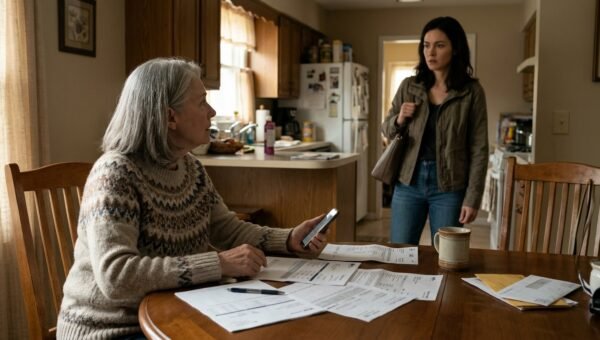
The mahogany conference table at Miller, Vance, and Holloway was wide enough to park a small car on, and the air conditioning in the downtown office felt cold enough to preserve meat. I sat on the leather chair with my hands resting flat on my knees, wearing the dark floral dress I bought off the clearance rack three days before Aunt Clara’s service. My hands were dry and rough from twenty-two years of handling warehouse packing tape, and every time I shifted in the seat, the leather gave a sharp squeak.
Across from me sat Arthur Vance, a probate attorney whose gray hair looked like it had been trimmed with a steel ruler. He cleared his throat, adjusted a pair of rimless reading glasses, and flattened out a five-page document with an embossed gold seal at the top.
“Mrs. Bennett,” he said, looking at me over the rims. “Your aunt, Clara Mae Higgins, was very specific about how her final estate should be distributed. As her sole surviving blood relative on the maternal side, you are named as the primary beneficiary.”
He tapped a manicured fingernail against the middle paragraph of page three.
“The estate includes the residential parcel on Sycamore Ridge Road, free and clear of any primary mortgage. It includes her 2018 Buick sedan, which has sixty-four thousand miles and a clean title. And after final medical clearances and outstanding utility debits, the liquid balance in her high-yield money market account sits at $119,460.”
The number made my breath catch in my throat. I am fifty-four years old. My husband, Tom, passed away six years ago after a long bout with congestive heart failure that took our savings, our life insurance payout, and the equity in our modular home. For the last five years, I had been renting a one-bedroom apartment over an auto repair shop on Route 9, working forty-six hours a week packing hardware shipments for thirteen dollars and eighty cents an hour. To hear someone say almost one hundred and twenty thousand dollars in cash, plus a paid-off home and a reliable car, felt like someone had reached down into a pit and pulled me up into the daylight.
“Is that… are there liens against the estate?” I asked. My voice sounded thin and strained.
“None,” Mr. Vance replied. “Clara paid every bill thirty days early her entire life. However, we have not reached the final page yet.”
He turned the legal-sized bond paper over with a slow, deliberate snap. The fifth page had only two typed paragraphs and a handwritten codicil across the bottom, signed with Aunt Clara’s familiar, cramped cursive.
“Here is the conditional clause,” Mr. Vance said. “You take title to the cash, the vehicle, and the real property immediately. But the deed contains a mandatory twelve-month restrictive covenant. You must establish physical residency at the Sycamore Ridge property within thirty days of probate confirmation. You cannot sell, lease, transfer, or encumber the property with a secondary loan for a minimum of twelve calendar months. If you list the house for sale or abandon physical residence before the three hundred and sixty-fifth day, the real estate reverts to the county historical land trust, and eighty percent of the liquid funds transfer to a private endowment.”
I stared at him, trying to make the legal language fit together in my head.
“Why would she put a restriction like that on me?” I asked. “Aunt Clara knew my situation. She knew I had nothing left.”
“Clara told me that Sycamore Ridge needed a resident who belonged to the family,” Mr. Vance said, folding his hands over the file. “She left precise instructions. She stated that if you simply cashed out and sold the acreage to a residential developer, you would lose something that can never be bought back. Those were her exact words. You have seven days to accept or decline the conditional bequest.”
I didn’t need seven days. The property had sat neglected for the last three years while Clara’s arthritis worsened, and the roof shingles were curling, but it was a home of my own. I signed the probate acknowledgment right there at the table.
Two weeks later, the moving van backed down the overgrown gravel driveway of Sycamore Ridge. The house was a two-story farmhouse built in 1948, surrounded by four acres of neglected crabapple trees and waist-high pasture grass. The white siding was streaked with gray mold, the front porch steps sagged three inches to the left, and the screen door had a jagged hole patched with green gardening wire. Inside, the rooms smelled of dried spearmint, damp wallpaper, and old wool blankets.
Clara had lived there alone for forty-one years after my Uncle Ray passed away in a farm machinery accident back in 1983. She never remarried, never took in boarders, and rarely invited neighbors past the front parlor.
I spent the first three weeks scrubbing baseboards, bleaching mold off the bathroom tile, and washing decades of dust out of the floral curtains. By the end of the month, the house was clean, warm, and quiet. The Buick was parked under the lean-to shed, and the bank had transferred Clara’s savings into a new checking account under my name. For the first time in six years, I didn’t wake up at four in the morning worrying about rent.
Then, on a rainy Thursday afternoon, I started cleaning out the bottom drawers in the kitchen pantry.
The kitchen had an old set of built-in birch cabinets installed back in the late fifties. Below the breadbox sat a narrow utility drawer that wouldn’t slide open. When I tugged on the brass pull, the wood gave an inch, then stopped dead with the metallic click of a brass cylinder lock. The faceplate was tarnished brown, with a small circular keyhole right below the lip.
None of the keys on Clara’s ring fit. I stood there with a flashlight, looking around the pantry shelves. On the top shelf, behind three dusty quart jars of pickled green tomatoes, my fingers bumped against something heavy inside an empty tobacco tin.
I took the tin down and opened it. Resting inside was a single small, flat steel cabinet key with the number twenty-four stamped into the head.
I took the key back to the pantry drawer, slipped it into the lock, and turned it clockwise. The cylinder gave a sharp, gritty snap, and the drawer slid out on its wooden runners.
The drawer was empty except for a thick legal envelope made of brown kraft paper, tied shut with red butcher’s twine. Across the front, written in Clara’s sharp, slanted handwriting, was a single sentence:
“To whoever takes this roof: read this before December 31st, then dial 614-555-0182. Ask for Henry.”
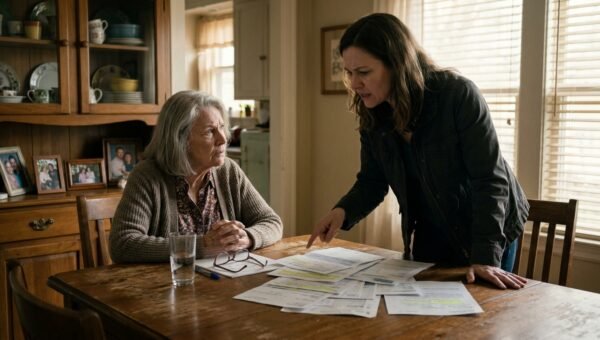
I cut the twine with a kitchen paring knife and dumped the contents onto the kitchen table.
Inside lay three yellowed carbon receipts from a private surveying company dated July 1979, four handwritten pages listing full names, dates, and street addresses, and an old black-and-white aerial photograph of the Sycamore Ridge acreage showing red grease-pencil boundaries drawn across the southern pasture.
At the top of the first lined page was an index of names. The third name on the list was my late father, Robert Higgins. Next to his name was a date: October 14, 1974. And next to that was a phrase written in red ink: “Settlement cleared through the township board.”
My heart began to thump against my ribs like a trapped bird. My father had never lived on Sycamore Ridge. He had worked as a foreman for the county water authority until he died of a stroke twelve years ago. He and Clara had barely spoken for the last fifteen years of his life, but whenever anyone asked why, Clara would only say that family pride was a terrible disease.
I picked up my cell phone with a hand that had gone completely cold. I looked at the ten-digit landline number written on the brown envelope, punched the digits into the keypad, and put the phone to my ear.
The line rang four times. Then a hollow click sounded on the other end, followed by the slow, rasping intake of an elderly man’s breath.
“Hello?” the voice said. It was deep, gravelly, and worn down by decades of tobacco.
“Hello,” I said, leaning my hips against the kitchen counter for support. “My name is Laura Bennett. I am Clara Higgins’ niece. I found this phone number inside a locked drawer in her kitchen.”
The line went dead silent for five full seconds. I could hear the faint ticking of an old wall clock in the room where he was sitting.
When the man spoke again, his voice had dropped into a low, deliberate murmur that made the hair on my arms stand straight up.
“Did she finally leave you the house, Laura?”
PART 2
The man’s question settled into the quiet kitchen like a block of iron.
“Yes,” I said, clutching the receiver tighter against my ear. “She left me the house. Who are you?”
“My name is Henry Ward,” he said. He had a slight tremor in his voice, but the words were steady. “I was your uncle Ray’s foreman for sixteen years at the township road depot. When Ray got crushed under that combine in eighty-three, Clara called me before she called the coroner. I’m eighty-one years old now, Laura, and I have been sitting in this recliner waiting for that phone to ring for four years.”
“Henry, what is this paperwork?” I asked, looking down at the yellowed surveying maps spread across the table. “There are names here. My father’s name is on this list. Dates from the seventies. Red lines across the pasture. Why did Clara make me promise to live here for a full year without selling?”
Henry let out a dry, raspy cough. “Because if you sold the property on the open market, the title company would have ordered a modern boundary and title search from the county auditor. And the second an outside surveyor puts pins in that southern four-acre line, the Miller family and the county commissioners would have taken that land for pennies before you ever knew what you were holding.”
“What am I holding?”
“You don’t talk about fifty-year-old township business over a cellular telephone,” Henry said sharply. “You get in that Buick Clara left you and drive out to the county access road behind the old feed mill. Number 412 Mill Creek Lane. It’s a gray trailer with an aluminum awning. Bring every scrap of paper from that drawer. And come alone.”
The line clicked dead.
I looked at the kitchen clock. It was twenty minutes past four in the afternoon. The rain was coming down harder now, drumming steadily against the tin roof of the porch. My common sense told me to put the papers back in the envelope, lock the drawer, and call Arthur Vance at his law office. But Arthur Vance was an estate lawyer who followed probate forms; Henry Ward was a man who worked the land when Uncle Ray was still breathing.
I gathered the papers, slipped them back inside the brown kraft envelope, and took Clara’s car keys off the peg by the door.
Mill Creek Lane was seven miles out toward the river, down a narrow strip of broken asphalt where the roadside ditches were clogged with weeds and rusted farm equipment. Number 412 sat behind a row of cedar trees. A gray double-wide trailer with a gravel turn-around and an old green Dodge truck parked under an awning.
When I stepped out of the Buick, the front door of the trailer opened. A tall, thin man in a faded flannel shirt and denim overalls stood in the doorway, leaning heavily on a carved walnut cane. His face was weathered like old saddle leather, but his blue eyes were clear and sharp.
“Come inside, Laura,” he said, holding the aluminum storm door open. “Wipe your feet. The coffee’s fresh.”
The inside of Henry’s trailer was small, immaculate, and smelled of cedar shavings and black coffee. He gestured toward a Formica kitchen table, poured two mugs of steaming coffee from an electric percolator, and sat down opposite me with a heavy sigh.
I laid the brown envelope between us.
Henry didn’t open it right away. He ran his calloused thumb over Clara’s handwriting on the front, his expression softening for just a second.
“Clara was a stubborn woman,” he murmured. “Hardest woman I ever knew. But she kept her word to Ray until the day they put her in the dirt.”
He pulled the papers out, laid the yellowed survey map flat on the table, and set a brass paperweight on the top corner to keep it from curling.
“Your grandfather owned three hundred acres along the ridge back in the forties,” Henry began. “When he died in 1968, he split the parcel between your dad, Robert, and your uncle, Ray. Ray took the homestead and the fifty acres on the south side. Robert took the hundred acres on the north side, near the state highway.”
“I remember the highway land,” I said. “Dad sold that to the commercial park in the early nineties.”
“That’s right,” Henry said, his jaw tightening. “Robert was a businessman. He liked quick money. But in 1974, the state transportation department decided to run the new county bypass straight through this valley. They needed a sixty-foot easement right along the boundary line between Robert’s parcel and Ray’s pasture.”
Henry tapped the red grease pencil line on the aerial photograph.
“Your father went to the township zoning board without telling Ray. Robert cut a backroom deal with Commissioner Donald Miller—that’s the father of the Miller family that runs the county development board today. Robert signed over the road right-of-way, took an eighty-thousand-dollar settlement under the table, and told the state engineers that the southern drainage ditch belonged entirely on Ray’s acreage.”
A cold pit opened in my stomach. “Dad put the drainage runoff on his own brother’s farm?”
“He ruined Ray’s bottom twenty acres,” Henry said flatly. “Every time it rained more than an inch, the highway runoff flooded Ray’s pasture, drowned his alfalfa, and poisoned his stock pond with road salt and diesel grease. Ray fought it for four years. He spent twelve thousand dollars on civil engineers, had the private surveys done in seventy-nine, and proved that Donald Miller and your father altered the township plat maps to shift the easement thirty feet south.”
Henry leaned forward, his knuckles whitening against the edge of the table.
“Ray had the original plat maps locked in his safe. He was going to file a federal civil suit against the township commissioners for fraud. He had the affidavits ready to sign. That’s what those names and dates are in your hand, Laura. Those are the township clerks and road crew workers who were paid cash to move the survey stakes in the dark back in seventy-four.”
“Then why didn’t Ray file the lawsuit?” I asked.
Henry looked me dead in the eye. “Because two days before the filing deadline in eighty-three, Ray’s combine slipped its brake on the ridge slope. The machine rolled into the culvert. Ray died pinned beneath the iron before the volunteer squad could get a jack under the axle.”
PART 3
The sound of the rain against the trailer’s metal roof seemed to double in volume. I looked at the names on the lined paper. Men who had worked on the county road crews fifty years ago. My father’s name, written in Clara’s hand, beside the payout date.
“You think Uncle Ray’s death wasn’t an accident?” I whispered.
“I think Ray was sixty-one years old and had operated that same John Deere combine for fourteen seasons,” Henry replied, his voice deadly quiet. “He never left a machine in neutral on a seven-degree grade. Never once. But the sheriff ruled it an accidental rollover before the sun went down that evening. The sheriff that year was Donald Miller’s first cousin.”
Henry took a slow sip of his coffee.
“After the funeral, Donald Miller drove out to Sycamore Ridge in his Lincoln. He sat on Clara’s porch and told her that since Ray was gone, the township was going to condemn the flooded twenty acres for an expanded water retention basin. He offered her ten thousand dollars for the whole fifty-acre homestead, told her she had thirty days to take it or the county would declare the ground uninhabitable.”
“What did Aunt Clara do?”
“Clara walked inside the house, came back out with Ray’s double-barrel twelve-gauge, and told Donald Miller that if his tires were still in her gravel by the count of three, she would blow his windshield through the back glass.”
A faint, bitter smile touched Henry’s lips.
“Miller backed out of the driveway. But he didn’t stop. The township slapped a high-risk flood encumbrance on the property deed. It meant no bank would ever write a mortgage on that land, and no buyer could ever get title insurance unless the county commissioners lifted the restriction. Clara was trapped. She couldn’t sell it for what it was worth, and she refused to let the Millers steal it for pocket change. So she stayed. She stayed for forty-one years, paying the property taxes every November, holding the title like an anchor so they couldn’t touch it.”
“Then why leave it to me?” I asked, my hands trembling as I held the coffee mug. “Why give it to Robert’s daughter? Robert helped cause this.”
“Because Robert is dead,” Henry said gently. “And because Clara watched you. You thought she never paid attention to you, Laura, but she did. When your husband was sick in that hospice bed and you worked three shifts to pay the medical suppliers, Clara knew about it. She told me two years ago, ‘Laura is the only one in that branch of the family with Ray’s blood in her veins. She works, she doesn’t whine, and she won’t run when things get steep.'”
Henry pulled the aerial map closer to him.
“Now listen to me, Laura. This is why you cannot sell that house for twelve months. The Miller family has been waiting for Clara to die. Donald Miller’s son, Greg Miller, is the chairman of the county regional planning commission today. They have a state grant pending right now to build a three-hundred-unit residential subdivision on the ridge, connecting to the new water main. But they cannot get the federal highway permits without that southern drainage corridor that runs through your property.”
“If I had tried to sell right away…”
“If you had put that house on the market thirty days after probate, Greg Miller would have stepped in through a front company, offered you two hundred thousand dollars cash, and you would have taken it because you were broke,” Henry said. “Then he would have cleared the title with one vote at the commissioners’ meeting, bulldozed Clara’s house, and sold the commercial rights to a Columbus developer for three million dollars.”
The room went cold.
“What happens after twelve months?” I asked.
Henry reached into his overall pocket and pulled out a small, heavy key attached to a brass ring. It was an old safe-deposit key from the Farmers and Merchants Bank in town.
“Clara left a second safe-deposit box at the bank,” Henry said, placing the key on top of the legal papers. “It isn’t listed in the probate inventory. It is registered under Ray’s old company name, Higgins Ridge Hauling. The lease on that box expires on December 31st of this year. Inside that box are the certified original plat maps from 1974, the canceled township checks Donald Miller paid to the county surveyor, and a signed confession from the deputy clerk who altered the state register.”
I looked at the brass key. “Why did she wait until now?”
“Because under the state statute of limitations on public land fraud, the records become public archive after fifty years,” Henry explained. “Fifty years from the date of the altered easement is October 14th of this year. Once that date passes, those records cannot be sealed by the county court. You take these documents to the state attorney general’s land division in Columbus, not the local sheriff. You force the state to clear the flood encumbrance off your deed, and you force the county to pay damages for fifty years of illegal water diversion.”
Henry leaned his chin on his hands, looking at me with eyes that had seen half a century of local politics.
“You have a choice, Laura. You can take the hundred and nineteen thousand dollars Clara left you, ride out your twelve months in that drafty house, let the year expire, and sell the whole place to Greg Miller for whatever he throws on the table. You will have enough to live simply for the rest of your days. Or you can take this key, finish what your uncle Ray started, and make the people who broke your family pay for every inch of dirt they stole.”
ENDING
I didn’t drive back to Sycamore Ridge right away. I sat in Clara’s Buick in the gravel drive outside Henry’s trailer for twenty minutes, watching the wiper blades clear the rain from the glass.
I thought about my father. I thought about the quiet, cold distance between him and Clara all those years, and the expensive suits he started wearing in the late seventies while Uncle Ray was breaking his back trying to keep water off his crops. I thought about Tom lying in that rented hospital bed in our front room six years ago, counting dollar bills to see if we had enough to cover his oxygen tanks, while county officials who had stolen land lived in brick mansions along the reservoir.
I put the Buick into drive and turned toward the county seat.
On October 16th, two days after the fifty-year archive limit expired, I walked into the Farmers and Merchants Bank on Main Street. With the brass key and Clara’s original executor certificate, the bank manager led me into the concrete vault in the basement.
The safe-deposit box was long, narrow, and coated in a thin skin of dry dust. Inside lay two cloth-backed surveyor maps stamped by the state highway department in June 1974, a carbon copy of a township warrant issued to Donald Miller for fourteen thousand dollars, and four handwritten letters on official county letterhead detailing how the road easement was shifted thirty feet south to protect the north-side commercial lots.
I didn’t take the papers to the local courthouse. I hired a private legal courier, took Arthur Vance with me as my independent legal counsel, and drove two hours west to the Ohio Attorney General’s office in Columbus.
We filed a formal petition for administrative review of fraudulent public land taking and requested an immediate state audit of the county drainage district.
The reaction from home was swift, messy, and loud.
Within two weeks of the state investigators arriving at the county administration building, Greg Miller resigned from his position as chairman of the county planning commission, citing family health reasons. The local paper ran a two-column story on the front page about an administrative inquiry into fifty-year-old road easements, but the real panic happened behind closed doors.
In January, three months before my required twelve-month residency at Sycamore Ridge was up, the county commissioners voted unanimously in an emergency executive session to settle our administrative claim. To avoid a public federal lawsuit that would have exposed thirty years of developer kickbacks, the county agreed to completely remove the high-risk flood encumbrance from the deed, reroute the highway runoff culvert four hundred yards east into a modern concrete retention basin, and pay Clara’s estate four hundred and eighty thousand dollars in restitution for fifty years of unauthorized land seizure.
After legal fees and state filings were settled, three hundred and sixty thousand dollars was deposited directly into my account, alongside the original money Clara had left me.
When the three hundred and sixty-fifth day arrived in early April, the required twelve-month restriction officially expired. Arthur Vance sent me the clean, unencumbered deed with the county recorder’s official seal pressed into the bottom corner. Sycamore Ridge was mine, clear and free, appraised by an independent Columbus firm at six hundred and twenty thousand dollars as prime agricultural and residential acreage.
A developer from Dayton offered me nine hundred thousand dollars for the entire parcel the very next week.
I tore the offer letter in half and threw it into the woodstove in Clara’s kitchen.
I hired a local carpenter to rebuild the front porch with solid white oak, replaced the curling roof shingles with standing-seam green steel, and had the old birch cabinets refinished until the grain shone like honey. I paid two local teenagers to clear the crabapple orchard, repair the fence lines, and seed the southern pasture with fresh orchard grass.
Henry Ward turned eighty-two that summer. Every Tuesday morning at ten o’clock, his green Dodge truck pulls into my gravel drive. He sits in the rocking chair on my new front porch, drinks black coffee from Clara’s old stoneware mugs, and looks out over the southern pasture where the grass grows thick, green, and completely dry under the sun.
My family spent half a century tearing itself apart over money, secrets, and pride. But the house on Sycamore Ridge is still standing, the water runs where it belongs, and for the first time in fifty years, every single foot of this ground is resting in the clear.