The coffee was still dripping into the pot when Arthur told me to choose between him and my son. I had one hand on the filter, trying to get the grounds out of the seam, and I remember thinking I’d have to clean it later. That is what my mind did first. It went to the coffee.
Arthur stood in our Greenwich foyer in his $5,000 suit, ready to leave for Manhattan.
He was 76, I was 61, and Toby was ten. Arthur said the house had become too loud, too full of toys, too full of interruptions. Then he looked at me and said, “Choose him or me, Emily.”
I didn’t answer right away. I saw Toby’s shadow on the staircase behind Arthur. He’d been listening. Arthur saw me look past him and turned, but Toby was already gone. I heard his bedroom door close upstairs.
That was when I knew what I was doing, though I didn’t know yet where we’d sleep that night. I was packing Toby’s things. Arthur took his briefcase and left without asking if I’d made my choice.
I want to be fair about how we got there, because I wasn’t tricked into marrying a stranger. I adopted Toby after my sister died. He was small enough then that his shoes kept falling off in the car, and I spent months checking the back seat after every trip.
Arthur knew I had full custody and guardianship. Before we married, he signed an agreement saying Toby would live with us.
At first, Arthur made a real effort. He took Toby to a baseball game and let him keep the ticket stub in a drawer. He wasn’t cruel every day. He just wanted everything in its place, and after a while, Toby’s place seemed to be wherever Arthur wasn’t looking. I told myself it was an adjustment. I also liked the security Arthur gave me, and that part is mine to own.
The house was beautiful, the kind of house people lowered their voices in. Toby learned not to leave his model airplanes on the dining table. I started saying “not now” before Arthur even asked. Little things. That is how a home changes without anybody moving a wall.
That morning, after Arthur left, I went upstairs. Toby was on the edge of his bed, still in his pajamas, twisting a loose thread on his sleeve. I sat beside him and tried to sound normal.
“Did you hear what Arthur said?” I asked.
Toby nodded. His eyes stayed on the carpet. “Am I going to boarding school?”
“No,” I said. I was sure of that much. “You’re staying with me.”
He asked if Arthur was mad because of the airplane parts he’d left on the breakfast table. I said it wasn’t about that. I wanted to tell him Arthur was wrong to make him feel unwanted, but I couldn’t make a ten-year-old carry the whole truth before I knew what came next.
I packed his clothes, his school things, and the small model airplane he’d been working on. I put his passport and adoption papers on the bed, then realized I didn’t know where the rest of his legal records were. Arthur kept important papers in his study. He’d always said it was easier if one person knew where everything was.
I didn’t like going into that room without him. I did it anyway. The desk smelled faintly of lemon oil, and one of the drawers stuck unless I lifted it a little. I found Toby’s birth certificate and the passport, but not the papers about his guardianship. Those were the papers I wanted in my hand before I walked out.
Arthur’s desk had a small safe built into the lower cabinet. I knew the combination because he’d once told me it was the date we got married. I’d never used it. Inside were a few folders, a watch, and a key I didn’t recognize. Behind them sat a worn metal box with a dull spot on the lid where the finish had rubbed away.
I knew the box. Arthur had kept it in his study for years, but I’d never seen him open it. The little key fit. Inside was an official letter addressed to me as Toby’s legal guardian. The envelope had been opened. The notice inside was dated two years earlier.
I had to read it twice. Toby’s parents had left him a family trust. The notice said the trust would be restored when he turned ten, including an inheritance and a deed to a coastal home. The house was meant for Toby and his guardian. His birthday had passed weeks ago.
I don’t remember sitting down, but I must have, because the letter was in my lap and my knees were pressed against the desk. I remember a tiny gray fiber caught in the paper fold. That’s a silly thing to remember. I also remember the date stamp. Arthur had received the notice and kept it from me for two years.
For two years, he’d let me believe I had nothing that was mine apart from what he chose to provide. He knew I’d adopted Toby. He knew the trust belonged to Toby. He knew the home was there for us. And he waited until the boy was ten, then demanded that I send him away.
I took the letter and the box. I put them beside Toby’s suitcase in the foyer. I didn’t call Arthur. I wasn’t going to give him time to get home and put the box somewhere else.
Toby came downstairs with his backpack. He saw the letter and asked if it meant we were going somewhere. I told him we were going to leave the house, and I’d explain the rest once I understood it myself. He nodded, then went back upstairs for the model airplane.
The house stayed quiet all afternoon. I called a local inn and booked a room for that night. I also called an attorney whose number I found in an old folder from my sister. I left a message saying I needed help securing a child’s trust and dealing with withheld legal mail. My voice sounded steady enough. My hand kept rubbing the edge of the box.
Arthur came home from Manhattan that evening. I heard his key in the lock, then his shoes on the floor. He looked at the suitcase and gave me a small, satisfied smile. I think he believed I’d agreed to send Toby away.
Then he saw the metal box.
He stopped. His eyes went to the letter on top of the suitcase, and his mouth tightened. I’d never seen him look at that box as if it belonged to someone else. He’d hidden it so well he’d forgotten I could find it.
“What is that doing out?” he asked.
I held the letter up. “You got this two years ago.”
Arthur took off his gloves slowly. He said he’d meant to tell me, but the timing had never seemed right. He said the trust involved lawyers and restrictions. He said he’d wanted to protect our marriage from money and confusion.
“You hid a notice addressed to me,” I said.
He said he’d been trying to keep our home stable. He said Toby’s inheritance could create problems and that I was making this into something it wasn’t. I let him talk. I’d heard enough of his explanations over the years to know they always ended with me being unreasonable for noticing what he’d done.
I pointed to the letter. It named Toby. It named me as his guardian. The trust and the house were his family’s, not Arthur’s. Arthur had signed an agreement before we married, then made sure I couldn’t act on the one thing that could have let me leave him without asking for money.
He looked at the suitcase again. “You can’t just walk out.”
“I can,” I said. “And I am.”
He said he had been protecting the marriage. I told him he’d been protecting his control over me. That was when his voice changed. The sharpness went out of it, and he started talking about how hard it would be to start over at his age. I felt sorry for him for half a second. Then I looked at Toby’s backpack by the door.
Arthur had made his choice long before that morning. I wasn’t going to make Toby live with the result.
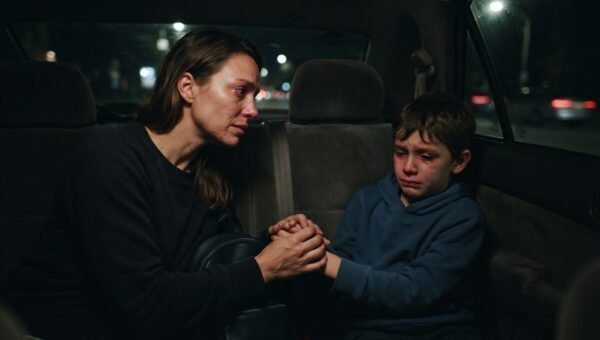
I took my son’s hand and carried the box out. Arthur didn’t follow us. Toby sat beside me in the car, the model airplane balanced on his knees. We spent that night at the inn, and the next morning I met the attorney. She confirmed the trust and helped me secure the property. I reported the notice that had been opened and withheld, and I filed for divorce. I didn’t ask Arthur for a dime.
The cottage was smaller than the Greenwich house and needed work. The first night, Toby asked if he was allowed to leave his things out. I told him yes. He left his shoes in the middle of the hall, and I stepped around them.
A few weeks later, he set his worn model airplane on the sunny living-room windowsill. It stayed there. Toby laughed at something I said and didn’t look over his shoulder first.