I got one thing wrong about my mother: I thought the money I sent was reaching Chloe. In Austin, Diane was still holding my suitcase when she told me my fifteen-year-old had wasted $32,000 on some boyfriend. I’d flown in two days after her call, thinking I was coming to straighten out a problem with my daughter. I didn’t know yet that Diane had made the problem up because I was finally asking where the money went.
Five years earlier, I’d taken a job out of state. It was the kind of choice that sounds reasonable when you’re trying to keep the lights on and tell yourself a move is temporary. Diane offered to take care of the school and medical stuff locally. I signed the guardianship papers, set up a custodial account she could manage, and sent a monthly amount for Chloe’s needs. I believed my mother would do what I would do.
I kept sending money. That’s the plain part. I’d call Chloe after work, ask about school, and hear that everything was fine. Diane handled the forms and told me when Chloe needed shoes or a field trip fee. Sometimes I wondered why Chloe never asked for anything. Diane said she was “independent,” and I was relieved to hear it. I was tired, working long hours, and I let a neat explanation do too much work.
There were little things I should’ve checked. A school picture envelope came back with the fee marked waived. Diane said the district did that for everyone. Chloe once asked whether I could help with a science club fee, then said never mind before I could answer. I was on a work call, and I told myself I’d circle back. I did not. I hate writing that, but it’s true.
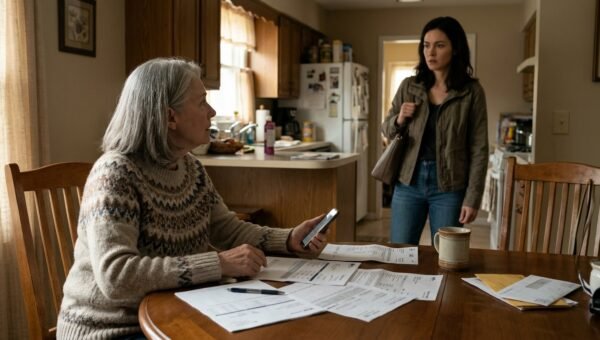
When I got to Diane’s house, she had already decided what I was supposed to believe. She said Chloe had been secretive, asking about driver’s education and college money, and that she’d started seeing a boy who was “nothing but trouble.” Diane’s voice stayed low and calm, which made me feel unreasonable for questioning her. Then she said, “She’s blowing your money on some boyfriend.”
I asked what boyfriend. Diane said she didn’t know his name, which should have been enough to stop me right there.
But she added that Chloe was lying and sneaking around, and I could feel myself getting angry at my daughter before I’d even seen her. That was part of what bothered me later. My mother knew exactly which old fear to press: that I’d left and didn’t know my own kid anymore.
I didn’t argue with Diane. I told her I wanted to see Chloe at school. She tried to talk me out of it, saying I’d embarrass her, but I went anyway. I’m glad I did. I walked into the cafeteria and saw Chloe sitting by herself, wearing sneakers that looked too small. She had a handful of coins on the table and was counting them, moving a penny back and forth like the numbers might change.
I stood there a second too long. Chloe looked up and pulled her hand over the coins. She asked what I was doing there.
I said I’d come to see her. She didn’t come toward me. She looked scared, which is a hard thing to see on your own child when you’ve been telling yourself she’s safe.
I asked whether she’d eaten. Chloe shrugged and said she didn’t have enough for the lunch tray. She said it like she was telling me the bus was late. I found the school office and asked to speak with Mrs. Alvarez, the counselor. I tried to keep my voice level. I said I needed to understand what kind of financial help Chloe had been receiving.
Mrs. Alvarez brought out a file. There were meal applications, fee waivers, and emergency assistance forms going back five years. The pages had Diane’s signature on them. Over and over, Diane had declared that Chloe had no financial support from me. One form used the phrase “indigent dependent status.” I remember the smell of the copier toner on the papers. It clung to my fingers.
I asked Mrs. Alvarez how the district could have approved the aid if I was sending money. She said the applications listed no household contribution and that the school had only the information Diane provided as Chloe’s local guardian. Mrs. Alvarez didn’t accuse anyone. She just showed me the records and explained how to correct them. I was glad she stayed matter-of-fact. I needed someone else to hold still while I tried to understand what I was looking at.
When I found Chloe afterward, she wouldn’t look at me for more than a second. I asked if Diane had told her I wasn’t sending money. Chloe said yes. Diane had told her I was busy and that asking me for anything would make me feel guilty. Chloe said she’d stopped asking because she didn’t want to be another bill I had to pay.
At a diner, I ordered her a full meal and watched her eat slowly, like she wasn’t sure if it was all right to finish. She told me she didn’t have a boyfriend. She’d asked Diane about college savings and driver’s ed because other kids were talking about them. Diane said there was nothing left because Chloe had cost too much already. Then Chloe added that Diane had warned her not to “run to me with every little thing.”
I told her I’d been sending money every month. Chloe looked down at her plate. I said it again, because one time didn’t seem to reach her. “I sent it for you.” She didn’t answer right away. Then she asked, very quietly, if I was sure.
That night, I sat in an extended-stay room with my bank app open and the district forms beside me. I went back through the account records and matched the deposits to Diane’s account. The $32,000 was there. So were transfers out, often within two days, to personal credit cards and retail accounts. I found payments for stores and expenses that had nothing to do with Chloe. I checked each month, even though after a while I knew what I’d find.
The next afternoon, I went back to Diane’s house to get Chloe’s things. Chloe had a bag half packed. I looked at her room and saw school supplies that were mostly worn out, clothes that didn’t fit, and very little else. In the living room were the things Diane had bought for herself. I’m not saying a person can’t have nice things. I’m saying I’d paid for my child’s care, and my child didn’t have lunch money.
Diane came into the dining room and started again about the boyfriend. I put the bank statements next to the aid forms. She went quiet. I told her the school had records of every application, and the bank had records of every transfer. She looked at the papers, then at me, and said she’d needed the money. She said retirement was expensive and that raising Chloe had taken more out of her than I understood.
I said I’d been paying for Chloe. Diane replied that she’d raised her too. She said she deserved something for the years she’d put in. I asked if Chloe deserved to be told her mother had abandoned her. Diane said she hadn’t meant for it to go that far. She didn’t say she hadn’t done it.
I had the guardianship authority revoked and made arrangements for Chloe to live with me. I gave Diane a choice: sign the full release and let Chloe go, or let the school and the bank records go where they needed to go. She signed. I closed the custodial account, removed Diane’s access, and made sure the school corrected its records. I didn’t pretend signing a paper made the five years disappear.
Chloe and I moved into a small apartment, and I changed my work schedule so I could be there through the rest of high school. We didn’t fix everything in a week. Some nights she still asked whether I was sure I wanted her home. I answered every time. Diane hasn’t seen Chloe since, and I don’t send her money or messages.
A few weeks later, Chloe and I pushed a full grocery cart through checkout together. She picked out cereal and the brand of peanut butter she liked. At school, she got a new student ID with her meal account set up correctly. She slid it into a clean wallet without checking the coins in her pocket.