PART 1
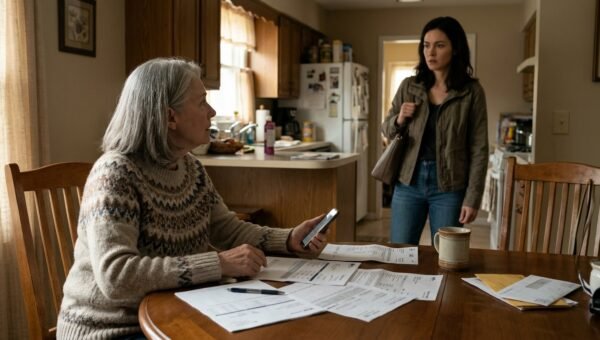
The glossy brochure had been sitting on the edge of the dining room table all afternoon. It had pictures of smiling silver-haired people playing bingo under bright fluorescent lights and a cheerful headline about assisted living. My daughter-in-law, Brenda, had placed it right beside the salt shaker, angling it so I could not miss it every time I walked in from the kitchen.
I am seventy-four years old. For forty-eight years, my husband Harold and I have lived in our small brick ranch in Canton, Ohio.
We paid off the thirty-year mortgage fifteen years ago with money Harold earned at the roller bearing plant and what little I saved from working part-time at the county library. But over the last six months, my family started treating me like a houseguest who was slowly losing her mind.
It started with small things. Last November, I left a pot of green beans on the back burner on low heat when Harold needed help getting to the bathroom, and the water boiled dry. The smoke detector chirped twice before I turned it off. Ever since then, my son David and his wife insisted I had a dangerous fear of the stove and could no longer be trusted to boil water. If I misplaced my reading glasses or forgot what day the trash truck came down our street, Brenda would exchange meaningful looks with David across the room, sighing under her breath.
They decided between themselves that I was no longer capable of living independently. David told me a nursing facility two towns over would be wonderful for me. He had already checked my passbook savings account, which held exactly thirty thousand dollars left over from Harold’s retirement buyout. David pointed out that thirty thousand dollars would pay for nearly a full year in a shared room, after which they could look into state aid or sell the house.
Nobody asked Harold what he thought. Ever since his stroke three years ago, Harold had lost most of his speech. He could understand every single word spoken around him, but his words came out slow and thick, so people simply stopped talking to him. They treated Harold like a fixture in the recliner and treated me like a child who needed supervision.
On Sunday evening, David and Brenda came over for family dinner. They brought their daughter, Megan, and Megan’s seven-year-old girl, Lily.
Brenda spent the whole meal taking charge. She took the serving spoons right out of my hands, insisting I sit down before I fell. While we ate our pot roast, David began discussing moving logistics. He talked about listing our furniture on local sale sites and how easy it would be to downsize my clothes into two suitcases. Harold sat at the head of the table, his right hand resting flat against his napkin, his brown eyes watching David with an expression of quiet agony. Harold could not argue with them, and my own protests were brushed away like lint on a Sunday coat.
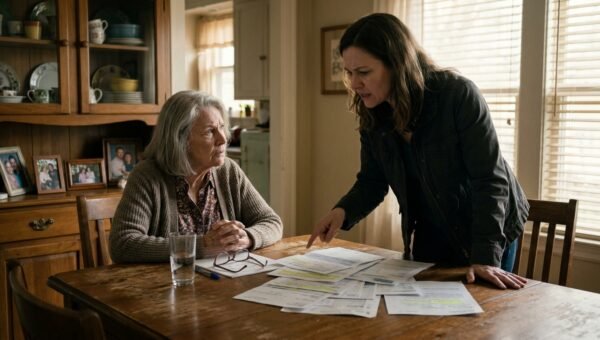
“Mama, you have to be realistic,” David said, pointing his fork across the table. “You’re getting too frail. You can’t manage this house anymore, and your memory is slipping. It’s unsafe for you to be here.”
I felt the tears stinging behind my eyelids. I looked down at my plate, feeling entirely defeated.
Then, little Lily set her glass of apple juice down on the table.
Her clear, seven-year-old voice cut straight through the conversation.
“Grandma gives Grandpa his injections every morning and night,” Lily said innocently. “She checks the little numbers on the needle, and she wipes his arm with the cold paper.”
The dining room went dead silent.
David stopped with his fork halfway to his mouth. Brenda froze, her napkin halfway to her lips.
Harold’s stroke had left him with brittle type-one diabetes. For thirty-six months, twice a day without fail, I had drawn up his NPH insulin, adjusted his sliding scale units based on his finger-stick glucose readings, kept the paper log on the refrigerator door, and administered every single dose with steady, practiced hands.
David slowly lowered his fork onto his plate. He turned to look at Harold, and then back at me, his face suddenly pale.
“Mama,” he asked quietly, the confidence draining from his voice. “If you leave, who will give him his shots?”
PART 2
David’s question hung in the air like a cloud of dust.
Brenda cleared her throat, trying to regain control of the room. “Well, David, the home health nurse comes by. Surely they handle that.”
“The home health nurse comes once a month to change Harold’s catheter script and check his vitals, Brenda,” I said, my voice steady for the first time in hours. “They haven’t done daily visits since the first sixty days after his discharge three years ago. The insurance stopped covering daily home care in 2023.”
David stared at me. He looked over at his wife, then looked down at Harold’s right arm, where the faint purple marks of the insulin needles dotted the skin near the shoulder.
“I thought… I thought you had visiting aides,” David stammered.
“You never asked,” I told him. “You come over every other Sunday for ninety minutes, you eat dinner, and you spend the rest of the time looking at the dust on my baseboards and telling me I’m slipping. You haven’t looked inside the refrigerator in three years, David. If you did, you would see seventy-two vials of insulin stored on the top shelf, separated by date, kept at thirty-eight degrees.”
Lily climbed out of her chair, walked over to Harold’s recliner, and laid her small hand on his arm. “Grandma lets me hold the band-aid, Uncle David. Grandpa never cries because Grandma is very gentle.”
Harold looked at Lily, then raised his head to look at our son. A single tear tracked down the right side of Harold’s face, dropping onto his collar. His hand trembled against the armrest, but his jaw was set tight.
“M-Me,” Harold forced out, the syllable thick and strained in his throat. He pointed his finger directly at me. “Stay.”
Brenda set her fork down with a loud clatter. “David, don’t let this derail the plan. If Harold needs nursing care too, then we just need to place Harold as well. We can look at double rooms at the facility. Both of their checks combined would cover it.”
“With what money, Brenda?” I asked.
“With Harold’s pension and your savings,” Brenda said, her tone growing sharp and defensive. “The thirty thousand dollars will get Harold admitted, and then the state takes over the rest once the house is sold.”
I stood up from my chair. My knees were stiff, but I did not wobble. I did not reach for the counter. I walked out of the dining room and into the small hallway closet where I kept our steel lockbox. I unlocked the latch with the small key on my ring, pulled out Harold’s blue medical binder, and walked back to the table.
I dropped the heavy binder onto the polished wood right in front of David.
“Open it,” I said.
David hesitated, then pulled the front cover open. Inside were three years of handwritten charts, filed by month. Every morning reading at seven o’clock, every evening reading at six o’clock, every carbohydrate count, and every emergency glucagon expiration date recorded in my neat cursive script. Tucked behind the logs were the quarterly lab printouts from Harold’s endocrinologist at Mercy Medical.
His A1C level last month was 6.4. That is near-normal for an eighty-year-old stroke survivor.
“His specialist told me last month that Harold has lived three years past his prognosis because of the care in this house,” I said, looking straight into David’s eyes. “Do you know what happens to brittle diabetic stroke patients in crowded facilities when the third-shift floor aide is responsible for thirty-five beds? They miss a dose, or they give the wrong units, and the patient goes into a ketoacidosis coma before morning. If you take Harold out of this house, he will not survive six months.”
PART 3
David began flipping through the pages of the binder. The dates went back to the autumn of Harold’s stroke. Hundreds of entries, three times a day, without a single missed morning or a single blank line.
“Mama,” David whispered, rubbing his forehead with his fingers. “Why didn’t you tell us you were doing all of this alone?”
“Because every time I try to talk to you about the bills or Harold’s pharmacy orders, you tell me not to worry my head about it,” I said. “You talk over me. You talk to Brenda about my memory. You saw me leave a pot of beans on the stove once when Harold choked on his water in the bathroom, and you turned it into a diagnosis. You wanted me to be helpless, David, because if I was helpless, you didn’t have to feel guilty about not visiting more often.”
Megan, David’s daughter, sat across the table with her arms folded, her eyes wide as she looked at her parents. “Dad, Mom told me Grandma couldn’t even remember to take her own vitamins. You told me she was wandering.”
“I never wandered,” I snapped, looking at Brenda. “I walked down to the mailbox at the end of the gravel lane to get Harold’s lancet delivery, and Brenda saw me from her car and told everyone I was wandering in the street.”
Brenda’s face turned bright red. She looked away from Megan, glaring at the tablecloth. “I was only trying to prepare for the inevitable, Evelyn. Harold’s condition is deteriorating, and you are seventy-four years old. You cannot carry a grown man if he falls. It is irresponsible to keep him in a house with stairs.”
“There are no stairs,” I said. “This is a single-story ranch. We took out the step to the garage two years ago with Harold’s brother. Harold has a transfer board, a shower chair, and an electric lift chair. The only thing in this house that is broken, Brenda, is your expectation that you can take Harold’s pension to pay for a room so you can sell this house out from under us.”
David looked up from the medical binder, his eyes wide. “What did you say?”
“I’m not blind, David,” I said quietly. “Last Tuesday, while I was sitting on the back porch, I heard Brenda on the phone in the driveway. She was talking to a real estate agent from North Canton. She asked what three-bedroom ranches on half-acre lots were bringing in this neighborhood. She told the agent the property would be vacated by summer.”
David slowly turned his head to look at his wife. The air in the dining room became suffocating.
“Brenda?” David said, his voice dropping low and dangerous. “Did you call a realtor about my parents’ home?”
“David, we have to be practical!” Brenda cried, throwing her hands up in the air. “We have Megan’s graduate school loans, we have our own roof that needs ten thousand dollars in shingles, and your mother has thirty thousand dollars sitting in an account while Harold’s pension is twelve hundred a month! If they go into care now, the house equity can be preserved before Medicaid puts a lien on it! I was trying to protect our family’s inheritance!”
Harold slammed his left fist down onto the oak table with a force that rattled the glasses.
The sound startled everyone. Harold leaned forward, his face flushed, his chest heaving. He pointed his finger directly at the front door.
“Out,” Harold said. The word was thick, but it was clear as a church bell. “Out.”
ENDING
Brenda gathered her purse from the floor without another word. Her face was mottled with red splotches of shame and fury. She didn’t look at Harold, she didn’t look at me, and she didn’t look at her own daughter. She walked down the hallway, pushed the screen door open, and let it bang shut behind her.
David stayed in his chair for a long time, staring at the scarred grain of our dining room table. His shoulders slumped forward.
“Mama,” he said, his voice trembling like it used to when he was ten years old and had broken one of my good serving bowls. “I didn’t know. I swear to you, I didn’t know about Brenda calling an agent. I thought… I thought you were struggling. I thought you were hiding how bad things were.”
“I am tired, David,” I told him, sitting back down in my chair beside Harold. Harold reached over and took my hand in his calloused fingers, squeezing with all the strength he had left. “Taking care of Harold is hard work. My back aches some evenings, and some days I would give anything to sleep past six in the morning. But Harold is my husband. We stood in the Methodist church on Fourth Street in 1976 and promised each other before God: in sickness and in health. You don’t put fifty years of marriage into a facility because someone left a pot on the stove.”
Megan stood up and took her father by the arm. “Come on, Dad. Let’s go home. You need to think about what you almost did.”
Before she left, Megan walked over to me, leaned down, and kissed my cheek. Lily threw her small arms around Harold’s neck, hugging him tight.
“I’ll come help you with the band-aids on Saturday, Grandpa,” Lily whispered. Harold patted her back with his good hand, his eyes shining with quiet tears.
When the front door clicked shut and their car backed out of the driveway, the house settled into its familiar, peaceful silence.
The glossy brochure for the nursing home was still lying on the table. I picked it up, walked over to the wastebasket by the pantry, and dropped it into the trash.
I set a pot of fresh water on the stove, turned the flame on beneath it, and made Harold a cup of decaf chamomile tea with a squeeze of lemon. I carried it over to his chair, set it on the side table, and sat down in the rocker beside him.
The clock on the wall struck eight.
“Time for your night check, old man,” I said softly.
Harold looked over at me, the corners of his mouth lifting into that slow, crooked smile I had loved for half a century. He rolled up his left flannel sleeve and waited patiently while I brought out the alcohol swab and the tiny, life-giving needle.
We don’t need a committee to tell us how to live our lives. We have our house, we have our garden out back, and as long as there is breath in my lungs, Harold will wake up in his own bed, under his own quilt, with the woman who loves him by his side.