PART 1
The bedroom door stayed shut twenty hours a day. From my pillow, all I could see was the upper half of the maple tree outside and the ceiling fan turning on its lowest speed.
Three months ago, I had a total right hip replacement at St. Joseph’s Hospital. I was sixty-eight years old, healthy, and used to tending my own garden and driving to church every Sunday morning.
But the recovery hit a wall the second I came home to this house in Lancaster, Ohio. My son, Greg, who moved back in two years earlier after his divorce, immediately took charge of everything.
He told the neighbors, our pastor, and my sister that the surgery had failed. He told everyone that the prosthetic joint had slipped, that my bone density was too low to support my weight, and that attempting to stand would shatter my pelvis permanently. He moved my bed into the downstairs spare room, carried my aluminum walker down to the unfinished basement furnace room, and told me that if I set foot on the floor without him lifting me, I would end up paralyzed.
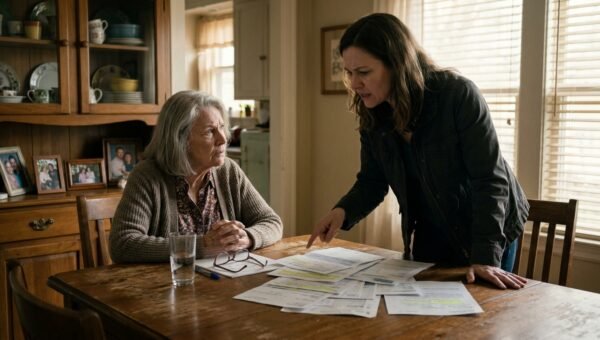
Whenever I asked for the home health physical therapist to continue her visits, Greg had an answer ready. He said Medicare capped the sessions at six visits. He claimed private nursing care was completely unaffordable, insisting that out-of-pocket nurses cost nearly four thousand dollars a month.
Meanwhile, he had set up direct deposit for my $2,180 monthly Social Security check straight into a joint account he opened in both our names, claiming he needed total control of the funds to buy my groceries, pay the property taxes, and manage my medications.
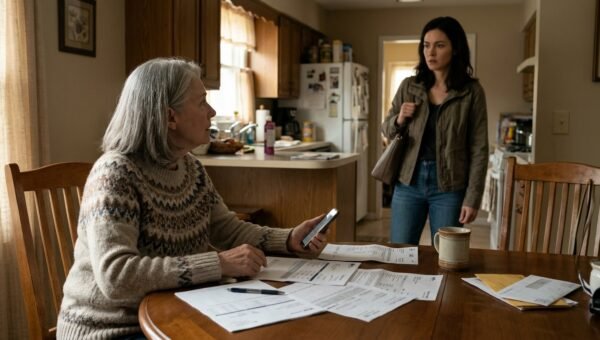
Every single morning, Greg brought me a plastic cup of water, two toasted pieces of bread, and a small paper cup with my heart pill and an extra-strength pain tablet. Then he would take my cell phone out into the kitchen to charge it on the microwave counter, leaving me alone in the quiet.
By the end of the eighth week, I began to believe him. My right leg felt heavy and stiff. I felt like an invalid, trapped in a body that had betrayed me, listening to the floorboards creak as Greg lived his life in the rooms above.
Then came a rainy Tuesday morning in late October.
Greg had run down to the local hardware store to pick up rock salt for the front walk.
While he was gone, the front doorbell rang twice. A minute later, I heard the faint rattle of the mail slot on the front porch, followed by hurried footsteps walking back down the concrete steps.
A sudden draft blew through the hallway. A folded white document slid across the polished hardwood floor, slipping under the bottom crack of my bedroom door and landing face-down on the braided wool rug.
My heart thumped against my ribs. I had not gotten out of that bed unassisted in ninety days. But the sight of that paper, sitting there in the middle of the floor like a dropped lifeline, pulled at something deep inside me.
I gritted my teeth, grabbed the wooden bedpost with both hands, and slowly slid my legs over the edge of the mattress. My bare feet touched the cold boards. My hip ached, a deep, tight pull, but the searing, bone-crushing pain Greg had warned me about never came.
I leaned heavily on the nightstand, took two shuffling steps across the rug, dropped to one knee, and picked up the paper.
It was an official patient progress log from Buckeye Home Health Services. The therapist, Brenda, had apparently driven by to drop off my discharge packet, slipping it through the mail slot because no one answered the front door, and it had slid all the way to my room.
I smoothed the crumpled sheet over my knee.
Across the top, printed in clean clinical boxes, was my full medical record from August. Brenda’s handwritten notes covered six full weeks of detailed physical therapy sessions.
Week 3: *Patient successfully performed ten unassisted sit-to-stand transitions from standard chair height.*
Week 4: *Patient ambulated seventy-five feet using single-point cane with steady gait and zero loss of balance.*
Week 5: *Patient ascended and descended four stairs with reciprocal footing. Full weight-bearing achieved.*
Week 6: *Discharge recommendation: Patient cleared for full independent ambulation with single-point cane. Home exercise program provided.*
At the very bottom of the page, written in bold red ink, was a nurse coordinator’s note dated September 2nd:
*Services terminated per patient’s son, Gregory Vance. Gregory reported patient requested immediate cessation of all therapy and refused further home visits. File closed.*
I stared at the red ink, my hands trembling so hard the paper fluttered against my leg.
I was never crippled. My surgery had not failed. For six weeks, I had mastered every single movement required to walk on my own two feet. And my own son had systematically hidden my recovery from me, locked my walker in the dark, and told the world I was helpless, all to keep a sick old woman trapped in bed while he pocketed my check every thirty days.
PART 2
The sound of Greg’s truck tires crunching over the gravel driveway snapped me out of my daze.
Panic surged through me. If he walked into the house and saw me sitting on the floor with that clinical paper in my hands, I had no idea what he would do. The man who had spent three months gaslighting his own mother was not someone I could trust in a quiet house.
I stuffed the folded therapy log down the front of my nightgown, pressed my palms flat against the wooden floor, and forced myself up. My right hip complained, muscles burning from ninety days of disuse, but the joint held solid. I braced one hand against the nightstand, grabbed the heavy oak bedpost, and pulled myself back onto the mattress. I hauled my legs up, pulled the quilt over my chest, and smoothed my hair just as the heavy front door swung open.
“Mom?” Greg called out from the entryway, his voice echoing down the hall.
I didn’t answer. I closed my eyes and slowed my breathing, pretending to sleep.
I heard his heavy work boots walk into the kitchen, followed by the clatter of a bag of rock salt being dropped onto the linoleum. Then his footsteps came down the hall. My bedroom door pushed open an inch. He stood there for several seconds, watching the steady rise and fall of my chest. Satisfied that his prisoner was still confined to her cage, he pulled the door shut and walked back to the living room to turn on the television.
I lay under that blanket for four hours, my mind racing.
I thought about the last three months. I thought about the way Greg insisted on opening every single piece of mail, how my sister Clara’s phone calls were always cut short because Greg claimed I was too fatigued to talk, and how our family pastor had visited only once, standing awkwardly at the foot of my bed while Greg answered every question on my behalf. Greg had isolated me so thoroughly that my world had shrunk to the four walls of that bedroom.
Around six o’clock, Greg opened the door, carrying a bowl of canned chicken noodle soup and a mug of tea. He set the tray on my bedside table, pulling a wooden chair close.
“How are we feeling tonight, Mom?” he asked, his voice dripping with that manufactured, patronizing sweetness he used whenever he played the devoted caregiver. “Still got that ache in the pelvis?”
I looked at him. Really looked at him. He was forty-two years old, sporting an unkempt beard and a receding hairline, wearing a stained flannel shirt. There was a smug, settled comfort in his posture, the look of a man who believed he had secured an easy ride for the rest of his life.
“Greg,” I said, keeping my voice soft and weak. “I was thinking about my hip today. I really feel like I could try standing up. Maybe if you brought the walker up from the basement, I could try taking a few steps to the bathroom.”
His face darkened instantly. The sweetness vanished, replaced by an irritated scowl.
“Mom, we have talked about this fifty times,” he snapped, crossing his arms over his chest. “You are not ready. Dr. Miller told me specifically that your bone graft hasn’t set. If you try to stand on that joint, you will collapse. You will break your femur, and then you’ll be in a nursing home in Columbus for the rest of your life. Do you want that?”
“No,” I whispered.
“Then stop bringing it up,” he said, standing up from the chair. “I am the one who has to lift you when you fall. I am the one sacrificing my career to take care of you. You don’t know your own limits. Just eat your soup and rest.”
He turned and walked out, pulling the door shut until the latch clicked.
As soon as his footsteps faded back toward the kitchen, I reached inside my nightgown and pulled out Brenda’s therapy log.
*Patient cleared for full independent ambulation with single-point cane.*
The words burned on the paper. He wasn’t trying to protect me from falling. He was terrified that if I stood up, his free ride would disappear. The $2,180 Social Security check that hit our joint account on the third of every month covered the mortgage on this house, his truck insurance, his weekly bar tabs, and his groceries. If I got better, I wouldn’t need a live-in caregiver. If I got better, he would have to find a real job.
That night, after the house went dark and the steady snoring from Greg’s upstairs bedroom vibrated through the floorboards, I threw off the quilt.
I sat on the edge of the bed for five minutes, letting my feet adjust to the floor. Then, slowly, carefully, I stood up.
My balance wavered for a second, but I locked my knees. The right leg held. I took a deep breath, walked across the bedroom, and reached the door. I turned the knob without making a sound.
The hallway was pitch-black. I rested my left hand on the wall, using the smooth plaster to guide my weight. One step. Two steps. Three steps. The muscles in my calf were tight, but there was zero structural failure. I reached the kitchen doorframe, transferred my grip to the laminate countertop, and walked the entire ten-foot length of the kitchen island.
I stood by the kitchen window, looking out into the moonlight. My aluminum walker was locked in the basement, but my own two legs were carrying me. I checked the microwave clock: 2:15 AM.
On the kitchen counter, plugged into the wall outlet, was my cell phone.
I unplugged the cord, slipped the phone into my nightgown pocket, and navigated my way back down the hallway, using the doorframes for balance. I slipped back into my room, clicked the door shut, and sat on the mattress.
I unlocked the screen. Greg had deleted dozens of text messages, but my contact list was intact. I dialed my sister, Clara, who lived twenty miles away in Newark. I set the phone to my ear, waiting through four long rings until her sleepy voice answered.
“Hello? Evelyn?”
“Clara, listen to me,” I whispered, my voice shaking with raw urgency. “Do not hang up, and do not call Greg. I need you, Pastor Thomas, and our brother Robert to come to this house tomorrow morning at ten o’clock sharp. Tell Greg you’re dropping off groceries. Do not give him any warning.”
“Evelyn, what is wrong? Greg said you were on strict bedrest, that you couldn’t even take visitors—”
“Greg is lying,” I told her. “I have the clinical records in my hands. Just get here at ten o’clock. And bring the police if you have to.”
PART 3
Wednesday morning arrived with cold, clear sunlight streaming through my window.
Greg brought my breakfast tray at eight o’clock, looking bleary-eyed and irritable. He dropped the bread and the water on the nightstand, didn’t even look me in the eye, and told me he had some paperwork to do in the living room.
I ate half a piece of toast, drank the water, and waited. Underneath my pillow, Brenda’s therapy log was folded into a neat square. My heart was pounding like a drum, but my mind was completely still. For three months, I had been treated like a broken object. That ended today.
At 9:58 AM, a car pulled into the gravel drive. A second vehicle followed immediately behind it.
I heard car doors slamming outside, followed by heavy footsteps coming up the front porch steps. Greg’s chair screeched against the living room floor as he jumped up.
A sharp knock echoed through the front door.
I heard Greg unlock the deadbolt and pull the door open. “Aunt Clara? Uncle Robert? Pastor Thomas? What are you guys doing here? Mom had a really bad night with her hip, she’s sleeping, she can’t have anyone in the room—”
“Step aside, Gregory,” Clara’s sharp voice cut through his excuses like a pair of shears. Clara was seventy-one, a retired school principal, and she took nonsense from nobody. “We haven’t laid eyes on my sister in over two months because every time we call, you say she’s too weak to speak. We brought some soup, and we are going to see her right now.”
“No, you can’t just barge in here!” Greg’s voice rose, cracking with genuine panic. “This is a private medical situation! The doctor gave strict orders—”
Inside my bedroom, I didn’t wait.
I threw off the quilt. I stood up on my own two feet, smoothed down my flannel nightgown, and walked over to the bedroom door. I pulled it open with a firm yank.
The sudden sound of the door opening cut through the argument in the living room.
Greg, Clara, my brother Robert, and Pastor Thomas were all standing in the foyer, frozen mid-stride. Greg’s face went pasty white. His mouth hung open, his eyes bulging as if he were staring at a ghost rising from a grave.
“Mom?” he stammered, raising his hands as if to catch me. “What are you doing? Get back in bed! You’re going to fall! You’re going to ruin the joint!”
I ignored him entirely.
I looked at Clara, Robert, and Pastor Thomas. With my head held high and my posture straight, I reached out, braced my right hand against the hallway wainscoting, and walked.
One steady step after another. No limp. No dragging. No screaming in pain.
I walked the entire fifteen feet down the hallway, stepping straight into the center of the living room, stopping right in front of the coffee table.
Clara gasped, her hands flying to her mouth. Robert’s jaw dropped. Pastor Thomas stepped forward, his eyes wide with astonishment.
“Evelyn,” Clara breathed, tears instantly filling her eyes. “You’re walking.”
“I have been able to walk since September,” I said, my voice ringing clear and steady through the quiet house.
I reached into the pocket of my nightgown, pulled out the folded sheet from Buckeye Home Health Services, and slapped it down onto the wooden coffee table right in front of my son.
“Read that, Clara,” I said, pointing at the paper. “Read what my physical therapist wrote before my loving son called them behind my back and canceled my care.”
Clara snatched the paper off the table. Robert leaned over her shoulder, his reading glasses perched on his nose. As their eyes scanned the therapist’s notes, the temperature in that living room plummeted to freezing.
“Cleared for independent ambulation on September 2nd,” Clara read out loud, her voice trembling with rising fury. “Services canceled by Gregory Vance, claiming patient refused further care.”
Robert looked up from the page, his face turning an ugly shade of dark crimson. He glared at his nephew with pure disgust. “You told us her pelvis was cracked, Greg. You told the whole church congregation that she needed round-the-clock nursing that you were paying for out of your own pocket.”
“It’s a mistake!” Greg shouted, backing up until his shoulders hit the front door. Sweat was visibly beading on his forehead. “That therapist was incompetent! She was pushing Mom too hard! Mom was complaining about pain every single night, I was just trying to keep her safe—”
“You kept me in that bed to steal my Social Security check, Gregory,” I said, stepping closer to him. Every word was measured, cold, and hard as stone. “You locked my walker in the basement. You hid my phone on the kitchen counter. You told everyone I was an invalid so you could sit in my living room, drive my car, and spend my twenty-one hundred dollars every month while I stared at a ceiling fan.”
“That’s a lie!” he yelled, his voice cracking into a desperate shriek. “I took care of you! I wiped your counters! I bought your food! You owe me for everything I gave up to stay in this house!”
“You gave up nothing,” I said. “You were evicted from your apartment in Lancaster before you crawled back here, and you found an old woman you thought you could bleed dry. But the show is over, Greg.”
ENDING
Pastor Thomas placed a gentle, steadying hand on my shoulder, while Robert walked straight up to Greg, standing inches from his face. Robert was a retired boilermaker, broad-shouldered and sixty-six years old, and he looked ready to take his nephew apart with his bare hands.
“Get your bags, Greg,” Robert said, his voice a low, dangerous rumble. “You have thirty minutes to pack whatever fits in the bed of your truck, or I am calling the county sheriff’s department to file elder abuse and financial fraud charges before lunch.”
“You can’t kick me out!” Greg screamed, looking at me with wild, terrified eyes. “Mom, this is my home! You can’t let them do this to me! I’m your son!”
I looked at him. The boy I had raised, the child I had worried over, had turned into a calculating stranger who was willing to let me rot in a bed so he could live off my government checks. The maternal pity I had carried for forty years was completely gone, replaced by a cold, clean clarity.
“You are not my caregiver, Greg,” I told him, looking directly into his panic-stricken face. “And this is not your home. Pack your clothes. If you are still on this property when the clock strikes eleven, Robert will call the deputies, and I will personally hand this therapy log and our bank statements to the magistrate.”
The realization that his mother was completely immune to his manipulation finally broke him.
He didn’t say another word. He turned, ran up the stairs, and spent twenty frantic minutes throwing clothes, shoes, and his television into black contractor bags. He dragged them down the stairs, shoved past his uncle without looking at anyone, threw the bags into the bed of his pickup truck, and tore out of the gravel driveway, kicking up dust and small stones as he sped toward the highway.
As soon as his truck vanished around the bend, Clara wrapped her arms around me, sobbing into my neck. I held onto my sister, letting the tears fall down my cheeks, but they were not tears of sorrow. They were tears of pure, unadulterated relief.
That afternoon, Robert drove me down to the local branch of the bank in his sedan. I walked through the double glass doors on my own two feet, leaning lightly on Clara’s arm. We sat down with the branch manager, showed him the joint account records, and closed the account immediately. I opened a new checking account solely in my name, with Clara listed as my designated emergency power of attorney. Then we drove over to the local Social Security administration office, where I filed a fraud alert and redirected my monthly direct deposit into my new private account.
On Thursday morning, Robert went down into the dark basement furnace room, brought up my aluminum walker, and carried it out to the curb for the weekly trash pickup. I didn’t need it. I bought a handsome, polished oak cane at the local pharmacy, which gave me all the stability I needed while my leg muscles regained their full strength.
Over the next four weeks, Brenda from Buckeye Home Health Services returned to my house, this time authorized under my own signature. We worked on balance, stair-climbing, and strengthening exercises three days a week. Within a month, I put the cane away in the hall closet.
Greg tried calling my phone twice from an unlisted number in Columbus, leaving whining, self-pitying voicemails asking for money to pay his truck repair bills. I didn’t return the calls. I forwarded the audio files directly to Robert, deleted them from my phone, and blocked the number permanently.
Last Sunday, for the first time in six months, I drove my own Buick down to the church on the corner. I walked up the concrete steps by myself, opened the heavy oak doors, and took my seat in the third pew beside Clara. When Pastor Thomas looked down from the pulpit and smiled at me, I felt a deep, steady warmth in my chest.
My son tried to steal my independence, my dignity, and my voice. But he underestimated the strength of the woman who raised him. I am back in my garden, my bills are paid, my doors are unlocked, and I walk wherever I please.