PART 1
Mom lost her life in a car accident while Dad was behind the wheel and survived. He mourned her for years. Three years later, Alzheimer’s began stealing his memories until he couldn’t even remember my name. But last month, on Mom’s birthday, his mind suddenly cleared.
My heart stopped when Dad looked at me and whispered, “There’s something you need to know. Your mother died because I…”
His voice hitched on the letter, and for two agonizing seconds, his eyes stayed locked on mine with an intensity I had not seen in four years.
The cloudy glaze that usually lived over his pupils was gone. He looked like the man who taught me how to drive on back gravel roads, the man who used to check my tire pressure every Sunday morning before I drove back to college.
Then his chin trembled. The nurse, a kind woman named Sarah who worked the evening shift at Oakridge Manor, knocked softly on the doorframe with a small plastic cup of water and his nighttime pills. The sudden sound broke whatever fragile bridge his brain had built across the fog.
His eyes drifted to the window. The clarity dissolved like mist. When he turned back, he looked right past my shoulder and asked if it was time for school yet.
I sat in the vinyl visitor chair beside his bed with my hands gripping my knees until my knuckles went white. For seven years, my family lived under one established truth.
On a rainy Tuesday night in October, my parents had been driving home from dinner across the county line. A slick patch of asphalt on Route 9, a sharp bend by the old quarry, and a guardrail that gave way. The police report had ruled it a single-vehicle loss of control. Dad survived with three broken ribs and a shattered collarbone. Mom was gone before the volunteer rescue squad could cut through the passenger door.
Everyone in town talked about his grief. He stopped going to church. He sold his woodshop tools. He left her garden to go to weeds because he could not bear to stand by the lilac bushes she planted. When the forgetfulness started three years after the crash, our relatives whispered that a broken heart had simply hurried his decline.
I stayed by his bed until eight o’clock, waiting for another flicker. It never came. He swallowed his pills, let Sarah tuck the thin blanket around his shoulders, and fell asleep with his mouth slightly open.
I walked out into the chilly November parking lot, sat in my sedan, and stared at the steering wheel. What could he have possibly done? Did he reach for his phone? Had he taken a sip of alcohol before leaving the restaurant, even though the police breathalyzer report in the file cabinet at home showed zero?
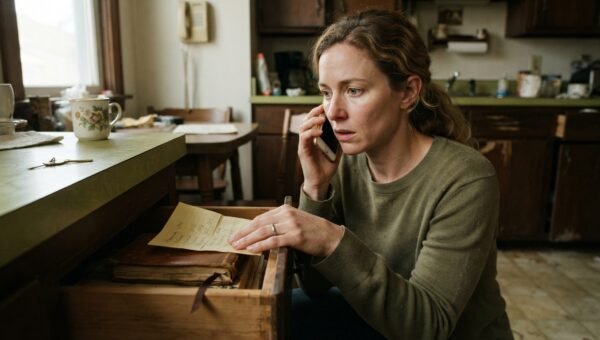
When I got to my house, I went straight to the hall closet where we kept the metal firebox. Dad had handed me the small silver key the month before we moved him into memory care, back when he still knew he was losing ground. Inside were the deeds, the insurance papers, their marriage license, and an accordion folder labeled “Accident – October 14.”
I pulled out the folder and sat on the carpet. Most of it was standard: towing receipts, the repair shop statement totaling the Buick, and the two-page county sheriff summary concluding speed too fast for conditions.
But tucked behind the insurance settlement letter was a folded sheet of yellow legal paper in Dad’s unmistakable, sharp handwriting.
It was dated three weeks after the crash, written to our family attorney, Mr. Henderson.
“Frank,” the note read. “I cannot sign the deposition as written. If I swear that she was asleep in the passenger seat, I will be lying under oath. You need to pull the file from the garage before the adjuster comes back.”
My stomach tightened. The deposition Dad actually signed, which was right there in the clip, said Mom had reclined her seat and fallen asleep twenty minutes before the curve.
I looked at the clock. It was nearly ten. I folded the note, slipped it into my purse, and waited for morning.
PART 2
At eight in the morning, I called Frank Henderson’s office. His receptionist informed me that Frank had retired two years ago and his son, Brian, had taken over the small estate and probate practice downtown.
Brian saw me at eleven. He was younger than me, but he remembered my parents well. When I slid Dad’s handwritten note across his desk, he read it twice without speaking.
“Your father’s file was closed out when the insurance cleared,” Brian said, resting his elbows on the blotter. “My dad kept physical archives in the basement storage across the street. Did your father ever explain what he meant by the file from the garage?”
“No,” I said. “He told me last night that Mom died because of him. Then he lost the thought.”
Brian looked uncomfortable. “People with advanced dementia often experience false memories and intense guilt, Laura. Especially survivors of traumatic accidents. It doesn’t mean a crime was committed.”
“He wrote this note three weeks after she died,” I said, pointing at the yellow paper. “He was completely lucid then.”
Brian hesitated, then stood up and told me to wait. It took him twenty minutes to return. When he walked back into the office, he carried a battered manila sleeve with our family name scrawled on the tab in faded black marker.
He opened it on the desk between us.
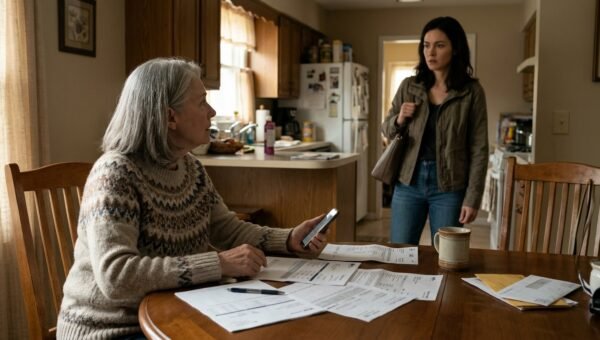
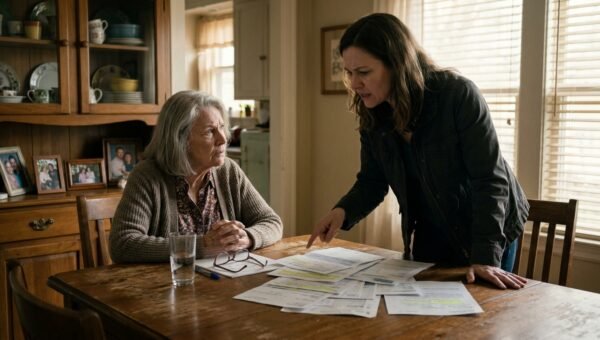
Inside was a series of printed bank statements from a regional savings bank two towns over, an account I had never heard of. It bore my mother’s maiden name, Martha Vance, alongside my father’s signature. Between July and October of the year she died, twelve withdrawals had been made in exact increments of $1,500. A total of $18,000 had vanished in cash from an emergency fund my parents had spent twenty years building.
Clipped to the statements was an envelope with two mechanic slips from a specialty auto garage in Millersville. They were dated four days before the crash. The work order was for brake line inspection and master cylinder replacement on the Buick. Across the bottom, stamped in red ink, was a notation: “Customer declined full replacement. Requested temporary seal only against technician advice.”
The customer signature at the bottom was not Dad’s.
It was Mom’s.
My hands shook as I held the yellow work order. Mom barely knew how to pump her own gas. Dad had handled every car repair, every oil change, and every household bill since they were married in 1978. Why was Mom taking the Buick to a town thirty miles away, pulling large sums of cash, and signing off on shoddy brake repairs?
“There’s more,” Brian said quietly. He turned over a police interview supplement that had never been attached to our copy of the public accident report. “My father kept this out of the civil claim because it wasn’t relevant to the road conditions finding. The deputy who responded to the quarry curve noted that the emergency brake was fully engaged when the car was pulled up the embankment.”
The emergency brake on that year of the Buick was a hand lever between the bucket seats. If the car hit a slick patch, Dad would have been steering with both hands.
Someone else pulled the brake.
PART 3
I left Brian’s office with the copies pressed against my chest. The rain from the previous night had cleared, leaving a sharp, bright autumn chill. I drove straight back to Oakridge Manor.
Dad was sitting in the dayroom, watching an old game show with three other residents. When I knelt beside his armchair and called his name, he blinked at me with mild, polite curiosity, the way he would greet a stranger who had dropped an umbrella.
“Dad,” I whispered, keeping my voice level so the nurses would not intervene. “I saw the paperwork from Millersville. I saw the receipts Mom signed.”
A muscle in his jaw twitched. His hands, spotted with age and resting on the armrests, slowly curled into fists. He looked down at the carpet.
“She didn’t know how to stop,” he said. The voice was thin, but it was not the voice of a man lost in a fog. It was the heavy, exhausted voice of a father who had been carrying an unbearable weight alone.
“Who was she giving the money to, Dad?”
He lifted his head. His eyes were clear again, filled with an ache that ran deeper than any illness.
“Your brother,” he said.
The room seemed to shrink. My brother, Kevin, had died twelve years ago of an overdose in a motel room outside Chicago. We had buried him, cried our tears, and tried to heal. At least, that was what I thought we had done.
“Kevin was gone, Dad,” I said, my voice trembling.
“He was gone,” Dad whispered. “But the people he owed weren’t. They found your mother two months before the crash. They called the house while I was at the hardware store. They told her Kevin took something that belonged to them, and if she didn’t clear the tab, they were coming to our house. They were coming to yours.”
The $1,500 withdrawals. The secrecy.
“She was terrified, Laura,” Dad murmured, his breath catching in his throat. “She took the cash out of our retirement. When the money ran low, she started cutting corners on everything. She went to that shop in Millersville because she was trying to save two hundred dollars on the brakes to give to the man on the phone. She didn’t tell me until we were in the car that night. We were driving back from the diner, and she finally broke down and told me what she’d done.”
I could see the rainy road in my mind. The wet pavement, the headlights cutting through the dark, the argument inside the cabin.
“I got so angry,” Dad said, a single tear cutting through the creases of his cheek. “I shouted at her. I told her Kevin was dead and buried, and she was letting ghosts bankrupt us. I said terrible things to her, Laura. Cruel things. I told her I couldn’t look at her.”
He swallowed hard, his throat working.
“We came around the bend by the quarry, and the pedal went straight to the floorboard. The pressure was gone. I panicked. But instead of letting me ride it into the gravel shoulder, your mother reached over and yanked the emergency brake with both hands. She was crying so hard she couldn’t see. She screamed that she was sorry and tried to stop the car herself. The back end snapped around. We hit the rail.”
He reached out and took my fingers. His grip was surprisingly strong.
“That’s what I needed to tell you,” he whispered. “Your mother died because I was screaming at her. If I hadn’t lost my temper, she wouldn’t have panicked. She wouldn’t have grabbed the lever. I killed her with my anger.”
ENDING
The truth hung between us in the noisy dayroom, stripped of seven years of mystery and assumptions.
Dad had spent the rest of his healthy life believing he was responsible for her death. When he gave the statement to the police that night, he had lied about her being asleep to protect her memory. He did not want the county to know she had panicked and caused the spin, and he certainly did not want the police digging into Kevin’s old debts or finding out that my mother had spent her final months living in terror.
He took the blame from the state, took the pity from the neighbors, and let himself be judged as an old man who simply lost control on wet asphalt.
“Dad,” I said, putting both of my hands over his cold, dry knuckles. “Look at me.”
He looked up, bracing himself as if expecting a blow.
“You were trying to save her,” I said. “And she was trying to protect our family. Neither of you did this on purpose.”
A long breath escaped his chest, a shuddering sigh that seemed to release decades of tension. He closed his eyes.
“She was so scared,” he said softly.
“I know,” I answered. “But it’s over now. It’s been over for a long time.”
We sat together in silence for another twenty minutes. Slowly, the focus in his eyes began to wander again. He pulled his hand back, looked toward the television screen where the colorful lights flashed, and asked me if the mail had arrived yet today.
The window had closed. The fog had rolled back in, likely for good this time.
I stood up, kissed the top of his thinning gray head, and walked out to my car.
The next morning, I took the yellow legal note, the mechanic slip, and the bank records out to the metal trash can behind my garage. I struck a match and watched the edges curl into black ash until there was nothing left to read.
Dad had spent seven years shielding my mother from the judgment of the world, paying for it with his own peace of mind. The least I could do was carry the secret the rest of the way for him, so he could finish his days in peace.