PART 1
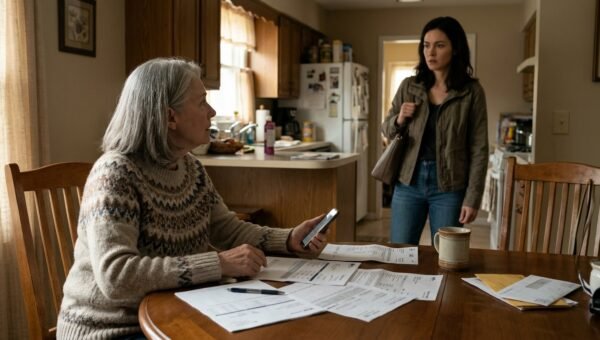
My mother slid the white envelope across the mahogany dining table right beside my sister’s champagne glass.
Inside was a cashier’s check for exactly $100,000.
It was a Sunday afternoon in June, two weeks before my younger sister Melissa married her fiancé, a corporate accountant from a wealthy family outside Richmond. Dad beamed from the head of the table, his chest puffed out in his Sunday suit. Melissa let out a delighted squeal, waving the paper in the air before leaping up to kiss both of them on the cheek.
I sat across from them in my work cardigan, holding a cup of lukewarm black coffee. At twenty-eight, I was working sixty hours a week as a medical records specialist, renting a drafty basement apartment, and eating grocery store peanut butter so I could pay down my state college loans. When I had gotten married four years earlier at city hall, my parents gave me a cast-iron skillet and told me they believed young couples needed to build their own grit.
“Mom,” I said, trying to keep my voice even. “Where did a hundred thousand dollars come from?”
My mother smoothed the front of her lace blouse, her smile flattening into the thin, tight line she always used when she wanted to put me in my place.
“Your father and I manage our affairs carefully, Nora,” Mom said. She looked around the table at Melissa and her fiancé, then right back at me. “Melissa has always aimed higher.
She is building a prominent life, and a Miller daughter needs a proper start. You’ve always chosen to stay small, dear. You just aren’t equally deserving.”
Melissa laughed, tucking the check into her purse like it was pocket change. Dad nodded in silent agreement, cutting his roast beef without looking at me.
Not one person at that table asked how that sentence sounded out loud.
I didn’t yell. I didn’t knock over my water glass or slam my chair back. I set my cloth napkin next to my plate, stood up, and walked out the front door into the summer humidity. I blocked both of my parents’ phone numbers and Melissa’s contact that very night.
For three full years, I kept that silence unbroken.
I changed jobs, moving to a regional healthcare network where overtime was plentiful. I lived on half of what I earned, putting every spare dollar into short-term treasury bills and high-yield savings.
I bought an eight-year-old compact car that never gave me trouble. By the time I turned thirty-one, I had saved enough for a modest down payment, closing costs, and a three-month emergency reserve.
I bought a small, two-bedroom brick bungalow on Maple Avenue on the quiet south side of town. The roof was good, the foundation was solid, and the backyard had an overgrown lilac bush that smelled like my grandmother’s porch.
The closing happened on a Thursday morning. On Friday afternoon, I was out in the front yard wearing old sweatpants, pulling weeds from the flagstone walkway, when a silver crossover SUV slowed down at the curb.
The driver’s side window rolled down. It was Melissa.
She stared at me through the open window, her sunglasses pushed up onto her headband, her mouth hanging open. She looked at the moving van in the driveway, then at the sold sign staked into the lawn with my real estate agent’s card on it, and then directly at me.
She grabbed her phone off the console. She didn’t realize her car speakers were linked to Bluetooth, and in the quiet afternoon air, her voice rang out across the lawn before she even hit the end of the block.
“Mom!” Melissa shrieked through the speakers, her voice cracking with fury. “You have to get in the car right now! Nora just bought a brick house on Maple! How can she afford that?”
PART 2
Forty minutes later, my father’s dark blue sedan pulled up behind the moving truck.
Mom stepped out first, practically running up the walkway with her leather handbag clutched tight against her ribs. Dad followed two paces behind, looking tense and watchful, his hands shoved deep into his windbreaker pockets. Melissa parked across the street and stood by her door, watching with folded arms.
“Nora!” Mom called out, stopping at the edge of the porch steps. She didn’t say hello. She didn’t say she was glad to see me after three years of silence. “What is the meaning of this?”
I stood on the second porch step holding a garden trowel. “It means I bought a house, Mom. What are you doing on my property?”
“Don’t take that tone with me,” Mom snapped. Her eyes darted from the heavy front door to the new brass address numbers I had screwed into the porch post that morning. “A house in this neighborhood costs at least two hundred and fifty thousand dollars. You worked a desk job for twenty dollars an hour. Where did you get the down payment?”
“That is none of your business,” I said.
Dad stepped up beside her, clearing his throat. His voice had the forced, booming authority he used whenever he felt cornered. “Nora, answer your mother. We need to know which bank holds this mortgage. Did you take out private financing? Who gave you the funds?”
It was a strange, frantic question.
If they had simply been jealous, they would have made snide remarks about the size of the yard or the age of the roof. But Dad wasn’t mocking me. He looked terrified. His knuckles were pale inside his jacket pockets, and Mom’s gaze kept flicking to the large envelope of closing papers sitting on the wicker table just inside my screen door.
“Why do you care which bank I used?” I asked, looking between them.
“Because we are your parents!” Mom said, her voice rising into that shrill, panicked register. “If you took family money or opened an account under our name, that is fraud! We have a right to protect our credit! Did you apply through First Commonwealth?”
First Commonwealth was the regional bank where my grandmother, Evelyn Miller, had kept her accounts for forty years until she passed away five years ago.
I looked at my mother’s tight face. “I got a standard conventional loan through a credit union downtown using savings from my own paychecks. I haven’t stepped foot in First Commonwealth since Grandma’s funeral.”
Mom let out a breath so sudden her shoulders dropped two inches. Dad looked down at the sidewalk, running a hand over the back of his neck.
“Well,” Mom muttered, adjusting her purse strap. “We just… we wanted to be sure you weren’t getting yourself into debt you couldn’t handle. You’ve always been reckless about money.”
“I am not the one who gave away a hundred thousand dollars at a dinner table,” I said. “Now please leave. You are trespassing.”
Dad grabbed Mom’s elbow and pulled her back toward the car. Melissa watched them leave, then climbed into her crossover and sped off down the street without saying a single word.
I went inside, locked the deadbolt, and stood in my new, empty hallway.
My parents had never cared about my debts. When my college car broke its transmission, Dad had refused to co-sign an eight-hundred-dollar repair loan. Why would they drive across the county in the middle of a Friday afternoon, terrified that I had opened an account at First Commonwealth?
On Monday morning, I called Arthur Vance.
Arthur had been Grandma Evelyn’s personal attorney and estate planner before he retired to a quiet private practice near the county courthouse. He was seventy-one, patient, and had known my grandmother since they were in church choir together in the 1970s.
“Nora,” Arthur said warmly when I reached him at his office. “It has been years. What can I do for you?”
“Arthur,” I said, sitting at my new kitchen counter with a notebook open. “When Grandma passed away five years ago, Mom told me Grandma had no assets left after her nursing home care. But my parents showed up at my house on Friday, terrified that I had accessed money at First Commonwealth. Did Grandma have an account there?”
Arthur was quiet for four seconds.
“Evelyn didn’t just have a checking account, Nora,” Arthur said slowly. “She created the Evelyn Miller Irrevocable Grandchildren’s Trust three years before she entered assisted living. Your mother was named the administrative trustee, but you were the sole named beneficiary.”
My hand froze around my pen. “I was the sole beneficiary?”
“Evelyn explicitly excluded Melissa because Melissa’s other grandparents had already established a private education trust for her,” Arthur explained, his tone sharpening. “The trust was supposed to be transferred to you on your thirtieth birthday. I sent two certified letters to your mother’s address last year requesting the final distribution accounting, but she never responded. Come to my office this afternoon, Nora. Bring your driver’s license.”
PART 3
Arthur Vance’s office smelled of old law books and peppermint tea.
He laid three thick accordion folders across his mahogany desk, pushing his reading glasses up onto his forehead.
“Because I was the drafting attorney of record, I filed a formal discovery petition with First Commonwealth on your behalf as the sole beneficiary this morning,” Arthur said, tapping the top folder. “The bank complied immediately. They provided the complete five-year audit log for the trust.”
I opened the manila folder. My eyes went straight to the ledger page dated June 8, three years ago.
There it was, printed in bold black ink: a single electronic cashier’s check withdrawal for exactly $100,000.
The authorizing signature was my mother’s. The memo line on the internal bank slip read: ‘Distribution to Beneficiary for Wedding.’
The check number on that voucher matched the exact cashier’s check Mom had slid across the table to Melissa two weeks before her wedding.
My parents hadn’t given Melissa their own money. They had raided my grandmother’s trust, taken the money Grandma had left for my future, and handed it to my sister while looking me in the eye and telling me I wasn’t equally deserving.
“Look at the other pages, Nora,” Arthur said quietly.
I turned the page.
It wasn’t just the $100,000 wedding check.
Four months after the wedding, there was a $42,000 withdrawal payable to a luxury RV dealership where Dad had bought a camper he claimed he won in a company raffle. Six months after that, there was a $28,000 transfer directly into Melissa’s personal checking account, labeled ‘Home Furnishings.’ Over the course of four years, my mother had systematically drained $215,000 out of a trust that had originally held $240,000.
There was only $25,000 left.
“A trustee cannot use trust funds for personal benefit or distribute them to an unlisted third party,” Arthur stated, his voice cold and steady. “This is not a family disagreement, Nora. This is a felony breach of fiduciary duty, grand larceny, and conversion under state law.”
“What happens now?” I asked, my voice barely above a whisper.
“I serve your mother with a formal demand for an immediate accounting and a notice of intent to file a petition for surcharge and criminal referral,” Arthur said. “She has fourteen days to restore every stolen dollar to the trust account, plus statutory interest, or I take this file directly to the county prosecutor’s office.”
The certified demand packet was delivered to my parents’ house on Wednesday morning at nine o’clock.
At ten-fifteen, my father’s car screeched into my driveway.
This time, Melissa wasn’t with them. Dad came up the porch steps so hard the wood creaked, with Mom following behind him, clutching a crumpled copy of Arthur’s legal letter.
I opened the front door, leaving the heavy brass latch chain hooked in the slot.
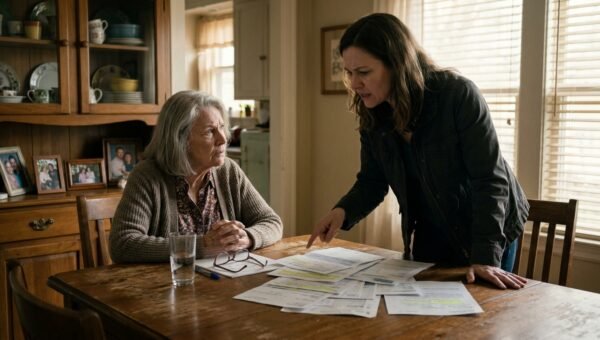
“Nora, call him off!” Mom cried through the crack, her face mottled red, her eyes wild behind her makeup. “Call Arthur Vance right now! Do you know what this letter says? It says they can freeze our bank accounts! It says they can put a lien on our house!”
“You stole my trust, Mom,” I said through the opening.
“We didn’t steal it!” Dad shouted, leaning against the door frame. “Your grandmother was confused near the end! She didn’t understand how much Melissa needed that wedding gift to look good in front of the Miller in-laws! We were going to replace the funds when my pension lump sum paid out next year!”
“You bought a camper, Dad,” I said. “You gave Melissa twenty-eight thousand dollars for living room couches. You told me I wasn’t equally deserving while you were handing my own inheritance to my sister.”
“It was family money!” Mom wept, grabbing the edge of the screen door. “Nora, please. If this goes to court, Dad’s firm will drop his consulting license. Melissa’s husband’s family will find out. They will never look at her the same way again. It will ruin her marriage!”
“Then Melissa can sell her furniture and her luxury crossover to help you pay it back,” I told her.
“She can’t afford that!” Mom shrieked. “You don’t understand how much pressure she is under to keep up with that family! You have always been fine on your own, Nora! You don’t need this money! You already have this house!”
I looked through the brass chain at the two people who had raised me.
There was no sorrow in their faces. There was no regret for the three years they had left me in silence, or the cold cruelty of that dining room table. There was only the raw, frantic panic of predators who had realized the trap had snapped shut on their own ankles.
“Arthur gave you fourteen days,” I said quietly. “If the $215,000 is not in the trust account by next Friday at five o’clock, the county prosecutor gets the complete file. Do not come back to my house.”
I shut the heavy wooden door and locked the deadbolt.
ENDING
My parents did not go to prison.
Arthur told me from the start that in estate recovery cases, criminal referrals usually end with the money vanishing into court fees and legal defense bills. The goal was full restitution.
On the twelfth day of the demand notice, my father signed a binding settlement agreement drafted in Arthur’s office. To raise the $215,000 plus $18,000 in accumulated interest and legal fees, Dad had to sell the luxury camper for a heavy loss and take out a high-interest home equity loan against their split-level house, adding an eleven-hundred-dollar monthly mortgage payment to their retirement budget.
Melissa did not contribute a single dollar.
According to my cousin who still lives in Richmond, Melissa threw an absolute tantrum when our parents asked her to return the $28,000 furniture transfer. She told Mom that any money given as a gift was legally hers, blocked both of our parents on her phone, and spent the entire summer avoiding family gatherings so her husband’s wealthy relatives wouldn’t hear about the scandal.
My parents had sacrificed their dignity, their integrity, and their second daughter to buy Melissa’s favor, and in the end, Melissa abandoned them the exact second they stopped being an open bank account.
The full $233,000 settlement was wired directly into my personal high-yield trust account in early autumn.
I didn’t buy a luxury car. I didn’t take an extravagant trip to Europe. I used a portion of the funds to pay off the remaining balance on my Maple Avenue mortgage, ensuring that no matter what happened in the economy or my healthcare job, the roof over my head belonged completely and irrevocably to me.
The rest of the money remained invested in safe, long-term bonds, earning quiet interest for my future.
On a Saturday morning in late October, the mail carrier brought a small manila package to my door. It was from Arthur Vance’s office. Inside was an old silver pocket watch that had belonged to my grandfather, and a small, handwritten recipe card Grandma Evelyn had tucked into her trust folder before she died.
Written in her shaky, familiar cursive was a recipe for blackberry cobbler, and at the bottom, two sentences in blue ink:
‘Nora, you were always the quiet worker who never asked for praise. Build a safe home for yourself, my sweet girl.’
I taped the recipe card inside my kitchen cabinet door right above the spice rack.
Outside, the autumn leaves were falling across the flagstone walkway I had weeded with my own hands. I put my kettle on the stove, sat down at the table by the window, and drank my morning coffee in the warm, absolute peace of a house that nobody could ever take away from me.