PART 1
The bedroom was freezing when the duvet was torn off my body.
The digital clock on my nightstand read 4:40 in harsh red numbers. Outside, the November air was pitch black and dead silent. I curled my knees to my chest against the sudden rush of cold, my heart hammering in my throat from the shock of waking up.
“Get up,” Daniel said. He was already fully dressed in jeans and an old fleece pullover, standing over my side of the bed. “Mom needs oatmeal before her pills.
Make sure it is the steel-cut kind with cinnamon. She cannot take her heart medication on an empty stomach.”
I blinked against the overhead glare. He had switched on the ceiling light, the harsh yellow bulbs stinging my eyes. “Daniel, what are you talking about? It is not even five in the morning.”
Then I looked past him toward the hallway doorway.
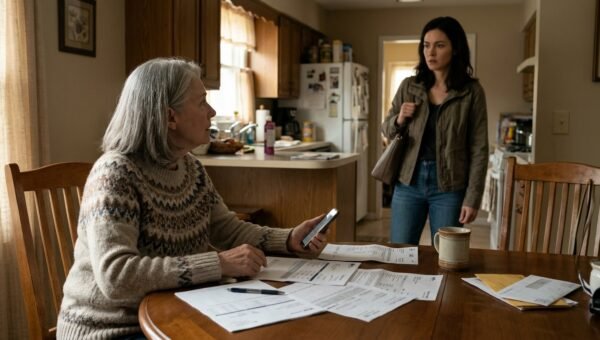
A woman was standing in the shadows of the frame. She had silver-gray hair cut into a neat bob, small wire-rimmed glasses, and a delicate, tired posture. She was wearing my plush blush-pink fleece bathrobe, the one my sister had bought me for my forty-eighth birthday. The sleeves were rolled up twice at her wrists because she was several inches shorter than me.
“She arrived forty minutes ago on the red-eye bus from Pittsburgh,” Daniel said, his tone flat and matter-of-fact, as if he were announcing a change in the weather. “Her landlord sold her building out from under her.
She has nowhere else to go. She will be staying with us. A few months, maybe until spring.”
I sat up slowly, pulling the cotton sheet up around my shoulders. “You moved someone into our home without telling me? Daniel, we talked about boundaries six months ago when you loaned your cousin five thousand dollars from our emergency account. You do not just move people in.”
“It is my mother, Sarah,” he snapped, crossing his arms. “I do not need your permission to take care of my own flesh and blood. Now get out of bed. She is shivering, and the kitchen in this house is your department.”
Lorraine looked at me from the doorway, her head tilted slightly. There was no apology in her eyes. There was only a calm, appraising stillness that felt completely out of place for an elderly woman who had supposedly just been evicted and ridden a bus all night.
I looked at Daniel. We had been married for six years. When we met, I was a senior operations manager at a mid-sized regional logistics company. I had my own savings, my own car, and my own home that I had purchased five years before I ever met him. Over those six years, Daniel had slowly, steadily chipped away at my independence. He persuaded me to drop down to part-time consulting so I could manage the house, take care of the yard, and cook hot meals every evening. He always had a reason why my income should go directly into our joint checking account to cover his business shortfalls.
He saw me as an unpaid housekeeper who subsidized his life.
I did not argue. I did not raise my voice. I swung my legs out of bed, stood up on the cold hardwood floor, and walked past them both toward the closet.
From the top shelf, I pulled down my large hard-shell suitcase. I laid it flat on the luggage rack and unzipped it. Then I began opening my dresser drawers, methodically packing my clothes: slacks, warm wool sweaters, socks, undergarments, and my work folders.
Daniel stared at me, his mouth dropping open before curling into an incredulous sneer. “What are you doing?”
“I am leaving,” I said quietly, without looking up as I folded a black knit sweater.
“You have got to be kidding me,” Daniel said, letting out a loud, mocking bark of laughter. He turned toward the doorway. “Mom, look at this. She is throwing a tantrum. You are seriously leaving your marriage over a bowl of oatmeal?”
I zipped the suitcase shut, locked the latches, and reached into the closet for my winter coat and my leather handbag containing my passport, checkbook, and car keys.
“Yes,” I whispered, looking straight into his eyes. “But not because of the oatmeal.”
I picked up my bag and rolled the suitcase down the hall. Neither of them moved to stop me. Daniel stood by the bedroom door shaking his head in disgust, while the woman in my pink bathrobe watched me from the kitchen archway, her expression entirely unreadable.
I walked out the front door into the freezing morning mist, loaded my car, and drove away before the sun touched the horizon.
PART 2
I checked into an extended-stay hotel four miles across town, near the commercial business park where my consulting office was located.
The room was clean, sparse, and blissfully quiet. For the first time in six years, nobody was demanding that I fix dinner, balance a late utility bill, or soothe someone else’s fragile temper. By eight o’clock that morning, I had already contacted my bank. The house on Elm Street was deeded exclusively in my name; I had bought it in 2012, long before I met Daniel, and I had kept the deed separate despite his repeated requests to put his name on the title. The joint account held our shared household expenses, but my primary savings were safely parked in an individual account at a credit union downtown.
I transferred my consulting retainer payments into my solo account, notified my attorney that I was filing for legal separation, and turned my phone onto silent.
For three days, the silence was absolute. Daniel did not call to apologize. He did not send a text asking where I was staying. In his mind, I was out in the cold, waiting for him to offer me a chance to come home and apologize for embarrassing him in front of his mother.
That silence broke on Friday afternoon at 2:15.
My phone lit up on my desk, vibrating repeatedly against the wood. Daniel’s name was on the caller ID. I let it ring four times before answering.
“Daniel?” I said.
The sound that came through the receiver was not anger or arrogance. It was a ragged, hyperventilating sob.
“Sarah… Sarah, oh God, please pick up,” he choked out, his voice cracking violently. “Please tell me you are listening. Please.”
I sat up straight in my office chair. “Daniel, what is going on?”
“You have to come back to the house,” he gasped, barely able to string words together between heavy, panicked breaths. “There are four police cruisers in the driveway. County detectives are tearing through the attic right now. They have yellow tape across the porch. Sarah, please come. Something terrible has happened.”
“What are you talking about? Did Lorraine have a medical emergency?”
“No,” he whispered, his voice dropping into a hollow, horrified register that made my entire spine go rigid. “Mom was not who she said she was.”
PART 3
When I pulled up to the curb on Elm Street twenty minutes later, the quiet suburban block was swarming with law enforcement.
Two unmarked black sedans and three county sheriff patrol units were parked diagonally across my front yard, their tires cutting deep ruts into the wet lawn. Neighbors were standing on their porches in heavy coats, watching in stunned silence.
I parked behind the rearmost patrol car, grabbed my purse and property deed folder, and walked up the front path. A sheriff’s deputy stepped forward to stop me at the yellow tape, but I held up my driver’s license. “I am Sarah Miller. I am the sole owner of this property.”
“Let her through,” a tall, gray-haired man in a dark windbreaker called out from the front door. He introduced himself as Detective Miller from the regional financial crimes division, flash-showing his gold shield.
Inside, the home I had maintained for six years was in utter disarray. Dresser drawers were pulled out onto the floor, cushions were lifted off the living room sofas, and two plainclothes officers were photographing the guest bedroom closet.
Daniel was sitting on a kitchen stool, his head buried in his hands, his knuckles white against his scalp. He looked smaller, pale, and completely broken.
“Mrs. Miller,” Detective Miller said, leading me toward the dining room table where a manila folder lay open. “Your husband gave us permission to secure the premises, but since you are the deed holder, you need to understand what has transpired here over the past seventy-two hours.”
“Where is the woman who was here?” I asked. “Where is Lorraine?”
“Her name is not Lorraine Miller,” the detective said plainly. “Her legal name is Evelyn Martha Vance. She is sixty-one years old, originally from Cleveland, and she has three active bench warrants across Ohio and Pennsylvania for grand larceny, identity theft, and elder fraud.”
I stared at the detective, trying to process the words. “Daniel told me she was his mother. He said she arrived from Pittsburgh after losing her apartment.”
Daniel lifted his head, his eyes bloodshot and swollen, tears tracking through the stubble on his cheeks. “She is not my mother, Sarah,” he croaked. “My mother died in a hospice facility when I was twelve. You knew that. Everyone knew that.”
“Then why did you bring her into my house and tell me she was your mother?” I demanded, my voice trembling with fury.
The full, humiliating truth came spilling out of him in a desperate, frantic rush.
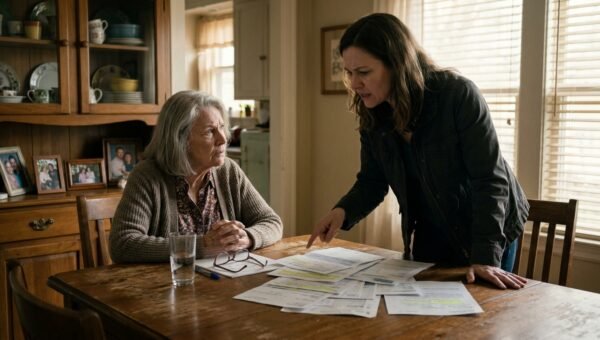
Three weeks earlier, Daniel had made a catastrophic investment in an unregistered private commodities pool he found through an online forum, hoping to double his personal savings without telling me. The pool was a complete fabrication. He lost forty-two thousand dollars, including fifteen thousand dollars he had secretly taken on a short-term personal bridge loan. Desperate to cover the debt before the monthly statements arrived, he reached out to a private real estate facilitator he met through an online business group.
The woman called herself Lorraine. She claimed she was a retired private wealth broker who specialized in helping small business owners liquidate property equity off the books. She offered to provide him with sixty thousand dollars in cash against the equity of our home, on one single condition: she needed to reside inside the property for ninety days to establish residency for private lender underwriting.
When she showed up at four o’clock that morning, she told Daniel that if his wife asked any questions, he had to tell her she was his long-lost biological mother who had re-entered his life. She convinced him that playing on emotional family obligations was the only way to keep me from asking to see legal financial documents.
“She told me it was standard practice for private equity placement,” Daniel sobbed, pressing his palms against his eyes. “She told me she would transfer the sixty thousand into my account by Friday morning. She said all she needed was my signature and copies of the property title and banking records.”
“And did you give them to her?” I asked, my voice cold as ice.
“He gave her everything,” Detective Miller answered for him. “He gave her your mortgage account numbers, utility verifications, tax statements from your office desk, and his own power of attorney form. But Evelyn Vance was not interested in an equity loan. She was a professional house thief.”
The detective turned the folder around to show me a series of scanned deeds.
In less than forty-eight hours, while Daniel was out running errands for her, the woman had used a forged quitclaim deed, complete with a counterfeit notary stamp, to attempt a fraudulent conveyance of my property to an offshore shell company. She had simultaneously applied for three separate hard-money loans totaling over three hundred thousand dollars against the house.
“The only reason the transfer did not go through,” Detective Miller continued, “is because of you.”
“Me?” I asked.
“When you bought this house in 2012, your settlement company registered an automatic fraud-alert monitor with the county clerk of records,” the detective said. “The moment that forged quitclaim deed was submitted electronically yesterday afternoon, the county clerk flagged the mismatched owner signature and alerted our division. When our officers knocked on the front door two hours ago, Vance tried to exit through the rear kitchen alley carrying a suitcase containing twenty-two thousand dollars in stolen jewelry, bearer bonds, and your personal vehicle spare keys.”
She was currently in custody at the county detention center, held without bail.
ENDING
The house went dead silent after the detectives finished bagging the evidence and left.
Daniel sat on the kitchen stool with his head down, staring at the floorboards where he had stood three days earlier, demanding that I get out of bed to cook oatmeal for a stranger.
“Sarah,” he whispered, looking up at me with absolute despair. “I didn’t know. I swear to God I didn’t know who she was. I was just trying to fix my investment loss so you wouldn’t find out how bad I messed up. I thought I was protecting us.”
“You weren’t protecting us, Daniel,” I said, standing near the hallway door with my car keys firmly in my hand. “You were protecting your own ego. You were so terrified of admitting you failed that you brought a complete criminal into my home, gave her my personal financial records, and ordered me out of my own bed to serve her.”
“I was desperate,” he cried. “Please. We can fix this. The detective said the house is safe. The deed never transferred. We can get past this. I will do whatever you want. I will get a second job. Just come home.”
“The house is safe,” I said evenly. “Because my name was on the deed, not yours. If it had been up to you, we would be standing on the sidewalk with nothing.”
I did not pack any more clothes that afternoon. I did not need to. I had everything that mattered in my car.
“I am not coming back, Daniel,” I said. “My attorney will serve you with divorce papers on Monday morning. You have fourteen days to pack your personal belongings and vacate this property. If you are not out by the fifteenth, the sheriff will remove you.”
He started to beg, reaching out toward my coat, but I stepped back out of his reach, turned around, and walked through the front door.
The legal proceedings took four months. Because the debt Daniel had accumulated was entirely in his own name and incurred through fraudulent negligence, the court assigned zero liability to my accounts. The forged quitclaim deed was formally expunged from the county registry by judicial order, restoring my clean title.
Evelyn Vance accepted a plea deal six months later, receiving eight years in state prison for habitual identity fraud and interstate grand theft.
Daniel moved into a small one-bedroom basement apartment twenty miles away, working two retail inventory jobs to pay off the forty-two thousand dollars he still owed on his bad loans. He tried to call me three or four times during the first year, leaving long, rambling voicemails about how much he regretted that cold November morning, but I never picked up the phone.
I sold the house on Elm Street the following spring. I did not want to live in a place where I had spent six years making myself small just to keep someone else comfortable. I bought a quiet cedar-shake cottage near the lake, forty minutes north of the city, with large bay windows that look out over the water.
Every morning, I wake up when the sun rises through the trees. I drink my tea in quiet, peaceful solitude, knowing that the only life I am responsible for rebuilding is my own.