PART 1
Aunt Clara passed away in early February on a gray morning that smelled like wet pavement. She was seventy-eight years old, with arthritis in both knees and a heart that finally stopped trying.
For the last four years of her life, I was the one who drove thirty miles out to her clapboard house in Pine Grove every Tuesday and Saturday. I clipped her toenails. I sorted her blood pressure pills into those plastic weekly trays with the worn-off lettering.
I wiped down her counters, made sure she ate something warm, and sat by her recliner while she dozed off to game show reruns. I was fifty-four, working forty hours a week as a floor nurse at St. Jude’s, but Clara was my mother’s younger sister, and taking care of her was just what you did.
Her own children, Michelle and Kevin, lived less than twenty minutes away in the newer subdivision by the bypass. They rarely visited. Michelle only showed up when she needed Clara to cosign an appliance loan or watch her dog while she went to Gulf Shores. Kevin only stopped by if he was in the neighborhood to pick up his lawnmower parts.
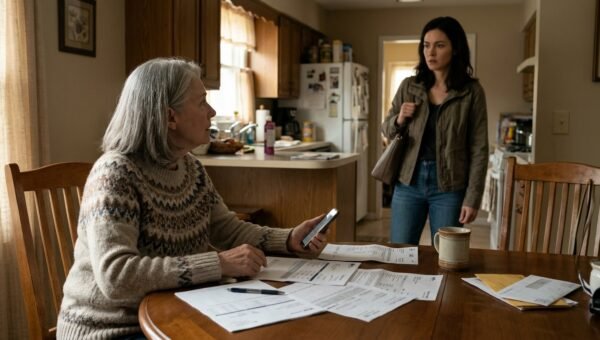
Yet, three days after Clara was buried, Michelle and Kevin called a family meeting in Clara’s living room. They did not hire an attorney. Kevin simply brought out a yellow legal pad and Clara’s floral metal lockbox.
“Mama didn’t leave an official will through probate,” Michelle announced, sitting on Clara’s sofa with her legs crossed and a glass of sweet tea resting on a paper towel. “She told Kevin and me what she wanted before she went into the hospital. Direct heirs take priority. That is just common sense.”
Kevin nodded, holding up the keys to Clara’s navy-blue Buick LeSabre. “The car is paid for. I’m taking that to replace my truck. Michelle gets the house to rent out or flip once we clean out the junk. And the savings account at First National will be split fifty-fifty between us to cover the estate expenses.”
That savings account had sixty-three thousand dollars in it. Clara had saved it penny by penny from her late husband’s railroad pension over thirty years.
I sat in the small wooden rocking chair in the corner, still wearing my scrubs from the morning shift. “What about her personal things? Her recipe cards? The cedar chest Uncle Ray built?”
Michelle laughed into her sweet tea, an ugly, dismissive sound that rattled the ice against the glass. “Everything in the house is going into an estate sale dumpster next week, Sarah. If you want a souvenir, take that.”
She pointed to the entryway table near the coat rack. Sitting there, beside an empty tissue box, was the black leatherette guest book from Clara’s memorial service at Mount Olive Baptist Church. It was cheap, with gold lettering stamped across the front that was already flaking off at the corners.
“You always liked church junk,” Michelle said with a smirk. “Go on and take it. Consider it your fee for checking on her.”
Kevin didn’t even look up from his legal pad. He was already writing down the serial number from the back of Clara’s flat-screen television.
I didn’t yell. I didn’t cause a scene. I stood up, walked to the table, and picked up the book.
It felt light and hollow in my hands. I carried it out to my sedan, set it on the passenger seat, and drove home with the heater blowing dry air into my face.
For nine months, that book sat on the lace runner of my bedroom dresser, right next to my jewelry box and my bottle of hand cream. I couldn’t bring myself to open it. Every time I looked at it, I remembered the way Michelle had smirked into her glass, treating four years of my devotion like unpaid servant work while they cashed Clara’s checks.
Then came last Saturday.
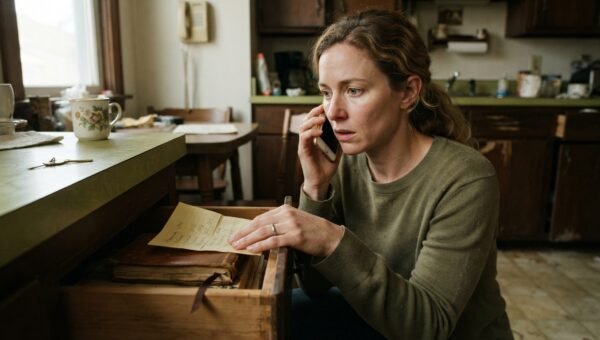
I was doing my regular morning dusting, using an old cotton rag to wipe down the furniture. When I picked up the guest book to dust underneath the base, the dry, artificial leather along the spine cracked with a dry snap. The bottom corner of the heavy cardboard backing split open, exposing the gray pressed paper inside.
I set the rag down. Through the split in the binding, something white and stiff scraped against the cardboard.
I carefully peeled back the torn outer layer. Tucked flat between the padded exterior and the inner spine board was an envelope, folded in thirds.
Inside that envelope was a yellowed church bulletin from Mount Olive Baptist dated June 14, 1998. Paperclipped to the bulletin was an official cashier’s check receipt from the county savings and loan.
The receipt was dated August 10, 1998, for the exact amount of twelve thousand five hundred dollars.
It was not made out to Aunt Clara. It was made out directly to the bursar’s office at Mercer Community College, listed for the tuition and fees of Sarah Lynn Walker.
That was me.
I gripped the edge of my dresser so hard the wood bit into my palms. In 1998, I was twenty-six years old, a single mother with an four-year-old boy, working nights at a gas station. I had qualified for the associate nursing program, but the tuition, uniforms, and lab supplies were completely out of reach. I had been two weeks away from giving up my seat.
Then, out of nowhere, the college financial aid department called to tell me an anonymous donor from our community had paid my full two-year program in advance. That grant changed my entire life. It was the only reason I was able to put food on the table and build a steady living for my son.
I turned the church bulletin over in my trembling hands.
On the front page, under the announcements, one line was heavily circled in fading blue ballpoint ink: “Special scholarship fund established anonymously for Christian vocational service.”
On the blank back page of the bulletin, Aunt Clara had written three paragraphs in her tight, slanted handwriting.
“Sarah,” the note began. “If you are reading this, I am gone, and Michelle has probably already shown her true colors. Tell them I paid your schooling because their father stole five times that much from your mama’s inheritance when your granddaddy died. He thought nobody saw the ledger, but I kept the proof. Look under the floorboards in Ray’s old workshop behind the house. Look under the metal drill press.”
PART 2
I stood beside my dresser for ten minutes without moving, reading those three sentences until the ink seemed burned into the back of my eyes.
My mother had passed away in 1995, three years before I started nursing school. When my grandfather died in the late eighties, there had been a bitter family dispute over the forty acres of timberland he owned near the river. My uncle Ray, Clara’s husband, had handled the estate sale as the designated executor. My mother had walked away with almost nothing, told by Ray that the debts, taxes, and funeral costs had eaten up the entire proceeds. My mother had died believing her father had left her empty-handed.
Now, Clara’s own handwriting was telling me that Uncle Ray had stolen sixty thousand dollars from my mother, and Clara had used her own secret money to pay my tuition as quiet penance.
I did not call Michelle. I did not call Kevin.
I walked into my kitchen, grabbed a heavy-duty flashlight, a flathead screwdriver, and a pair of work gloves from the laundry room. I got into my car and drove straight back out to Pine Grove.
The house sat empty on Maple Lane. Michelle hadn’t sold it yet. She had put a cheap handwritten “For Sale By Owner” sign in the front yard, asking an outrageous price that no local buyer would pay, while the grass grew knee-high around the porch.
I parked down the road near the drainage culvert so the car wouldn’t be visible from the street, then walked up the gravel driveway. The main house was locked, but the detached wooden workshop out back had an old latch held closed with a rusted nail.
I pulled the nail free and stepped inside. The air was thick with the smell of motor oil, dry rot, and old sawdust.
Ray’s old cast-iron drill press stood in the far corner, bolted onto a heavy wooden workbench. Beneath the bench, the floor was made of rough two-inch pine planks, covered in layers of dust and dried mud.
I dropped to my knees, shining the flashlight along the seams. Near the back wall, where the bench met the siding, two planks were slightly shorter than the rest, notched at the ends.
I jammed the screwdriver into the seam, pried upward, and felt the old wood groan. With a hard tug, the plank popped loose.
Sitting in the dry dirt between the floor joists was an olive-drab steel ammunition box.
I lifted it out. It was heavy, sealed with a rubber gasket and a metal latch. When I popped the latch, the smell of damp paper and old metal hit my nose.
Inside was Uncle Ray’s original 1989 bank ledger from the timber sale. Folded inside the ledger were two carbon copies of cashier’s checks. One was for thirty-five thousand dollars deposited directly into Ray’s personal commercial account. The other was an official settlement agreement from the timber company showing the true total payout was one hundred and ten thousand dollars, not the twenty thousand Ray had reported to the probate court.
There was also a small red leather savings passbook. It showed an account opened in Clara’s name alone in 1991, with deposits matching the exact amounts Clara had quietly skimmed from Ray’s business account over the years.
Clara had kept a written diary inside the ledger, dated between 1990 and 1998. Every single entry detailed how Ray had bragged about shorting my mother, and how Clara had vowed that my mother’s child would get what was stolen, even if she had to do it behind Ray’s back.
And tucked beneath the diary was one final document, folded neatly inside a blue legal backer.
It was an official, witnessed, and notarized last will and testament, dated October 14, 2021.
Signed by Clara Mae Miller.
Witnessed by two nurses from her local clinic.
In clear, typed language, Clara had revoked all prior wills. She left the house on Maple Lane to me, Sarah Lynn Walker, as restitution for what had been taken from my mother. She left the Buick to Kevin. And the sixty-three thousand dollars in the First National savings account was divided equally between Michelle and Kevin, with one strict condition: if either child challenged the distribution of the real property, their share of the cash was automatically revoked and transferred entirely to the humane society.
Kevin and Michelle had never searched the workshop. They had simply taken the lockbox from Clara’s closet, assumed there was no paper trail, and divided the estate among themselves without ever opening probate.
PART 3
On Monday morning, I took the entire box to Mr. Thomas Vance, an estate and probate attorney who had handled my father’s legal affairs twenty years ago.
Mr. Vance spent forty minutes examining the 2021 will, checking the notary seal against the county registry, and reading Clara’s handwritten records. When he looked up over his half-moon glasses, his expression was completely grim.
“Sarah, this will is entirely valid,” Mr. Vance said, tapping the blue paper. “Clara had full testamentary capacity in 2021. She had it properly witnessed and notarized. Your cousins had no legal right to seize that house or divide those accounts without opening a formal probate proceeding.”
“They’ve already split the bank account,” I said. “Michelle is trying to sell the house.”
“Then we file an emergency petition for probate this afternoon,” Mr. Vance replied. “And I will file an immediate lis pendens on that property, blocking any sale, transfer, or encumbrance. Then I will summon your cousins to probate court.”
The court summons was served on Michelle and Kevin the following Friday.
My phone started ringing at seven-fifteen that evening. Michelle’s name flashed on the screen four times before she finally left a voicemail. Her voice was shrill, shaking with rage.
“What kind of disgusting game are you playing, Sarah? Mama left that house to us! You stole that fake document out of her house! You have no right to touch our family’s property! Kevin is calling the sheriff on you!”
The sheriff never came.
Instead, three weeks later, we stood in the second-floor courtroom of the county courthouse before Judge Robert Henderson.
Michelle had spent three thousand dollars to retain a high-volume divorce lawyer from the county seat. She showed up wearing an expensive black pantsuit, her hair freshly dyed, glaring at me from across the aisle like I was a thief in the night. Kevin sat beside her in a rumpled suit jacket, looking miserable and nervous.
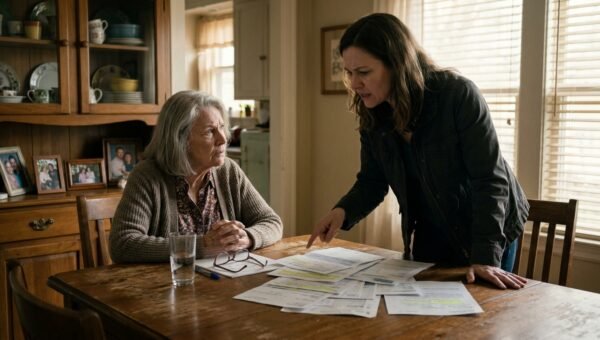
Michelle’s lawyer argued that the 2021 will was unverified, that Clara had suffered from mild dementia, and that the family had operated under an oral family agreement.
Judge Henderson did not look impressed. He picked up the original 2021 document, then looked over at the two clinic nurses Mr. Vance had brought in as sworn witnesses. Both women testified clearly that Clara had come in alone, perfectly lucid, and asked them to witness her signature because she did not trust her children.
Then Mr. Vance handed the judge the 1989 timber sale records and Clara’s handwritten diary from the ammunition box.
“Your Honor,” Mr. Vance stated calmly, “this was not an oversight. This was a deliberate act of family restitution. The decedent preserved this will in a location she specifically designated to her niece. Meanwhile, the respondents have already unlawfully converted sixty-three thousand dollars in liquid estate assets without court authorization, while attempting to dispose of real property that never belonged to them.”
Judge Henderson set the papers down on his bench with a firm thud.
He looked directly at Michelle. “Ma’am, an oral agreement between two self-interested siblings does not supersede a properly executed, notarized last will and testament. You had no legal authority to touch a single cent of your mother’s accounts without letters of administration from this court.”
The judge looked at the petition. “I am admitting this 2021 will to probate today. Sarah Lynn Walker is appointed executor of the estate of Clara Mae Miller. The real property on Maple Lane belongs solely to Sarah Lynn Walker as specified in Article Three.”
Michelle let out a sharp gasp, half-rising from her chair. “Judge, you can’t be serious! That house is worth one hundred and eighty thousand dollars! She’s just a niece!”
“Sit down, ma’am, or you will be held in contempt,” Judge Henderson warned, his voice cutting through the room like iron.
He then turned to Kevin and Michelle together. “Furthermore, the court orders both respondents to provide a full accounting of the sixty-three thousand dollars removed from First National Bank within thirty days. If those funds have been spent, the estate may place liens on your personal assets to recover the balance. Court is adjourned.”
ENDING
Michelle collapsed back into her chair, her face mottled with red blotches, staring at the table in absolute shock.
Kevin turned on her immediately right there in the gallery. “I told you we should have run this through a lawyer! I told you! Now we owe thirty grand each, and I don’t have it, Michelle! I put my half into my truck and paying off credit cards!”
Michelle didn’t answer him. She just glared at me as I gathered my coat. When I walked past their table, she hissed, “You’re a snake, Sarah. You took advantage of an old woman who lost her mind.”
I stopped and looked at her. I didn’t raise my voice. I didn’t smile.
“Clara never lost her mind, Michelle,” I said quietly. “She remembered everything. She remembered what your father did to my mother thirty-five years ago. And she remembered who showed up on Tuesdays to clip her toenails while you were sitting by the pool in Gulf Shores.”
I turned and walked out of the courtroom, listening to the heavy double doors swing shut behind me.
It took four months to settle the estate completely.
Kevin had to sell his newer truck and take out a personal loan to pay back his share of the thirty-one thousand five hundred dollars he had taken from Clara’s bank account. Michelle had already spent her half on kitchen renovations and a trip to Mexico, so Mr. Vance filed a judgment lien against her primary residence until the money was returned to the estate account.
Once the legal process was finished, I took Clara’s house.
I didn’t sell it to an out-of-town investor, and I didn’t flip it. My son, David, had just gotten married in the spring and was struggling to afford rent in town while working as an apprentice electrician.
In May, I signed the deed over to David and his new wife for one dollar.
We spent three weekends repainting the living room, tearing out the worn floral carpet to expose the original oak floors underneath, and clearing out the overgrown yard. When we were finished, the house looked bright and proud, exactly the way Clara kept it when I was a little girl.
I kept the black guest book from Clara’s funeral.
I took it to a local bookbinder in town, an older man named Joseph who had a shop near the town square. He repaired the broken spine with fresh black cloth, reinforced the cardboard backing, and cleaned the flaking gold lettering on the front cover.
Today, that book sits in the center of the coffee table in David’s living room.
Inside the front cover, pasted neatly against the endpaper, is the yellow church bulletin from 1998 and the cashier’s receipt for twelve thousand five hundred dollars.
Every time I walk into that house to visit my son and watch him build a life in those clean, sunny rooms, I look at that guest book. Michelle thought she was handing me a piece of useless trash to mock my time and my loyalty. But Clara knew what she was doing all along. She gave me the one thing that told the truth, and the truth gave my family our home back.