PART 1
I spent my sixty-third birthday sitting alone in the cafeteria of Saint Luke’s Hospital, stirring cold black coffee with a wooden stick while my husband, Joe, had double bypass surgery two floors up.
The surgery was scheduled for 7:30 in the morning. By noon, nobody had shown up.
I had texted all three of our grown children the night before. Our youngest, Chloe, texted back that her daughter had a regional soccer tournament three hours away and she couldn’t pull her out without forfeiting the team’s ranking.
Our middle son, Tyler, said he had an inventory audit at his auto parts store that he couldn’t legally delegate. And our oldest, Mark, called from Charlotte, nine hundred miles south. He told me his flight was nonrefundable, his firm was closing a commercial acquisition on Friday, and he would call me as soon as he stepped out of his afternoon meeting.
“Mom, Joe is strong,” Mark had said over the phone, his voice smooth and calm against the background noise of what sounded like an airport concourse. “The doctors do hundreds of these every year. You don’t need to sit there panicking. Just keep your phone on.”
“I’m not panicking,” I told him. “I just wanted someone here in case.”
“In case of what?” he had asked, almost annoyed. “He’s in good hands. Call me when he’s in recovery.”
So I sat at a Formica table by a vending machine that hummed too loudly.
I watched nurses in scrubs buy bottled tea, and I kept looking at my watch. Sixty-three didn’t feel like an achievement. It felt like an empty room.
Around twelve-fifteen, a nurse in dark blue scrubs walked over and stood by my table. Her badge said Sarah, Cardiac Step-Down. She looked tired around the eyes, but she gave me a gentle smile and set a small plastic container on the table. Inside was a single vanilla cupcake with pink frosting.
“Happy birthday, Mrs. Warren,” she said.
I looked at the cupcake, then at her. “Excuse me?”
“Your husband told us yesterday during his pre-op admission,” Sarah said, pulling out the chair across from me and sitting down. “He pulled me aside right after they checked his vitals. He told me today was your sixty-third, and he said if he was still under anesthesia at lunch, somebody on staff had to make sure you got something sweet.”
My throat tightened. Joe had been having chest pains for three months, hiding them behind antacid tablets until he collapsed on the garage floor on Monday. Even with blocked arteries and a surgical consent form in his hand, he had remembered my birthday.
“That’s Joe,” I said, my voice shaking a little. “He’s still asleep, right?”
“Still in the recovery suite,” she confirmed. “Vitals are stable. Dr. Alvarez came out about twenty minutes ago to look for you, but he was paged back upstairs. Everything went clean. No complications.”
The relief hit me in my chest, heavy and warm. I let out a breath I felt like I’d been holding since Monday afternoon.
“Thank you, Sarah,” I said. “Really. Thank you for the cupcake.”
She hesitated. She didn’t stand up. She reached into the side pocket of her scrub jacket, pulled out an envelope, and laid it flat on the table between the coffee cup and the cupcake.
It was a standard white business envelope, sealed shut. Written across the front in black felt-tip pen was one word: *Mom*.
The handwriting was sharp, slanted slightly to the left, with the distinctive open loop on the capital *M* that I had watched my oldest son practice across kitchen tables when he was nine years old.
“Where did you get this?” I asked.
“A gentleman dropped it off at the cardiac family desk about forty-five minutes ago,” Sarah said, watching my face carefully. “He asked if Joe Warren was still in surgery. When the receptionist said yes, he gave her that, described what you were wearing, and said to bring it to you.”
“Did he give his name?”
“He said Mark,” she replied. “He told her he was your son.”
My hand hovered over the paper. Mark had told me at eight o’clock that morning that he was walking into a corporate office in North Carolina. Charlotte was a fourteen-hour drive or a three-hour flight.
“Did he say where he was going?” I asked.
Sarah shook her head. “He told the desk clerk he couldn’t stay. He said he had to get to the bank before two o’clock.”
PART 2
I picked up the envelope. It was surprisingly heavy, stiffened by folded documents inside rather than a birthday card.
“Did he look upset?” I asked Sarah.
“The clerk said he looked like he was in a rush,” Sarah said quietly. “Suit, overcoat, carrying a leather folio. She told him he could wait in the family room, but he checked his watch, handed her the envelope, and practically ran toward the west parking deck.”
I sat in that plastic chair with the unopened envelope resting against my palm. My oldest son had told me he was nine hundred miles away because a ticket was nonrefundable. He had listened to me talk about his father’s chest being opened up, told me not to panic, and then drove to our local hospital just to leave paper with a receptionist and run out the door.
I slid my finger under the glued flap and pulled out the contents.
There was no card. There was no note wishing me a happy birthday.
Inside were four folded pages. The top page was an official letterhead from Oakridge Community Bank, the small branch three blocks from our house where Joe and I had kept our checking account, our savings, and our modest home equity line of credit for twenty-eight years.
The document was titled: *Notice of Default and Demand for Accelerated Balance*.
The date stamped at the top was September 3rd, seven days prior. The balance demanded was $84,650.
My eyes scanned down the page. The account listed was not our personal checking. It was a joint business line of credit registered under *Warren Logistics LLC*, a hauling business Joe had run for fifteen years before retiring his two trucks back in 2018. Beneath Joe’s printed name on the guarantor line was a second signature.
Mark Warren.
Attached to the bank notice were three stapled pages: a loan modification agreement dated fourteen months ago, an electronic funds transfer authorization, and a recorded deed of trust encumbering the four-acre parcel behind our house. That parcel had belonged to my father. Joe and I had paid the property taxes on it every November since 1991, keeping it clear of liens so we could sell it if our retirement savings ever fell short of our medical needs.
The deed had been signed using a durable power of attorney Joe had granted to Mark four years ago, during the six months Joe underwent chemotherapy for early-stage colon cancer. Mark had insisted on having the authority then in case Joe became incapacitated. We had never revoked it. We had forgotten it even existed once Joe went into remission.
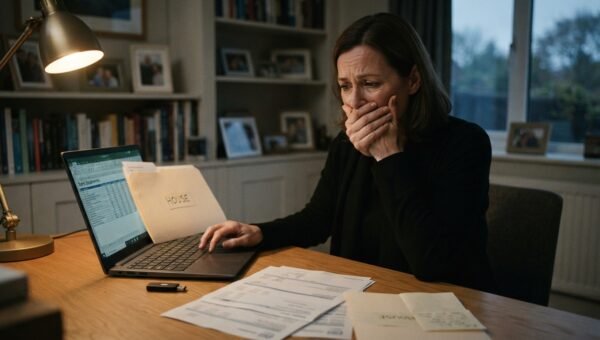
I looked at the figures on the third page. In June of the previous year, Mark had drawn $85,000 against the property using Joe’s old business shell. The payments were $1,140 a month. Three payments had been made from an account in Mark’s name, and then they stopped completely in May. The bank had sent four warning letters to the business’s old post office box, a box Joe hadn’t checked in nearly three years because the LLC was supposed to be inactive.
Mark had not flown nine hundred miles to visit his father in surgery. He had flown in because the bank’s final demand gave thirty days before initiating public foreclosure on the parcel, and that thirty-day deadline expired on Friday at 5:00 PM.
He had gone to the branch to do something about the loan. But why drop the papers at the hospital for me?
I reached into my purse, took out my reading glasses, and checked the bottom of the envelope. Folded into a tiny square at the very bottom was a single yellow sticky note, written in Mark’s hurried hand:
*Mom. Don’t let Dad sign anything from the bank when he wakes up. I’m meeting with Vance at the Oakridge branch right now. I’m trying to roll it over so you don’t lose the back acreage. Keep your phone on.*
My hands started to shake. Not with fear, but with a cold, clear anger that felt completely foreign to me.
I stood up from the cafeteria table. I left the cupcake sitting next to my cold coffee, walked out to the parking garage, and got into my six-year-old Buick. The hospital was four miles from the bank branch.
PART 3
The parking lot of Oakridge Community Bank was half-empty when I pulled in at 1:10 PM. Parked directly in the front visitor space was a sleek dark grey rental sedan with out-of-state plates.
I walked through the double glass doors. The lobby was quiet, smelling of floor polish and paper. In the glassed-in corner office labeled *Vance Miller, Branch Vice President*, two men were seated across from each other.
One was Vance Miller, a man in his late fifties who had gone to high school with my younger brother. The other was my son Mark, wearing a dark navy suit, leaning forward over a wooden desk covered in manila folders.
I didn’t knock. I pushed the heavy wooden door open and walked inside.
Mark turned around, his face tight with stress. When he saw me, his jaw dropped. “Mom? What are you doing here? Dad’s still in the hospital.”
“I know where your father is,” I said. My voice was completely level. “He’s in a recovery room with tubes in his chest while you told me you were in Charlotte.”
Mark looked at Vance, who immediately shifted uncomfortably in his leather chair and stood up.
“Hello, Mrs. Warren,” Vance said cautiously. “I’m very sorry to hear about Joe. We didn’t know he was in the hospital today.”
“Of course you didn’t,” I said. “Because Mark didn’t want you to know Joe was incapacitated. He wanted to handle this before Joe woke up.”
I dropped the four pages from the hospital envelope onto Vance’s desk, right on top of the open folders.
“Mom, stop,” Mark said, standing up and reaching for my arm. “You don’t understand the structure of this. You shouldn’t be here. Let me finish talking with Vance, and I’ll explain everything at the house.”
I pulled my arm back. “Explain what? Explain why there is an $84,650 default against my father’s land? Explain why you used a five-year-old medical power of attorney to borrow money against a retired LLC?”
Mark exhaled sharply through his teeth. He ran both hands through his hair. “I didn’t steal anything, Mom. I was expanding my consulting firm’s regional branch last year. The commercial interest rates through normal channels were nine percent. Dad’s old LLC had a grandfathered commercial credit line at five point two. I used the power of attorney because Dad was out at the cabin and the paperwork needed to be closed that week.”
“You mortgaged our land,” I said.
“I secured it against the back lot because the bank required collateral for a draw over fifty thousand,” he snapped, his voice dropping into that familiar condescending tone he used whenever anyone questioned his financial decisions. “I made the payments. My client in Raleigh went bankrupt in April and stiffed me on two major retainers. It was temporary cash flow. I was going to pay off the entire balance this month once our acquisition closed.”
Vance cleared his throat. He looked down at the paperwork on his desk, then up at Mark.
“Mark,” Vance said quietly. “The acquisition paperwork you brought me today is an unexecuted letter of intent. There’s no certified escrow, and there are no guaranteed funds attached to this.”
Mark turned on Vance. “It closes in three weeks! We’ve discussed this for two hours.”
“Three weeks is past the foreclosure notice date,” Vance replied, his tone firm now. “And under state banking regulations, a power of attorney executed specifically for medical and personal maintenance during a medical emergency cannot be used to encumber primary family real estate for third-party commercial ventures without specific corporate resolution. When your father signed this LLC authorization in 2020, it was for operational continuity of Warren Logistics, not your LLC in Charlotte.”
Vance looked at me. “Mrs. Warren, did you or Joe sign a spousal joinder on this deed of trust?”
“No,” I said. “I didn’t even know it happened.”
“Then the bank’s lien on the acreage is legally flawed,” Vance said directly to Mark. “Which I just told you ten minutes before your mother walked in here. If your father didn’t authorize this commercial draw, and your mother didn’t sign off on the marital property encumbrance, this isn’t a loan modification situation, Mark. This is an unauthorized encumbrance.”
The room went dead quiet.
Mark didn’t look at Vance anymore. He looked at me. For the first time all afternoon, the slick, confident corporate veneer cracked completely. He didn’t look like a successful executive closing deals in North Carolina. He looked like a cornered man who had gambled with his parents’ future to cover his own business mistakes.
“Mom,” he whispered, his voice thin. “If the bank flags this as unauthorized, they’ll refer it for legal review. It will ruin my credit rating. My license. Everything I’ve built.”
I looked at my son. The boy I had stayed up with through ear infections, the boy Joe had worked twelve-hour shifts to send to college, the man who had lied to my face on the phone while his father lay on an operating table having his chest sawed open.
“You let me sit alone on my birthday,” I said, every word hitting hard and plain. “You told me you were nine hundred miles away because a plane ticket was nonrefundable. You let me think you couldn’t be bothered to hold my hand while your father might have died, all because you were sneaking into town to clean up your paper trail before Joe found out what you did.”
“I was trying to protect you from the stress,” he pleaded.
“You weren’t protecting us,” I said. “You were protecting yourself.”
I turned to Vance. “What happens to the four acres if this isn’t paid by Friday?”
“The bank doesn’t want your land, Ruth,” Vance said gently. “If the lien is contested based on lack of spousal consent, foreclosure stops immediately while legal sorts out the validity. But the debt doesn’t vanish. The debt remains Mark’s personal liability, and the bank will pursue him directly.”
“Then pursue him,” I said.
Mark stared at me. “Mom. You can’t be serious.”
“I am completely serious,” I said. “You will sign whatever paperwork Vance needs to remove my husband’s name and our property from this debt today. You will use your own savings, your own house, or your own car to satisfy your loan. And you will not say a single word about this to your father until his cardiologist tells me he can handle it.”
“Mom, please—”
“Sign the transfer papers, Mark,” I said. “Or I will walk across the street to the magistrate’s office before two o’clock.”
He looked at my eyes, realized I meant every syllable, and slowly reached for the pen.
ENDING
The bank paperwork took forty-five minutes. Vance prepared an emergency assumption agreement, stripping Warren Logistics and our four-acre parcel from the obligation and attaching Mark’s personal assets as sole guarantee, backed by an immediate wire of $15,000 from Mark’s personal liquid accounts to cure the immediate default.
Mark signed every page in silence. He didn’t look at me once.
When it was finished, he gathered his coat and his leather folio. We walked out of the bank lobby into the crisp September afternoon.
“Are you coming back to the hospital?” I asked him in the parking lot.
He stood by the driver’s door of his rental car, his collar turned up against the wind. “I don’t think Dad needs to see me right now.”
“No,” I agreed. “He doesn’t.”
He got into the car, backed out of the space, and drove away toward the highway.
I drove back to Saint Luke’s Hospital. By the time I took the elevator to the fourth floor, Joe had been moved into Room 412.
The room was quiet except for the rhythmic beep of the heart monitor and the steady hum of the oxygen line. Joe was pale, with grey stubble along his jaw and tape across his collarbone, but his eyes fluttered open when I sat in the vinyl armchair next to his bed.
He looked over at me, his mouth dry, his speech slow and slurred from the painkillers.
“Ruthie,” he whispered.
“I’m here, Joe,” I said, reaching out and wrapping both of my hands around his right hand. His skin was warm.
“Did Sarah… find you?” he asked, fighting to keep his eyes open.
“She found me,” I said.
He managed a weak, crooked smile beneath his oxygen cannula. “Pink frosting?”
“Pink frosting,” I told him. “Just like you asked.”
He squeezed my fingers with what little strength he had, satisfied that he had taken care of me, and drifted back to sleep.
I sat there in the quiet room for three hours, watching his chest rise and fall. My phone buzzed in my purse at 4:30 PM. It was a text from Chloe, asking if surgery was over and sending a picture of her daughter holding a third-place trophy. A few minutes later, Tyler texted a thumbs-up emoji from his shop.
I didn’t reply to either of them.
Later that evening, after the visiting hours ended and the floor lights were dimmed, I reached into my coat pocket and took out the yellow sticky note Mark had left in the cafeteria. I walked over to the small metal trash can beside the sink, dropped the note inside, and washed my hands with hot water.
Then I pulled my chair closer to Joe’s bed, leaned my forehead against his forearm, and stayed right where I belonged.