PART 1
My Aunt Clara was a woman who understood the quiet dangers of dependency. She lived alone in a neat brick bungalow in Roanoke, worked thirty-two years as a county clerk, and never married. Whenever she visited us in Richmond, she would watch the way my husband, David, managed our finances with a silent, watchful intensity.
Three months ago, Aunt Clara passed away peacefully in her sleep at the age of seventy-nine.
Her will distributed her modest personal effects, her furniture, and her car among the family in plain daylight. But two weeks after the funeral, I received a certified letter from an estate attorney in Roanoke. Attached was the paperwork for a private payable-on-death savings account containing sixty-two thousand, four hundred dollars.
Along with the bank forms, there was a handwritten note from Clara on her pale blue stationery.
“Maggie,” she wrote in her neat, looping cursive. “A woman must always have her own safety net. Keep this account in your own name. Do not mingle it, do not announce it, and do not spend it on everyday trifles. Save it for the rainy day you hope never comes.”
I followed her instructions to the letter. I opened an individual high-yield account under my sole name, deposited the funds, and opted for paperless banking. Or at least, I thought I had selected paperless.
Last Tuesday evening, a confirmation statement from the bank arrived in our roadside mailbox. I was still stuck in traffic on the Chippenham Parkway when David checked the mail.
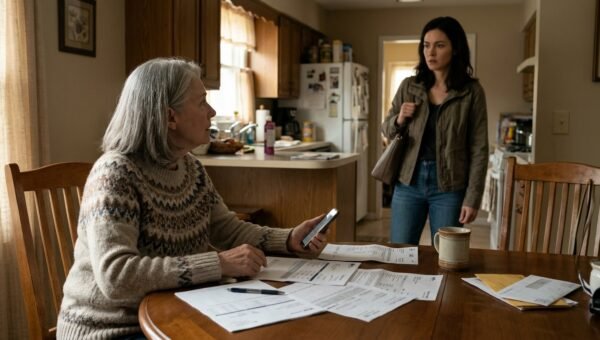
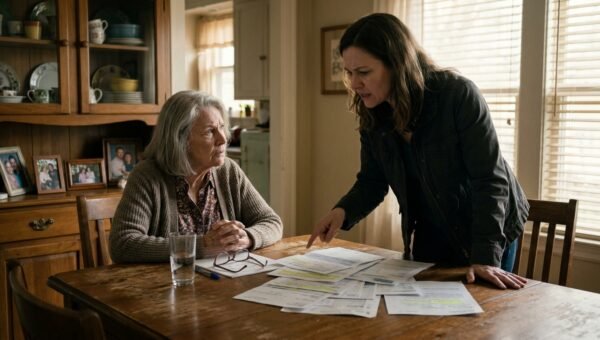
When I walked through the side door with my coat over my arm, David was sitting at the dark oak dining table. The opened envelope was laid flat on the table runner, flanked by his reading glasses and an empty water glass.
David is forty-six, an estimator for a commercial roofing firm, and a man who prides himself on keeping tight control over every dollar that moves through our household. For nineteen years, we have operated on a joint checking account that he audits every Sunday evening down to the cent.
“Care to explain this, Maggie?” he asked, his tone deceptively mild as he tapped the printed paper with his forefinger.
My stomach dropped into my shoes. “It is an inheritance from Aunt Clara, David. She set it up as a direct transfer.”
David’s eyebrows shot up. “Sixty thousand dollars sitting in a private account that you kept hidden from your husband? We share everything in this house, Maggie. Keeping secret funds is deceitful. It borders on financial infidelity.”
“It was her explicit wish that I keep an emergency cushion in my own name,” I replied, setting my purse on the counter. “It has nothing to do with our household budget.”
David didn’t argue further that night. He simply folded the statement, slid it into his shirt pocket, and said we would discuss it when we were both calm.
I foolishly believed that meant a private conversation between husband and wife.
Instead, when I came home from work on Thursday afternoon, two unfamiliar vehicles were parked in our driveway: my father-in-law Robert’s tan Buick, and my brother-in-law Kenny’s battered work van.
Inside, the family was already assembled in the living room. David was leaning against the mantelpiece with his arms folded.
His mother, Evelyn, sat on the sofa holding a cup of coffee, looking like a judge convening an emergency court session. Across from her sat Kenny, thirty-eight years old, his shoulders slumped and his hands clasped between his knees.
David had called a family summit behind my back.
“Maggie, come sit down,” Evelyn said, gesturing toward the empty armchair with a cold, formal smile. “David told us about the blessing Aunt Clara left you. God truly works in mysterious ways. We were just discussing how this money will save Kenny from absolute ruin.”
Kenny had spent the last three years sinking over eighty thousand dollars of borrowed capital into an artisanal hot sauce bottling venture that failed to turn a profit. He had defaulted on equipment leases, run up high-interest business credit cards, and was currently ninety days delinquent on a commercial warehouse loan that threatened to drag Robert and Evelyn down with him because they had co-signed the note.
“Kenny needs fifty-four thousand dollars by the end of next week to satisfy the bank’s demand letter,” David announced, looking at me with total conviction. “If he doesn’t clear the balance, the lender moves against Mom and Dad’s home equity line. We have to use your sixty thousand to clear his debts.”
I stared at David, then at his parents. “Aunt Clara gave that money to me for my personal security. Kenny took out those business loans, David. It is not our debt.”
Evelyn set her coffee cup down with a sharp clatter on the glass table. Her eyes hardened.
“Refusing to help family when you have idle cash sitting in a bank is not just selfish, Maggie,” Evelyn said, her voice dripping with venom. “It is an outright rejection of this family. If you let Kenny go under and allow our credit to be destroyed while you hoard sixty thousand dollars, you are telling us that you were never truly part of this marriage.”
David stepped forward, his jaw tight. “She is right, Maggie. In this family, we sacrifice for each other. If you refuse to surrender that account, I don’t know how I can look at you the same way again. It will destroy this marriage.”
They sat in silence, waiting for me to break. And for one terrifying moment, looking at my husband of nineteen years threatening to end our life together, I felt my resolve crack.
PART 2
The pressure in that living room was suffocating. I stood up, excused myself without answering, and walked down the hall into our guest bedroom, locking the door behind me.
Outside the door, I could hear their muffled voices. Kenny was muttering about how lucky they were that the money showed up in time, while Evelyn reminded David to make sure the cashier’s check was made out directly to the commercial creditor to avoid tax complications. They were already spending my aunt’s money as if the transfer were a settled legal fact.
I sat on the edge of the guest bed, staring at the floorboards, my heart pounding in my throat. Nineteen years of marriage is a long time. We had raised our daughter, Hannah, who was now a sophomore at Virginia Tech. We had weathered layoffs, home repairs, and holiday dinners. The instinct to keep the peace, to bend my knee and hand over the money just to make the hostility vanish, was powerful.
Then I pulled Aunt Clara’s blue note from the bottom of my purse.
*A woman must always have her own safety net.*
Clara had watched David for nearly two decades. She had watched him question every supermarket receipt, review every department store bag I brought home, and dictate how our tax refunds were spent, while his own family perpetually bled our checking account for emergency loans that were never repaid. Over nineteen years, David had quietly loaned Kenny over fourteen thousand dollars for car down payments, broken lawnmowers, and unpaid rent. Not a single cent had ever come back.
I wasn’t preserving my marriage by surrendering the money. I was simply feeding a bottomless pit.
The next morning, while David was at his construction trailer in Henrico, I took a half-day off from my job at the medical clinic. I drove to the commercial banking center downtown, met with a trust officer, and had the entire sixty-two thousand dollars transferred into an irrevocable trust, naming our daughter Hannah as the sole contingent beneficiary upon my death, with an independent trust company acting as co-trustee.
Under Virginia law, personal inheritances kept separate from marital property are non-marital assets. By locking the funds into a separate legal trust structure, David could not claim an equitable interest, nor could any creditor pierce it.
Next, I walked two doors down to the law offices of Harrison, Cole & Sterling and sat down with a family law attorney named Linda Harrison.
“If your husband is threatening divorce over non-marital funds, Maggie, you are not dealing with a financial misunderstanding,” Linda told me plainly, reviewing the inheritance documents. “You are dealing with coercion. And if you pay Kenny’s debt, that money is gone forever. You have zero legal recourse to recover it.”
I asked Linda to draft a formal letter of representation, along with an initial inventory of our marital assets, just in case.
I arrived back at the house at four in the afternoon.
David came home forty-five minutes later, carrying a manila envelope under his arm. He walked into the kitchen, set a blank wire-transfer authorization form on the granite island, and laid his favorite pen right next to it.
“I talked to Mom and Dad this afternoon,” David said, his tone matter-of-fact, as if he were giving instructions to a junior subcontractor. “The bank branch on Broad Street stays open until six. We can drive down together, initiate the wire to Kenny’s creditor, and put this ugly disagreement behind us. I told my parents you would do the right thing.”
I looked at the pen, then looked directly into my husband’s eyes.
“I am not signing that wire, David,” I said. “And the money is no longer in that checking account. It has been placed into an irrevocable trust for Hannah’s future and my personal emergencies.”
PART 3
The color drained from David’s face, replaced immediately by a dark, furious flush that crept up his neck.
“You did what?” he shouted, slamming his hand onto the island counter so hard the fruit bowl rattled. “You tied up sixty thousand dollars without my consent? While my brother is facing financial ruin? My parents could lose their home equity line, Maggie!”
“Your brother took out commercial equipment loans on a business that had no revenue, David,” I said, keeping my voice low and level. “Your parents chose to co-sign those notes without asking us. It is their responsibility, not mine.”
“You are selfish, cold, and disloyal!” David snarled, pacing across the kitchen floor. “I told you what would happen if you refused. I am not going to stay married to a woman who hides money from me and lets my family drown. You either dissolve that trust tomorrow morning and get Kenny his check, or this marriage is over. I mean it. I will pack my bags and walk out that door tonight.”
It was the ultimate ultimatum. For nineteen years, David had used that exact threat, the fear of abandonment, to dictate where we went for Thanksgiving, how our savings were invested, and whose family received our holiday bonus money. Every time he raised his voice and threatened to walk away, I had folded.
I looked at the man standing across the island, his fists clenched, his eyes full of contempt.
I reached into my purse, pulled out the business card Linda Harrison had given me two hours earlier, and set it on the counter right on top of his blank wire-transfer form.
“Then pack your bags, David,” I said softly.
He froze. His chest was heaving, his mouth slightly open, waiting for me to cry, plead, or reach for his sleeve. When I didn’t move an inch, the bravado in his posture began to falter.
“What is this?” he asked, picking up the card.
“That is my attorney,” I said. “Her name is Linda Harrison. If you decide that nineteen years of marriage, our home, and our life together are worth less than bailing out Kenny’s bad business decisions for the fourth time, then call her office on Monday. She will handle the division of our marital property.”
David stood there in the silent kitchen for two full minutes. The grandfather clock in the foyer ticked with heavy, rhythmic beats. He looked at the card, then down at his blank wire form, realizing that his bluff had run straight into a brick wall.
He didn’t pack his bags that night.
Instead, he grabbed his truck keys, slammed the garage door behind him, and drove over to his parents’ house in Chesterfield.
For the next four days, my phone was bombarded with calls and text messages. Evelyn left two voicemails calling me an ungrateful daughter-in-law who had abandoned the family in their hour of need. Kenny sent a long, rambling message claiming that if his business went into commercial foreclosure, his depression would be entirely my fault.
I didn’t answer a single text. I forwarded every recording and message directly to Linda Harrison’s secure client portal.
On Sunday evening, Robert, my father-in-law, called my cell phone. His voice was different from Evelyn’s. He sounded exhausted, humbled, and deeply embarrassed.
“Maggie,” Robert said quietly. “I want to apologize for the way Evelyn and David spoke to you in your home on Thursday. It was wrong. Kenny’s debts are his own doing. I should never have allowed my wife to pressure you for your aunt’s money. We met with a commercial bankruptcy attorney yesterday morning. Kenny is filing Chapter 7 for the business, and the bank is restructuring our home line over ten years. We will manage. Please don’t let this destroy your home with David.”
ENDING
David returned to the house on Monday evening with his head down.
He walked into our bedroom, set his keys on the dresser, and sat down on the armchair across from the bed. The arrogance, the sharp demands, and the talk of divorce had completely vanished. He looked tired, sheepish, and visibly diminished.
“Mom shouldn’t have said those things to you,” David admitted, staring down at his work boots. “And I was wrong to bring them into our finances. I was stressed about Kenny dragging down my parents, and I took it out on you.”
I sat on the edge of the bed and looked at my husband. I didn’t raise my voice, but I didn’t offer an easy smile either.
“You didn’t just take it out on me, David,” I told him. “You demanded that I surrender my late aunt’s gift to cover your brother’s reckless behavior, and then you threatened to throw away nineteen years of marriage when I said no. That trust for Hannah and my future stays exactly where it is. It will never be touched for Kenny, for your parents, or for this household.”
David swallowed hard and nodded. “I understand.”
“And moving forward, things change,” I continued. “We are opening two separate checking accounts for our personal discretionary spending. Our joint account will cover the mortgage, utilities, and groceries, and nothing else. The era of writing off-the-books checks to your brother is over. If you give Kenny a single dollar from our marital funds, I will file for legal separation the very next morning.”
David agreed. He didn’t have a choice. He knew that if he walked away, a judge would look at our nineteen-year marriage, award me fifty percent of our accumulated marital equity, and leave him with nothing to show for his posturing.
The rift with his family did not heal quickly. We skipped Thanksgiving at Evelyn’s house that year, choosing instead to drive up to Blacksburg to spend a quiet, joyful holiday weekend taking Hannah out to dinner. Evelyn barely looks at me during family gatherings, and Kenny avoids eye contact whenever we cross paths at family funerals or graduations.
I do not lose an hour of sleep over their coldness.
Aunt Clara’s money remains safely locked in the trust, earning steady interest month after month. Every time I log into that private portal, I think of her quiet bungalow in Roanoke, her neat cursive on pale blue paper, and the hard-won wisdom of an independent woman who knew that peace in this world often requires having the courage to draw an unyielding line in the sand.
I did not surrender my inheritance, and by refusing to be bullied, I saved far more than sixty thousand dollars. I took back my dignity, protected my daughter’s future, and made sure that no one in that family will ever mistake my kindness for weakness again.