PART 1
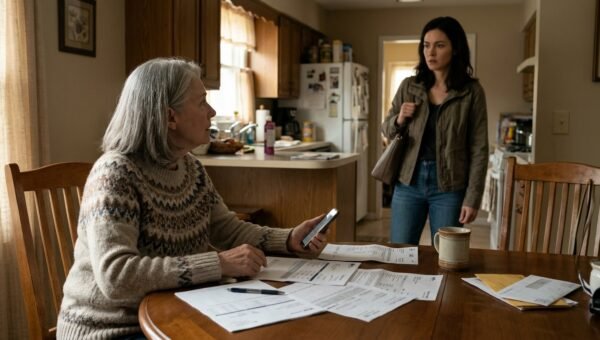
The hospital discharged me on a Tuesday in late October with a brand new titanium right hip and strict orders to keep moving. I was sixty-six years old, retired after thirty-one years as a county records clerk, and living in the one-story brick home my late husband Arthur and I paid off in 2011. My son, Kevin, was thirty-four. He had moved back into my spare bedroom eight months earlier after a divorce left him short on cash.
When the surgeon cleared me to go home, Kevin took off work early, loaded my bags into his sedan, and told the nurses he would handle every single detail of my recovery.
At first, I thought God had blessed me with a devoted boy. The pain during that first week was sharp and deep, like a hot wire running from my groin down into my knee. Kevin helped me to the bathroom, brought me bowls of canned soup on a plastic tray, and reminded me to take my blood thinners. He insisted on taking my handbag into his room so I would not have to bend over to reach it. He said he would manage the bills, sort the incoming mail, and handle the deposits so I could rest with my leg elevated.
My only steady income was my monthly Social Security check, which came to exactly $2,180 after Medicare deductions.
It was deposited automatically on the third Wednesday of every month into my primary checking account at First National. Arthur had left me a modest life insurance cushion, but that was locked away in a separate high-yield certificate of deposit that I never touched. The $2,180 paid the property taxes, electric, water, groceries, and supplemental medical coverage, with about four hundred dollars left over each month. In early November, Kevin asked me to sign a simple bank authorization form so he could transfer funds to his account and pay the bills directly from his phone. I trusted my own flesh and blood, so I signed the line with an unsteady hand while propped up on three pillows.
By mid-November, the deep surgical pain began to fade, replaced by the stiff, tight ache of healing bone and muscle. My discharge instructions clearly stated that home health therapy was scheduled for three visits a week for the first month, followed by outpatient physical therapy at the rehabilitation clinic two miles down Elm Street.
A visiting physical therapist named Marcus came by twice during that first week. He taught me how to stand up safely using the aluminum two-wheeled walker the hospital had sent home with me. He had me doing heel slides, ankle pumps, and standing leg lifts. By the end of his second visit, Marcus told me my quad activation was remarkably strong for someone my age.
Then Marcus stopped coming. When I asked Kevin why the therapist had not shown up on Thursday, Kevin walked into my bedroom carrying a basket of clean laundry and shook his head. He pulled the chair close to my bed, leaned his elbows on his knees, and spoke in that quiet, mournful tone people use in funeral parlors. He told me Marcus had called to say my insurance refused to authorize further home visits because my surgical notes showed signs of joint instability. Kevin said Marcus had warned him that bearing weight too early risked dislocating the ceramic head right out of the socket.
I felt a cold drop in my stomach. I remembered the surgeon telling me that dislocation was the worst possible complication. When I asked Kevin where my aluminum walker was so I could at least stand by the window, he looked down at the carpet. He told me he had moved the walker down into the basement because seeing it in the hallway tempted me to get up on my own. He said my balance was completely shot, that my reflexes were sluggish, and that if I fell on the hardwood, nobody would be there to lift me. He told my sister Clara over the phone that Mom was bedridden, fragile, and unable to support her own weight. When my neighbor Evelyn knocked on the door with a tuna casserole, Kevin cracked the door three inches, accepted the dish, and told her I was too tired and confused to have visitors.
For three long months, November, December, and January, the walls of that bedroom became my whole world. Kevin brought me breakfast at seven, lunch at noon, and dinner at six. Every time I asked about getting out to the living room or trying outpatient therapy, he offered the same heavy sigh. He told me the nursing home across town charged over six thousand dollars a month for long-term care and that my $2,180 check barely covered our household utilities and the special high-calorie meals he was buying for me. He made it sound like we were walking a financial tightrope, and he made it clear that keeping me in bed was the only thing preventing me from being dumped into a state-run facility.
I spent those weeks staring at the pale plaster ceiling, feeling my muscles turn to jelly. I could wiggle my toes, flex my calves, and squeeze my thigh muscles until they burned, but the fear Kevin planted took deep root. What if the hip really was unstable? What if taking three steps caused the bone to fracture? I believed him because he was my son, and mothers are built to believe their children would never turn their home into a prison.
PART 2
The break in the wall came on a wet Thursday afternoon in the final week of January. Kevin had left the house at one o’clock, claiming he had an extended shift at the distribution center. Around three, the front doorbell chimed twice. Nobody answered, of course, because Kevin kept the deadbolt turned and my bedroom door pulled shut. A few minutes later, I heard the metallic rattle of the mail slot in the front door, followed by hurried footsteps descending the porch steps. Then there was a sharp slide of stiff paper across the hardwood floor of the hallway, right beneath the gap under my bedroom door.
The draft from the front foyer had pushed a folded document across the polished oak. It came to rest just two feet inside my room.
My heart began to thump against my ribs like a trapped bird. For three months, I had obeyed Kevin’s orders to stay flat on my back, only sliding gingerly onto a bedside commode he had placed beside my nightstand. But looking at that crisp white paper lying on the floor, an old stubborn spark flared up inside me. I kicked back the heavy wool quilt. I swung my legs over the edge of the mattress and let my bare feet touch the cold floor.
My right thigh felt stiff, but there was no grinding pain. No tearing sensation. I pressed both palms flat against the wooden top of the nightstand and pushed upward. My knees trembled slightly, but the joint held solid. I stood straight for the first time in ninety days. The air in the room felt entirely different from that height.
Taking small, deliberate shuffling steps, I kept one hand on the solid oak footboard, then reached out to grip the doorframe. I leaned down slowly, bending at the good left knee while keeping my right leg slightly braced, and snatched the paper off the floor. I shuffled back to the mattress, sat down with a thud, and unfolded the sheet.
It was not junk mail. It was a formal clinic visit summary and home exercise protocol on heavy letterhead from Elm Street Rehabilitation Services. Printed across the top was my name, my date of birth, and my primary care physician’s name. A bright yellow sticky note was attached to the corner, written in neat blue ink by a woman named Brenda: *Mrs. Vance, we missed you again for your re-evaluation today! Driver said nobody answered the door. Leaving your Phase 2 and Phase 3 completed charts and your home progression plan so you don’t lose the momentum from your early clinic sessions.*
My eyes scanned the printed grid below. The dates were clearly logged: October 28, November 2, November 6, November 9, November 13, November 17. Six full weeks of clinical records. Next to each date were therapist initials and detailed progress notes: *Patient completed 200 feet independent ambulation with single-point cane. Quad strength 4+/5. Balance testing normal for age. Patient cleared for stairs with handrail on Nov 17. Discharged from active home phase to outpatient maintenance. Excellent prognosis.*
I sat on that bed with the paper clutched against my flannel nightgown, counting the dates over and over until the ink blurred. Kevin had told me the therapist canceled because my hip was broken and unstable. Kevin had told me the insurance company refused coverage. But according to this official record, I had been cleared to walk with a simple cane before Thanksgiving. Kevin had systematically declined the clinic’s transportation vans, turned away the home health aids at the front door, and lied directly to my face every single morning while pouring my orange juice.
Why would he do that? The thought made my stomach churn. If I was healthy, if I could walk, I would walk down to First National Bank. I would look at the monthly statements. I would drive my car, which had been sitting parked in the driveway under a gray tarp since October.
That evening at six-fifteen, the front door clicked open. Kevin walked in carrying a paper sack from the local diner. He hung his wet coat on the hall rack and stepped into my room with a plastic cup of lukewarm black coffee.
“How are we doing tonight, Mom?” he asked, his voice smooth and practiced.
I held up the white sheet of paper. My hand was shaking, but not from weakness. “Kevin, what is this?”
He paused, his eyes landing on the Elm Street Rehabilitation logo. His expression did not shatter into guilt; instead, it tightened into annoyance, like a parent catching a toddler with scissors. He set the coffee cup on my dresser and reached out his hand.
“Where did you get that?” he demanded, snatching the sheet from my fingers.
“A therapist left it under the door this afternoon,” I said, keeping my voice level. “It says I was walking two hundred feet with a cane in November. It says my hip is completely healed. Kevin, why did you tell me I was crippled? Why did you hide my walker in the basement?”
Kevin crumpled the paper slightly in his fist, shoved it into his jacket pocket, and turned his back to me to fiddle with the coffee lid.
“You don’t understand clinical charts, Mom,” he said coldly. “Those therapists write whatever they need to write to bill the insurance. The day after that note was written, your doctor called me directly. He told me the X-rays showed microscopic loosening around the femoral stem. You try to put your full weight on that leg and you’ll fall flat on your face. You’ll break the other side, and then nobody will be able to take care of you. You’ll end up in County Manor, sharing a room with two dementia patients. Is that what you want?”
He stared down at me, daring me to challenge him. For three months, that threat had paralyzed me. But looking at him now, standing in my bedroom with my hard-earned life in his pocket, I saw the fear in his eyes. He wasn’t afraid I would fall. He was afraid I would stand up.
PART 3
I did not sleep that night. I waited until two in the morning, when the rhythmic sound of Kevin’s heavy snoring drifted down the hallway from the back room.
I quietly swung my legs out of bed. I stood up without holding onto the nightstand. My right ankle felt stiff and my hip flexors pulled tight, but there was no instability. The bone was locked solid. I placed one hand against the wall, took a step, then another. I moved down the narrow hallway, using the door frames and the edge of the kitchen counter for support, exactly as the clinic chart had described.
In the kitchen, the dim light over the stove illuminated the neat pile of mail Kevin kept on the breakfast bar. I opened the lower cabinet where he kept his briefcase. It was unzipped. Inside, I found three months of unopened bank statements from First National, along with my primary debit card, which I had not seen since the day of my surgery.
I pulled out the December and January statements and turned on the small under-cabinet light.
My monthly Social Security deposit of $2,180 had arrived on schedule every month. But within twenty-four hours of each deposit, Kevin had transferred $1,900 directly out of my checking account into an account labeled *K. Vance Consulting LLC*. The remaining two hundred and eighty dollars had gone toward paying the minimum balance on his personal credit card and buying fast food. My electric bill was forty days overdue. The municipal water utility had sent a second shut-off notice dated January 18. Worse yet, there was a letter from my auto insurer stating that my car insurance had lapsed due to non-payment.
He had not been managing my household. He had been draining my monthly income to fund his failing online marketing business while letting my home slide toward utility cutoffs. If I remained in bed, unable to leave the house or answer the telephone, nobody would ever uncover what he was doing. He had turned my bedroom into a paid containment cell.
I carefully put the statements back into his briefcase, but I took my debit card and slipped it into the pocket of my housecoat. Then I walked to the kitchen window and looked out at the street. Across the asphalt, the porch light was on at my sister Clara’s house. Clara was sixty-eight, sharp-tongued, and fiercely protective of our family. Kevin had told Clara that I was too disoriented to speak on the phone, that visiting me would only agitate my failing mind.
I took a deep breath, walked quietly back down the hallway, and went back to my bed. I did not confront him in the dark. A records clerk knows that when you are dealing with deceit, you do not yell. You assemble the file, you pick the room, and you present the documentation in front of witnesses.
The following morning was Saturday. Kevin had arranged what he called a “family care check-in” for eleven o’clock. He had invited my sister Clara and my brother-in-law Tom over to discuss what he termed “Mom’s declining condition and long-term care arrangements.” He planned to convince them that my Social Security check needed to be permanently assigned to him through a durable power of attorney so he could quit his job to become my full-time paid caregiver.
At ten-thirty, Kevin brought me a fresh nightgown and told me to stay under the covers until he called everyone into the room.
“Aunt Clara and Uncle Tom are coming over to say hello,” he said softly, smoothing my blanket with a fake smile. “Just smile and nod, Mom. Don’t worry about the finances. I have everything under control.”
“Of course, Kevin,” I replied quietly.
At ten minutes to eleven, I heard Clara’s sedan pull into the driveway, followed by the sound of the front door opening and the murmur of polite greetings in the foyer. Kevin’s voice was loud and performative, talking about how exhausting the night shifts were and how hard it was to watch a mother lose her independence.
Inside my bedroom, I did not put on the nightgown. I put on a pair of navy blue slacks, a warm wool sweater, and my sturdy walking shoes with the rubber soles. I took the crumpled rehabilitation sheet from my pocket and flattened it against the wood of my dresser.
I heard the dining room chairs scraping against the floorboards as Clara and Tom sat down at the large mahogany table.
“She’s just getting worse, Clara,” Kevin was saying, his voice thick with rehearsed sorrow. “The doctor told me the hip implant didn’t seat right. She can’t support her own weight. I’m doing everything I can, but I need legal authority to handle her estate before the state steps in.”
I stepped out of my bedroom.
I did not use a cane. I did not touch the hallway wall. I walked deliberately, step by step, down the corridor toward the dining room. Every movement felt like an act of reclamation. When I turned the corner into the bright dining room, my sister Clara looked up. Her coffee cup froze halfway to her lips. Tom’s jaw dropped.
Kevin had his back to the hallway, holding a manila folder filled with power-of-attorney forms. He was in the middle of a sentence when Clara’s eyes went wide.
Kevin turned around.
The color instantly drained from his face. His mouth opened, but no sound came out. For five full seconds, the only sound in the house was the ticking of the mantle clock Arthur had bought us for our twenty-fifth anniversary.
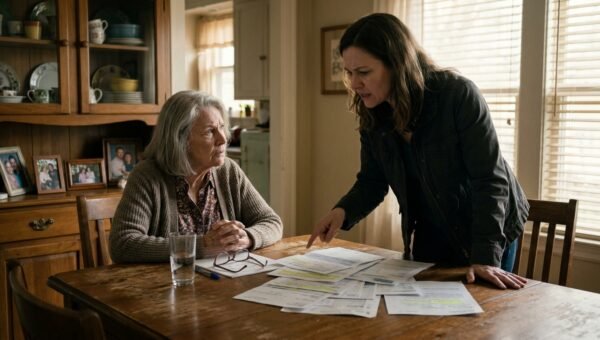
I walked straight past Kevin, pulled out the heavy head chair at the end of the mahogany table, and sat down. Then I laid the physical therapy discharge record right in the center of the wood, flat and smooth.
ENDING
“Clara,” I said, looking directly across the table at my sister, “I have been medically cleared to walk since the seventeenth of November.”
Kevin lunged forward, his hands trembling as he reached for the table. “Mom, please! You shouldn’t be out of bed! You’re having an episode, you’re endangering your health—”
“Sit down, Kevin,” Tom snapped, his voice cutting through the panic like an axe. Tom was a retired high school principal who had dealt with lying teenagers for thirty years. He leaned forward and pinned Kevin with a look that kept my son frozen in his tracks.
I placed my First National debit card on top of the medical sheet.
“For three months,” I said, speaking slowly so every syllable landed clearly in the quiet room, “my son has told our family and our neighbors that I was an invalid. He put my walker in the basement so I could not move. He told me the therapy was canceled because my hip was broken. And every single month, he has transferred $1,900 of my $2,180 Social Security check into his own business account while our water and electric bills sat unpaid on the kitchen counter.”
Clara stood up so fast her chair screeched against the floor. She snatched the physical therapy sheet from the table, her eyes scanning the dates, the progress notes, and the therapist’s signature. Then she looked at Kevin. The sheer fury on her face made my thirty-four-year-old son look like a frightened child.
“Is this true?” Clara demanded, her voice shaking with rage. “You kept your mother locked in a back room for six hundred dollars a week?”
“It wasn’t like that!” Kevin stammered, backing toward the front door. “I was taking care of her! I cooked every meal! The business needed capital to get off the ground, and once the contracts came in, I was going to pay every single dollar back! I was protecting her from a nursing home!”
“You weren’t protecting me from a nursing home, Kevin,” I said, looking him dead in the eye. “You were protecting yourself from having to get an honest job.”
The reality of what he had done hung in the air between us, heavy and permanent. There was no misunderstanding to clear up, no medical complication to hide behind. The documentation was sitting on the table, verified by the clinic and stamped by the bank.
Tom pulled his cell phone from his pocket, stood up, and dialed our cousin David, who had retired as a detective sergeant from the municipal police department three years earlier. Tom put the phone on speaker and explained the situation in plain, unvarnished terms: unlawful confinement of an elderly dependent, financial exploitation, and unauthorized diversion of federal benefit funds.
When Kevin heard David’s voice on the other end of the line advising us to secure the bank accounts immediately and file a formal adult protective services report, the excuses stopped. Kevin did not apologize. He did not ask for forgiveness. He grabbed his car keys off the hallway table, walked out the front door, and slammed it behind him.
We did not chase him.
That afternoon, Clara and Tom drove me down to First National Bank. I walked through the double glass doors on my own two feet, leaning lightly on Clara’s arm only when we navigated the curb. The branch manager, a woman named Mrs. Henderson who had known Arthur for twenty years, sat us down in her private office. Within twenty minutes, my checking account was completely frozen and a brand-new, individual account was established in my name alone. The direct deposit for my $2,180 monthly check was rerouted. Mrs. Henderson flagged Kevin’s consulting account for fraudulent electronic transfers, initiating an internal bank clawback on the unauthorized funds transferred over the previous sixty days.
By Monday morning, an adult protective services caseworker and an investigator from the county prosecutor’s office sat at my kitchen table. I handed over the clinic records, the unopened utility shut-off notices, and the three months of bank statements. Because the money involved federal benefit funds diverted from a recovering dependent, the legal process moved with quiet, bureaucratic finality. Kevin was formally served with a restraining order barring him from my property, and the county attorney filed charges for financial exploitation of a vulnerable adult.
Kevin moved two states away to live on a friend’s couch in Kentucky while his public defender negotiated a deferred prosecution agreement that requires him to pay back every cent of the $5,700 he stole, garnished directly from whatever wages he earns. He does not call me, and I do not call him. That silence hurts in a way that physical surgery never could, but the quiet of an empty house is far better than the poison of a false caregiver.
My neighbor Evelyn came over yesterday with another tuna casserole, but this time she did not leave it on the porch. We sat together at the kitchen table, drinking black tea while the morning sun poured through the clean windows. Afterward, I took my light aluminum cane and walked down to the end of the driveway to check the mailbox myself. The road was clear, the cold winter air was clean, and my feet carried me forward with every single step.