PART 1
For ten years, my family took vacations without me. Every summer there was an Outer Banks beach rental with matching monogrammed towels. Every spring break there was a group trip to Disney World with character breakfasts and group photos in front of Cinderella Castle. Every winter there was a ski lodge in New Hampshire where my two brothers and their wives posed by stone fireplaces with mugs of spiked cider.
I was never invited.
The story they told extended relatives was that I was simply too negative. They said I had a dark cloud over my head. My sister-in-law Karen loved to sigh into her wineglass at Thanksgiving and tell the table that I brought everyone down, that vacation was about light energy and unwinding, and that my personality just did not mesh with a relaxing getaway.
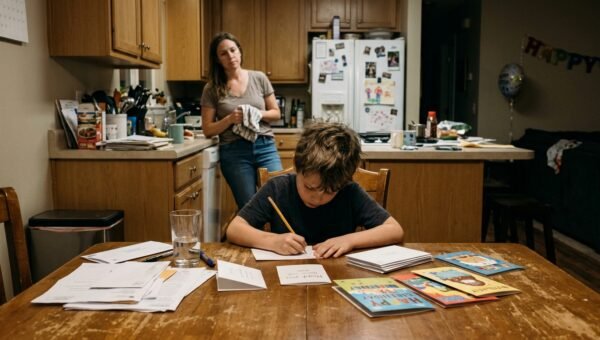
The truth was much simpler. I was the only person in the family who refused to look away from my father’s morning drinking.
My father, Robert, had been a functioning alcoholic for as long as I could remember. But around the time he turned sixty-five, the functioning part fell away. He started pouring bourbon into his morning coffee mug by eight in the morning. By noon, his speech was thick. By three in the afternoon, he was sitting in an armchair with red-rimmed eyes, dropping lighted cigarettes onto the carpet or snapping at my mother until she shrank into the kitchen.
My brothers, Mark and Greg, made an unspoken pact to protect their own comfort. As long as Dad paid for the big vacation houses out of his pension and stock accounts, nobody was allowed to mention the smell of liquor on his breath at nine in the morning. Nobody was allowed to ask why he was handing car keys to a twelve-year-old grandson to drive down to the convenience store for more tonic water.
Ten years ago, at a lake house in Maine, I finally broke the family rule. Dad had stumbled down to the dock with a tumbler full of whiskey while my niece and nephew were swimming without life jackets. I took the tumbler out of his hand, poured it straight between the dock planks, and told him to his face that he was drunk and reckless.
My brother Mark did not yell at Dad. He yelled at me.
He told me I was making a scene. He said Dad worked hard his entire life and deserved to relax however he wanted on his own dollar. That night, Dad announced to the living room that he would not pay for a vacation where he was treated like a criminal in front of his grandchildren.
From that weekend forward, I was cut out completely.
The group texts about lodging dates quietly stopped including my number. The shared photo albums were set to private. I would find out about their trips weeks later when my mother would call me on a Tuesday morning, sounding guilty and tired, whispering into the phone about how pretty the mountain view had been in Lake Placid.
“You should have been there, Sarah,” she would whisper. “It would have been nice if you could just let things go.”
“I am not going to pretend Dad is sober so Mark can get a free week in a hot tub, Mom,” I told her.
Eventually, the pain stopped feeling sharp and turned into a dull, hard knot.
I stopped waiting for an apology. I stopped checking Facebook to see where they were staying. I was fifty-two years old, working steadily as a high school guidance counselor, living in a small two-bedroom cape in western Massachusetts with my golden retriever, Barnaby.
I decided that if my family wanted to build a world based on lies and free handouts, I would build my own peace.
For eight years, I saved every spare dollar. I took summer curriculum development work. I skipped expensive dinners and paid off my mortgage early. Two years ago, an old cedar cabin on three acres in southern Vermont came on the market. It was forty minutes north of Brattleboro, tucked halfway up a quiet ridge with a sweeping view of the Green Mountains, a massive wood stove in the living room, and a wrap-around porch that caught the morning sun.
The place needed work. The roof had loose shingles, the chimney needed repointing, and the plumbing had frozen twice under the previous owner. But the bones were solid hemlock. I bought it, spent eighteen months hiring local carpenters to restore the beams and seal the pipes, and furnished it with sturdy pine furniture, wool blankets, and stacks of firewood stacked three cords deep along the shed.
I called it my sanctuary. I spent weekends there reading, hiking the back trails with Barnaby, and drinking real coffee on the porch in total silence.
Aside from my mother, none of my relatives knew much about the cabin. They knew I had bought a small fixer-upper somewhere in the woods, but Mark and Greg had laughed it off during a brief phone call at Easter, asking if I had bought an outhouse with a tin roof.
Then came late October.
I had not heard from my brother Mark in nearly four months. He usually only called when Mom had a doctor appointment he wanted me to drive her to.
My phone rang at seven on a Thursday evening while I was stacking kindling on my porch in Vermont.
I picked up. “Hello, Mark.”
“Hey, Sarah,” Mark said. His tone was breezy, loud, and familiar, as if we had spoken yesterday instead of months ago. “How are things up in the woods?”
“Things are quiet,” I said, setting down an armful of birch logs. “What’s going on?”
“Well, listen,” he said, clearing his throat. “I’m looking at the calendar for winter break. You know how crazy things get with the kids between Christmas and New Year’s. Karen and I were talking, and we think it would be great for Tyler and Chloe to get some real snow time this year. Tubing, maybe some snowshoeing. A real winter cabin vibe.”
I listened, holding the phone against my ear.
“We were thinking we could bring the kids up to your place for five or six nights right after Christmas,” Mark continued, his voice full of casual entitlement. “Karen checked the rental rates around Mount Snow and Stratton, and people are charging twelve hundred bucks a night for a decent three-bedroom. It’s completely insane. So I told her, my sister has that place up on the ridge. It makes way more sense for us to just use your cabin. We’ll save a fortune.”
He did not ask if I was using the cabin. He did not ask if I had plans. He offered no apology for ten years of silence, ten years of excluded holidays, or the fact that his wife had spent a decade calling me bitter behind my back.
He simply announced that he was taking my sanctuary for winter break.
PART 2
I stood on my porch looking out at the darkening tree line. A light wind moved through the bare maples, rattling the dry leaves on the lower branches.
“Mark,” I said, keeping my voice completely even. “Who exactly were you planning on bringing?”
“Just our family,” he said, sounding like he was granting me a favor by keeping the head count small. “Me, Karen, Tyler, and Chloe. Though Dad mentioned he might want to ride up for a couple of days if the roads are clear. He likes the idea of sitting by a real fire.”
I took a slow breath. Ten years of exclusion, ten years of being erased from family memories so they could protect their free vacations, and now Mark was trying to book my private home like a boutique mountain lodge.
“No, Mark,” I said.
There was a long silence on the other end of the line.
“What do you mean, no?” he asked, his breezy tone vanishing instantly. “Are you using it that week?”
“Whether I am using it or not isn’t the point,” I told him. “You don’t get to call me out of the blue after four months of silence and demand my house.”
“I’m not demanding,” Mark snapped, his defensive edge rising fast. “I’m your brother, Sarah. We are talking about your niece and nephew. Tyler is thirteen and Chloe is eleven. They want to see snow. Are you really going to tell your own family they can’t stay in an empty house during Christmas break just because you want to be difficult?”
“I remember how the family works, Mark,” I said, my voice quiet and steady. “For ten years, you, Karen, and Greg have made it very clear that family trips require positive energy. You told everyone at Thanksgiving that I spoil the atmosphere. You told Mom that my personality ruins vacations.”
“Oh, come on,” Mark groaned. “Are you still crying about that old stuff? That was years ago! Why do you always have to hold a grudge?”
“I am not holding a grudge,” I said, looking down at Barnaby, who had settled onto the doormat by my boots. “I am just respecting the rule you created. Sorry, Mark. My cabin is reserved for positive people.”
Mark erupted.
“You are so damn childish!” he yelled into the phone, his voice shaking with anger. “You buy some rundown shack in the middle of nowhere and suddenly you think you’re better than everyone else! Karen was right about you! You are a miserable, selfish woman, and you’re going to die alone in that woods with your dog!”
He slammed the phone down. The call disconnected with a sharp beep.
I stood there on the porch for a moment, listening to the quiet rustle of the woods. My hand was warm against the plastic case of my phone, but my pulse was completely steady. For the first time in my adult life, Mark’s anger did not hurt me. It did not make me feel guilty, and it did not make me want to defend myself.
I picked up my armful of kindling, walked inside, latched the heavy timber door behind me, and built a fire in the hearth.
The next morning, the fallout began.
My mother called at eight-thirty. I could hear the nervous tremor in her voice before she even said good morning.
“Sarah,” she started, her words hurried. “Mark called his father last night. He was terribly upset. He said you refused to let the children visit the snow.”
“Mark didn’t ask to bring the children to visit me, Mom,” I said gently. “Mark demanded to use my home as a free ski condo so he wouldn’t have to pay commercial rental rates.”
“Well, yes, but family helps family,” my mother pleaded. “He said you threw the old vacation arguments right in his face. Sarah, your father’s health isn’t good. His liver numbers came back worse last week, and he was really looking forward to seeing the grandkids up in Vermont. If you could just let Mark have the keys for four days, it would bring so much peace to this family.”
“Mom,” I said, stopping her. “Did Mark tell you why he didn’t rent the house in Stratton?”
“He said it was too expensive.”
“No,” I told her. “Mark didn’t rent the house in Stratton because Dad didn’t pay for it. Dad’s money is tied up in his medical bills now, isn’t it?”
My mother went dead quiet.
PART 3
For ten years, my brothers had treated our parents’ bank accounts like an open tab. Dad had paid for every single beach house, every lift ticket, every catered meal, and every theme park pass. Mark and Greg had kissed his ring, laughed at his slurred jokes, and poured him fresh glasses of whiskey at nine in the morning because Dad was writing the checks.
Now Dad was seventy-four, his liver was failing, his prescription drug copays were stacking up, and his savings were dwindling. The well had finally run dry.
For the first time in their adult lives, Mark and Greg were faced with paying for their own family vacations. And the minute they saw the price tag on a winter holiday, Mark came looking for the sister he had spent a decade locking outside the gate.
“Mom,” I said into the silence. “Is Dad still drinking?”
My mother let out a small, broken sob. “He keeps a bottle hidden behind the water heater in the basement. He thinks I don’t know. Mark knows, too. Mark saw him down there two weeks ago and told me to just let it be so Dad wouldn’t get agitated.”
“Mark doesn’t care about Dad’s peace, Mom,” I said plainly. “Mark cares about keeping things easy for Mark. And I am not going to turn my home into another place where everyone tiptoes around a bottle while Mark saves twelve hundred dollars.”
“So you won’t even consider it?” she whispered.
“I will not give Mark my keys,” I said. “Not for four days, and not for four hours.”
Two hours later, my sister-in-law Karen took her turn. She didn’t call. She sent a four-paragraph message on Facebook, tagging my brother Greg’s wife, Lisa, in the thread.
She wrote that she was deeply saddened by my lack of Christian charity. She wrote that Tyler and Chloe were heartbroken because Uncle Mark had already told them they were going to a mountain cabin. She said that withholding shelter from innocent children during the holy season of Christmas showed what kind of heart I really had.
I did not write back four paragraphs.
I took a screenshot of her message and saved it to my external drive. Then I opened my phone settings, blocked Mark’s number, blocked Karen’s number, and blocked my younger brother Greg, who had already started texting me about how I was tearing the family apart.
I left only my mother’s number unblocked.
Four days before Christmas, an unexpected package arrived at my school office in Massachusetts. It was a cardboard shipping box from an address in New Hampshire.
Inside was a heavy, hand-knitted wool throw blanket in dark forest green, along with a handwritten card from my twenty-two-year-old niece, Hannah. Hannah was Greg’s oldest daughter, a senior at the state university.
I opened the card.
“Aunt Sarah,” the note read. “Mom and Dad were talking at Sunday dinner about what you said to Uncle Mark. They were angry, but I wanted you to know that I remember that summer in Maine ten years ago. I was twelve. I remember you taking that glass out of Grandpa’s hand by the dock. Nobody else ever protected us like that. I heard you have a cabin now. I made this blanket for your reading chair. You don’t owe any of them a single room.”
I sat at my desk in the quiet school hallway, holding that green wool blanket against my chest, and let myself cry for the first time in months. The knot that had been sitting in my throat for ten years finally gave way.
I wasn’t the crazy one. I had never been the crazy one.
ENDING
Christmas week arrived with twenty inches of fresh, dry powder across southern Vermont.
The ridge was completely transformed. The hemlock branches hung heavy with white shelves of snow, the mountain road was plowed into clean, quiet banks, and the smoke from my wood stove drifted straight up into an ice-blue sky.
On December twenty-seventh, a small red sedan made its way slowly up my gravel driveway.
Hannah stepped out of the passenger side, wrapped in a thick scarf and winter boots. Behind the wheel was my mother.
Two days before Christmas, my mother had packed a single suitcase, told my father that she was taking a week to breathe clean air, and asked Hannah to drive her north. For forty years, my mother had stayed by that chair, smelling the whiskey, smoothing over the cracks, and making excuses for men who demanded everything and gave nothing back.
She had finally walked out the front door for seven days.
When she stepped onto my porch, she looked smaller than I remembered, her shoulders hunched against the cold. But when she looked up at the sturdy cedar logs, the stacks of split birch, and the wide glass doors overlooking the valley, her eyes filled with tears.
“Oh, Sarah,” she whispered, touching the rough wood of the railing. “You did all this yourself?”
“I did, Mom,” I said, putting my arm around her winter coat and pulling her inside. “Come in by the fire. The kettle is already on.”
We spent five days on that ridge. There were no arguments. There was no tiptoeing down the hallway to see who was awake. There were no secret bottles hidden behind appliances, and no sneering comments about people being too negative.
Hannah and I strapped on snowshoes and hiked the upper ridge behind the cabin, Barnaby plowing through the snowdrifts ahead of us like an otter. In the afternoons, my mother sat in the big pine rocker by the hearth, wrapped in the dark green wool blanket Hannah had made, drinking tea and watching the chickadees eat seeds from the feeder on the porch rail.
On our third evening, while the stew was simmering on the stove, my mother looked across the table at me. The tight, exhausted lines around her mouth had softened.
“Mark called your father yesterday,” she said quietly. “He ended up putting eighteen hundred dollars on his credit card for two nights at a motel near Rutland. He was screaming at his father because Dad wouldn’t transfer the money to cover it. Dad hung up on him.”
She shook her head, looking out the dark window where the snow was falling softly against the glass.
“All those years,” she said, her voice barely louder than the crackle of the wood stove. “We thought we were keeping the peace. We were just feeding the greed.”
“You don’t have to feed it anymore, Mom,” I told her.
“I know,” she said. And for the first time in ten years, she looked directly into my eyes without looking away.
My brothers still do not speak to me. To this day, in the stories they tell their friends, I am the bitter, cold-hearted sister who turned away innocent children in the dead of winter.
They can tell whatever story they need to tell to survive their own choices.
Up here on the ridge, the air is clean, the wood is dry, and the door stays latched against anyone who thinks peace is something you can buy, borrow, or steal.