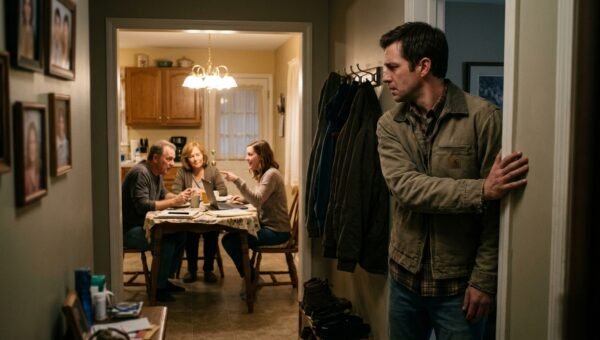
The last ordinary thing Karen asked me was which cabinet I liked better. She had two samples open on my kitchen table, and I remember thinking the one she favored looked too gray. “The other one,” I told her. “It’ll be easier to keep clean.”
Three years later, on my 65th birthday, I was sitting at that same table with one slice of cake on a plate. Nobody from Karen’s house had called. I had just started putting the cake away when someone knocked.
I’d spent three birthdays trying not to make too much of the silence. I sent cards anyway. I sent gifts for Maya and her brothers. I told myself they were busy, or that Karen needed time. That evening, my granddaughter stood at my door with a backpack and two grocery bags.
“Mom thinks I’m at a sleepover,” Maya said.
I stepped aside. She was fourteen, and she looked tired in the particular way kids look when they’ve been trying to be brave all day. One grocery bag had eggs in it. The carton clicked against a jar as she set it down.
“What happened?” I asked.
She didn’t answer right away. Instead, she pulled out a small metal bank with my name written on it. The letters were in my own handwriting, though I couldn’t remember ever writing on a bank.
“I found this in Mom’s closet,” she said. “Under the winter bedding. There was a loose board under the cedar lining.”
Then she swallowed.
“Grandma, Mom told us you stopped loving us. But these were there.”
I put my hand on the bank. It was cold from being carried outside. I didn’t open it yet.
Three years earlier, Karen had sat across from me with those cabinet samples, telling me how much she wanted the new kitchen. The remodel was $20,000. I had the money in retirement savings, but it was meant to keep me steady, not make somebody else’s kitchen look nicer.
“I can’t give you that,” I told her. “I’m living on a fixed income.”
She shut the cabinet samples. I remember the little tap they made against the table.
“So you’ve chosen money over family,” she said.
I tried to explain that loving her didn’t mean I could afford every thing she wanted.
I also got defensive. I told her she should’ve saved for the remodel before ordering samples. That was unkind, and I knew it as soon as I said it. But she’d already decided what my refusal meant.
After that, she stopped inviting me to the children’s birthdays. When I asked if I could still send something, she said, “There’s no point pretending we’re close.”
I mailed the cards anyway. I put a note in each one, and sometimes a small check or a savings bond. I won’t pretend I never hoped the money might soften things. I did. But I also wrote about Maya’s first day of school, the way she used to line up her stuffed animals, and the little crooked smile she got when she was trying not to laugh.
When the cards didn’t get a reply, I told myself the children might not care about cards anymore.
That was easier than thinking Karen had kept them from seeing me.
Maya sat down at my kitchen table. She’d brought flour, sugar, eggs, and a small bottle of vanilla. I could smell the sharp sweet scent when she opened the grocery bag.
“I wanted to make you a cake,” she said. “You shouldn’t have been alone on your birthday.”
I had to look down at the table for a second. Then I opened the bank.
Inside were three years of birthday cards, all still sealed. The postmarks were clear. My address was written on each envelope in my hand. Beneath them were savings bonds, checks, letters for birthdays and school milestones, and a few childhood photos I’d tucked in because I thought Maya might like seeing herself when she was little.
Maya reached for the top card. “Can we open them?”
I nodded.
We opened the first one slowly. I’d written about her ninth birthday and the cake she’d wanted with blue frosting. She read it twice.
“You remembered that?”
“Of course I did,” I said.
“I thought you just stopped calling.”
The next card had a picture of Maya at my house, wearing a paper crown and holding a plastic horse. I’d written that she’d spent the whole afternoon making up stories for it. She stared at the photo a long time.
“Mum said you didn’t want to see us,” she said. “She said you’d rather keep your money.”
I pressed my lips together. I wanted to tell Maya exactly what I thought of her mother. I wanted to say Karen had been mean and selfish and wrong. But Maya had come because she was trying to understand, not because she needed me to put her between us.
“I’m sorry you were told that,” I said. “You didn’t do anything to make me stop loving you.”
Maya looked at the unopened pile. “Why would Mom keep them?”
I didn’t know. Not then.
We opened more. There were checks and bonds tucked into some of the cards, all untouched. There were notes for the first day of middle school and for a school concert I hadn’t been told about. The details were ordinary. That was what hurt. I’d written about the things a grandmother writes down because she wants a child to know she noticed.
The old kitchen clock ticked over the sink. I remember the tiny scrape of Maya’s thumbnail on one envelope as she tried to lift the flap without tearing my handwriting.
“I found the bank today,” she said. “I was looking for luggage tags for a school trip. Mom keeps the old ones under the winter blankets.”
She had noticed a board shifting beneath the cedar lining in Karen’s master bedroom closet. She pried it up and found the bank tucked beneath the floorboards.
“Mom said you’d thrown everything away,” Maya said. “She said that when my brother asked about you, too.”
The words sat there between us. Karen hadn’t tossed the cards. She’d kept them hidden. She’d told the children I had thrown them away, while the sealed envelopes and the money inside stayed in her closet.
I asked Maya if Karen knew she’d left. She shook her head.
“I said I was sleeping at Leah’s. I couldn’t stay there after I saw all this.”
I felt glad she’d come to me, and scared about what would happen next. Both things were true. I didn’t want her taking a bus by herself again, and I didn’t want to send her back into the house without knowing she was safe.
“We’re going to let your mom know you’re here,” I said. “You can tell her yourself, or I can sit with you while you call.”
Maya held her phone. She didn’t call. A few minutes later, headlights swept across the front window. Karen was out of the car before I reached the door.
She came into the kitchen fast, then stopped when she saw the cards on the table. Her eyes went from Maya to me.
“What did you tell her?” she said.
“Nothing that wasn’t true,” I said.
Karen looked at Maya. “You were supposed to be at Leah’s.”
“I know.”
“You left without telling me.”
“I told you I was going to a sleepover.”
“That’s not the same thing.”
Maya’s hands were shaking, but she kept her voice level. “You said Grandma stopped loving us.”
Karen turned back to me. “You had no right to drag her into this.”
“I didn’t bring her here. She came to my door.”
“You could have called me.”
“I’m glad she came in,” I said. “I wasn’t going to turn her away.”
I slid the opened cards across the table. I didn’t throw them or wave them around. I just placed them where Karen could see the postmarks, the checks, the bonds, and the notes in my handwriting.
Karen’s mouth tightened. “I didn’t throw them out.”
“You told the kids I did,” I said.
She looked down at the cards. “I was angry.”
“Because I wouldn’t give you $20,000?”
“You made me feel like I was begging.”
I could see the shame under her anger. I knew the kitchen had become a big deal to her. She wanted it to look right, wanted the family to think everything was fine. I also knew a new kitchen wouldn’t have fixed whatever was already wrong. Still, I’d hurt her with my sharp words. I could admit that without pretending her choice was mine.
“I shouldn’t have spoken to you that way,” I said. “But I wasn’t going to risk my retirement money.”
Karen glanced at Maya. “I kept the checks because I thought maybe I’d need them. I couldn’t throw the letters away.”
There it was. She’d kept the money as a bitter backup, or because she couldn’t bring herself to destroy what I’d written. Maybe it was both. She’d still hidden all of it and told her children I’d discarded them.
“You don’t get to make Maya carry our money argument,” I said.
Karen shook her head. “You’re making me out to be a monster.”
“No. I’m telling you what happened.”
Maya looked straight at her mother. “You said Grandma didn’t care. You knew she sent these.”
Karen didn’t answer.
That silence hurt more than her first accusation had. Maya was her child. I didn’t want to make her choose between us, but Karen had already put her in the middle and called it the truth.
I moved closer to Maya. “You can love your mom and still know what she did was wrong.”
Karen’s eyes filled, but she didn’t apologize. She said Maya needed to come home. I told her she could take Maya home when Maya was ready, and that I’d be part of the conversation. I also told her there would be no more hiding cards, no more telling the children I’d stopped loving them, and no more using my money as the price of a relationship.
“You can be angry with me,” I said. “You can’t use her to punish me.”
Karen stayed for another minute, then left without the cards. I didn’t follow her outside. Maya stayed with me that night, and I told Karen by text that Maya was safe and that we’d talk in the morning.
The next day, we did. Karen and I didn’t fix three years in one talk. She didn’t suddenly become the daughter I missed, and I didn’t pretend the lie was small. But she agreed Maya could contact me directly. I set up a phone line Maya could use without asking her mother to pass messages, and I opened a savings account for Maya that Karen couldn’t withdraw from or control.
There are still things I wish I’d said differently. I could have been less sharp when Karen first asked for help. Maybe that’s the part I’ll keep working on. But I wasn’t going to apologize for keeping enough money to live on, or for telling Maya the truth about my love for her.
In the morning, Maya and I made the cake with the groceries she’d carried across town. The top came out lopsided. She laughed when I tried to fix it with a butter knife, and that laugh sounded a little like the girl who used to make up stories for her plastic horse.
We set one candle in the middle. Beside the cake, I stacked the opened cards and letters neatly, their envelopes no longer sealed. Morning sun reached the kitchen counter before we’d finished singing.