PART 1
I spent ten years saving every single dollar I could scrape together to buy my first home. Ten years of picking up double shifts at the hospital billing office, driving a beat-up sedan with peeling clear coat, cutting my own hair, and turning down every weekend trip my friends invited me on. When you grow up in a family where money is always an emergency and always someone else’s fault, you learn early on that having your own foundation is the only way you survive.
Two weeks ago, I finally closed on a modest three-bedroom ranch out in the county. It was built in the late seventies, needed new carpets, and the kitchen counters were old laminate, but every square inch belonged to me. The title was in my name alone. I had paid my twenty percent down from money I earned through pure grit, without a dime of help from anyone.
When I drove over to my mother’s house to share the news, I thought she might finally show a flicker of respect. I was thirty-three years old, completely independent, and I had accomplished something nobody else in our family had ever pulled off.
Instead, the moment the words left my mouth, her face twisted into pure venom.
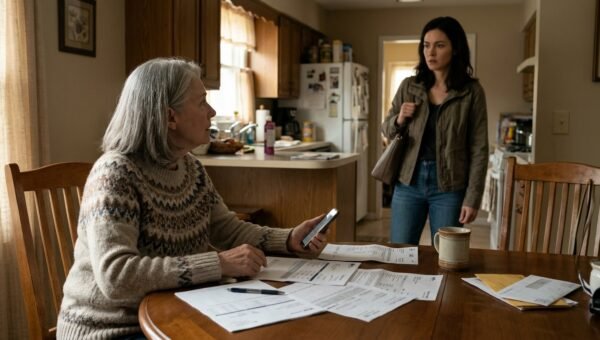
My sister Chloe was sitting at the kitchen table, scrolling through bridal magazines. Chloe had been engaged to a guy who could barely hold down a warehouse job for three years, and our mother had decided Chloe’s wedding needed to be a thirty-thousand-dollar country club extravaganza.
“You bought a house?” my mother said. Her voice went dead cold. “With what money, Nora?”
“With my savings,” I told her, setting my purse on the counter. “Ten years of savings.”
My mother stood up so fast her dining chair screeched against the linoleum. Before I could process what was happening, her hand shot out and clamped into the roots of my hair at the crown of my head. She jerked my head back with a violence that made my neck snap and brought tears to my eyes instantly. Chloe gasped, but she did not move an inch from her chair.
With her other hand, my mother pulled a yellow Bic lighter from the pocket of her house cardigan. She flicked the wheel. The small orange flame flared two inches from my cheek. I could smell the butane, followed by the terrifying heat radiant against my skin.
“You are not even married,” she spat directly into my face, spraying spit across my forehead. “You have no business owning property by yourself.
That money was for your sister’s wedding. We talked about this. You knew she needed a venue and a caterer, and you stole her future to buy yourself a monument to your own selfishness.”
“Let go of me!” I screamed, slamming my hands into her wrists. The pain in my scalp was blinding. “It is my money! I earned every cent! Get that away from me!”
I shoved her back hard enough to break her grip. A clump of my hair stayed tangled between her fingers. She stumbled against the stove, clicking the lighter shut, her chest heaving like an animal. Chloe just sat there, staring wide-eyed, not saying a single word to stop her.
“Get out of my house,” my mother hissed. “You owe this family seventy-five thousand dollars. If you think you’re going to sleep soundly in that place while your sister goes without, you have another thing coming.”
I ran to my car, shaking so violently I dropped my keys twice on the gravel driveway. My head throbbed where she had ripped the hair out, and my cheek felt raw from the proximity of the open flame. I locked the car doors, drove straight to my new home, and spent my first night sleeping on an air mattress in the middle of an empty living room with a baseball bat beside me.
For four days, there was dead silence. No calls, no texts. I foolishly believed the shock of what she did had made her back off. I spent those four days scrubbing baseboards, painting the hallway, and trying to convince myself I was safe behind my own deadbolts.
Then came Saturday afternoon.
A sharp, authoritative pounding hammered against my front door. When I looked through the peephole, two county sheriff’s deputies were standing on my porch, their cruisers parked out on the street with the flashers running.
When I cracked the door open, the older deputy looked at a clipboard, then up at me.
“Nora Vance?” he asked. “We received a direct complaint regarding elder exploitation, grand larceny, and the unauthorized transfer of family estate funds. Step outside, please. We need to talk to you right now.”
Looking at the squad cars parked outside the house I had bled for ten years to buy, I felt my stomach drop straight through the floorboards. I knew the worst was only just beginning.
PART 2
The deputies did not cuff me, but they did not treat me like a bystander either. The older officer, Deputy Miller, stood on my porch while his partner stayed near the steps, hand resting casually near his duty belt.
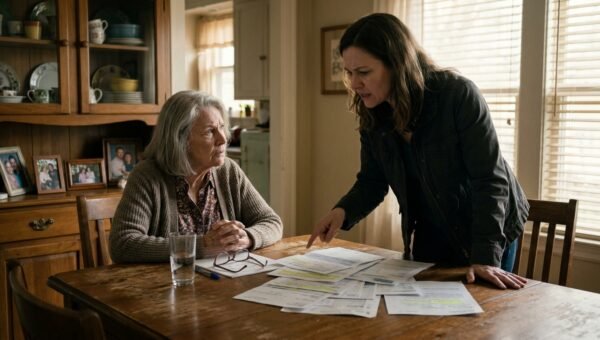
“Your mother, Evelyn Vance, came into the station this morning accompanied by your sister,” Deputy Miller said, looking over his notepad. “She filed an official report alleging that over the past six years, you systematically drained sixty-four thousand dollars from a joint family emergency account set aside from your late father’s life insurance. She claims you used those stolen funds to make the down payment on this property.”
A cold numbness washed over my arms. My father had passed away eight years ago. There was no life insurance. He died with twelve thousand dollars in medical debt and a second mortgage that my mother barely managed to refinance.
“Officer, that is a complete lie,” I said, keeping my voice as steady as humanly possible. “There was no joint account. There was no life insurance payout. I work as a senior medical billing coordinator at St. Jude Regional. I bought this house through a standard conventional loan through First Valley Bank using ten years of my own payroll savings.”
“She brought in bank statements showing transfers into an account bearing your name,” Deputy Miller replied, his eyes narrowing slightly. “She claims you had power of attorney over her personal finances and abused it.”
That was when the trap became clear. Two years ago, when my mother had her gallbladder removed, she asked me to help set up her online portal to pay her electric and water bills. She had given me temporary administrative access to her checking account for exactly three weeks so I could make sure her mortgage did not lapse while she was in rehab. I never took a penny. In fact, I had transferred three thousand dollars of my own money into her account during that period to cover her copays.
“I need you to look at my scalp right now,” I told the deputies, stepping into the porch light and parting my hair. The red, scabbed patch where my mother had ripped out my hair four days earlier was still glaringly inflamed. “Four days ago, my mother grabbed me by the hair and threatened to burn my face with a lighter because I refused to hand over my life savings to pay for my sister’s wedding. She threw me out. Now she is trying to use the sheriff’s department as leverage to extort me.”
Deputy Miller looked closely at my head, then glanced at his partner. His expression shifted from rigid suspicion to professional caution.
“Did you report that assault when it occurred, ma’am?”
“No,” I admitted, my voice catching. “I was terrified, and I thought if I just cut contact and stayed in my house, she would leave me alone. That was my mistake.”
“Well, right now there is an open criminal complaint for felony theft,” Miller said. “Because the dollar amount she cited is over ten thousand, the state’s financial crimes unit has to review it before any warrants are issued. Do not leave the county, and gather every piece of financial documentation you have. If this is what you say it is, you better be able to prove every dollar down to the cent.”
After they left, I did not cry. The fear burned out, replaced by a cold, calculating anger. My mother was not just angry that Chloe was not getting her dream wedding. She was trying to ruin my life, give me a felony record, and force me to sell my home to settle an imaginary debt.
I sat down at my laptop at four in the afternoon and did not get up until two in the morning.
I downloaded seven years of W-2 forms. I pulled every bi-weekly pay stub from St. Jude Regional showing my automatic direct deposits into my dedicated high-yield savings account. I printed out the complete closing disclosure from my title company, including the certified cashier’s check receipt, the loan approval letter, and the bank underwriting verification that traced the source of my funds back through thirty-six months of continuous personal deposits.
Then, I logged into my personal email and searched my mother’s name.
What I found made my blood run cold.
In November of the previous year, my mother had sent an email to Chloe with the subject line: *Nora’s House Fund.*
I had forgotten that my mother occasionally used an old shared family email address that forward-synced to my backup inbox. In the email thread, my mother wrote to Chloe:
*Nora told me she has almost eighty grand saved in her bank. She thinks she’s buying some place out in the valley. Don’t worry about the reception hall deposit or the open bar. Once she gets close to closing, I’ll make sure she covers it. She owes it to this family for leaving us to handle Dad’s debts alone. If she fights it, we’ll tell the family she took Dad’s funeral money.*
Chloe had replied: *Make sure she pays the photographer upfront too. The deposit is due in March.*
They had planned this for months. They did not just hope I would help. They believed my savings belonged to them by right, and my mother had manufactured a paper trail using fabricated transfer receipts to frame me if I dared to say no.
PART 3
On Monday morning, I did not wait for the sheriff’s department to call me.
I hired a local defense attorney named Marcus Vance—no relation, but a man with thirty years of experience handling fraud and probate disputes in our county. I handed him a three-inch binder containing my verified bank records, the closing documents, the hospital payroll records, high-resolution photographs of my scalp, and the printed email exchange between my mother and sister.
Marcus flipped through the pages for twenty minutes without speaking. When he finally looked up, his jaw was set tight.
“This is not just a family dispute,” Marcus said. “Your mother filed a signed, sworn affidavit with the sheriff’s office alleging grand larceny. That is filing a false police report, which is a misdemeanor, and attempted extortion involving a felony accusation. Furthermore, this physical assault on your scalp constitutes domestic battery with a weapon.”
“I don’t want a settlement,” I told him flatly. “I want her stopped. If I back down, she will keep doing this until I am broke or in jail.”
“She won’t get a chance,” Marcus said. “We go to the prosecutor’s office today.”
By noon, Marcus and I were sitting in a conference room with Detective Kowalski from the county financial crimes unit and Assistant District Attorney Reynolds. Marcus laid out the binder on the table, walking through the underwriting trail first. He showed that my down payment had sat in an FDIC-insured high-yield account accumulating interest from my direct hospital wages for nearly a decade.
Then Marcus produced the documents my mother had submitted to the deputies.
Detective Kowalski examined them under a desk lamp. My mother had taken old bank statements from her own checking account, used an online editing tool to alter the recipient name on several wire transfers to read my name, and printed them out on home paper. The routing numbers did not even match First Valley Bank’s institutional clearing codes.
“She forged bank records to support a sworn felony complaint,” Detective Kowalski muttered, shaking his head. “She handed fabricated financial instruments to law enforcement officers.”
“And here is the motive,” Marcus said, sliding the printed email thread across the table, along with the medical report from the urgent care clinic where I had my scalp examined that morning.
ADA Reynolds read the emails, looked at the photographs of my torn hair follicles, and leaned back in her chair.
“We are closing the investigation against you immediately, Ms. Vance,” Reynolds said. “And Detective Kowalski will be securing an arrest warrant for Evelyn Vance by three o’clock.”
I asked Marcus if we could serve a formal cease-and-desist and an emergency restraining order at the same time. Marcus smiled grimly. “Consider it done.”
That evening, I drove out to my mother’s neighborhood, parking half a block down the street. I wanted to see it with my own eyes. I needed to know the monster who had terrorized my childhood and tried to burn my face was finally out of power.
At five-fifteen, two patrol cars and an unmarked detective vehicle pulled into my mother’s driveway.
Chloe was the first to come out onto the porch, wearing a pink bridal sweatshirt. When she saw the deputies walk up with handcuffs, she started screaming, waving her arms, and pointing at the house. My mother emerged behind her, wearing her gardening gloves.
I could hear my mother’s voice carrying down the quiet suburban street, shrill and indignant.
“What is the meaning of this? Did you arrest her? Did you get my money back?”
Detective Kowalski did not argue with her. He pulled a folded warrant from his jacket pocket, unfolded it, and read it aloud. Then he took her by the arm, turned her around against the porch railing, and snapped the steel cuffs around her wrists.
My mother began to shriek, thrashing against the deputy’s grip. Chloe fell to her knees on the porch steps, sobbing into her hands. Neighbors were coming out onto their front lawns, watching the entire spectacle unfold in broad daylight.
As they led my mother down the walkway toward the squad car, she caught sight of my car parked down the road. She stopped dead in her tracks. Her face twisted into the exact same violent mask she had worn when she held the lighter to my cheek.
“You ungrateful little bitch!” she screamed at the top of her lungs, her voice cracking with fury. “You destroyed this family! You destroyed your sister! God will punish you for this!”
Deputy Kowalski pushed her firmly into the back seat of the cruiser and slammed the door shut, cutting off her voice behind the reinforced glass.
ENDING
My mother spent four nights in the county jail before Chloe managed to scrape together enough cash from her fiancé’s relatives to post her five-thousand-dollar bond.
She was officially charged with filing a false police report, making terroristic threats, and misdemeanor battery. Because she had no prior criminal record, her public defender negotiated a plea deal to avoid prison time. She was sentenced to two years of supervised probation, two hundred hours of community service, mandatory anger management counseling, and a formal five-year protective order that prohibits her from coming within five hundred feet of me, my workplace, or my home.
Chloe’s fiancé broke off the engagement three weeks after the arrest.
He found out that Chloe had known about the forged bank statements and had actively participated in the plan to shake me down for their wedding expenses. He moved out of their shared apartment, canceled the venue bookings, and told mutual friends he refused to marry into a family that tried to put their own daughter in prison over banquet hall fees. Chloe had to move back into our mother’s house, working double shifts at a dry cleaner to pay off the attorney fees and credit card bills she had accumulated.
A few family members tried reaching out to me in the months that followed. A couple of aunts called to tell me that “family should handle things privately” and that having my own mother arrested was a disgrace.
I did not argue with them. I simply forwarded them the police report, the forged bank slips, the photograph of my scalp, and the emails where my mother and sister planned to rob me. Then I blocked their numbers without another word.
Now, six months later, my house finally feels like home.
I replaced the old carpets with solid oak flooring that I installed myself over three weekends. The walls in the living room are painted a warm, soft sage, and my backyard is filled with raised garden beds where tomato plants and herbs are thriving in the afternoon sun.
Every morning, I sit on my back porch with a cup of black coffee before I get ready for work. There are no sudden screams echoing down the hall. There are no demands for cash, no threats, and no lighters held inches from my face.
Every single nail in this house was paid for with my own sweat, my own sacrifices, and my own quiet patience. My mother tried to tell me that I had no right to own anything of my own because I was alone. But as I sit here on my porch, listening to the wind move through the pines, I know the truth: I am not alone. I am finally free.