PART 1
The envelope arrived on a Tuesday in the middle of April. It was thick, cream-colored paper with the return address from a high school forty miles north in Shelby County. Inside was a printed announcement for my grandson Luke’s graduation on May 22nd.
Luke was eighteen. I had seen him maybe six times in his entire life, mostly at Thanksgiving dinners where everyone kept their coats on a little too long and spoke in the careful voices people use around sick relatives.
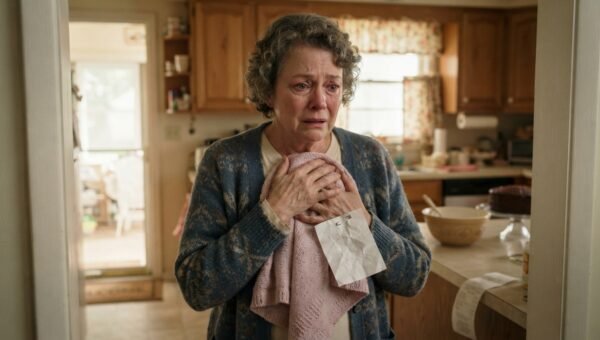
My wife Brenda stood at the kitchen island, drying a coffee cup with a yellow dishtowel. She looked at the front of the envelope before I could even set down the rest of the mail.
“The school printed the card,” Brenda said, pointing with the corner of the towel. “Look at the front. The name and the street were done with a ballpoint pen. That’s David’s scrawl.”
She knew his handwriting as well as I did, even after three decades. David wrote with a left-handed slant that hooked toward the top of the paper, heavy on the downstroke. He had written that way when he was fourteen, when he still lived under our roof and slammed his bedroom door hard enough to rattle the framed pictures in the hallway.
I opened the flap. The printed invitation slid out, stiff and formal, along with a small slip of lined paper torn from a pocket notebook.
There were four words written on it in blue ink:
Come alone this time.
Brenda leaned over my shoulder to read it. Her mouth pulled tight at the corners. She set the coffee cup down on the granite counter with a sharp rap.
“Well,” Brenda said. “That tells you everything you need to know. Thirty years later and he’s still carrying that torch. He wants you to disrespect our marriage.”
“He’s asking his father to see his grandson graduate,” I said. My voice sounded thin to my own ears.
“He’s giving you an ultimatum,” she said. “He’s telling you that after everything we built, after thirty years of me keeping this home together, I’m not good enough to sit in a folding chair for two hours. If you go up there without me, Frank, you’re telling him he was right.”
She walked into the pantry and shut the door behind her.
I stood by the counter and looked at that torn slip of paper.
In the fall of 1995, David was fourteen. His mother, Sarah, had died of breast cancer two years before that.
Brenda and I had been married for eight months. The house was small, an eleven-hundred-square-foot ranch with thin walls and hardwood floors that carried every footstep. David resented Brenda being there, and Brenda had no patience for a boy who refused to eat her dinners, refused to answer her questions, and left muddy boots by the front door.
They fought like cats. It was constant, grinding friction. Every evening when I pulled my truck into the driveway after ten hours on the road for the lumber yard, my stomach tightened before I even turned the key in the ignition.
One Saturday in October of 1995, Brenda came into the garage in tears. She told me David had cursed at her in the kitchen and said she wasn’t his mother and never would be. She told me she couldn’t take another day of it. She said it was either him or her, and that a growing boy needed a firmer hand than she could give him.
I didn’t argue with her. I didn’t sit David down to ask what happened. I was forty-two years old, worn down to the bone, and all I wanted was a quiet house.
I called Sarah’s parents, Arthur and Evelyn, who lived forty miles up the road on a five-acre farm outside Shelbyville. Arthur listened quietly over the static of the landline, then said, “Pack his clothes, Frank. Bring him up Saturday morning.”
I told David it was for his own good. I told him his grandparents had more room, that the country air would help, that he could fish in the pond out back. I said it so many times during that forty-mile drive that I almost made myself believe it. When we pulled into Arthur’s gravel driveway, David got out of the truck, grabbed his two duffel bags from the bed, and walked up the porch steps without turning around.
I drove back home. The house was completely quiet. Brenda had made a roast, and we ate at the small kitchen table without anyone slamming a door or raising a voice. I told myself I had saved our marriage and given my boy a fresh start.
For thirty years, that quiet house was what I lived in. We did the obligatory holidays. Arthur and Evelyn raised David into a steady, hardworking man who ran an auto body shop and coached Little League. Whenever David and I spoke on the phone, the conversations were brief and polite, mostly about weather, oil changes, and football scores.
Now I was seventy-two years old, staring at four handwritten words.
I folded the lined scrap of paper, slid it into my wallet behind my driver’s license, and left the printed invitation on the kitchen counter.
PART 2
For the next four weeks, Brenda barely spoke to me.
She did her gardening, watched her morning programs, and folded laundry, but whenever she passed the counter where the graduation card lay, she looked at it like an unpaid bill someone had left on purpose.
“You haven’t sent the RSVP card back,” she said on a Sunday morning in early May, pouring skim milk into her cereal.
“There wasn’t an RSVP card,” I told her. “Just the ticket.”
“Then you aren’t going.”
“I am going, Brenda.”
She stopped with the spoon halfway to her bowl. Her eyes narrowed. “You’re going to let a forty-four-year-old man dictate terms to you? You’re going to let him insult your wife because he couldn’t get along with me when he was a teenager?”
“He’s my son,” I said. “And Luke is my grandson. If I don’t go to this, I will never get another chance.”
“If you walk out that door by yourself on the twenty-second,” she said, her voice dropping into that quiet, hard register she used whenever she meant business, “don’t expect me to be waiting around with dinner when you get back.”
Thirty years earlier, that threat would have worked. It would have made me fold my hands, look at the floor, and agree that family drama just wasn’t worth the headache. That was how I had lived my entire adult life, purchasing peace five minutes at a time by giving up whatever cost the least immediate pain.
On the morning of May 22nd, I got dressed in my good gray slacks and a blue button-down shirt. Brenda stayed in the bedroom with the door shut. I left my house keys on the hall table, took my truck keys, and walked out to the driveway.
The drive north on Highway 53 felt longer than forty miles. The old farm fields had turned into housing subdivisions and strip malls, but once I crossed the county line into Shelbyville, the road narrowed between limestone cuts and stands of cedar.
The graduation took place on the high school football field under a clear, warm sky. There were hundreds of parents and grandparents carrying cameras and bouquets of grocery-store flowers. I found a seat on the top bleacher near the thirty-yard line, away from the crowd.
When the senior class filed in wearing navy gowns, I scanned the rows until I spotted the name on the program: Luke Thomas Miller.
He looked just like David had at eighteen. Tall, broad-shouldered, with thick brown hair and his mother’s narrow jaw. When Luke walked across the raised wooden stage to take his diploma, I stood up and clapped until my palms stung.
Down in the third row of folding chairs on the grass, David stood with his phone raised to record his son. David’s hair was graying at the temples, and his shoulders filled out a dark suit coat that looked a little tight on him.
After the ceremony ended, the field dissolved into a sea of teenagers tossing caps and families taking group photographs. I walked down the metal bleacher steps and stood by the chain-link fence near the home-team dugout, keeping my hands in my pockets.
I didn’t want to crowd them. I told myself if he had friends and family to entertain, I would just wait until he had a spare minute, shake his hand, and leave.
David turned around while Luke was taking a picture with three other boys. David’s eyes moved past the crowd and stopped directly on me.
He didn’t look angry. He didn’t look surprised, either. He spoke to his wife, Karen, pointed toward the fence, and started walking through the grass.
He stopped three feet in front of me. Up close, I could see the fine lines around his eyes and a small scar on his chin from a bicycle wreck he had when he was eleven.
“You came alone,” David said.
“You asked me to,” I said.
David looked at me for a few seconds. The noise of the graduates shouting and laughing around us seemed very far away.
“Luke’s going to the local pizza place with his class,” David said. “Karen is taking the younger kids home to set up for a cookout tonight. Walk across the street with me to the diner. I have something in my truck I want to show you.”
PART 3
The diner was called the Kettle, an old brick place with vinyl booths that smelled of fried potatoes and coffee. We took a booth near the back window overlooking the parking lot.
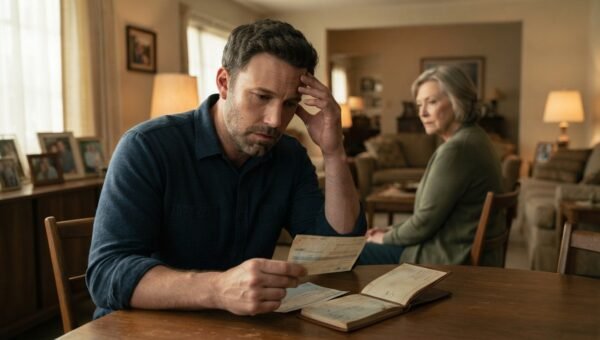
The waitress brought two mugs of black coffee without asking. David set a weathered manila expanding folder on the laminate table between us. The cardboard corners were soft and gray with age.
“When Grandpa Arthur died in 2021,” David said, keeping both hands flat on the table, “I had to clean out his study. He had an old oak filing cabinet in the corner by the gun rack. He kept everything. Tax returns going back to 1968, receipts for tractor parts, every piece of paper that ever came through that farmhouse.”
I took a sip of the coffee. It was too hot, but I held the mug just to keep my fingers busy. “Arthur was a careful man.”
“He was,” David said. “He had a whole folder labeled with my name. Inside it were forty-eight check stubs. Every single month, from November 1995 until the month I turned eighteen in 1999, you sent him a cashier’s check for $450.”
I looked down at the mug. “I couldn’t put you on our joint account. Brenda kept the books. But I had my overtime checks from the yard. I cashed them at the bank in town and bought the money orders. It was the least I could do for your food and clothes.”
“That came out to twenty-one thousand six hundred dollars,” David said. “I never knew you sent a dime. Grandpa never told me. Whenever I needed new work boots or money for football cleats, Grandpa just pulled cash out of his wallet and said, ‘Take care of your gear, Dave.’ He let me believe he was paying for all of it.”
“He didn’t want you to feel obligated to me,” I said. “And he was right. Money doesn’t fix putting you in a truck and leaving you on a porch.”
“That’s not why I asked you here,” David said.
He reached into the manila folder and pulled out a single sheet of pale yellow lined paper. It had been folded into thirds. The creases were dark and worn thin, like it had been opened and closed dozens of times.
He slid it across the table toward me.
“Grandpa had this clipped to the very first check stub from November 1995,” David said. “Read it.”
I unfolded the paper. The handwriting was unmistakable. It was Brenda’s small, rounded cursive, written with a black felt-tip pen.
The letter was addressed to Arthur.
Arthur,
Enclosed is Frank’s first payment. Please make sure David understands that he is not to call this house asking to come back on weekends. Frank is working fifty hours a week and finally getting a full night of rest. Our marriage will not survive David coming back and forth every Friday night. If David asks about coming home for the holidays, tell him Frank thinks it is best for him to remain in Shelbyville until he finishes school. Frank agreed that this is the cleanest way for everyone to move on.
Brenda
The air in the booth felt very thin. I stared at the sentences.
I remembered November of 1995. I remembered coming home from work on Friday nights and sitting by the telephone in the kitchen, wondering why the boy never called. I had asked Brenda twice if David had phoned while I was at the yard. Both times, she looked at me with soft sympathy and said, “Frank, you know how teenagers are. He’s with his grandparents on a farm. He’s got his cousins. He’s moving on. Don’t force yourself on him if he needs space.”
I had believed her. I had believed her because believing her meant I didn’t have to get in my truck, drive forty miles, and face my boy.
“Grandpa never showed me this while he was alive,” David said, his voice flat and controlled. “He didn’t show it to me because he knew I would have done something stupid. When I found it in his desk four years ago, I almost drove down to your house that night. But Karen told me to sit on it. She said an angry man never gets the truth.”
David leaned forward, looking straight into my eyes.
“Did you tell her to write this, Dad?” he asked. “Did you tell her you didn’t want me calling?”
ENDING
The question hung in the space between our coffee mugs.
It would have been very easy to blame Brenda entirely. It would have been easy to tell David that she had gone behind my back, that she had poisoned the well, that she was the villain who stole thirty years of our lives with a felt-tip pen and a postage stamp.
Part of that was true. But the bigger truth was uglier, and it belonged to me.
“No,” I said. “I didn’t tell her to write it. I never saw that letter until this exact second.”
David let out a slow breath, but I didn’t let him take comfort in it.
“Don’t let me off the hook, Dave,” I told him. “I didn’t write it, but I let it happen. I came home every Friday night and saw that silent phone. I knew in my gut that something was wrong. But I was tired, and I was weak, and I liked having a quiet house more than I liked fighting for my own son. She built that wall, but I paid for the bricks, and I hid behind them for thirty years.”
David looked down at the table. His knuckles were pale where his hands rested against the laminate. For a long time, the only sound was the clatter of silverware from the kitchen and the bell above the diner door as customers came and went.
Then David picked up the yellow paper, folded it along the old creases, and slid it back into the manila folder.
“Thank you for not lying to me,” David said.
He didn’t hug me. He didn’t say everything was fine. Thirty years of absence doesn’t wash away over two cups of five-dollar coffee.
“Karen’s making a pork loin,” David said, sliding out of the booth. “Luke’s going to be home from the pizza place around five. We’ve got iced tea on the back porch. You can come over if you want to.”
I reached into my pocket, laid a twenty-dollar bill on the table for the coffee, and followed my son out into the Shelbyville sun.
I stayed at David’s house until nearly eight o’clock. I sat in a wooden chair on the back deck while Luke showed me the engine of the 1998 Chevy pickup he had rebuilt himself. I listened to David talk about the supply chain problems at his body shop, and I ate a slice of cherry pie off a paper plate balanced on my knee. Nobody shouted. Nobody walked on eggshells. It wasn’t perfect, but it was real, and it was thirty years late.
It was dark when I pulled into my driveway at nine-thirty.
The front porch light was off. Inside, the house was completely dark and silent, exactly as it had been every evening since the fall of 1995.
I opened the front door. Brenda was sitting on the living room sofa in the dim light coming from the television, which was muted. She had her arms crossed over her chest.
She didn’t get up. She looked at me from the shadows.
“You stayed a long time,” Brenda said, her voice sharp and tight in the quiet room. “I suppose you think you proved something today.”
I looked around the immaculate, quiet living room. The pictures on the wall were straight. The carpet was vacuumed. Nothing was out of place. It was the peaceful house I had traded my flesh and blood to keep.
I took the envelope out of my jacket pocket and set it squarely in the center of the coffee table between us, right under the lamp.
“I proved I have a grandson,” I said.
My voice was not loud, but it filled the room from corner to corner.
“And next Sunday,” I told her, “I’m going back up there to see him again.”
I didn’t wait for her to answer. I walked into the kitchen, turned on the overhead light, and poured myself a glass of water.