PART 1
My husband began withdrawing $40 every morning before work. I noticed the pattern on our joint statement during the second week of October. It was always the drive-up machine behind the grocery store on 4th Street, always between 6:35 and 6:45 in the morning, and always the exact same amount.
I had a reason for not reacting right away. It was small enough that I almost ignored it.
Forty dollars does not sound like an emergency. You tell yourself a man might be buying breakfast sandwiches, gas for the lawnmower, or scratch tickets he feels embarrassed about. We had been married thirty-one years. When you have lived with someone that long, you try not to hover over every little habit.
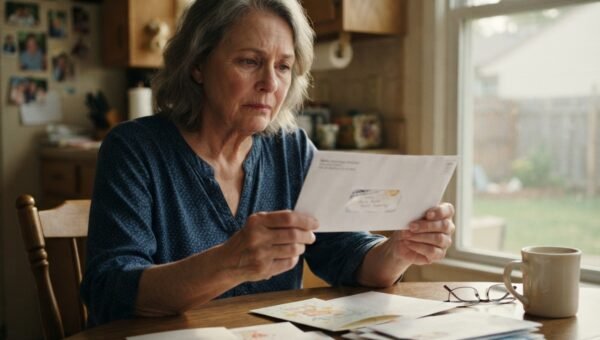
Then came the morning I went to hang up his heavy canvas work jacket. I reached into the right pocket to pull out his leather gloves, and my fingers hit a thick stack of paper. It was held together with a faded blue rubber band.
I counted them at the kitchen counter while the coffee brewed. There were thirty-two ATM slips. Every single slip was for $40. Some had dates from three weeks back, some were from earlier that week, and three were from the month before. Thirty-two slips meant $1,280 in cash had left our checking account without a single receipt from a store to match it.
When Dan came down the stairs tying his work boots, I laid the stack beside his keys. I didn’t shout. I just asked him what was going on.
He looked down at the slips, then picked up his lunchbox. He did not look me in the eye.
“I’m helping somebody. Leave it alone,” he said.
Before I could ask who, he grabbed his keys and the back door clicked shut. His truck engine started up, and he drove off into the gray morning.
I wish I had asked one more question right then. Instead, I let his words sit in my chest like gravel for two whole days. Helping somebody usually meant lending a floor jack to our neighbor Carl or buying a bag of fertilizer for his brother. It did not mean thirty-two separate stops at dawn. It did not mean secrets kept from the woman who balanced the checkbook.
On Thursday morning, I set my alarm for five-thirty. I did not turn on the kitchen lights. I dressed in dark pants and my woolen car coat, slipped out through the front door, and drove my sedan two blocks past the 4th Street grocery store.
I parked by the laundromat directly across from the bank machine. The headlights were off. My wipers cleared the morning mist every couple of minutes so I could see through the windshield. At 6:38, Dan’s white pickup pulled into the gravel lane behind the grocery store.
I watched him reach out the window, punch his pin, and wait for the green light to spit out the bills. He took the cash, tucked the fresh slip into his shirt pocket, and then pulled his truck over by the dumpster instead of pulling out onto the main road.
He put his hazards on. He was waiting.
A woman walked out from behind the bus shelter near the avenue.
She wore a coat that was far too large for her, the hem dragging wet against her boots, and she was carrying a dark blue baby carrier I had never seen in my life.
I leaned forward against the steering wheel. I was still trying to process the idea of another woman, another life, or some mistake from his past.
Then the woman stepped under the amber streetlight.
It was my daughter, Megan. We had not spoken in eight months.
PART 2
The breath caught in my throat. I sat in my car watching my own child hand my husband the handle of a plastic grocery bag while he handed her the two crisp twenty-dollar bills.
Dan leaned over the baby carrier. He touched the edge of the blanket with one thick finger. Then he took a carton of milk and a loaf of bread from his passenger seat, handed them through the window, and gave Megan a quick squeeze on the shoulder.
She turned around and walked back toward the bus shelter before his truck even pulled out.
I did not follow Dan to his job site. I shifted my car into drive, turned across the road, and pulled right up to the curb by the bus shelter.
When Megan heard the car door slam, she pulled the hood of her jacket forward like she was ready to run. Then she saw my face.
She stopped cold on the wet concrete. Her face was thinner than I remembered, her eyes ringed with purple shadows that went deep into her cheekbones. The baby carrier sat on the bench beside her, covered in a soft yellow flannel blanket.
“Mom,” she said. Her voice was cracked and small.
“What are you doing here?” I asked. My hands were shaking inside my coat pockets. “Megan, where have you been living? Whose baby is that?”
She stepped back, putting her body between me and the bench. “Dan said you wouldn’t come out here. He promised me he wouldn’t tell you.”
“Your father has thirty-two bank receipts in his coat pocket,” I told her. “I thought he was losing his mind or throwing our savings away. And now I find you standing at a bus stop in the cold at seven in the morning.”
A tear tracked down through the dust on her cheek. “I told him to leave me alone, but he saw me at the food bank by the train tracks last month. He wouldn’t let it go.”
“Why didn’t you call me?”
She looked down at her shoes. One of the seams on the left boot was held together with electrical tape.
“Because of what you said on my birthday,” she whispered.
The words hit me right between the ribs. Eight months ago, Megan had called me from a gas station outside of town. She was crying about Tyler, the man she had moved three hours away to live with. Tyler had emptied her paycheck again, screamed at her, and put a dent in her kitchen wall.
Instead of listening, I had lost my temper. I had told her that she picked men who ruined her life, that I was tired of bailing her out of bad choices, and that if she went back to him again, she had made her bed and shouldn’t come running to me to pay for her mistakes.
She had hung up. That was the last time I heard her voice.
“I didn’t know I was pregnant when I left him,” Megan said, pulling the blanket slightly back from the carrier. “I didn’t have anywhere to go. Tyler took my name off the lease, and then the collection agency froze my debit card because of his credit card debt. If Dan transferred money to an account, the bank would take every penny for Tyler’s overdue loans. Dan had to give me cash every morning so Tyler’s creditors couldn’t touch it, and so I could buy formula.”
Inside the carrier, a tiny boy with a patch of dark hair yawned against the flannel.
“His name is Samuel,” Megan said. “He is six weeks old.”
PART 3
We stood on that cold sidewalk while two city buses went by, throwing gray spray against the curb.
I looked at the baby. His cheeks were round and pink, fast asleep despite the diesel engines rumbling five feet away. Megan was trembling all over. She had a bag from the thrift store stuffed with cloth diapers and a single tin of powdered milk.
“Where are you staying?” I asked.
“Above the dry cleaner on Maple,” she said. “A lady rents the room in the back by the week. It’s thirty dollars a day. That’s why your father brought forty. Thirty for the room, ten for food and formula.”
Thirty-two days. Dan had been paying for her roof, her food, and her survival one twenty-dollar bill at a time, keeping it off the bank statements so Tyler’s legal notices wouldn’t find her, and keeping it away from me because he knew what I had said to her.
Dan wasn’t covering up an affair. He was shielding our daughter from my tongue while trying to keep her from sleeping in an alley.
“Pick up the carrier,” I said.
Megan shrank back. “Mom, please. I don’t need a lecture. I’m doing the best I can. I have an interview at the laundry on Monday.”
“I am not giving you a lecture,” I said. I had to swallow twice before my voice worked properly. “Pick up Samuel, Megan. You are getting in the car.”
She hesitated, her hands gripping the plastic handle. I did not wait for her to argue. I stepped forward, lifted the heavy carrier with both hands, and opened my back door. I strapped the base into the back seat using the seatbelt, making sure the buckle clicked loud and clear.
Megan stood on the pavement watching me.
“Get in the passenger side,” I told her. “The heat is on.”
She got in. She sat stiffly with her knees pressed together, staring at the dashboard like she expected me to pull over and drop her off at the next light.
I didn’t drive to Maple Street. I drove straight back to our house.
When we walked into the kitchen, the thirty-two slips were still sitting on the counter by Dan’s coffee mug. I led Megan up the stairs to her old bedroom. The bed was made with the quilted spread she had picked out in high school.
“Take a shower,” I told her. “There are clean towels in the hall closet. I will keep Samuel down here.”
She started to cry then, the kind of hard, ugly crying that comes when someone has carried a heavy weight alone for too long. She didn’t say thank you. She just went into the bathroom and closed the door.
At five that afternoon, Dan’s truck pulled into the driveway. He walked into the kitchen with his shoulders rounded, bracing himself for another round of questions about the checkbook.
He stopped at the kitchen doorway.
The table was set for three. Samuel was asleep in the wooden bassinet we had brought down from the attic, wrapped in an old flannel receiving blanket.
Dan looked from the bassinet to me. His face went tight with worry.
“Margaret,” he started.
“Sit down, Dan,” I said.
I took the rubber band off the thirty-two ATM slips, laid them in a neat row across the table, and put his coffee cup down beside them.
“You should have told me,” I said quietly.
“She begged me not to,” Dan said, his voice thick. “She thought you’d tell her it was her own fault. She thought you’d make her feel like dirt.”
I looked at the floor. He was telling the truth. If he had come to me five weeks ago saying Megan was pregnant and broke, my first reaction would have been anger. I would have asked why she didn’t listen. I would have complained about the money before I bought the milk.
“I know what I said to her,” I told him. “And you were wrong to keep it secret, Dan. But you were right to feed her.”
ENDING
The next morning, Dan’s alarm went off at 5:45 as usual.
I was already awake, sitting at the kitchen table in the gray light. Samuel had woken up at four for a bottle, and Megan was upstairs finally getting three straight hours of sleep without having to listen for landlord footsteps or street traffic.
Dan came into the kitchen with his boots laced, reaching into his pocket for his wallet.
“Don’t go by the grocery store this morning,” I said.
He stopped with his hand near his hip.
“I called the legal aid office in town yesterday afternoon,” I told him. “They have an appointment for Megan at ten o’clock. We are going to close out the joint liabilities with Tyler, change her legal address, and get her filed for state child support. And I moved three thousand dollars from our emergency savings into a new account under my name for her and the boy.”
Dan stood there for a long moment. He looked at the empty spot on the counter where his stack of ATM receipts had lived for the past month.
“You don’t have to pull out forty dollars every morning like a thief, Dan,” I added, pouring him a cup of coffee. “If our grandson needs milk, we buy the milk from the front door.”
Dan didn’t say anything back. He just walked over to the bassinet, pulled the blanket up over Samuel’s shoulder, and sat down at the table across from me to drink his coffee.
For the first time in thirty-two days, his truck stayed parked in the driveway until seven.