PART 1
My father told me he had forgotten my birthday for the fifth year in a row.
He didn’t sound particularly guilty about it when he called around noon on a Tuesday. He just sighed into the phone, gave that short, dry chuckle he always used when he wanted to brush off a mistake, and said, “I’m just bad with dates, kid. You know how my head is lately.”
I didn’t raise my voice. I’d learned a long time ago that arguing too early only gives people time to change their story. I just kept my hand flat against the kitchen counter, looked out at my overgrown backyard, and told him it was fine. I told him work was busy anyway and that we could grab lunch next month when he came down toward the county seat.
I pretended it didn’t bother me. I kept pretending right up until the delivery truck stopped across the gravel driveway the very next afternoon.
I was out on the porch bringing in two empty plastic planters when the driver set a small, heavy cardboard box down on the top step. My father moved into an assisted living apartment forty minutes north two years ago, but he still used my street address for his credit cards and his old catalog orders because he refused to update his paperwork.
Packages showed up at my house for him every few months: orthopedic socks, hard candies, replacement batteries for his hearing aid.
This package wasn’t like that. It was taped tight with security bands from a high-end jeweler in Richmond, and the label bore my home address, but the recipient name wasn’t mine and it wasn’t his.
It was addressed to “Little Sparrow.”
My chest tightened instantly. Nobody had spoken that name aloud in our family in thirty-four years.
That was what my father called my mother before she walked out the summer I turned twelve. She had packed two vinyl suitcases, taken the family station wagon, and vanished down Route 17 without leaving a forwarding address or a note on the fridge. For three decades, my father had maintained the exact same story to anyone who asked: she abandoned us, broke his heart, cut all ties, and left him to raise a young girl on a machinist’s salary with no support.
If her name ever came up during holidays, he shut the room down. He would get up from the table, tap his knuckles on the wood, and say, “We don’t dig up people who threw us away.”
I carried the box inside, set it on the kitchen table next to my cold cup of coffee, and stared at it.
I’m not proud of how long I waited. I stood there for twenty minutes, listening to the refrigerator hum, scared that whatever was inside would hurt far more than thirty-four years of wondering. But my father had just looked me in the eye over the phone twenty-four hours earlier to claim he couldn’t remember the day his only child was born.
I took a paring knife from the butcher block and slit the tape.
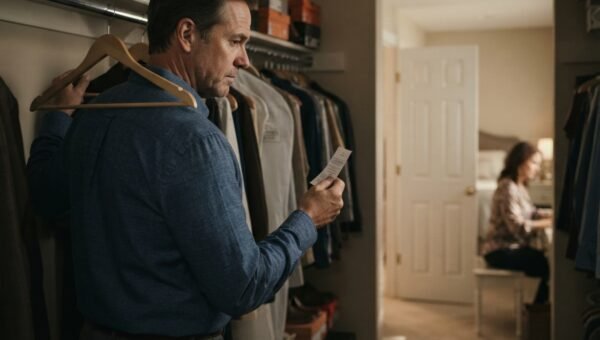
Beneath the bubble wrap sat a dark blue velvet case. Tucked inside the packing slip sleeve was an itemized store receipt for a women’s gold-link wristwatch with a mother-of-pearl face.
The total at the bottom was exactly $1,200, charged to his debit card on Friday afternoon, four days before my birthday.
And tucked into the hinge of the velvet box was a handwritten card in his familiar, shaky slant.
“Forty-six years ago today, Little Sparrow. You’re always right on time. All my love, Arthur.”
My forty-sixth birthday had been yesterday.
PART 2
I stopped arguing with myself and checked the paperwork line by line.
The billing address was my home. The credit card used was the joint checking account my father had opened with me five years ago when his eyesight started slipping, an account I rarely looked at because he insisted on handling his own small pension checks. The shipping note indicated the package was intended for local courier pickup, but because he had left my street address as the default delivery profile on his web order, the automated system had routed it straight to my front porch.
He hadn’t forgotten my birthday. He had bought a $1,200 watch on the Friday before it, using the money he repeatedly told me he didn’t have for his dental work.
And forty-six years ago on that date wasn’t an anniversary. It was the exact day I was born.
I didn’t call him right away. I sat down at my laptop and logged into the bank portal. I hadn’t checked the transaction history in nearly nine months. What I found made my hands shake against the keyboard.
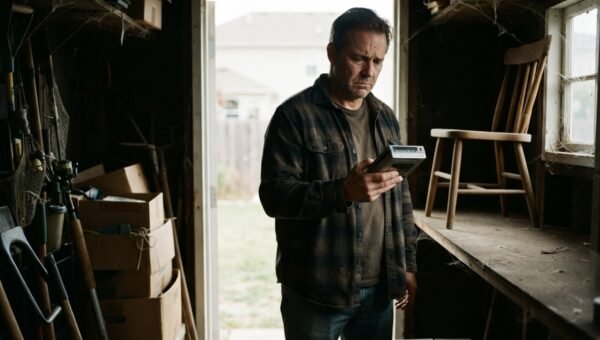
Every single month on the third, a scheduled transfer of $450 left the account. The recipient name was masked on the summary screen as an external credit union transfer, but the notation attached to each line was the same: “Personal care.” It went back through the digital records as far as the bank allowed me to scroll. Three years of steady payments.
I printed out the statements, folded them into my coat pocket, put the blue velvet box inside my purse, and walked out to my car.
The drive up Route 29 felt endlessly long. The trees along the highway were just starting to turn dull brown, and the air coming through the vents smelled like dust and damp pavement. All my life, I had shaped my personality around being the sensible daughter who never asked for too much. When my mother left, I learned how to cook scrambled eggs at twelve so he wouldn’t come home from the machine shop to a dark kitchen. When he forgot graduations or birthdays, I told myself his grief had simply hollowed out that part of his brain. I had spent four decades excusing his neglect because I thought we were comrades in an old, shared tragedy.
When I reached Cedar Creek Assisted Living, the receptionist waved me through. I walked down the carpeted hallway to apartment 114 and found him sitting in his armchair by the window, watching a muted afternoon game show. His reading glasses were propped on his forehead.
“Well, look at you,” he said, turning his head slowly. “I told you we’d get lunch next month, kid. You didn’t have to drive up here in the middle of the week.”
I didn’t sit down on the small sofa. I walked over to his side table, reached into my purse, and placed the blue velvet jeweler’s box directly next to his water glass. Then I set the $1,200 receipt on top of it.
His face changed immediately. He didn’t blink. He looked at the receipt, then slowly reached up and pulled his glasses down over his nose.
“Where did you get that?” he asked. His voice wasn’t weak anymore. It was tight and guarded.
“It came to my house yesterday,” I said. “The courier delivered it because you never changed your default shipping address. Who is Little Sparrow, Dad?”
PART 3
My father didn’t answer right away. He reached out with a hand that had worked metal lathes for forty years, took the receipt, and smoothed the creases with his thumb.
“You shouldn’t have opened mail that wasn’t addressed to you,” he said quietly.
“It had my address on it,” I said, keeping my voice down even though my throat felt raw. “You told me yesterday you forgot I was born. You’ve told me that five years in a row. But on Friday you paid $1,200 for a watch, and you wrote a card saying ‘Forty-six years ago today.’ That is my age. That is my birth date. Tell me who you sent this to.”
He looked toward the window, watching the rain start to streak against the glass. The defensive edge in his posture began to crumble, replaced by a dull, exhausted resignation.
“Your mother didn’t walk out because she didn’t want you,” he said. The words came out flat, without any dramatic rise or fall. “She walked out because she was sick. She had early-onset dementia. It started when she was thirty-eight, but back in the late eighties nobody called it that. They called it nervous breakdowns. They called it unstable.”
The room seemed to shrink. I stared at him, unable to bridge the gap between the cruel ghost I had grown up hating and the sentence he had just spoken.
“You told me she left us for someone else,” I whispered.
“I told you that because I was a coward,” he said. He didn’t look at me; he looked at his own shoes. “By the time you were twelve, she was wandering down to the highway at two in the morning. She left the gas stove on twice. She looked at you one morning and asked me whose pretty little girl was sitting at our table. I couldn’t afford a private facility on what the shop paid me, and her sister in Maryland offered to take her into a specialized home near Baltimore if I signed over guardianship and agreed to stay away so she wouldn’t get agitated.”
“You stayed away?”
“I stayed away for six years until she passed,” he said. His voice cracked slightly on the last word. “She died when you were eighteen, during your freshman year of college. You were finally happy. You were finally building a life that didn’t smell like machine oil and sadness. I couldn’t bring myself to tell you that your mother died in a state ward thinking she was twenty-one years old.”
“Then who is this watch for?” I asked, pointing directly at the blue velvet box. “Who have you been sending four hundred and fifty dollars a month to?”
My father closed his eyes.
“Her sister,” he said. “Your Aunt Evelyn. She’s eighty-two now, living in a nursing cottage outside Frederick. She took care of all the burial expenses back then. She kept every scrap of your mother’s things in her attic for thirty years because I told her I didn’t want them in the house. Three years ago, Evelyn called me. She had run out of savings for her assisted living, and she asked if I could help her with her monthly care gap so she wouldn’t lose her room.”
He rubbed his temples, his shoulders slumped deep into the recliner.
“I started sending her what I could spare from my pension,” he continued. “And last week, Evelyn called and told me she finally had to downsize out of the cottage. She said she had kept your mother’s original silver watch all these years, but it was lost when the moving company cleared the room. Evelyn was heartbroken. She cried on the phone. She said, ‘Arthur, I lost the only thing your wife wanted your girl to have on her wedding day or her milestone birthday.’ So I bought a replacement. I was going to mail it to Evelyn so she could give it to you when I’m gone. I didn’t want you to know I had let your mother die alone in Maryland while you thought she was living some grand life without you.”
ENDING
The silence in the small apartment lasted a long time.
I stood beside his chair, looking down at the white hair thinning at his crown. The story I had carried for over thirty years—the story of being the discarded daughter of a selfish woman, protected by a stoic, wounded father—had simply dissolved. There was no runaway mother. There was only a broken, terrified young father who chose an ugly lie over a tragic truth because he thought anger would hurt me less than grief, and who had spent the rest of his life trapped inside the fiction he built.
“Every year on my birthday,” I said, the realization settling heavily in my chest, “you didn’t forget. You just couldn’t bear to talk to me on the day she had you make that promise.”
He didn’t answer with words. He just reached out, took my right hand in his rough, dry fingers, and squeezed it once. A single tear tracked down the crease beside his nose and disappeared into his collar.
“I called you Little Sparrow when you were a baby,” he murmured. “Before your mother ever used it. Because you wouldn’t stay in your crib. You kept trying to fly out.”
I didn’t take my hand away. I pulled the straight-backed desk chair over, sat down beside him, and picked up the blue velvet box from the side table.
I opened the clasp. The watch lay against the white satin interior, its mother-of-pearl face catching the gray light from the window. It was elegant, practical, and entirely unnecessary.
“We’re going to call Aunt Evelyn together,” I told him quietly. “This afternoon. And you’re going to let me help pay for her cottage.”
He looked at me then, his pale blue eyes bloodshot and rimmed with red, looking smaller and older than I had ever seen him.
“You don’t owe her anything,” he said.
“Neither did she,” I answered.
I took the watch out of the box, slipped the gold band over my wrist, and clicked the clasp shut. It was slightly too loose, sliding down toward my palm, but I didn’t take it off. I reached into my coat pocket, took out the folded bank statements, and set them gently on the desk beside his reading glasses.
We sat together by the window for another hour, listening to the rain hit the glass, before we finally picked up the phone.