PART 1
My wife, Brenda, started asking me to donate my late mother’s wedding dress back in September.
My mother had passed away fourteen months earlier, and her dress had been sitting on the upper shelf of our bedroom closet inside an old, taped cardboard box. It was a cream-colored satin gown with hand-stitched lace along the collar and cuffs, the same dress she wore when she married my father back in 1968.
Brenda brought it up almost every Saturday morning while we folded laundry. She kept saying our closet was too crowded, that we could barely slide our winter coats onto the rod, and that keeping a fifty-year-old dress in a box was pointless.
“Your mother was a practical woman, David,” Brenda told me over coffee one morning. “She wouldn’t want it gathering dust when some young bride who can’t afford a gown could actually use it.”
I hated the idea, but I also hated fighting. Every time I looked at Brenda, she looked tired, and every time the closet door stuck, she sighed like the house was falling apart. That was the whole problem between us. I spent most of our marriage trying to keep the peace, stepping around small landmines to keep our home quiet.
So on a Tuesday evening, after another long argument about space, I gave in. I told her she could call the local church charity and arrange a pickup.
The truck was scheduled to come by on Friday morning.
By Thursday afternoon, a heavy knot had settled in my stomach. I couldn’t shake the feeling that I was throwing away the last piece of my mother’s youth. I decided I couldn’t go through with it. I walked into our hallway to pull the dress back into my office closet, intending to tell Brenda that I had changed my mind and that I would find another place to store it.
Brenda had already moved the dress out of the cardboard box. It was hanging on the back of the hallway coat closet door inside a navy blue zippered garment bag.
I unzipped the top six inches just to touch the lace on the collar one last time.
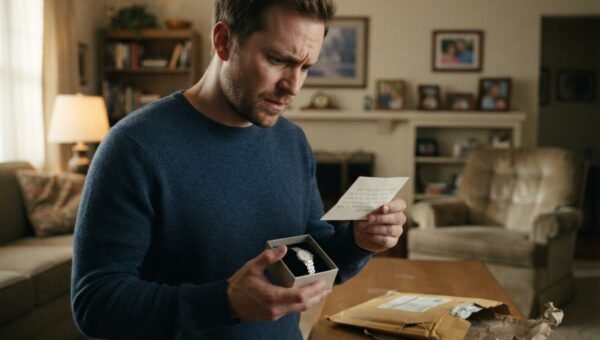
When I reached inside, my fingers hit a stiff piece of paper stapled to the cardboard neck of the hanger. I pulled it out into the hallway light.
It was a yellow receipt tag from Town Square Dry Cleaners, and the stamped drop-off date was three weeks earlier.
I stared at the numbers. You do not spend eighty or ninety dollars to dry clean a vintage gown just to toss it into the back of a charity truck.
Right then, the front door opened. Brenda walked in carrying a bag of groceries. She saw me standing by the open closet with the yellow slip in my fingers.
Before I could even open my mouth, she spoke.
“I was only trying to help,” she said. Her voice was sharp, the way it always got whenever she felt cornered. “I wanted it to be clean and presentable for whoever gets it.”
I didn’t argue. I didn’t accuse her of anything. I just put the yellow tag back inside the bag and walked into the kitchen to help her unpack the groceries.
I needed time to think, because something about her reaction felt completely off.
Later that night, around ten o’clock, Brenda went upstairs to wash her face. I went back to the hallway closet to take the bag up to my study for good.
The navy garment bag was gone.
The hanger was gone.
The charity truck was not due until ten the following morning, but the closet was completely bare.
I didn’t sleep more than an hour that night. At eight the next morning, as soon as the sign on their front door flipped to open, I called Town Square Dry Cleaners. I read the five-digit ticket number from the receipt I had written down on a scrap of paper.
The woman on the other end tapped on her keyboard for a few seconds.
“Yes, ticket 41802,” she said. “The vintage satin gown with the lace trim. That was picked up two days ago.”
“Who picked it up?” I asked.
“A young woman,” the clerk replied. “She paid the balance and signed the slip under Lauren Miller.”
Lauren Miller was my twenty-six-year-old daughter.
PART 2
Lauren was my daughter from my first marriage. Her mother passed away when Lauren was nine, and for six years it was just the two of us before I met Brenda.
Over the last few months, Lauren had grown quiet around me. She had gotten engaged back in May to a quiet young man named Mark, an electrician who treated her well. I had offered several times to help pay for their reception, but every time I brought up wedding plans over the phone, Lauren became distant. She gave short, polite answers and found quick excuses to hang up. I had spent months wondering what I had done wrong.
I sat in my parked truck two blocks from my house, holding my phone with both hands.
If Lauren had the dress, why did Brenda tell me we were donating it to charity? And why would Brenda claim the charity truck was coming to pick it up on Friday morning if Lauren had already taken it on Wednesday?
I didn’t call Brenda. I put the truck in gear and drove thirty minutes across town to Lauren’s apartment.
When Lauren opened the front door, she was wearing grey sweatpants and an old college t-shirt. She looked surprised to see me standing on her porch on a Friday morning.
“Dad?” she said. “Is everything okay?”
“Can I come in for five minutes, Lauren?”
She hesitated, then stepped back and let me into her living room. Sitting right in the center of her small dining table was a large, acid-free white preservation box with a clear plastic window on top. My mother’s cream-colored dress was folded neatly inside.
I looked at the box, then looked at my daughter.
“I called the cleaners this morning,” I said quietly. “They said you picked it up.”
Lauren folded her arms across her chest. Her jaw tightened, and she looked down at the carpet.
“If you came here to ask for more money, Dad, I don’t have it,” she said. Her voice sounded thin and worn out. “You got what you asked for. Mark and I had to cut forty people from our guest list just to cover it.”
A cold knot formed in my stomach.
“What are you talking about, Lauren?” I asked. “What money?”
“Don’t do that,” she said, looking right at me. Her eyes were red. “Don’t pretend you don’t know. Brenda called me three weeks ago. She told me you were selling Grandma’s dress to a vintage bridal shop online because your truck’s transmission died and you couldn’t afford the repair.”
I stared at her. “My truck is fine. I never said that.”
“She said you needed fourteen hundred dollars,” Lauren said, her voice rising. “She told me you were listing the dress on Thursday morning unless I bought it from you first. She said you didn’t want to talk to me about it directly because you were embarrassed about your finances.”
Lauren grabbed her phone from the kitchen counter, unlocked the screen, and shoved it into my hands.
There on the screen was a bank transfer receipt from three weeks earlier. Fourteen hundred dollars, sent directly from Lauren’s savings account to Brenda’s personal checking account.
The memo line read: Mom’s dress and truck repair.
PART 3
I stood in Lauren’s apartment with her phone in my hand, reading that memo line over and over.
Brenda had known how much that dress meant to my daughter. Lauren had talked about wearing her grandmother’s lace down the aisle since she was twelve years old. Brenda had taken fourteen hundred dollars from a young woman working two jobs, told her that her own father was shaking her down for money, and then told me that Lauren had no interest in family heirlooms and that our closet was too cluttered.
The fake donation was just Brenda’s cover story to explain why the box would be permanently missing from our house.
“Lauren,” I said, looking her in the eyes. “Listen to me very carefully. I never asked for a penny. I didn’t know you wanted the dress right now, and I had no idea Brenda contacted you. She told me yesterday that we were giving it away to a charity truck.”
Lauren’s face crumbled. She sat down on the edge of her sofa, covering her mouth with one hand.
“She told me you were angry with me,” Lauren whispered. “She said you were bitter that Mark and I weren’t having a big church wedding, and that’s why you were making me pay for the dress.”
I sat down next to my daughter and put an arm around her shoulders. For the first time in six months, she didn’t pull away.
I stayed with Lauren until she stopped crying. I took a clear photograph of her phone screen showing the fourteen hundred dollar transfer to Brenda’s account, along with the date and time. Then I told Lauren to keep the dress locked in her bedroom closet, got back into my truck, and drove home.
When I walked into our kitchen, Brenda was sitting at the island, chopping celery for a chicken salad. She looked up and smiled, like it was any other Friday afternoon.
“Did you take the trash out back?” she asked.
I didn’t answer. I pulled out a chair, sat down across from her, and laid three items on the counter between us.
First, the yellow dry-cleaning receipt.
Second, the photograph I had printed of Lauren’s bank transfer showing the fourteen hundred dollars.
Third, the small framed photograph of my mother wearing the dress on her wedding day, which I had taken from my nightstand.
Brenda stopped chopping. She looked at the papers, and the small smile disappeared from her mouth.
“David,” she began, wiping her hands on a dish towel. “You don’t understand the pressure I’ve been under. Our credit card balance has been getting out of hand, and you never want to look at the bills. Lauren has a good job at the clinic. She has savings. I was going to use that money to pay down the Home Depot card before you saw the interest.”
“You told my daughter I was extorting her,” I said. My voice was very low. “You made her believe her own father valued fourteen hundred dollars over her happiness.”
“I was trying to keep our heads above water,” she snapped, her voice rising in defense. “You hold onto every scrap of the past like it’s holy, and I’m the one who has to manage this house.”
“Open your phone, Brenda,” I told her.
She blinked at me. “What?”
“Open your banking app right now. You are going to send fourteen hundred dollars back to Lauren while I watch your screen. If you don’t do it before the clock on that microwave turns to twelve-fifteen, I am walking down to the county precinct to file a report for theft and fraud.”
She looked at me for a long, quiet minute, trying to see if I was bluffing. She had spent ten years watching me back down from arguments to keep our weekends peaceful.
She saw nothing in my face to suggest I was backing down today.
Brenda picked up her phone with shaking fingers. She tapped the screen, authenticated her account, and initiated the return transfer. I watched the confirmation number flash on her glass screen.
ENDING
Two hours later, Brenda’s sister arrived in a grey sedan.
Brenda packed two large suitcases and four cardboard boxes of her clothes from the bedroom closet she had complained about for so long. She didn’t say much while she loaded the trunk. She muttered that I was throwing away a decade of marriage over a misunderstanding, but she never looked me in the eyes. When the sedan pulled out of the driveway, the house was completely silent.
That was three weeks ago. My lawyer has already drafted the separation agreement, and the house will be put on the market in the spring so we can divide the equity cleanly.
Yesterday afternoon, I drove back over to Lauren’s apartment.
A seamstress named Mrs. Gable was there, kneeling on the living room rug with a mouthful of silver pins. Lauren was standing in the center of the room wearing my mother’s dress. The satin was smooth and clean, and the lace around her wrists fell into the exact same delicate points I had seen in my parents’ old wedding album.
Lauren turned toward the mirror on her wall and smiled.
“Does it look okay, Dad?” she asked.
“Your grandmother would have loved it,” I said.
Then Lauren stepped off the small wooden footstool, walked over, and asked me if I would walk her down the center aisle of the church in October.
I told her there was nowhere else in the world I would rather be.