PART 1
My sister Brenda stood right in front of room 114 with her arms crossed over her chest. The corridor smelled like floor wax and industrial laundry detergent, quiet in the heavy way hospice wings always are. She looked at me like I was a delivery driver who had brought the wrong package.
“You don’t get to show up at the end,” Brenda said. Her voice was flat, low enough not to disturb the nurses at the desk ten feet away. “Not until you look me in the eye and apologize for abandoning this family.”
I had been driving for six hours straight on Interstate 71. My lower back ached, my eyes burned from the road, and my hands still smelled like the gas pump from two exits back. I just stood there looking around the hallway, wondering when my family had decided this was normal behavior. Two years earlier, I took an operations job two states away in Ohio because the plant back home had shut down. It was the only way I could keep earning enough to cover my own rent and help Mom.
I kept trying to stay calm. “Brenda, Mom has days left. Dr. Miller said three to five days at most. Let me walk inside.”
“You chose your career,” she whispered, leaning in just an inch. “I stayed. I did the laundry, I picked up the prescriptions, and I sat by her bed. If you want through that door, you admit what you did. Otherwise, get back on the highway.”
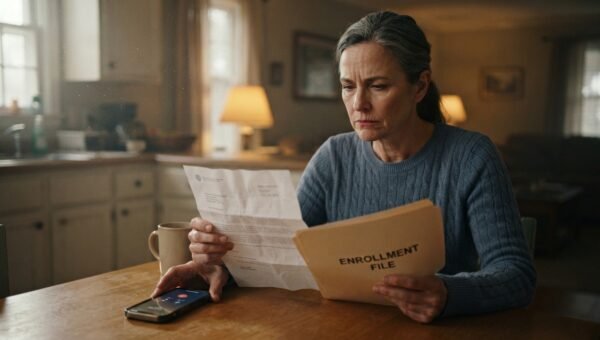
Normal felt safer than admitting how bad things had gotten, so I did what I always did when Brenda picked a fight. I stepped away. I went out to the small family lounge near the vending machines, sat on a vinyl chair, and opened my banking app on my phone.
The detail I kept coming back to was $1,950 recurring transfers.
On the third of every single month for the past fourteen months, $1,950 had moved out of my checking account into Mom’s checking account. That was the exact figure Brenda told me was needed for Mrs. Gable, the home health aide who came four mornings a week before Mom had to be moved into inpatient care last Tuesday. I had paid it without missing a single date. I had skipped car repairs and cut my grocery budget in half just to make sure that $1,950 went through clean.
I stared at the screen. The last transfer had cleared just six days ago. But Mom had already been bedridden in the county hospital before they transferred her here. Why had the home aide billed for a full month when Mom was already in a facility bed?
I picked up my bag, walked down the hall past room 114, and took the elevator to the administrative floor instead of arguing in the corridor. A nameplate by the corner office said Karen Vance, Social Services.
The door was open. Karen was an older woman with silver wire glasses and a stack of manila folders on her desk. She looked up when I knocked gently on the wooden frame.
“Can I help you?” she asked.
“My name is Laura Davis,” I said. “My mother is Evelyn Davis, in room 114. My sister is Brenda. Brenda told me I am not permitted in the room.”
Karen adjusted her glasses and pulled Evelyn Davis’s blue intake folder from a rack. She flipped through the front pages, looking at the intake signatures and emergency contacts. Her brow furrowed, and she turned a page back to double-check.
She looked up at me with genuine confusion.
“Laura Davis?” Karen asked slowly. “Why did your sister list herself on all the intake paperwork as an only child?”
PART 2
Karen stared at me, waiting for an explanation that I did not have.
“An only child?” I repeated. The word sounded ridiculous in my ears. “We grew up in the same three-bedroom ranch on Maple Street. I was born two years before Brenda.”
Karen did not look away. She turned the file toward herself, running a pen down the primary admission forms. “Mrs. Davis was admitted here under our direct hospice benefit on Tuesday afternoon. Your sister signed the intake forms as sole surviving relative and primary legal agent. She checked the box indicating no other adult children or dependents exist. Under facility policy, the primary agent decides the visitor list if the patient is non-responsive or resting.”
“Mom is resting?” I asked.
“She was given comfort medication two hours ago,” Karen said gently. “She is sleeping. But Laura, if you are her daughter, you have every right to be listed as family.”
“I have my driver’s license,” I said, pulling out my wallet with shaking hands. “My passport is in my car. I have ten years of tax returns where Mom is listed as my dependent. And I have my bank statements.”
I set my phone on Karen’s desk, swiping through the account summary. I showed her the recurring transfers: $1,950 on the third of every month, labeled “Mom Caregiving – Aide Services.”
Karen looked at the screen, then looked back at Mom’s chart. Her expression tightened.
“Laura,” Karen said carefully, “hospice care in this facility is fully funded under Medicare Part A. Everything here, from medication to room and board, is covered. And your mother hasn’t had home health services since October, when she was placed under outpatient palliative monitoring. Who were you paying $1,950 to?”
“To Mom’s checking account,” I said. “Brenda told me Mrs. Gable was still coming every morning to help Mom turn, bathe, and eat until the hospital transfer.”
Karen picked up Mom’s financial profile from the admission packet. “Mrs. Gable was let go in late October when Evelyn became too weak for unassisted transfers. Your mother has not had a private aide in five months.”
The room went completely quiet except for the hum of Karen’s desktop computer.
Five months. That was $9,750. I had been wiring money directly into Mom’s account, and Brenda was the only person with the debit card and checkbook in town. Brenda had not stayed home out of pure devotion. Brenda had turned Mom’s illness into a monthly payroll.
I stood up. “I want to see my mother.”
Karen closed the file and stood up with me. “Give me three minutes to update the intake record and make a copy of your identification. Then I will walk down with you.”
PART 3
Brenda was still sitting on the wooden bench outside room 114 when the elevator doors opened. She had a paper cup of coffee between her hands, and she looked up with an irritated scowl, clearly expecting another round of me begging her for permission.
Her scowl vanished when she saw Karen Vance walking beside me with a yellow clipboard.
“Brenda,” Karen said in a calm, professional tone, “we need to have a quick word in the conference room.”
“What is this?” Brenda asked, standing up fast. Her coffee sloshed over the plastic lid. “I told the front desk Laura isn’t allowed back here. She doesn’t have rights to disrupt Mom’s care. I’m Mom’s sole contact.”
“You’re not an only child, Brenda,” I said. My voice was surprisingly steady. “I just gave Karen my license and my birth certificate. They’re adding me to the chart right now.”
Brenda’s face stiffened. She glanced toward the nurse’s station, where two floor nurses were already watching the exchange. “You don’t know what you’re talking about. The paperwork was just standard hospital paperwork. I filled it out in a rush while Mom was in the ambulance.”
“You checked the box that said no other surviving children,” Karen said quietly. “And you signed it three separate times.”
“I was stressed,” Brenda snapped. Her defensive shell was cracking, her eyes darting between me and the clipboard. “I’ve been carrying this entire house on my back while Laura lived her comfortable life out in Columbus.”
“I paid $1,950 every single month,” I said, taking two steps toward her. “I paid it on the third of November. I paid it on the third of December, January, February, and March. Five payments after Mrs. Gable was let go. Where did that money go, Brenda?”
Brenda opened her mouth, but nothing came out. The defiance in her shoulders dropped an inch.
“I had expenses,” she mumbled, dropping her gaze to the floor tiles. “Mom’s roof leaked. The car needed tires. I had to quit my job at the hardware store to be there when the visiting nurses showed up.”
“You lied to me,” I said. “You told me Mrs. Gable was at the house every morning. You told me Mom would end up in a substandard state facility if I didn’t wire the nineteen-fifty on time. And then you tried to lock me out of her room so I wouldn’t find out she was already covered here.”
“I was going to pay you back,” Brenda whispered. Her voice was thin now, stripped of all that righteous anger from an hour before. “I just needed to get through the winter. Mom didn’t care about the money. She didn’t even understand it anymore.”
“I cared,” I said. “And Mom would have hated what you did.”
Karen stepped between us. “Brenda, facility policy states that immediate family cannot be barred without a legal restraining order. Laura is going into room 114 now. If there is any disturbance, security will escort you off the grounds for the rest of the day.”
Brenda looked at me. There was shame in her eyes, but underneath the shame, there was the cold calculation of someone who knew she had run out of road. She turned around, tossed her half-full coffee cup into the blue recycling bin, and walked toward the exit doors without another word.
ENDING
The door to room 114 clicked shut behind me, cutting off the noise of the hallway.
The room was dim, with the blinds tilted just enough to let in the pale afternoon sun. Mom looked smaller than I had ever seen her. Her hands were resting on top of the white waffle blanket, her skin paper-thin and dotted with liver spots. A small plastic radio on the nightstand was playing soft instrumental music on low volume.
I pulled the armchair up to the edge of the mattress and sat down. I took her right hand between both of mine. Her skin was warm, but her pulse felt light, like the flutter of a sparrow.
“Mom,” I whispered. “It’s Laura. I’m here.”
Her eyelids fluttered, then slowly opened. She looked confused for a couple of seconds, staring at the ceiling tiles, before her eyes shifted toward my voice. The tension in her forehead smoothed out.
“Laura,” she breathed. It was barely more than a sigh.
“I drove in,” I said. “I’m staying right here.”
She squeezed my fingers with what little strength she had left. She did not ask about Brenda, or the house, or where I had been. She just held on.
Mom passed away four days later, early on a Sunday morning while the rain tapped against the window. I was sitting in that same vinyl armchair, holding the same hand. Brenda came back only once, late on Saturday night when she knew the halls were empty, stayed for ten minutes, and left without speaking to me.
After the funeral, I went to the bank in town and had Mom’s accounts closed and frozen for probate. The balance in the checking account was $142. Brenda had drained every transfer within forty-eight hours of it landing. Brenda asked me in the parking lot of the funeral home if I was going to take her to court over the $9,750.
I looked at her, standing by her car with the wind blowing her coat around her. I realized that whatever money was gone was never coming back anyway.
“No,” I told her. “Keep it. That’s the price of never having to talk to you again.”
I drove back to Ohio the next morning. On the passenger seat of my car sat Mom’s silver wedding band and the small brass key to her cedar chest, the only things I asked to take from the house. When I crossed the state line, I finally turned off the monthly transfer on my phone, put the phone in the cup holder, and kept my eyes on the road ahead.