PART 1
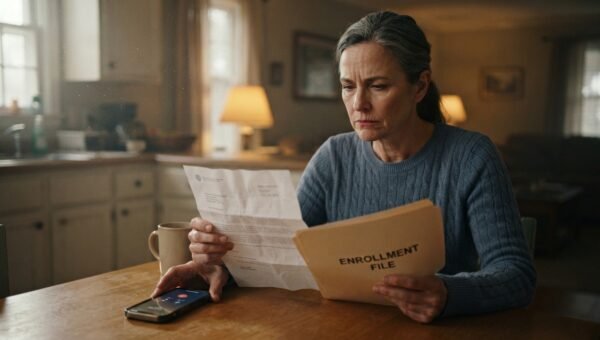
The clinic receptionist called me at two o’clock on a rainy Thursday afternoon. Her name was Karen, and her voice had that cautious, careful tone people use when they think they are about to step into the middle of a family fight.
“Brenda, I’m sorry to bother you at work,” Karen said. “We have Arthur down for his third physical therapy session today at one-thirty, but he hasn’t arrived.
That makes three weeks in a row. Our policy requires us to discharge patients after three consecutive no-shows, and Dr. Vance would have to issue a brand-new referral.”
I stood in the break room at the county records office with my half-eaten sandwich in my hand. “Three weeks? Karen, that can’t be right. My brother Greg has been taking him every Thursday morning since the start of the month.”
“Nobody has checked in under Arthur’s name since his initial evaluation on the third,” she said quietly. “We left two messages on the home landline last week, but we didn’t get a return call.”
My stomach tightened. I had spent six weeks trading Saturday filing shifts with Linda just so I could keep my Thursday mornings open for Dad. Dad had undergone a full right hip replacement in August, and at seventy-four, his recovery had been slow and stiff. Two miles of walking had shrunk to shuffling from the bedroom to the refrigerator.
When Greg offered to take over Thursdays, I felt a wave of relief I had not felt all summer. Greg had looked me in the eye across Dad’s kitchen table and told me I was doing too much. He said he was Dad’s son, he had flexible hours at the lumber yard, and it was time he pulled his own weight.
I clocked out an hour early, took the bypass around town, and drove straight to Dad’s small brick ranch on Elm Street.
The first thing I saw when I hit the garage door opener was Dad’s new walker. It was a four-wheeled silver drive walker with hand brakes and a padded seat. The doctor had insisted on it. It was standing folded against the water heater, pushed behind two bags of lawn fertilizer. The plastic wrap was still taped around the aluminum handles, and the white paper price tag for $164.99 was dangling from the right front wheel.
It had never touched pavement.
Inside the house, the hallway smelled like stale black coffee and toast. Dad was sitting in his usual brown vinyl chair at the kitchen table, wearing his navy windbreaker and his velcro tennis shoes. His hands were wrapped around an old ceramic mug, staring down into cold dregs.
“Dad?” I said, setting my car keys on the counter. “Why are you still dressed like you’re going somewhere?”
He flinched, then blinked up at me with that vague, polite smile he used whenever he wanted to smooth things over. “Oh. Brenda. What day is it?”
“It’s Thursday, Dad. The clinic just called me. You missed your appointment again.”
He looked back down at the mug. He cleared his throat twice. “Well. My head was foggy this morning. I must have simply forgotten. You know how I get since the surgery.”
“You forgot three weeks in a row?” I asked. “Greg was supposed to be here at nine to pick you up. Did he come by?”
Before Dad could answer, the side door clicked open. Greg walked in without knocking, carrying a half-empty cup of convenience store coffee. He was forty-six, three years younger than me, wearing his work boots and a baseball cap pulled down low. He froze for a second when he saw me standing by the sink, then recovered with a quick, dismissive shrug.
“Brenda,” he said, leaning against the doorframe. “What are you doing here on a workday?”
“Karen from the physical therapy clinic called me,” I said, keeping my voice level. “She said Dad hasn’t been there once this month. You told me three weeks ago that you had this covered.”
Greg didn’t hesitate. He took a sip of his coffee and shook his head, looking over at Dad with a heavy sigh. “I was here, Brenda. I drove over at nine sharp. He refuses to go. I tried to get him out the door for twenty minutes, but he dug his heels in. You know how stubborn he gets when his hip hurts. He wouldn’t get in the truck.”
I turned to look at Dad. “Dad? Is that true? Did you refuse to go?”
Dad didn’t speak. He stared at his coffee cup, his jaw locked tight. His knuckles were gray from gripping the ceramic handle. He looked small, cornered, and miserable, but he wouldn’t meet my eyes.
“See?” Greg said, his tone thick with self-righteous irritation. “He does this every time. I’m taking time out of my morning to drive clear across town, and he won’t even stand up. You can’t force a grown man into a car, Brenda.”
I started to speak, but something on the corner of the table caught my attention. It was a cheap black flip phone, brand new, sitting beside Dad’s pill organizer.
The moment Dad saw me glance at it, his left hand drifted across the Formica, picked up the phone, and turned it facedown.
PART 2
Dad had never owned a cell phone in his life. He kept a beige push-button rotary-style telephone plugged into the kitchen wall, and whenever I had offered to buy him a basic flip phone over the years, he had waved me off, saying he had no business carrying the world in his pocket.
Yet there it was, sitting under his palm, face pressed against the plastic tablecloth.
“What is that?” I asked.
“Nothing,” Dad muttered, his voice barely above a whisper. “Just a phone.”
“Where did you get a cell phone, Dad?”
Greg stepped forward, cutting between me and the table. “I bought it for him, Brenda. Is that a crime? In case he fell in the yard while I was running errands. I put minutes on it. We don’t need you interrogating him like he committed a felony.”
“I’m not interrogating him,” I said. “I’m asking why his walker is still wearing the store tag in the garage while you claim he’s been trying to walk out to your truck.”
“I took it out of the box so he’d have it,” Greg snapped. “If he won’t use it, that’s on him. I’ve got to get back to the yard. You want to handle his appointments? Be my guest. I tried.”
He tossed his empty paper cup into the trash can by the pantry, turned on his heel, and slammed the side door behind him. The sound rattled the small window above the sink. A second later, the gravel in the driveway crunched as his pickup backed out into the street and sped off.
The kitchen went dead quiet.
I pulled out the chair opposite Dad and sat down. Outside, the gray October drizzle tapped against the glass. Dad was still looking down, his shoulders hunched inside the navy windbreaker.
“Dad,” I said gently. “Look at me.”
He took a slow breath, but his eyes stayed fixed on the table.
“Did you really tell Greg you wouldn’t go?”
“I don’t want to cause trouble,” he whispered.
“You’re not causing trouble. But your hip is going to freeze up if you don’t do the rehabilitation. The doctor told us that three weeks ago. If you can’t walk, you can’t stay in this house by yourself.”
Those words hit him like a physical blow. His chin quivered, and for the first time, he looked up at me. His eyes were watery, filled with a raw, sharp terror that broke my heart. Our mother had spent the last eighteen months of her life in a nursing facility thirty miles south, and Dad had visited her every single day. When she passed, he had made me promise three separate times that I would never let anyone move him out of the house he had built with his own hands in 1978.
“I can walk,” Dad said, his voice shaking. “I’ve been doing my exercises right here in the kitchen. Greg said that counted.”
“Greg said what counted?”
Dad swallowed hard. He looked down at the black flip phone still resting under his hand. He looked like an eight-year-old boy caught with something forbidden.
“Dad,” I said, reaching across the table and touching his wrist. “May I see the phone?”
He hesitated for three or four seconds. Then his fingers uncurled, and he slid the plastic device across the table toward me.
It was an inexpensive prepaid phone from the discount store down on Fourth Street. The screen was smudged with thumbprints. I flipped it open. The battery was fully charged. The contact list had only one name saved in it: Greg.
I opened the recent calls log.
There were no calls to 911. There were no calls to me. There were only three outgoing calls listed on the small screen, each spaced exactly seven days apart: October eighth at 9:00 AM, October fifteenth at 9:00 AM, and October twenty-second, today, at 9:00 AM.
The number was an 800 number. It was not Greg’s cell phone. It was not the physical therapy clinic. It was not Dad’s doctor.
Every single Thursday morning, at the exact minute Greg was supposed to be pulling into the driveway to take Dad to physical therapy, Dad had dialed this toll-free number. The calls had lasted less than two minutes each.
“Dad,” I asked, holding the screen up. “Who is this?”
Dad reached for his cold coffee mug again, his hands trembling so badly the dark liquid slopped over the rim. “That’s the verification line,” he whispered.
“The verification line for what?”
“For the home therapy program,” Dad said. He wouldn’t look at me. “Greg set it up with the clinic. He told me the insurance changed the rules. If I called that number at nine o’clock sharp every Thursday, it logged that I was doing my walking exercises at the table, and they wouldn’t drop my coverage.”
I stared at him, trying to process what he was saying. “Dad, physical therapy clinics don’t have an automated phone line to verify home exercises. Who told you that?”
“Greg told me,” Dad said, his voice rising in panic. “He said you were working yourself to death trying to take off Thursdays. He said you were behind on your own car payments, Brenda. He said if you kept missing work for me, you were going to lose your job at the courthouse, and then the state would step in and say I was an unsafe dependent. He said they’d put me in Oak Ridge Manor before Thanksgiving.”
A knot of ice formed in the center of my chest. “Greg told you I was going to lose my job?”
“He said we had to keep it between us,” Dad stammered, tears finally spilling over his wrinkled cheeks. “He said he was handling the co-pays directly so you wouldn’t have to see the bills. He told me to just call the number at nine, let the recording play, and then leave the cash on the counter for the driver.”
The air left my lungs. “What cash, Dad?”
Dad pointed a shaky finger toward the microwave on the back counter. Sitting beside the salt shaker was an empty white envelope with Dad’s pencil handwriting on the front: *Oct 22 – PT.*
“Two hundred and forty dollars,” Dad whispered. “Every Thursday morning. I gave him the checkbook the first week, but he said the clinic only takes cash for the home-care program. So he’s been taking my debit card to the drive-thru to pull it out for me.”
PART 3
I sat frozen in the chair for a full minute, listening to the hum of the refrigerator.
Dad’s monthly Social Security check was $1,420. After his heating oil, his blood pressure medications, and his property taxes, he had barely three hundred dollars left over each month for groceries. He had been giving Greg $240 every single week for three weeks. That was $720. More than half of his entire monthly income, drained in twenty-one days.
I picked up the black flip phone, hit redial on the toll-free number, and pressed the speaker button.
A crisp, automated female voice filled the quiet kitchen:
“Thank you for calling First Horizon Bank telephone banking services. For account balance and recent transactions, press one. To report a lost or stolen card, press two.”
Dad stared at the phone on the table. The confusion on his face slowly turned into something far worse, a sickening, hollow comprehension that drained whatever color was left in his skin.
“That’s… that’s my bank,” Dad whispered.
“Yes, Dad,” I said, my voice steady, though my hands were shaking with rage. “It’s your bank.”
“He told me… he told me it was the clinic dispatch. He wrote the number on a sticky note and told me to press call at nine o’clock and listen to the voice so the computer knew I was awake and moving.”
Greg hadn’t even bothered to invent a fake number. He had simply programmed Dad’s own automated bank line into the speed dial. He knew Dad couldn’t hear well enough through the tiny speaker to understand the automated menu, and he knew Dad was terrified of pushing the wrong button. He had instructed Dad to call it at 9:00 AM so Dad would be distracted and occupied while Greg drove to the automated teller machine down the road.
I pressed one on the keypad and entered Dad’s account number and four-digit pin from memory. I had helped Dad set up the account five years ago after Mom died.
The automated voice read out the ledger:
“Your current checking balance is eighty-four dollars and twelve cents. Recent transactions: October twenty-second, cash withdrawal, ATM at Miller’s Gas and Mart, two hundred and forty dollars. October fifteenth, cash withdrawal, ATM at Miller’s Gas and Mart, two hundred and forty dollars. October eighth, cash withdrawal, ATM at Miller’s Gas and Mart, two hundred and forty dollars.”
Miller’s Gas and Mart was two blocks from Greg’s lumber yard.
Dad put his face in his hands and began to weep. It was a terrible, silent weeping, his thin shoulders shaking under his windbreaker. He wasn’t crying because of the $720. He was crying because his only son had looked at his bad hip, his loneliness, and his mortal terror of a nursing home, and used them all to rob him blind while making him feel like a burden to me.
“I didn’t want you to lose your job, Brenda,” Dad choked out between sobs. “I swear to God, that’s the only reason I didn’t say anything. He told me you were drowning.”
“I am not drowning, Dad,” I said, coming around the table and wrapping my arms around his shoulders. “My job is fine. My car is paid for. Greg lied to you. Every single word he told you was a lie.”
I didn’t wait. I took Dad’s landline off the hook, called the First Horizon fraud department, and had Dad’s debit card canceled immediately. Then I called Karen back at the clinic.
“Karen,” I said, “I need to reschedule Dad’s appointments. He will be there next Tuesday morning at eight sharp, and I will be driving him myself.”
“We’d love to have him, Brenda,” she said. “We’ll hold the spot.”
When I hung up, I walked out to the garage. I grabbed the silver walker from behind the fertilizer bags. I carried it into the kitchen, found a pair of scissors in the junk drawer, and clipped the white $164.99 price tag off the wheel. I peeled the plastic wrap off the foam handles, set the brakes, and adjusted the aluminum legs to the proper height for Dad’s frame.
“Stand up, Dad,” I said gently.
He looked at the walker, then up at me, wiping his eyes with the sleeve of his jacket.
“Come on,” I said. “You’re not staying in this chair.”
He grabbed the handles. He pushed himself up, wincing as his right hip took his weight, but the four rubber wheels held firm. He stood tall in the middle of his kitchen for the first time in three weeks.
Ten minutes later, the side door flew open again.
Greg walked back in, holding a brown paper bag from the hardware store. He stopped dead when he saw Dad standing at the sink, leaning on the adjusted walker, with Dad’s bank statements spread out across the kitchen table.
“What’s going on?” Greg asked, his eyes darting between me and the paperwork. “Brenda, I thought you went home.”
I picked up the white envelope with *Oct 22 – PT* written on it and tossed it onto the center of the table.
“Dad’s card is canceled, Greg,” I said.
Greg didn’t move. The color drained from his face. “What are you talking about?”
“Seven hundred and twenty dollars,” I said. “Three ATM withdrawals at Miller’s Mart, every Thursday morning at eight-forty-five. You took his money, you lied to him about my job, and you threatened him with Oak Ridge Manor so he wouldn’t tell me he was missing therapy.”
“You don’t know what you’re talking about,” Greg stammered, stepping toward the table. “He gave me that money for his expenses. He agreed to it.”
“He thought he was paying the clinic for a home program you made up,” I said, cutting him off before he could build another lie. “You told the clinic he refused to go, because you were too lazy to drive him and too greedy to give up seven hundred dollars of his pension.”
“He’s my father too!” Greg yelled, his voice cracking with ugly defensive anger. “You don’t know what it’s like dealing with him every day! You come over for an hour, you act like the saint, and I’m the one who has to hear him complain about his leg!”
“You didn’t deal with him,” I said. “You left him sitting in this kitchen waiting for a ride that never came, calling his own bank at nine in the morning because you told him it was the only way to keep his house.”
Dad didn’t shout. He didn’t curse. He stood between the kitchen counter and his walker, looking at Greg. His eyes weren’t watery anymore. They were clear, flat, and hollowed out.
“Give Brenda the house key, Gregory,” Dad said.
Greg blinked, stunned. “Dad, come on. Brenda is blowing this out of proportion—”
“Give her the key,” Dad repeated. His voice wasn’t loud, but it had an authority I hadn’t heard since Mom was alive. “And don’t come back down my driveway until you have that seven hundred and twenty dollars in your hand.”
Greg stood there for five long seconds, his chest heaving, his mouth open. When he realized neither of us was going to look away, he reached into his pocket, unclipped the brass house key from his ring, and threw it onto the table. It slid across the Formica and stopped against Dad’s cold coffee mug.
“Fine,” Greg spat. “See how long you last on your own.”
He slammed the door for the second time that afternoon. This time, when his truck tires tore out of the gravel, nobody moved to watch him go.
ENDING
The house was quiet again by four o’clock.
I called my supervisor at the records office and officially swapped my schedule, moving my thirty-two hours to Monday through Wednesday and full Saturdays. It meant longer shifts and less sleep, but Thursdays were mine again. Nobody was going to barter for Dad’s care.
Dad sat back down at the table while I brewed a fresh pot of coffee. The empty envelope was in the trash, and the black flip phone was sitting on the counter, powered down and dark.
“I feel like a fool, Brenda,” he said softly, staring at his hands. “A seventy-four-year-old fool.”
“You trusted your son,” I said, setting a fresh, hot mug in front of him. “That doesn’t make you a fool. That makes him a thief.”
“I was so scared of that home,” he whispered. “When your mother was there… at the end… she didn’t know the room. She kept asking me to take her out to the garden. I couldn’t bear the thought of somebody locking me in a place where I couldn’t see my own trees.”
“Nobody is putting you in a home, Dad,” I said, pulling my chair beside his. “Not Greg, not the state, and not me. But you have to do the work. If you want to stay in this house, you have to walk.”
He looked at me for a long moment, then reached out and took my hand. His grip was frail, but his skin was warm.
“All right,” he said.
On Friday morning, I drove back over before my shift. The rain had cleared, leaving the asphalt damp and dark under a pale autumn sun.
Dad was already waiting at the front door. He had his navy windbreaker on, his sneakers tied tight, and his two hands planted firmly on the rubber grips of the silver walker.
We didn’t go far. We moved out onto the porch, down the small wooden ramp we had built after his surgery, and onto the concrete walkway. His right leg dragged a little, and his breath came hard through his teeth, but he didn’t stop. We made it all the way down to the black metal mailbox at the end of the driveway and turned around to look back at the house.
Dad leaned against the padded bar of the walker, caught his breath, and looked up at the brick porch.
“We’ll do it again tomorrow,” he said.
I took the brass key Greg had left behind out of my jacket pocket and slipped it onto my own keychain.
“Yes, we will,” I told him, and we started the slow walk back toward the door.