PART 1
The wood shavings on the floor of Miller’s Sign Shop were fresh cedar, smelling like sharp turpentine and rain. I had only stopped by to drop off a box of grease pencils for old man Miller, the way I had done every spring for twenty years. But there on the workbench, leaning against two sawhorses, was a four-foot slab of clear pine.
The carved letters were painted navy blue with gold trim: Henderson and Son Bait and Tackle. Est. 1998. Frank and Kevin Henderson, Proprietors.
I reached out and touched the sticky gold paint on Kevin’s name. For twenty-six years, the weathered sign hanging over our front door on the Sandusky channel had read: Henderson Bait and Tackle: Frank and Martha Henderson.
“Frank said he wanted it ready before the walleye run starts next week,” Miller said, wiping his hands on an oily rag. “Told me the boy was taking the helm. Nice to see a family place stay in the family, Martha.”
“Yes,” I said. My voice sounded flat in my own ears. “Frank always has a plan.”
I walked out to my station wagon and sat with both hands gripped on the steering wheel. My knuckles were red and stiff. When Frank’s knees went bad four years ago, he didn’t sell the shop, and he didn’t hire a hand. He just stopped setting the alarm. He sat in his green vinyl recliner behind the counter, drinking black coffee from a thermos, telling every retired dockworker and charter captain who walked in that he was semi-retired.
I took the early hours. Every morning at four o’clock, seven days a week, I drove down to the dock while the lake was still pitch black. I hauled five-gallon buckets of live minnows from the aerated tanks in back. I packed nightcrawlers in damp dirt. I handled the supplier invoices, scrubbed the scales off the stainless cutting tables, and kept the sales tax records straight for the state of Ohio.
Then our son, Kevin, came home in May with a business degree from Bowling Green. The first weekend he was back, he dropped his duffel bag in the hallway, looked at the lake through our kitchen window, and told me Dad had promised him the entire place. Kevin was twenty-two, full of big talk about espresso machines and kayak rentals. I laughed it off at the time. I thought it was just Frank blowing smoke over Sunday dinner, the way men do when they want their boys to think they own the world.
Then I saw that cedar slab in Miller’s workshop.
I drove straight home. The front door was unlocked, and Frank was sitting at the kitchen table with his knee braces unstrapped on the floor beside him. He was cutting fishing line with his pocketknife.
“You ordered a sign from Miller,” I said, dropping my keys on the counter.
He didn’t look up from his knot. “Miller talks too much.”
“He didn’t talk at all, Frank. The sign was sitting right on his bench. My name is gone.”
Frank set the knife down and rubbed his thumb over the spool. “Kevin graduated college, Martha. He needs a future. A young man isn’t going to stick around running a minnow shack if his mother is still running the counter. He needs his name over the door. It gives him pride.”
“And what about my name?” I asked. “I’ve run that counter since 1998.”
“You’re sixty-two,” he said, like he was explaining basic arithmetic to a slow child. “You taught middle school for thirty-one years. You’ve got your pension. Let the boy have the shop.”
“My pension,” I said. The word tasted sour. “The shop loan was sixty days from default three years ago when the harbor froze in November. Who paid off the commercial note at First National, Frank? It wasn’t Kevin. It wasn’t you.”
For thirty-six straight months, exactly $1,180 had come out of my state teachers retirement account by direct deposit to pay down the last $42,480 of the property note. Frank had looked me in the eye three years ago and sworn that if I covered the mortgage, our retirement would be secure on the lake for the rest of our lives.
“You were always going to help us anyway,” Frank said. He picked up his pocketknife again and clicked the blade shut. “We’re a family. It all goes into the same pot.”
“It didn’t go into the same pot,” I said. “It went into your building.”
He waved his hand at me, dismissing me the way he did when a customer complained about a dry batch of worms. “You’re getting worked up over wood and paint. Go make some tea.”
I didn’t make tea. I waited until ten o’clock, until Frank took his sleeping pills and his snoring filled the hallway.
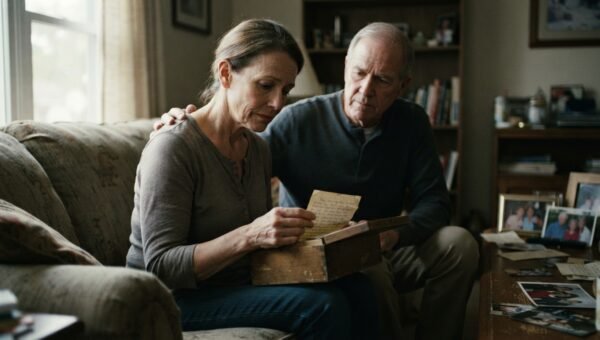
I walked down the dark stairs to the shop. The building smelled of damp concrete, outboard motor oil, and lake water. Behind the counter stood Frank’s roll-top desk, stuffed with thirty years of tackle receipts, state fishing digests, and rusted pliers. In the bottom drawer, under an old wool blanket, was the green canvas ledger where we kept the shop’s property paperwork.
I carried it under the single bare bulb over the cash register.
The ledger smelled of mildew. I flipped past the original 1998 purchase pages until I reached the back section, where Frank kept the tax records and municipal permits.
Halfway down the page for last October, a single line was circled in thick red grease pencil.
The handwriting was Frank’s: Commercial lot and riparian dock rights transfer.
Beside the circled words was a date from two weeks ago: September 14th.
And directly below the date was a sharp, narrow signature in blue ink that I had never seen in my life: Harlan Vance.
PART 2
I stared at the name Harlan Vance until the blue ink seemed to blur into the paper.
I knew the name Vance. Harlan Vance owned the private dry-dock marina three miles down Route 2 toward Marblehead. He was a commercial developer who had spent the last five years buying up small waterfront slips along our channel, tearing down old fish-cleaning shacks, and replacing them with high-dollar fiberglass floating docks for thirty-foot cabin cruisers.
Frank had spent years calling Harlan Vance a vulture who was pricing ordinary fishermen off Lake Erie.
Yet there was Vance’s name in our private ledger, dated fourteen days ago, sitting right under Frank’s red circle.
I turned the page carefully. Folded inside the binding was a single sheet of cream-colored legal paper with the letterhead of a law office in Port Clinton. It was titled Memorandum of Option and Commercial Intent.
I leaned close to the bare yellow bulb and read every word.
The agreement was between Frank Henderson and Vance Marina Holdings. Frank had agreed to sell the bait shop’s water rights, including our four deep-water boat slips and fifty feet of channel shoreline, to Harlan Vance for $210,000.
The deal did not include the physical shop building where we sold nightcrawlers and tackle. But without the water slips, our bait shop was useless. We could not run our commercial minnow tanks, which drew fresh water directly from the channel through an intake pipe under Slip Two. We could not dock the live-well delivery boats. We could not rent tie-ups to the local charter guides who bought two hundred dollars in shiners every morning.
Selling the slips would choke the bait shop to death within a single season.
At the bottom of the memorandum was the clause that Frank had circled:
Seller warrants that all primary commercial liens on Parcel 44-B shall be satisfied in full prior to closing, and Seller agrees to deliver clean, unencumbered title, including spousal quitclaim, on or before October 15th.
My hands were shaking, not with fear, but with a cold, clear anger that settled behind my ribs like river ice.
Frank had not promised the business to our son so Kevin could become a proud second-generation shopkeeper. Frank was using Kevin as the cover story. He had ordered that new sign to flatter Kevin and make me look like an unreasonable, bitter mother if I dared to object. He had waited until my pension checks paid off the last dime of the First National mortgage, because Harlan Vance’s lawyers would not close on property with a bank lien on it.
Frank intended to pocket $210,000 from the slip sale, leave our boy with a dying tackle shack that had no water access, and push me out the door without a nickel of the money I had spent thirty-one years earning in a classroom.
I took out my phone and took clear photographs of every single page, every signature, and the red grease pencil note. Then I closed the green ledger, placed it back under the wool blanket in the bottom drawer, turned off the bulb, and went back upstairs.
I didn’t sleep. I sat in the dark in the armchair by our bedroom window, watching the warning lights blink on the Sandusky coal docks across the bay.
At seven in the morning, Kevin came clumping down the stairs in his clean boat shoes, humming to himself. He poured a cup of coffee and set a shiny blue folder on the kitchen table.
“Morning, Mom,” he said, grinning. “I’m meeting the sign guy at noon to pick up the pine board. Dad said we’re hanging it before Friday’s perch tournament.”
I poured my own coffee and stayed on my feet. “Kevin, what did your father tell you about how this transfer works?”
Kevin puffed his chest out a little. “He told me he was stepping down because of his knees. He said the family business needs young energy. He said you were tired, too, and that you’d already paid your part and wanted to rest.”
“Did he mention Harlan Vance?”
Kevin paused, his mug halfway to his mouth. “Vance? From the yacht club? Dad said Vance might partner with us on some dock rentals next summer to bring in high-end clients. Why?”
“Your dad didn’t tell you about a sale?”
“What sale?” Kevin frowned, his face open and confused. “Mom, Dad’s giving me the shop. He’s deeding it to me. We’re keeping it in the Henderson name.”
Frank walked into the kitchen then, using his aluminum cane, his bad knee stiff. He took one look at the two of us standing by the table, and his mouth tightened into a hard line.
“What are you interrogating the boy for?” Frank said, leaning heavily on the counter. “I told you yesterday, Martha. It’s settled.”
“Nothing is settled, Frank,” I said quietly. “I took a ride past the county recorder’s office on my phone last night.”
Frank’s eyes shifted toward the hallway, just for half a second. “You don’t know what you’re talking about.”
“I know that Harlan Vance doesn’t buy bait,” I said. “And I know that Friday isn’t just about hanging a new sign.”
PART 3
Frank didn’t answer right away. He shuffled over to his chair, sat down with a heavy groan, and laid his cane across the table.
“Kevin,” Frank said without looking at me. “Go down to the shop and check the aerator on tank three.”
“No,” I said, my voice cutting through the kitchen. “Kevin stays right where he is. If he’s a partner in this business, he can sit here and listen to business.”
Kevin looked back and forth between us, his face losing its easy confidence. “Mom, what’s going on?”
I reached into my cardigan pocket, pulled out my phone, and set it on the table between Frank’s coffee mug and Kevin’s blue folder. I pulled up the photo of the memorandum and slid the screen toward our son.
“Read paragraph four, Kevin,” I said.
Kevin picked up the phone. His eyes moved across the lines. As he read, the color drained out of his cheeks.
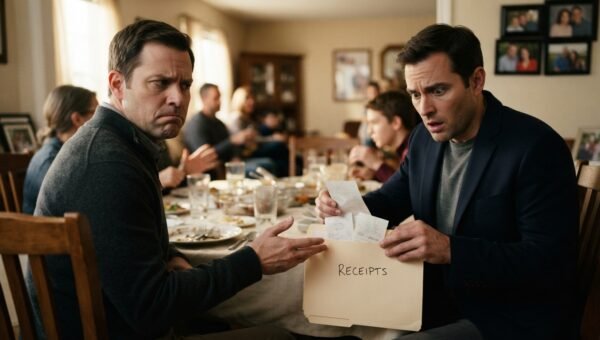
“Two hundred and ten thousand dollars?” Kevin whispered. “Dock slips one through four? Dad, those are our charter slips. The intake pipes for the shiner tanks run right through Slip Two. If Vance owns the docks, where do our boats go?”
“It’s business, Kevin,” Frank snapped, his face turning an ugly mottled red. “Vance is putting in steel pilings. We don’t have fifty grand to rebuild those wooden bulkheads. They’re rotting into the mud. If we sell him the slips, we get a lump sum, and he leases us back two slots on the end.”
“A lease,” I said. “For how much, Frank? Five hundred a month? A thousand? Until Vance decides he doesn’t want minnow scales and worm dirt next to his hundred-thousand-dollar yachts?”
Frank slammed his open hand against the kitchen table, making the coffee mugs jump. “I built that shop! Twenty-six years on this lake! I dragged the lumber for those docks out of the swamp with my own truck!”
“And who kept it from the auction block?” I said, stepping right up to the table. “When the lake froze early three winters ago and the pipes burst, the bank gave you thirty days to come up with twelve thousand dollars or they were calling the entire commercial loan. You sat right in that chair, Frank, and you cried. You told me you were going to lose the only thing your father left you.”
Kevin looked at his father, his mouth slightly open. “Dad? Is that true?”
“I took twelve thousand dollars out of my savings that week,” I said, keeping my eyes locked on Frank. “And for the last three years, thirty-six months in a row, exactly $1,180 was taken out of my state teachers retirement check to pay First National. That’s $42,480 of my pension, Frank. Money I earned grading papers at midnight for thirty years.”
“You lived under this roof!” Frank shouted. “You ate the food!”
“I bought the food!” I told him. “And you told our son you were giving him an inheritance, while you were quietly setting up a deal to pocket over two hundred thousand dollars and leave him with an empty shell of a store.”
Frank turned to Kevin, his voice dropping into that wheedling, injured tone he always used when he was cornered. “Kevin, listen to me. The money was going into a fund for you. I was going to use it to set you up in a real franchise in Sandusky. Something better than scooping frozen minnows at four in the morning like a common laborer.”
Kevin set my phone down on the table. He looked down at his clean boat shoes, then at the blue folder with his notes about kayak rentals.
“You told me Mom was tired,” Kevin said. His voice was very quiet now. “You told me she didn’t want to work the counter anymore and that she wanted to give it up.”
“She is tired!” Frank said. “Look at her! She’s sixty-two years old!”
“I am tired, Kevin,” I said. “I’m tired of hauling nightcrawler flats in the freezing rain while your father tells tourists he’s an executive. But I am not stupid. And I am not a volunteer.”
I turned to Frank.
“Harlan Vance’s contract has a condition,” I said. “I read the red circle, Frank. It requires a spousal quitclaim deed. That means Vance’s title company checked the county records in Port Clinton and found out what you already knew. The shop and the lakefront parcel are titled to Frank Henderson and Martha Henderson, joint tenants with right of survivorship.”
Frank glared at me, his jaw clamped shut.
“You can’t sell a single splinter of those docks without my signature,” I said. “And you can’t deed this building to Kevin, or to Vance, or to God Almighty Himself unless I sign that paper.”
“You sign it,” Frank hissed, leaning forward. “Or we lose the Vance deal entirely. He’ll pull the offer by Friday.”
“Then let him pull it,” I said.
ENDING
Harlan Vance did pull the offer.
When his title attorney called our house that afternoon asking when the signed quitclaim would be delivered to the title company, I answered the phone myself. I told him there would be no quitclaim, no sale of the docks, and that any further communications regarding Parcel 44-B needed to be sent to my attorney in Sandusky.
The silence on the other end of the line was brief. Vance’s lawyer said, “Understood, Mrs. Henderson,” and hung up.
Kevin didn’t pick up the pine sign from Miller’s workshop.
He spent two days locked in his old bedroom. On Sunday morning, he brought his duffel bag downstairs, put it in the trunk of his civic, and walked into the kitchen where I was packing live bait orders for the morning rush.
He didn’t look at his father, who was sitting in the recliner pretending to watch the weather channel.
Kevin walked over to the counter and hugged me. He was trembling just a little.
“I’m sorry, Mom,” he said against my hair. “I really didn’t know. He made it sound like… he made it sound like you were happy about it.”
“I know you didn’t know, honey,” I said, smoothing the back of his shirt. “You’re twenty-two. You wanted to believe your dad was making you a partner.”
“I got a job at the state park marina in Marblehead,” he told me. “Starting Monday. Dock hand and rental coordinator. It’s thirty-four thousand a year with state benefits. I’m moving into an apartment near the ferry with two guys from school.”
“Good,” I said. “Work for somebody who pays you on a paycheck, Kevin. Never work on a promise.”
I filed for legal separation and a court-ordered partition of the business two weeks later.
Frank tried to fight it at first. He hired an old friend from the Elks Lodge to argue that my pension payments were gifts to the marital estate, but my lawyer produced thirty-six bank receipts, each one marked commercial loan principal reduction, paid directly from my Ohio STRS account.
The judge in Ottawa County did not care about Frank’s bad knees or his hurt feelings. The court ordered the bait shop and the waterfront lot placed on the open market.
A young couple from Port Clinton bought the whole place in September for $285,000. They kept the bait tanks, kept the old wooden docks, and hired a local boy to help run the early morning minnow runs.
At the closing table in Sandusky, after the real estate fees and taxes were settled, the escrow officer handed me two checks.
The first was for $42,480, returning every single dollar my pension had poured into that building. The second was for $112,500, my exact half of the remaining equity.
Frank took his check, signed his papers without looking at me once, and walked out of the title office on his aluminum cane. He moved into a one-bedroom rental duplex in Fremont, six miles away from the water.
I bought a small brick ranch house three blocks from the public library in Huron. It has a fenced backyard, an enclosed sunporch, and a kitchen with brand-new white cabinets that belong to nobody in this world but me.
Yesterday morning, I drove down to the harbor just after sunrise. The lake was choppy and gray, the way it always looks in late October when the cold winds start blowing down from Canada. The new owners had hung their own sign over the bait shop door, painted bright green with an outline of a walleye.
I sat in my car with the heater running, watching the gulls wheel over the channel slips.
For twenty-six years, I thought my life was tied to that damp concrete floor and those rusted tanks. I thought being a good wife meant swallowing your pride, getting up in the dark, and keeping another person’s dream from drowning.
I put the car in drive, turned up the radio, and drove home to make my own breakfast in the quiet of my own house.