PART 1
My father promised to walk me down the aisle, then disappeared an hour before the ceremony. I thought that was the whole problem.
I kept trying to stay calm while two bridesmaids pinned my veil and the organist ran through the prelude for the third time. My father was never late. He was a retired county road supervisor who kept three spare tires in his shed and set every clock in his house seven minutes fast.
When 2:45 passed and his blue truck still had not pulled into the church gravel, his cell went straight to voicemail.
I told everyone he was stuck in traffic on the bypass because I was too embarrassed to say I didn’t know where he was. When the chapel coordinator finally touched my arm at twenty past three and asked what we were doing, I gripped my bouquet until my knuckles went white and walked myself down the runner. Nathan, my new husband, met me at the altar with a sympathetic look and took my cold hand. During the reception, Nathan was the one who told the guests to be gentle on my dad, saying older folks get confused under pressure. That remark stung worse than the empty chair at the head table.
The next morning at eight, my father walked up our driveway. He looked gray and worn out. He carried the rented charcoal suit on a wire hanger, still covered in plastic.
When I opened the screen door, he looked at the porch floor and whispered, “I can explain.”
I was still too angry to let him finish. I told him he had embarrassed me in front of two hundred people, took the suit from his hand, and closed the door before he could step inside.
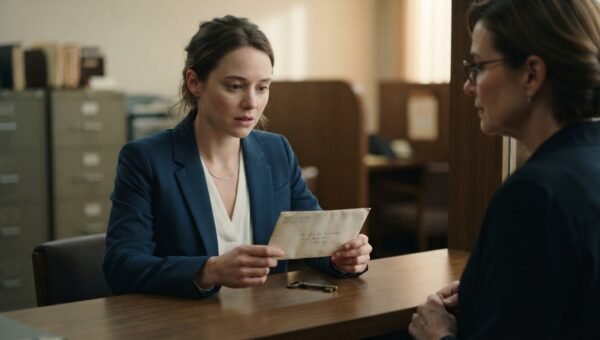
I only touched the jacket an hour later because the rental shop charged a fifty-dollar late fee if it was not back by noon. When I reached into the inside breast pocket to make sure his sunglasses were not left behind, my fingers brushed a stiff slip of paper.
The detail I kept coming back to was a parking receipt from the riverboat casino across town. It was stamped 2:18 PM on the afternoon of my wedding.
I told myself I only wanted one clear answer. I was still trying to process why my quiet, frugal father would skip his only daughter’s wedding to sit in a casino garage.
Then my eyes moved to the bottom line. Printed beneath the fifteen-dollar valet charge was the name on the credit card used to pay for the ticket: Nathan Cole.
My husband had paid for my father’s parking forty miles away while he was supposed to be waiting for me in the church parlor.
PART 2
I stood by the kitchen island with the receipt between my fingers. Nathan was still upstairs sleeping off the reception champagne. His leather wallet was sitting right by the coffee pot, next to his car keys.
I walked over, opened the billfold, and checked the last four numbers on his personal credit card. They matched the digits printed beside the authorization code on the receipt.
Nathan had arrived at the church at one in the afternoon. His mother had made a fuss about how handsome he looked in his vest, and his best man had posted a picture of the two of them in the chapel garden around 1:30.
There was no physical way Nathan had driven forty miles to the riverboat casino, paid for valet parking at 2:18, and driven back in time for our 3:30 vows.
That meant only one thing. My father had Nathan’s card in his pocket.
I left the rental suit on the sofa, took my car keys, and drove straight to my father’s small brick house on Maple Street. His truck was parked in the gravel drive, ticking as the engine cooled.
When I pushed open the unlocked back door, my father was sitting at his kitchen table in an undershirt and work pants. A chipped mug of black coffee sat between his rough hands. He looked up at me, his eyes rimmed in red, and he did not say a word.
I laid the white slip of paper flat on the table between us. “You told me you could explain,” I said. My voice was shaking, but I kept it low. “Start now. Why did you have Nathan’s credit card at the casino an hour before my wedding?”
My father stared at the slip. He did not pull it toward him. He looked like an old oak tree that had taken one storm too many.
“Nathan called me at one-thirty,” my father said quietly. “I was already dressed. I had my corsage pin on the dresser, ready to walk out the door.”
“Why did he call you?”
“He said he was in trouble,” my father answered, his voice steady but hollow. “He said three men had shown up at the chapel parking lot before the guests arrived. They didn’t want a scene at the church, so they took him in a car over to the riverboat cage. They told him if he didn’t clear an eight-thousand-dollar debt by three o’clock, they were going to walk right into that chapel during the ceremony and take his car, his watch, and make sure everybody knew what he owed.”
The air went completely still in the kitchen.
“Nathan didn’t have eight thousand dollars,” my father said. “He spent his savings on the rehearsal dinner and the band to look big in front of his family. He begged me not to tell you. He told me it would ruin your life if they made a scene.”
PART 3
I pulled out the chair across from him and sat down. “You went there?”
“He’s your husband, Laura. You loved him. I thought he was just a young man who got in over his head and panicked.” My father looked down at his rough knuckles. “Nathan gave those men his credit card to pay the valet so they wouldn’t leave his car on the street, but the card was over the limit for the debt itself. The men wouldn’t let Nathan leave until the cash was on the table.”
“So where did you come in, Dad?”
“I went by the First National branch on Fourth Street and took out eight thousand two hundred dollars from my savings. The clerk had to count it out twice because of the federal withdrawal slip. That took twenty minutes right there.”
He rubbed his forehead with a thumb. “I drove to the casino cage. I handed the envelope to the floor man Nathan pointed out. Nathan took the keys, took his wallet, and ran out to his car. He told me he was speeding back to the church so you wouldn’t be standing there alone. He said he would tell the pastor to hold the start until I got back.”
“Nathan was already at the altar when I arrived,” I said, my chest tightening. “He acted like he had been there all afternoon.”
“My truck wouldn’t turn over in that concrete garage,” my father whispered. “The alternator died. By the time the tow driver got me jumper cables, it was quarter past three. I called the church office twice from my cell, but nobody picked up the line. When I finally got to the church steps, the parking lot was full and the organ was playing the recessional.”
He swallowed hard. “I stood behind the glass doors and watched Nathan kiss you. He looked happy. You were smiling, but you looked worn out. I couldn’t walk into that foyer in my grease-stained cuffs and make a scene. I went back to my truck and sat there until the lot cleared out.”
The anger I had carried for twenty-four hours did not just disappear; it turned around and pointed straight at the man sleeping in my bed across town.
My father had emptied a third of his retirement fund, endured the shame of missing the only walk we would ever take together, and let me yell at him on his own porch, all to keep my wedding day from turning into a public circus. Nathan had stood at that altar, held my hand, and let my father take the blame for being unreliable.
I stood up. I reached out and picked the parking receipt off the table.
“Get your boots on, Dad,” I said.
“Laura, don’t do something crazy,” he said, rising halfway out of his chair.
“I’m not doing anything crazy,” I told him. “You paid eight thousand two hundred dollars to buy me a wedding day. I’m going to make sure you get every penny back before lunch.”
ENDING
When we walked into our kitchen forty minutes later, Nathan was sitting on a barstool eating a bowl of dry cereal. He looked startled to see my father standing behind me.
“Arthur,” Nathan said, setting his spoon down and trying to put on a polite smile. “Laura, I thought we agreed we’d give your dad some time to rest after yesterday.”
I didn’t answer him. I laid the First National withdrawal receipt and the casino parking slip right beside his cereal bowl.
Nathan’s face dropped the second his eyes hit the bank stamp. The easy, charming look he wore for my family vanished completely.
“You have until five o’clock on Monday to wire eight thousand two hundred dollars into my father’s checking account,” I told him. My voice was low, perfectly calm, and completely finished. “If that money isn’t back in his account by five, I am taking these two slips of paper to your mother and your partners at the firm.”
Nathan looked from me to my father, his mouth opening and closing without a word. He tried to reach for my wrist, but I stepped back out of his reach.
“Laura, please,” Nathan muttered. “You don’t understand the pressure I was under.”
“I understand that my father took the blame for you,” I said. “And I understand that you let him.”
We didn’t go on the honeymoon to Savannah. Nathan spent that afternoon on the phone with his bank, transferring funds from a high-interest line of credit he had kept hidden from me. By Monday at two in the afternoon, the wire cleared into my father’s account.
Three months later, the marriage was formally annulled for financial fraud. It took time to untangle the paperwork and move my furniture out of the house, but I never looked back.
On Sunday mornings now, I drive over to Maple Street. My father’s blue truck has a brand-new alternator under the hood, and we sit at his kitchen table with two chipped mugs of coffee. We don’t talk about the church runner or the dress that stayed in its plastic bag. Some promises get broken in public, but the quiet ones you keep for each other are the only ones that actually matter.