PART 1
My 74-year-old mother started locking her bedroom door every afternoon at two o’clock sharp.
She had lived in that brick ranch house in western Pennsylvania for forty-two years, and she had never locked an interior door in her life. When Dad was alive, our house didn’t even have keys in the brass knobs. So when I stopped by to drop off groceries three Tuesdays in a row and found her bedroom handle rigid, my stomach knotted up.
Mom had forgotten a pot of soup on the burner back in November. In January, she put the television remote in the crisper drawer. I was terrified of dementia, stroke damage, or some quiet decline she was hiding out of pride.
Last Thursday, she had an appointment with her rheumatologist at two-fifteen. Her friend Evelyn picked her up in the driveway. As soon as Evelyn’s sedan backed into the road, I went to the pantry, climbed onto the step stool, and took down the old tackle box where Dad kept spare keys.
The brass skeleton key worked on the second turn.
I expected pills she was hoarding. I expected unpaid property tax notices or predatory credit card mailings. I thought I might find filthy laundry or rotten fruit tucked under the mattress, the kind of things people find when an aging parent begins to lose track of the world.
Instead, the room was spotless. The chenille bedspread was pulled tight over the pillows.
The only thing out of order was on the small sewing desk in the corner.
A tin cookie box sat open beneath the desk lamp. Inside were stacks of drawings made on cheap ruled paper: crayon sketches of dogs, stick-figure baseball games, and pencil portraits of our town’s old steel bridge. Tied around the drawings with a piece of butcher twine were twenty-six envelopes. Every single one had the same return address stamped in purple ink: State Correctional Institution Rockview. Every envelope was addressed to Mrs. Eleanor Vance.
And on the back of each envelope, written in neat block print, was the sender: Thomas Vance.
My father’s name was Arthur. My name is Claire. I had never heard the name Thomas in my life.
I sat on the edge of Mom’s cedar chest with the letters in my lap for nearly an hour. The letters inside were short, polite, and full of small details.
The writer asked about the hydrangeas in the front yard. He asked if the kitchen pipes still rattled when the washer filled. In the most recent letter, postmarked six days earlier, the writer had written: “The hearing went through. I catch the 1:15 bus from Bellefonte on the twenty-second. I have enough gate money for a coat. You do not need to meet me at the station.”
The sound of Evelyn’s car door slamming outside brought me back to my feet.
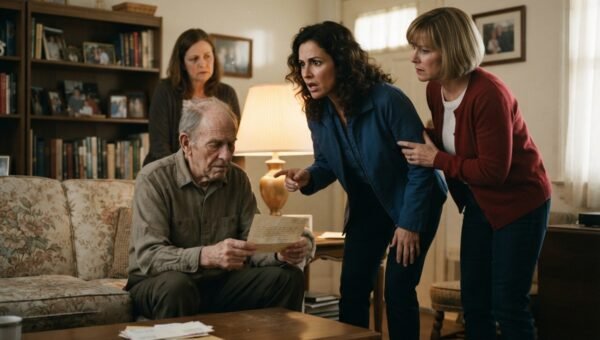
I didn’t hide the tin. I carried it out to the living room, set it right in the middle of the coffee table, and waited.
Mom walked in carrying her cardigan over her forearm, breathing a little hard from the front steps. When she saw the tin and the stack of prison mail sitting beside my purse, she stopped. Her car keys made a dull clatter as she set them on the entryway console.
“Who is Thomas?” I asked. My voice sounded higher than I wanted.
Mom walked into the room without looking at me. She sat down on the edge of the floral sofa, folded her hands in her lap, and took a slow, heavy breath.
“Your brother,” she said.
A dry laugh came out of my throat. I couldn’t help it. I was forty-eight years old. I had grown up as an only child in that house. I took piano lessons alone, sat in the backseat of Dad’s Buick alone, and buried Dad three years ago completely alone.
“Mom, stop it,” I said. “I don’t have a brother. Did you get taken in by one of those prison pen-pal scams? Did you send someone money?”
She didn’t answer. She reached into the large leather handbag she always carried, unzipped the inner pocket, and pulled out an envelope made of heavy, yellowed cardstock. She handed it across the table.
It was a certified copy of a birth certificate from St. Jude’s Hospital in Pittsburgh, dated May 14, 1971. That was three years before I was born.
The mother’s name was Eleanor Mae Miller, my mother’s maiden name. The father’s line was a row of typed asterisks. The baby boy was registered as Thomas Miller.
“I don’t understand,” I whispered. My hands were shaking so hard the paper rattled. “Where has he been? Where was he when I was growing up?”
Before Mom could answer, a loud, deliberate knock echoed through the front door.
Three raps. Solid and firm.
Mom’s head snapped toward the hallway. Her face went completely still. She gripped the fabric of her skirt, looked at the grandfather clock by the coat rack, and whispered, “He’s early.”
PART 2
The second round of knocks came before I could stand up.
“Don’t open it,” I told her. The letters on the table suddenly felt like dangerous objects. “Mom, you don’t know who is standing out there. You’ve been writing to an inmate. You don’t bring people from a state penitentiary to your front porch.”
“He has a key,” Mom said quietly. Her voice wasn’t panicked. It was resigned, the way she sounded when she finally admitted Dad wasn’t coming home from the hospice wing. “I mailed it to him two weeks ago. He’s knocking out of courtesy.”
The brass doorknob rattled. We both looked down the narrow hallway.
The door pushed inward, and the cold March draft hit the floorboards. A man stepped across the threshold, wiping his work boots carefully on the bristled mat.
He was tall, slightly stooped, with salt-and-pepper hair cut down to the scalp. He wore an olive green army-surplus field jacket that was two sizes too large for his shoulders, cheap denim pants, and brown boots that looked brand new. In his left hand, he carried a black nylon duffel bag with no logo.
When he looked up, my chest seized. He didn’t look like my father at all, but he had Mom’s eyes: small, dark hazel, set deep beneath heavy brows, with the exact same tiny cleft in the center of his chin.
“Eleanor,” he said. His voice was raspy, like someone who hadn’t used his vocal cords for an entire afternoon.
Mom stood up from the sofa. She looked smaller than she ever had, barely coming up to his chest. She walked over to him without hesitation and put both hands flat against his chest. She didn’t hug him right away. She just kept her palms there, feeling his breathing, as if she were checking to see if he were made of solid matter.
“You caught the early coach,” she said.
“Driver made good time on eighty,” he said. He glanced over her shoulder and saw me standing by the coffee table, holding the yellow birth certificate against my stomach like a shield. His posture stiffened immediately. He dropped his gaze to the linoleum floor. “I told you I could go to the shelter in Altoona for the first week. You said she wouldn’t be here until Sunday.”
“She came early too,” Mom said softly.
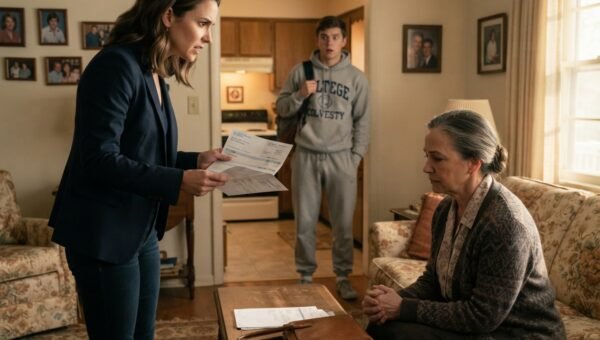
“What is this?” I demanded. I walked toward them, stopping just past the dining room archway. “Mom, you tell me right now what this is. You let an ex-convict walk into this house with a key? Who is this man?”
The man didn’t get angry. He didn’t step forward or raise his voice. He took one step backward, his back almost touching the front door, and set his duffel bag down by his boots.
“I’m Thomas,” he said, looking at the floor between our shoes. “I did eight years for commercial burglary at a distribution warehouse in Clearfield. I got paroled this morning at eight. I have seventy dollars in my pocket and a voucher for a state bus pass. That’s the whole file, if you’re wondering.”
“That’s not what I asked,” I said, my voice cracking. “I want to know why my mother has your birth certificate, and why she’s hiding twenty-six of your letters in her sewing table while she locks herself in her room like a stranger.”
Mom turned around slowly. “Sit down, Claire. Sit down and let me pour a pot of tea. If you want to shout, you can shout after I tell you.”
We sat in the kitchen. Thomas didn’t sit at the head of the table where Dad used to sit. He chose the small wooden chair by the radiator, keeping his hands flat on his knees. Mom filled the kettle, her movements mechanical and slow.
“In 1970, I was nineteen,” Mom began. She didn’t look at either of us; she watched the blue flame beneath the kettle. “I worked at the telephone company in Greensburg. I met a boy named Dale who worked on the pipeline. He stayed in town three months, and by the time I knew I was pregnant, his crew had moved to Texas. He never answered a letter, and his supervisor said he’d quit.”
I stared at her. My mother had been the church organist for thirty years. She kept the altar linens clean. She ironed pillowcases.
“My father told me I had two choices,” Mom continued, her voice flat and steady. “I could go to the home for unwed mothers in Bethlehem and give the baby up, or I could leave the house with twenty dollars and never speak to my sisters again. I went to Bethlehem. I carried Thomas for nine months in a dormitory with forty other girls. When he was born, they let me hold him for ten minutes. Then a woman from county social services carried him down the hall in a white blanket.”
“You gave him up,” I said.
“I surrendered him,” she corrected. “There is a difference. I didn’t want to let him go. But I was nineteen, I had no money, and the world in 1971 didn’t give apartment leases to unmarried girls with infants.”
Thomas looked out the kitchen window toward the bare dogwood tree in the yard. “I got placed with a family in Butler,” he said quietly. “They were decent people until my adoptive dad died of a coronary when I was twelve. After that, things went sideways. Foster homes. Group homes. I dropped out in tenth grade.”
“And Dad?” I asked Mom, the anger rising back up. “Did Dad know? Did Arthur know you had a son?”
Mom turned the burner off as the kettle began to hiss. She didn’t pour the water.
“Arthur knew before we got married,” she said. “He told me he would give me a good life, a clean name, and a home of my own. But he made one condition. He said the boy belonged to another life, and if I ever looked for him, our marriage was over.”
PART 3
The silence in the kitchen was thick.
I looked at the framed photograph hanging on the wall beside the refrigerator: Mom and Dad on their twenty-fifth anniversary in Cape May. Dad had his arm around her shoulders, grinning, looking like the pillar of the community he had always been. He was a deacon. He ran the local hardware store. Everyone in town said Arthur Vance was the most generous man in the county.
“He forbade you?” I whispered.
“He protected what was his,” Mom said, not with bitterness, but with an old, dried-out honesty. “He wanted a family that was completely his own. When you were born, Claire, he told me that you were my only child now. And for thirty-five years, I obeyed him. I kept the house. I raised you. I never searched a registry. I never asked around Butler.”
She walked to the table and laid the stack of twenty-six envelopes between the sugar bowl and the napkin holder.
“Then Arthur got sick,” Mom said. “Three years ago, when the oncologist told us there was nothing left to do, Arthur woke up one night in the hospital. He was very clear-headed. He looked at me and said, ‘If you need to find him after I’m gone, Eleanor, you do it. Just don’t let people talk while I’m in the ground.'”
Thomas shifted in his chair. “A state caseworker found me in 2023,” he said. “I was five years into an eight-year stretch. I didn’t think it was real. I thought somebody was running an inmate locator scam to get canteen money. But then the first letter came. She described the birthmark on the back of my left shoulder. Nobody knew about that except the county intake file from 1971.”
“Why did you lock your door, Mom?” I asked, looking at her weathered hands. “Why hide it from me? I’ve been coming over here three days a week worrying that you had Alzheimer’s. I thought your mind was slipping.”
“Because I was ashamed,” Mom said. Her chin quivered, the first crack in her composure all afternoon. “I was ashamed that I left him out there in the world for fifty years while you and I had clean sheets, heat in the winter, and Sunday dinners. And I was afraid of you, Claire.”
“Afraid of me?”
“You’re Arthur’s daughter,” she said softly. “You have his temper. You have his sense of right and wrong. You see things in straight lines. I thought if you knew I had a boy who spent his life in trouble and ended up behind bars, you would look at me the way your father looked at people who made mistakes.”
The words hit me square in the chest.
She was right. If she had told me three years ago that she wanted to reach out to an estranged son in state prison, I would have warned her about con artists. I would have brought financial power-of-attorney papers to the kitchen table. I would have told her she was being reckless with Dad’s life insurance. I would have treated her like an elderly woman who couldn’t protect herself.
“The drawings,” I said, remembering the ruled paper in the tin box. “What were those?”
Thomas cleared his throat. “I don’t have kids,” he said, his ears turning red. “When I was in county lockup back in my twenties, an art instructor came in twice a week. He taught us how to draw from memory. When Mom and I started writing, she told me about this house. She told me about the kitchen, the garden, the dog you had when you were twelve. I drew what I imagined I missed. Just to pass the time between head counts.”
I picked up the top drawing from the stack. It was a pencil sketch of our back porch, drawn with painstaking precision: the split railing, the concrete steps, the aluminum clothesline pole. Thomas had never seen that porch until today, but he had drawn it from her letters.
“What are your plans, Thomas?” I asked. My voice wasn’t warm, but the edge was gone.
“The parole board approved this address for my home plan,” he said. “I have to report to the probation office on Market Street tomorrow morning by nine. There’s a pallet factory outside of town that hires re-entry workers on the second shift. If they take me, I pay Mom two hundred a month for the basement room, buy my own food, and stay out of the way. If she wants me to leave, the shelter in Altoona has a bed on Monday.”
He picked up his nylon duffel bag and set it on his knees, ready to stand up if I told him to.
I looked at Mom. She wasn’t watching Thomas; she was watching me. She was waiting for Arthur’s daughter to give the verdict.
ENDING
I stood up and walked to the stove. The kettle was still warm, but the water had stopped steaming. I struck a match, lit the burner again, and reached into the cupboard for three mugs instead of two.
“The basement is damp,” I said, keeping my back turned while the water heated. “The sump pump kicks on every twenty minutes when it rains. You’ll need the electric space heater from the hall closet, and the spare blankets are on the top shelf.”
Behind me, nobody spoke for a long time.
Then I heard the dull thud of Thomas’s duffel bag hitting the linoleum as he set it down on the floor for good.
“I can fix the float on that sump pump,” Thomas said quietly. “I did maintenance work at the facility. It probably just needs the switch cleaned.”
“We’ll look at it after breakfast tomorrow,” Mom said. Her voice sounded lighter, like a weight she had carried since 1971 had finally been laid down on the floor between us.
I brought the three mugs to the table and set one in front of Thomas. He looked at the mug, then looked up at me. He didn’t offer a handshake, and I didn’t offer an embrace. We were fifty years behind, and two hours at a kitchen table wasn’t going to turn us into siblings overnight. There were still parole officers to deal with, neighbors who would ask questions, and a whole lifetime of missing years neither of us knew how to talk about.
But as I sat down, I noticed his hands resting beside the ceramic mug. His knuckles were thick and square, with the exact same crooked pinky finger I had inherited from Mom.
“Do you take milk?” I asked him.
“Just black,” he said. “Thank you, Claire.”
Mom reached across the table, took the yellow birth certificate, folded it neatly along its original creases, and laid it right beside the sugar bowl. She didn’t put it back in her purse. For the first time in my life, she left the bedroom door wide open.