PART 1
The scratch ran six feet along the passenger side, white and jagged against my dark gray paint.
My sister, Laura, stood on my driveway on a Tuesday afternoon, handing back my keys. Her own sedan had been at the transmission shop since Friday. She looked tired, with dark rings under her eyes and her hair pulled into a messy clip.
“I topped it off,” she said, nodding toward the driveway.
When I started the engine after she left, the low-fuel light pinged immediately.
The needle sat flat on empty. I walked around the passenger side and saw the gouge. It was deep enough to catch my fingernail, starting near the front wheel well and ending at the back handle.
I called her right away. Laura answered on the second ring.
“I have no idea how that happened,” she said. Her voice was too quick, pitched high. “I only drove it to work and the grocery store. Somebody must have hit you in the parking lot at the market. And the gas gauge was fine when I parked it. Maybe the sensor is broken.”
I was angry, but I let it drop. Laura was forty-two, four years younger than me, and she had always been careless with other people’s property. She lived four streets away from our seventy-one-year-old mother and handled most of the daily drop-ins, so I told myself a tank of gas and an insurance deductible were not worth a family feud.
Forty-eight hours later, an electronic toll notice landed in my email inbox.
The toll authority in our state operates with overhead night cameras on the river bridge connecting our county to North Valley. The notice listed the date as Sunday night, the time as 2:17 a.m., and the amount as $4.75.
Attached was a high-resolution night-vision photograph of my car on the suspension deck.
Laura was behind the wheel. The camera caught her face clearly through the windshield under the highway halogen lamps. In the passenger seat sat a second person, slumped low against the headrest, wrapped in an oversized dark coat.
Laura’s husband works third shift at the water treatment plant, so I knew he was not in that car.
I called Laura while staring at the screen on my laptop.
“The toll system sent me a picture,” I said. “Sunday night. Two seventeen in the morning on the north bridge.”
She went quiet for three seconds. “Their clock is wrong. I told you, I went to the market at five on Sunday.”
“I am looking at you,” I said. “And someone is sitting next to you. You have one chance to tell me the truth.”
I waited for her to confess to an affair, or to sneaking out with some friend she was embarrassed about.
Instead, Laura exhaled a ragged breath into the phone.
“I was taking Mom somewhere,” she said.
My stomach dropped. Our mother had gone to bed at nine o’clock Sunday night. I had talked to her on the landline myself while she drank her chamomile tea.
“Mom was asleep,” I said.
“No, she wasn’t,” Laura whispered. “Look at the building right off exit four on the other side of that bridge.”
PART 2
Exit four led to only two places at two in the morning: a twenty-four-hour truck stop and the regional geriatric psychiatric hospital.
“Why was she in my car?” I asked. My voice shook. “Why didn’t you call me?”
“Because you would have called nine-one-one,” Laura said. “And Mom made me swear on Daddy’s grave that I wouldn’t let strangers put her in an ambulance.”
I drove over to Laura’s house twenty minutes later. Her husband was asleep before his night shift, so we stood in her kitchen by the back door, talking in low, tight whispers.
Laura pulled two folders from a kitchen drawer. They were full of medical receipts, clinic notes, and handwritten logs going back eight months.
“Mom’s doctor warned her in February that her memory tests were slipping,” Laura said, keeping her eyes on the counter. “Mom hid the paperwork from you. She told the doctor that I was her primary emergency contact because she knew you worked fifty hours a week in the city.”
“She has an evaluation on file?” I asked. I picked up a carbon copy from a clinic in North Valley. The diagnosis line had two words typed in blue ink: moderate cognitive impairment, early Alzheimer’s type.
“She started wandering in July,” Laura said. “Just in the backyard at first. But Sunday night she walked three blocks down Elm Street in her nightgown and slippers at one in the morning. A neighbor found her trying to open the back door of the old bakery where Daddy used to work. The bakery closed twelve years ago, Nora.”
Laura pointed out the window toward my car parked on the street.
“The neighbor called me directly because Mom had my number taped inside her slipper. When I tried to get her into your car, she fought me. She thought I was trying to rob her. She took her metal garden trowel out of her pocket and dragged it down the door panel trying to push me away.”
“Why the bridge?” I asked. “The county hospital is ten minutes from her house.”
“The county hospital keeps patients in the regular emergency bay for days,” Laura said. “The North Valley facility has a private emergency assessment wing for seniors. I had to get her calmed down, checked for hypothermia, and back in her bed before sunrise so you wouldn’t find out.”
I leaned against her counter. “Why would you hide this from me? I am her daughter too.”
“Because you fix things with spreadsheets and facilities,” Laura said, and her voice finally broke. “Mom knows you. She said, ‘If Nora finds out I got lost, she will have my house sold and me in a nursing home before Thanksgiving.’ She begged me to protect her.”
PART 3
I spent the next morning at our mother’s house.
The kitchen looked normal on the surface. The yellow curtains were open, the copper kettle sat on the front burner, and the small radio on the counter played soft big band music. But when I looked closely, the reality was everywhere.
The stove knobs had been removed and placed on top of the refrigerator where she could not reach them. Inside the pantry, cans of soup were arranged backward. On the dining room table sat a notepad covered in Mom’s shaky cursive: *Keys are in the blue dish. Nora comes on Sunday. Laura comes at noon.*
Mom came out of the bathroom wearing her good wool sweater over cotton pajama bottoms. She smiled when she saw me, but her eyes held a careful, frightened distance.
“Nora,” she said, touching her hair. “You didn’t say you were coming today.”
“I had some free time,” I said gently.
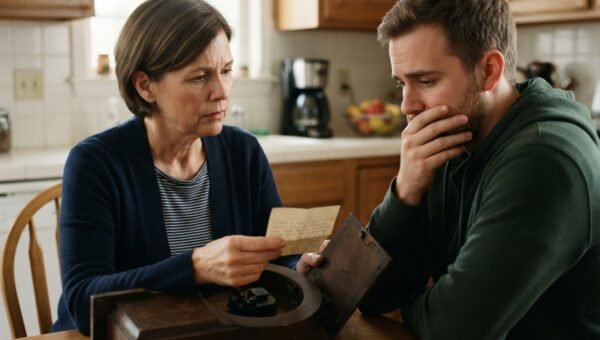
I made tea. While the water heated, I sat beside her and placed the bridge toll receipt on the table between our cups.
Mom stared at the paper for a long time. She did not touch it. Her fingers smoothed the hem of her sweater over and over.
“Laura told you,” she whispered.
“She had to,” I said. “You were out in the cold on Sunday.”
Mom’s eyes filled with tears, but she held her chin up. It was the same stubborn pride she had carried through forty years of marriage and twenty years of widowhood.
“I am not crazy, Nora,” she said. “I just get turned around when the sun goes down. Everything looks different at night. The street signs don’t make sense anymore.”
“You don’t have to be afraid of me,” I said.
“You have a plan for everything,” Mom said. Her voice was small, thin like paper. “You always have. You took care of your father’s estate in three weeks. You had his clothes donated before the month was out. I was afraid you would take my keys, pack my dishes into cardboard boxes, and leave me in a room with a plastic identification bracelet.”
Hearing her say it hit harder than any argument Laura and I had ever had.
She was right about me. My instinct when trouble came was to take control, organize the problem, and make fast, practical decisions. I had treated our mother’s aging like a project to manage instead of a life she was trying to hold onto.
“I am not packing your dishes,” I told her.
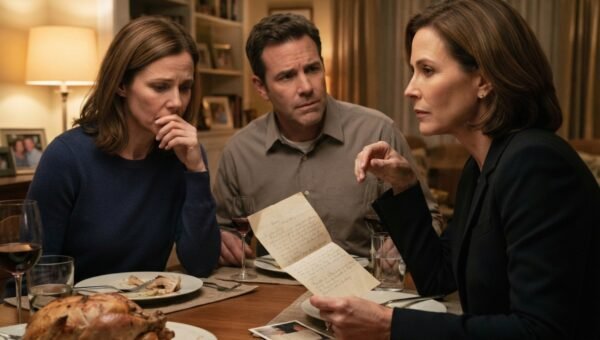
We sat together at the table for two hours. Laura came over at noon, just like the notepad said. The three of us sat in that yellow kitchen and talked without yelling, without excuses, and without secrets.
We agreed on what had to happen next. Mom agreed to allow daytime home health aides three days a week so Laura would not be carrying the burden alone. We installed door alarms that connected directly to both of our phones if an exterior door opened between ten at night and six in the morning. And we scheduled an appointment with the neurologist together, as a family.
ENDING
The body shop charged nine hundred dollars to sand down the passenger door, fill the gouge, and repaint the panel. Laura tried to hand me three hundred dollars toward the bill, but I gave the envelope back to her.
She had been carrying the weight of our mother’s failing memory alone for eight months because I had made myself too efficient to be trusted with her fear.
Now, on Tuesday nights, I stay at Mom’s house.
We eat soup from the cans in the pantry and sit together in the living room until nine o’clock. When she gets confused about the year or asks where my father went, I do not correct her with facts or dates. I just sit on the sofa, hold her hand, and tell her that everything she needs is right here in this room.
When she falls asleep, I check the front door latch, set the night chime, and put the car keys in my pocket.