PART 1
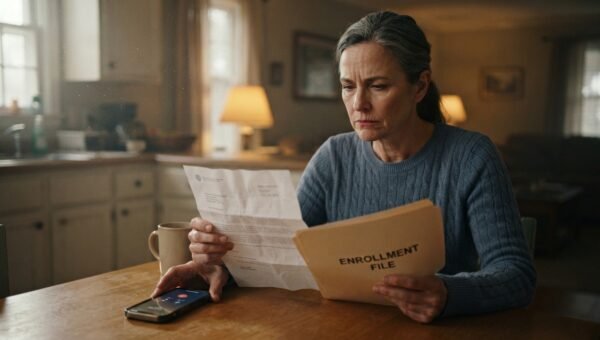
For thirty-one years, I worked as the head billing coordinator for a county medical clinic.
I raised my two boys, Jason and Bradley, in a modest three-bedroom split-level in suburban Ohio. Their father walked out when Bradley was six and Jason was nine, leaving behind an old pickup truck with a cracked block and eighty-four dollars in a joint checking account. From that day on, my life was measured in double shifts, coupon envelopes, thrift-store school clothes, and keeping the furnace running through bitter winters.
I paid off the split-level mortgage when I turned fifty-eight. I helped both boys with their state college tuition so they did not drown in student loans. When Jason married Kelly and had three kids, I was the one who bought their nursery furniture. When Bradley started his independent landscaping firm and needed commercial insurance deposits, I co-signed the note and gave him four thousand dollars to secure the truck.
I never complained. I believed that is what a mother does. You pour yourself out like water until the pitcher is dry, and you tell yourself that seeing them stand on their own two feet is your reward.
On a Friday evening in early May, my family gathered in the private back room of an Italian steakhouse downtown to celebrate my official retirement. I was sixty-four years old. After three decades of insurance codes, Medicare audits, and forty-hour weeks, my service was finished.
My state pension was locked in, my modest retirement savings were intact, and I was finally free.
Around the table sat Jason, his wife Kelly, their two youngest children, Bradley, his long-term girlfriend Megan, and my younger sister, Clara.
The dinner had barely reached the main course when the conversation shifted. It did not shift to my career, or to the fact that I had not taken a full week of vacation since 2011. It shifted directly to my calendar.
“Mom, now that you are off the county payroll, we need to sit down and map out the summer,” Jason said, cutting into his ribeye. “Kelly’s maternity leave at the dental office is ending, and infant daycare in our school district is fourteen hundred dollars a month. That is highway robbery. If you take the baby and the toddler Monday through Thursday, Kelly can work four full days. It saves us nearly twenty grand a year, and you get plenty of quality bonding time.”
Kelly nodded eagerly, wiping marinara sauce from her little boy’s chin. “We can even set up your old rocking chair in our basement playroom, Brenda. You can stay over on Wednesday nights so you don’t have to drive in morning traffic.”
Before I could swallow my water, Bradley leaned across the white tablecloth, his fork pointed right at his older brother.
“Hold on a minute, Jason,” Bradley broke in, his voice rising with that competitive edge he had carried since childhood. “You already had Mom watching your kids every Saturday morning for three years while you played golf. That is completely unfair. Megan and I are trying to refinance our bungalow so we can add an upstairs master suite. Rates are terrible right now. Mom, your split-level is worth at least two hundred and sixty thousand dollars. If you sell it, you can move into our daylight basement apartment. We can put your pension toward the combined mortgage, and you won’t have to worry about lawn care or property taxes ever again.”
“Your basement apartment smells like damp concrete, Brad,” Jason snapped. “And Mom is not selling her house just to finance your second-story renovation. Childcare is an immediate household necessity.”
“Oh, and paying your household bills isn’t using her?” Bradley sneered. “You just want a free live-in nanny so you and Kelly can keep your gym memberships!”
I sat back in my high-backed chair, watching them.
Neither of them had looked at my face once. They did not ask how my arthritis was feeling after years of typing at a desk. They did not ask what I wanted to do with my mornings, or whether I wanted to sleep past six o’clock for the first time in thirty years. They were carving up my days, my energy, and my bank account like leftover roast beef on a Sunday platter. To them, I was not a woman who had just completed thirty-one years of labor. I was an asset to be managed, a piece of family furniture to be moved where it was most convenient.
Beside me, my sister Clara set her wine glass down with a firm click against the wood. She looked at me, her dark eyebrows raised, waiting to see how long I would let them talk.
I let them go back and forth for another three minutes. They argued about square footage, driving distances, and gas allowances.
Finally, I picked up my linen napkin, wiped my lips, and laid it neatly beside my plate.
“Boys,” I said.
My voice was not loud, but the calm tone cut through their bickering. Both of them stopped and looked at me, slightly annoyed at being interrupted.
“You can stop drawing up schedules,” I told them evenly. “I have already made my plans. I am moving.”
Jason let out a short, dismissive laugh. “Moving where, Mom? Florida? You hate humidity.”
Bradley chuckled into his beer. “You can’t move to Florida. Senior condos down there are through the roof, and your split-level needs twenty thousand in plumbing updates before you could even list it.”
I did not argue. I reached into my handbag, pulled out a four-by-six glossy photograph, and slid it across the white tablecloth. It came to rest right between Jason’s bread plate and Bradley’s steak knife.
The photograph showed a small, immaculate buttercup-yellow cottage with white trim, sitting on a gentle green rise twenty yards from the shoreline of a quiet, clear lake. A wide screened porch ran across the entire front, shaded by two massive weeping willows.
Jason picked up the photo. He frowned, turning it over to check the back, then looked at me with genuine confusion.
“What is this?” Jason asked. “A rental cabin for a weekend?”
“That is my new home,” I said. “I closed on it ten days ago. The movers are coming to pack the split-level on Tuesday.”
Bradley snatched the picture from his brother’s hand. His eyes narrowed, his forehead creasing in irritation.
“Wait a second,” Bradley said, his voice dropping into a harsh, suspicious pitch. “Lake Erie waterfront property? Even a small lot out there goes for three or four hundred thousand dollars. Mom, you don’t have that kind of cash. Did you pull money out of your state pension early? Did you take out a massive mortgage behind our backs? How on earth could you afford this?”
Before I could open my mouth to answer, Clara lifted her wine glass high into the candlelight.
She smiled a sharp, knowing smile, looked directly across the table at both of my sons, and said, “Should I tell them what their mother has been doing every Saturday for the last eleven years?”
PART 2
The table went completely still. Even the grandchildren stopped squirming.
Jason stared at Clara, his fork suspended halfway to his mouth. “What are you talking about, Aunt Clara? Mom was at home on Saturdays. Cleaning the house. Doing laundry.”
“No, Jason,” Clara said, taking a slow sip of her pinot noir. “She was not.”
Bradley shook his head, his face turning an aggravated shade of pink. “Yes, she was. Whenever I dropped off my dirty work clothes or swung by to borrow her lawn mower, she was around.”
“You came by at eight in the morning or eight at night, Brad,” Clara replied, setting her glass down with deliberate precision. “Between nine in the morning and four in the afternoon every single Saturday since 2015, your mother was forty miles away in Medina County.”
Kelly leaned forward, her eyes wide with curiosity and concern. “Doing what, Brenda? You had another job? You never told us that.”
I looked at my daughter-in-law. “It was not a job, Kelly. It was my life.”
Eleven years ago, after both boys had finished college and moved into their own apartments, I woke up in that quiet split-level on a Saturday morning and realized something terrifying. My entire identity was built around answering other people’s emergencies. If the phone did not ring with a crisis, I did not know who Brenda was.
My grandmother had been a master quilter and fiber artist in rural Pennsylvania. When I was a little girl, she taught me how to dye raw wool with walnut hulls and marigolds, how to spin flax on an antique treadle wheel, and how to draft traditional geometric patchwork patterns. During my thirty-one years at the county clinic, that part of me had been buried under billing statements, claim forms, and the endless hustle of keeping food on the table.
In the spring of 2015, Clara drove me out to an artisan cooperative tucked inside a restored timber barn in Medina County. There was an open studio space in the back with tall northern windows and high rafters. The rent was two hundred and fifty dollars a month.
I took that little space. I bought a commercial-grade longarm quilting machine from a retired textile teacher who was moving to Arizona, paying eighteen hundred dollars in cash from a small inheritance my aunt had left me.
Every single Saturday for eleven years, while Jason assumed I was sitting by the phone and Bradley assumed I was waiting for his laundry, I got in my car and drove to Medina.
I designed custom heirloom heritage quilts. I made museum-quality wall hangings using hand-dyed wools and vintage linens. I restored antique quilts from the nineteenth century for collectors, historical societies, and interior designers across the Midwest.
“You make quilts?” Jason asked, his voice dripping with condescension. “Mom, you bought a lake house by selling blankets at craft fairs? Are you serious?”
“They were not blankets at craft fairs, Jason,” Clara cut in, her tone sharp enough to draw blood. “Your mother does not sell pot holders at church bazaars. She was commissioned by architectural firms in Chicago and New York. She restored a Civil War regimental quilt for the state historical society four years ago that paid nine thousand dollars alone. While you two boys were treating her house like a free dry cleaner and an emergency credit union, your mother was running an established, high-end studio under her own maiden name.”
Bradley looked like someone had slapped him across the mouth. He stared at the photograph of the yellow lake house, then looked at me with raw disbelief.
“You had a whole business?” Bradley whispered. “For eleven years? And you never told us?”
“Why would she tell you, Brad?” Clara asked, leaning across the table until she was looking right into his eyes. “Every time your mother had an extra five hundred dollars in her checking account, one of you showed up with a broken water heater, a past-due truck payment, or a pitch for some half-baked investment scheme. If she told you she had a successful studio, you two would have bled her dry before she ever reached sixty.”
PART 3
Neither of my sons spoke. Jason looked down at his steak plate, his jaw working silently. Kelly was staring at me with her mouth slightly open, as if she were seeing a complete stranger sitting in her mother-in-law’s chair.
Bradley was the first to find his anger.
“That is unbelievable,” Bradley muttered, tossing his cloth napkin into the middle of his plate. “We are your family, Mom! When I was struggling to keep the landscaping business going two years ago, I had to take out a high-interest line of credit! You sat there at your kitchen table and let me take that loan when you had thousands of dollars sitting in a business account?”
I looked directly at my youngest son. My voice was low, steady, and entirely free of the guilt I had carried for thirty years.
“Bradley,” I said, “two years ago, you bought a brand-new thirty-foot fiberglass fishing boat with twin outboards. You told me the line of credit was for commercial mowers, but three weeks later you were posting pictures of that boat docked at the marina. I gave you four thousand dollars for your business insurance when you started. I co-signed your truck. I paid off your credit card balance when you were twenty-four so you could qualify for your first apartment lease. I did not owe you my retirement so you could finance weekend toys.”
Bradley opened his mouth to shout, but the words died in his throat. He looked around the dining room, suddenly realizing that the waitstaff and the people at the neighboring table were watching him.
Jason cleared his throat, trying to regain his footing. He leaned forward, adopting that calm, reasonable tone he always used when he was trying to negotiate an advantage.
“Okay, Mom,” Jason said softly. “Look. We understand that you worked hard, and that’s great. Really. Congratulations on the art business. But let’s be practical here. You are sixty-four years old. You cannot live alone out on a lake. What happens when it snows? Who is going to plow your driveway? Who is going to maintain a property that far out from town?”
“The cottage has a brand-new metal roof, a high-efficiency geothermal heat pump, and an automatic whole-house generator,” I said. “And the township road is plowed by seven in the morning every winter. I am forty-five minutes from the county hospital. I am sixty-four, Jason. I am not an invalid.”
“And what about our arrangement?” Jason pressed, his voice tightening with desperation. “I told my office manager today that Kelly was returning four days a week starting in June! We planned our entire household budget around you watching the children! What are we supposed to do now?”
“You are going to hire a licensed daycare provider, Jason,” I said. “Or Kelly can work part-time until the baby is in preschool. The same way I worked night shifts and took typing jobs at home when you and your brother were small.”
Kelly’s face hardened into a cold, furious mask. “You are abandoning your grandchildren, Brenda. That is what you are doing. You are choosing a hobby house over your own flesh and blood.”
That word hit the table like a brick. *Abandoning.*
I did not flinch. I looked at Kelly, then at Jason, and finally at Bradley.
“I have spent thirty-one years making sure you two boys never went without,” I told them. “I wore shoes with worn-out soles so you could play middle-school football. I skipped dental work so you could go on your senior class trips. I gave you my youth, I gave you my health, and I gave you a safe home to grow up in. But I am not an inheritance to be divided up while I am still breathing. I am not a free day-care center, and I am not a mortgage co-signer for your basements.”
I reached into my handbag, pulled out two neat white envelopes, and set one in front of Jason and one in front of Bradley.
“What is this?” Jason asked, eyeing the paper suspiciously.
“Those are the spare keys to the split-level house,” I said. “The moving van takes my furniture on Tuesday. On Wednesday, a local painting crew is coming in to freshen the walls, and the real estate agent is listing the house on Friday morning. If there are any of your childhood belongings still in the attic or the garage, you have until Monday night at eight o’clock to remove them. Whatever is left on Tuesday morning goes into the estate sale dumpster.”
Bradley stared at the key in front of him. “You are selling our childhood home? Without even offering to let one of us buy it?”
“If either of you can qualify for a conventional mortgage at fair market appraisal, you are welcome to submit an offer through my listing agent,” I said calmly. “Just like any other buyer. But there will be no family discounts, no seller financing, and no deferred payments. That equity is going into my primary retirement trust.”
Bradley grabbed the envelope, his hands trembling with rage. “You really don’t care about us at all, do you?”
“I love you both,” I said, looking him dead in the eye. “I have loved you through every sacrifice of my adult life. But loving your children does not mean letting them consume you until there is nothing left of your bones. I have finished raising you. Now it is time for me to live.”
ENDING
Jason and Kelly stood up from the table without finishing their meals. Kelly gathered the children’s jackets in silence, her lips pressed into a hard, white line. Jason picked up his coat, looked at me for three long seconds as if waiting for me to back down, and then turned toward the exit.
“Have a nice life on your lake, Mom,” Jason said coldly.
They walked out into the restaurant lobby. Bradley and Megan lingered for another minute. Bradley stood with his hands jammed into his pockets, staring at the white envelope on the table. Finally, he snatched the key, gave Clara a look of pure disgust, and followed his brother through the double doors.
The private dining room was suddenly very quiet. The only sound was the low jazz music playing from the speakers near the ceiling.
Clara looked across the table at me. She did not say I told you so. She reached over, took my hand in hers, and gave it a long, warm squeeze.
“How does it feel, Brenda?” Clara asked softly.
I took a deep, clean breath. For thirty years, my chest had felt like it was wrapped in tight iron bands, waiting for the next phone call, the next bill, the next crisis that only Mom was supposed to solve.
Right then, looking out the restaurant window at the streetlights glowing in the warm May night, the iron band was gone.
“It feels like air,” I whispered.
The following week was a whirlwind of cardboard boxes, packing tape, and old memories. Neither Jason nor Bradley came to help carry boxes. On Sunday afternoon, Bradley pulled up to the split-level with an open utility trailer, spent two hours hauling his old weight bench and several boxes of high-school yearbooks out of the garage, and left without coming inside to say goodbye. Jason sent Kelly on Monday evening to collect a bin of winter clothes from the attic. She did not look at me while she carried them down the stairs.
On Tuesday morning, the moving truck loaded my essentials: my grandmother’s cherrywood dining table, my bedroom set, my books, and the heavy longarm quilting machine from my studio in Medina.
By late Wednesday afternoon, I was standing in the kitchen of the yellow cottage on the lake.
The walls were painted a warm, creamy ivory. The pine floorboards were wide and polished, smelling faintly of citrus oil and lake breeze. Through the tall glass doors in the living room, the water stretched out like dark blue satin under the late afternoon sun, ripples catching the light like thousands of tiny mirrors.
Clara arrived on Friday with two bags of groceries and a flat of red geraniums for the porch planters. We spent the weekend hanging curtains, arranging my studio in the bright second-floor loft, and planting flowers along the stone walkway leading down to the water.
The split-level in Ohio sold four weeks later to a young couple expecting their first baby. The proceeds went straight into my low-risk retirement portfolio, giving me more than enough passive income, combined with my county pension, to live in complete comfort for the rest of my days.
Over the summer, the silence from my sons was heavy, but it was not unexpected.
Jason tried sending a text in late July, asking if I would pay for his oldest son’s private school registration since they were struggling with the daycare bills for the baby. I texted back the contact information for the county’s family assistance office and wished them well. He did not reply. Bradley called once in September to ask if I still had the title to an old utility trailer Dad had left behind. I told him the trailer had been sold with the house.
They were angry because the bank had closed. They were angry because the person who had spent thirty years absorbing their burdens had finally stepped out of the way.
Yesterday morning, I woke up at seven o’clock without an alarm.
I made a pot of French roast coffee, poured a mug, and walked out onto my screened porch wearing a wool sweater and warm slippers. The lake was completely calm, covered in a thin veil of early autumn mist that rose into the crisp October air. A pair of Canadian geese drifted near the edge of the reeds, their quiet calls echoing across the water.
Upstairs in my loft studio, a nine-foot heritage quilt hung from the main display wall, finished the night before. It was a complex geometric design of deep indigos, slate blues, and warm amber golds, pieced from vintage linens I had collected over a decade. In two weeks, a courier from a gallery in Cleveland would come to pick it up for a winter exhibition.
I held the warm coffee mug between my hands, leaned against the porch railing, and watched the morning sun burn the mist off the water.
My sons thought my life was over the day I handed in my employee badge. They thought I was an empty vessel waiting to be filled with their schedules and their debts.
They were wrong.
I took a slow sip of coffee, closed my eyes, and listened to the gentle lap of the water against the shore. For thirty-one years, I was what everyone else needed me to be. But here, on this quiet porch beside the water, I am finally Brenda. And that is more than enough.