PART 1
The text message arrived two days after my granddaughter was born. It came from my son-in-law, Greg, not my daughter, Chloe. He wrote that my presence was too disruptive, that I was emotionally unstable, and that they had decided as a couple to protect their newborn from my negative energy. He told me not to come to the hospital, not to visit their house, and not to call.
Chloe never answered my calls. I left three voicemails, each quieter than the last, asking her to tell me directly what I had done wrong. She had always been quiet, the kind of girl who avoided confrontation at any cost, but we had never gone a single month without talking. When she married Greg fourteen months earlier, she slowly stopped meeting me for Sunday breakfasts. Greg always answered her phone when I rang their landline. He said she was sleeping, or resting, or stressed by my expectations.
I was fifty-eight years old, working forty hours a week as an administrative clerk at a local water authority, living in the same two-bedroom brick ranch where I raised her. I spent three weeks crying in my kitchen after work. Then I boxed up the yellow baby blanket I had spent five months knitting, along with three soft sleepers and a small white hat with my initials, M.E., stitched in tiny green thread into the inner brim.
I mailed the box to their address with a tracking number. It was delivered on a Thursday. I never received a thank-you note. I never received a single photograph.
Six months went by like water dripping on stone. I woke up, drank my coffee, went to work, and stared at my desk phone, hoping Chloe would call.
On a Tuesday afternoon in early October, the front desk receptionist at my office transferred a call to my extension. A woman’s voice introduced herself as Dr. Brenda Warren, a pediatrician at Oakridge Family Health, an urgent clinic about twenty miles north of my house.
“Mrs. Evans?” Dr. Warren asked. “I’m calling regarding a six-month-old infant, Noah. You are listed on his intake paperwork as the primary emergency contact and medical guarantor.”
My pen stopped moving across my ledger. “I’m sorry,” I said. “You must have the wrong number. My daughter had a boy six months ago, but his name is Liam.
And I haven’t been allowed to see him. I definitely never signed any paperwork.”
There was a heavy pause on the other end of the line. Paper rustled softly. “The mother brought him in twenty minutes ago under the name Noah Miller,” Dr. Warren said carefully. “The mother’s name is Chloe Miller. But she gave your office landline and wrote your full name, Margaret Evans, as the only family contact. When I stepped out to pull old vaccination files, she took the baby and walked out of the exam room.”
“She walked out?” I asked, my voice rising.
“She left before we could finish evaluating him,” the doctor said, her tone tightening with professional concern. “He had visible bruising on his upper ribs that does not match normal infant mobility. And your daughter seemed terrified. When I asked about the child’s legal surname, she began shaking and couldn’t answer.”
I grabbed my purse off the bottom drawer, told my supervisor I had a family emergency, and ran out to the parking lot.
The drive to Oakridge took twenty-five minutes through steady highway rain. My hands were slick on the steering wheel. Greg’s last name was Miller, but Chloe had kept our last name, Evans, when they got married, or so she told me at the courthouse. Why had she used a fake first name for the baby? Why had she listed my office number after six months of total silence?
When I pushed open the glass doors of Oakridge Family Health, the waiting room was mostly empty. Two elderly men were sitting under a muted television, and a mother was wiping a toddler’s nose near the corner. I walked straight to the sliding glass partition.
“I’m Margaret Evans,” I told the receptionist. “Dr. Warren called me about my daughter.”
The receptionist looked at a clipboard, then looked up at me with sympathetic eyes. “I’m so sorry, ma’am. Dr. Warren had to step into another room with a patient. But your daughter left nearly forty minutes ago. She walked out the side exit into the rain while we were verifying her insurance.”
I stepped back from the counter. The room felt suddenly hollow. I walked over to the vinyl chairs near the side exit door, wondering if I should drive straight to their house and risk Greg calling the police on me.
Then I looked down at the low wooden magazine table against the wall.
Lying on the lower shelf, half-hidden beneath an outdated parenting magazine, was the small knitted white hat I had mailed six months ago.
I picked it up. The yarn was slightly gray around the brim from use, but when I turned it inside out, the small green stitches were right there: M.E.
Chloe had kept it. She had brought it here today.
Tucked tightly inside the crown of the hat was a folded white paper. I pulled it out. It was a receipt from a discount pharmacy located three blocks from Chloe’s first apartment, dated two days ago. On the back of the receipt, someone had written a dosage in black ink: *0.5ml liquid diphenhydramine twice daily to keep him down.*
Underneath the dosage, scrawled in Chloe’s rushed, shaky handwriting, was one single word that made my stomach drop: *LOCKED.*
PART 2
I took three long breaths through my nose, walked back to the receptionist’s window, and held the receipt against the glass.
“Call the police right now,” I said. My voice was completely flat. “My daughter left this here. She is in danger, and so is my grandson.”
The receptionist took one look at the handwriting and picked up her desk phone. Within ten minutes, two patrol officers from the county sheriff’s department walked into the clinic. One was an older deputy named Kowalski who looked like he had seen thirty years of family trouble. I handed him the receipt and the knitted hat. I told him about Greg’s text message from six months ago, the accusation that I was unstable, the sudden cutoff, and the phone call from Dr. Warren.
Dr. Warren came out to the lobby and spoke directly to Deputy Kowalski. She explained that the baby’s rib contusions were consistent with being squeezed forcefully, not from a fall or normal handling. She also noted that when she asked Chloe for an insurance card, Chloe had whispered that her husband kept all cards, keys, and phones in his locked tool chest when he went to work.
“She gave your office number because it was the only number she had memorized,” Deputy Kowalski said, looking at me. “She didn’t have her own phone with her, did she?”
“Greg told me she didn’t want to talk to me,” I whispered. The shame of those six months hit me right in the center of my chest. I had sat in my kitchen feeling sorry for myself, wounded because my pride was hurt, while my quiet daughter was being methodically isolated and trapped.
Kowalski looked at the address on their file. It was a rental property on Miller Creek Road, five miles outside town limits. “We’re going out there for a welfare check,” Kowalski told me. “You cannot interfere, Mrs. Evans. You stay behind our unit.”
I followed their cruiser in my sedan, the windshield wipers slapping back and forth against the drizzle. We turned onto a narrow gravel driveway shaded by overgrown pine trees. The house was a small, one-story rental with peeling white siding. A gray work truck was parked in the gravel turnabout, its engine cold.
The two deputies stepped up to the front porch. I stayed parked fifty feet back, keeping my headlights on the porch.
Deputy Kowalski knocked firmly. Nobody answered. He knocked again, calling out his department and name. After two minutes, the front door opened two inches. Greg stood in the opening, wearing a clean flannel shirt and jeans. Even from the car, I could see his stiff posture. He had always presented himself as polite, soft-spoken, and reasonable, the kind of man who smiled with his mouth closed.
Kowalski spoke to him. Greg shook his head, smiling with that calm, practiced patience he had used on me during family dinners. He gestured back into the house as if inviting them to look, but he kept his body planted firmly in the doorway.
Then Kowalski held up a copy of the clinic intake sheet. Greg’s smile disappeared. His jaw hardened. He took a half-step back to pull the door shut, but Kowalski put his boot in the frame.
Through the passenger window of my car, I saw a bedroom curtain flutter on the far left side of the house. A pale hand pressed against the glass, followed by Chloe’s face. She wasn’t holding an infant in her arms. She was pounding on the glass with both fists, making no sound that could cut through the double-pane window.
I didn’t think. I kicked open my car door, ignored Kowalski’s earlier warning, and pointed at the side window.
“She’s in the bedroom!” I shouted across the wet yard. “The window! Look at the window!”
PART 3
Greg spun toward the sound of my voice. The instant his attention broke, Kowalski’s partner pushed the front door wide open. Greg lunged forward to block the hallway, shouting that they had no warrant and that his wife had postpartum depression and was having an episode. Kowalski shoved Greg against the wood-paneled wall, cuffed his hands behind his back, and told him to sit on the floor.
“Check the bedroom!” Kowalski yelled to his partner.
I walked up the porch steps and stepped inside the house. The living room was spotless, perfectly organized, and completely sterile. There were no baby toys on the floor, no blankets draped over the sofa, no signs that a six-month-old child lived there, except for a baby monitor sitting on the kitchen counter with its power cord unplugged.
Down the short hallway, the deputy was using a pry bar from his duty belt on the bedroom doorknob. The brass lock gave way with a loud, splintering crack.
The door swung inward.
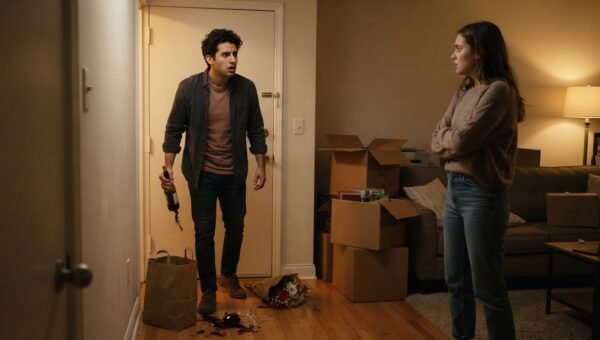
The bedroom was dark. The curtains had been nailed to the wooden frame at the edges with small roofing tacks. Sitting on the bare mattress on the floor was Chloe. She was wearing an oversized gray sweatshirt that hung off her collarbones, her hair tangled into a knot.
In her lap, wrapped in a faded bath towel, was my grandson. He was awake, his brown eyes huge and watery, staring up at the flashlight beam without making a sound.
Chloe looked up. When her eyes found mine in the hallway, she didn’t cry out or say my name. She just held the baby out toward me with both hands, her wrists shaking violently.
“Mom,” she said. It was barely more than air. “He took the car keys. I ran to the clinic when he left for the lumber yard, but I had to come back before his lunch break. If he found us gone…”
“I’ve got him,” I said.
I stepped past the deputy, knelt on the floorboard, and took the baby into my arms. He was tiny for six months, light as a bundle of dry kindling, but his chest was rising and falling against my sweater. I pulled the towel back just enough to see his face. He had Chloe’s chin and the same dark, wide-set eyes she had when she was small.
Greg was screaming from the front room now, his voice no longer calm or controlled. He was threatening lawsuits, claiming Chloe had abused the baby, claiming she was mentally incompetent and that he had kept her inside to protect the boy from her episodes.
Deputy Kowalski walked into the bedroom with his flashlight pointed at the closet. On the floor of the closet was an open metal lockbox. Inside were Chloe’s driver’s license, her social security card, her debit card, her phone, and two empty bottles of over-the-counter sleep medication. Next to them was a ledger where Greg had written down every dollar she had brought into the marriage, down to an eighty-dollar cash gift I had given her for her birthday two years ago.
“Mrs. Evans,” Kowalski said softly, looking at the baby in my arms. “Paramedics are pulling in the drive. Let’s get them both into an ambulance.”
Chloe reached out and gripped the sleeve of my coat. Her fingers dug in until her knuckles turned yellow. “Don’t let him tell them I’m crazy, Mom. Please. He told everyone in his family that I was hearing things. He said if I called you, you’d agree with him because you always thought I was weak.”
“I never thought you were weak,” I told her, pressing my forehead against hers. “I was an idiot who let a bully tell me where I belonged.”
ENDING
The county hospital kept Chloe and Noah for four days.
The doctors confirmed Noah had suffered two hairline rib fractures from rough handling, likely from being squeezed while crying, along with mild dehydration. Chloe’s primary issue was severe malnutrition and acute trauma. The sheriff’s office took photographs of the bedroom door with its external slide-bolt, the nails in the window frames, and the pharmacy receipts Greg had forced her to buy with cash from his weekly allowance.
Greg was charged with felony domestic abuse, false imprisonment, and child endangerment. Because of the documentation found in the lockbox and Dr. Warren’s detailed initial report, a county judge denied him bail during the preliminary hearing and issued an immediate protective order covering both Chloe and the baby.
When the hospital discharged them on a crisp Saturday morning, they didn’t go back to Miller Creek Road. Deputy Kowalski escorted me to the rental house two days later while Greg was in county custody, and we packed three suitcases of Chloe’s clothes, Noah’s crib, and the box of baby sleepers I had mailed six months earlier. The box was still taped shut, hidden in the back of the pantry behind cans of paint.
They live with me now, in my quiet brick ranch.
Noah is nine months old today. He has gained four pounds, and his laugh fills the hallway every time the ceiling fan spins. He sits on a quilt in the middle of my living room floor, banging a wooden spoon against an empty plastic bowl while Chloe chops carrots at the kitchen counter.
Chloe still flinches when someone knocks on the front door, and she checks the deadbolt twice before she goes to bed every evening. Recovery doesn’t happen in a straight line, and there are days when she sits on the back porch and stares at the grass for an hour without speaking. But on Tuesday, she started working part-time at the municipal library three blocks away, walking there and back with her own keys in her pocket.
On the coat rack beside our front door hangs the little white knitted hat. The yarn has been washed clean, the loose threads are trimmed, and the tiny green M.E. is turned outward now, where anyone who walks into the house can see it.