PART 1
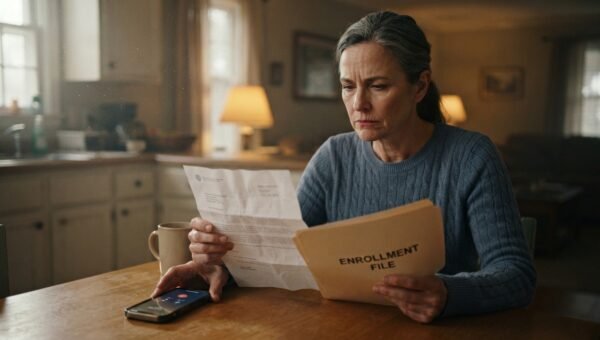
The manila envelope sat on the corner of my desk between my mug and the keyboard. It was 9:15 on a Tuesday morning. The courier had asked me to sign a digital slip on his handheld device, and when I asked who sent it, he only shrugged and said the delivery originated from an uptown legal dispatch office.
Inside was a twelve-page legal waiver. The title across the header read: WAIVER OF MARITAL PROPERTY AND SPOUSAL EQUITY RIGHTS.
It was the exact document my mother-in-law, Evelyn, had shoved across our dining table on Sunday evening.
On Sunday, Evelyn had smoothed her beige linen pants, pushed her reading glasses up her nose, and told me it was simply standard family protocol. She said my husband, David, was bringing in three new commercial partners for his logistics warehouse, and the investors needed to see a clean cap table without spousal encumbrance. She called it a formality to protect the family.
I had read the first page on Sunday night. It was not a formality. It surrendered any claim to past investments, sweat equity, or future valuation in the business David and I had spent fourteen years building together. When David started the company, I took out a second mortgage on the small bungalow I owned before we married. I handled his books for the first six years while working my full-time job at an insurance brokerage.
When I slid the paper back across the dining table on Sunday and told Evelyn I would never sign it without having my own lawyer review the entire packet, David looked at me like I had slapped his mother. Later that night in our bedroom, he told me I was paranoid. He said I was letting my insecurities ruin the biggest expansion of his career, and that Evelyn was only trying to safeguard his future because she loved us.
Now, sitting in my office on Tuesday morning, I turned to the final page of the courier’s packet.
There was a line for my name: Brenda Hall.
The line was already signed.
The blue ink had dried completely. The slant was sharp. The initial B had the slightly hurried flick I had used since high school, and the crossed t at the end matched how I wrote on company checks. To an untrained glance, it looked like my own hand had pressed that pen against the paper.
I didn’t yell. I didn’t call David. My stomach felt hollow, but my head stayed quiet.
I picked up the phone and called Clara Vance. Clara was a retired forensic document examiner who had provided expert testimony on disputed signatures for our insurance underwriting division for more than a decade. She lived twelve minutes from my office in an older brick duplex with a screened porch full of potted fern plants.
When I walked into her study forty minutes later, Clara turned on her high-magnification stereomicroscope and laid the waiver flat under the dual lamps. She placed three known samples of my signature beside it: my driver’s license, an office payroll authorization from last month, and a birthday card I had written to my sister.
Clara spent nearly twenty minutes looking back and forth through the twin eyepieces, occasionally clicking a dial on the side of the housing. She leaned back in her rolling chair, took off her wire-rim glasses, and rubbed the bridge of her nose.
“Brenda, whoever did this took their time,” Clara said, turning the lamp slightly. “They probably traced a projection or used a carbon light transfer to get the proportions. The line tremor is minimal. But human muscle memory is stubborn. Look right here.”
She motioned for me to look through the right ocular.
Under the lens, the capital B was enlarged to the size of a teacup. Clara pointed a slender metal probe at the upper interior loop.
“When you write a capital B,” Clara said quietly, “you bring the pen up from the spine and loop clockwise, coming inward toward the stem. Whoever made this stroke started from the center and rolled outward, counterclockwise. It is a very specific, habitual motor habit. You don’t have it. The person who forged this does.”
I stood up straight and stepped away from the microscope.
I knew that exact counterclockwise loop. I had seen it every single December, every birthday, and every anniversary for twenty years. It was the identical, stubborn flourish Evelyn drew whenever she signed cards to our children: With all my love, Nana.
PART 2
I took a picture of the magnified stroke on Clara’s monitor with my phone, paid her fee in cash, and asked her to prepare a preliminary certification letter.
“If this document is filed with the county clerk or attached to a commercial loan,” Clara warned as she handed me my folder, “it becomes criminal fraud, Brenda. You need to decide right now whether you’re handling this as a family problem or a legal one.”
I put the papers back into the envelope and walked out to my car.
Instead of going back to my office, I drove to the commercial park near the river where David kept his main office and warehouse. David’s company, Hall Commercial Freight, had grown from two rusted flatbed trucks to a fleet of twenty-eight rigs. Our names were both on the original commercial lease from 2012.
When I pushed through the glass door of his front lobby, David was standing behind the front desk with a stack of quarterly manifests. When he saw the manila folder under my arm, his shoulders tightened immediately.
“Brenda, I’m in the middle of routing for the weekend,” he said, not meeting my eyes. “If this is about what happened at Sunday dinner, we can talk at home tonight.”
“We need to talk in your office,” I said. My voice was very level.
He looked at the receptionist, sighed with exaggerated exhaustion, and pushed open his frosted-glass door. I walked in, closed it behind us, and laid the document flat on his mahogany desk.
“A courier brought this to my office two hours ago,” I said. “Turn to page twelve.”
David looked down. He didn’t pick up the paper right away. When his eyes hit the bottom of the page, his expression didn’t change with surprise. It tightened. There was no confusion on his face.
“Brenda, listen to me,” he said, lowering his voice until it was almost a whisper. “We had a deadline with the private equity group at noon today. If the waiver wasn’t attached to the disclosure packet, they were pulling the 2.4 million dollar mezzanine loan. Mom knew you were just being emotional about it. She handled it so we wouldn’t miss the window.”
The words hung in the air of that quiet office.
“She handled it?” I repeated. “David, she committed a felony. And you knew she was doing it.”
“She didn’t steal anything from you,” David argued, his voice rising in anger. “The company is in my name as managing partner. She was protecting my equity. Once the loan funds clear and we open the new distribution terminal in Allentown, the whole family benefits. You would have gotten your money back ten times over.”
“You wouldn’t even have a company if I hadn’t put our house on the line in 2011,” I told him. “You wouldn’t have this building.”
“That was fourteen years ago!” he snapped. “You act like because you helped in the beginning, you get to veto my entire life. Mom spent three weeks organizing this deal with their attorneys. She understands commercial lending. You don’t.”
He reached out to pick up the packet, intending to slide it into his drawer, but my hand was already flat on top of it.
“Where is she?” I asked.
“She’s having lunch at the club with Martin Ross,” David said, naming the senior partner of the investment group. “They’re signing the final subscription agreements at one o’clock. Leave it alone, Brenda. Don’t blow up my business over your pride.”
PART 3
I walked out of his office with the folder pressed firmly against my ribs.
The Oakridge Country Club was four miles away, sitting behind iron gates and a driveway lined with white dogwoods. Evelyn had kept a social membership there since her first husband died twenty-five years ago. It was where she went when she wanted people to see her managing family affairs.
I didn’t take off my trench coat when I walked into the dining room.
The room was half-empty. Evelyn was seated near the tall windows overlooking the tenth green. Across from her sat Martin Ross, a silver-haired man in a dark charcoal suit, reading through a leather-bound folio while sipping iced tea.
Evelyn was laughing softly, touching the gold chain around her neck, looking completely at ease. When she looked up and saw me walking toward the table, her smile froze.
“Brenda?” she said, setting her glass down carefully on a linen coaster. “What are you doing here? David is at the yard.”
“Excuse me, Mr. Ross,” I said, addressing the man directly. I did not raise my voice, but three waiters near the sideboard immediately paused. “My name is Brenda Hall. I am David Hall’s wife and half-owner of the marital assets tied to Hall Commercial Freight.”
Mr. Ross looked up, slightly startled, and closed his folio. “Mrs. Hall. Your mother-in-law was just explaining that you couldn’t join us due to an office conflict.”
“That isn’t true,” I said.
I opened the manila folder and laid Clara Vance’s preliminary report on top of the twelve-page waiver directly between Evelyn’s salad plate and Mr. Ross’s iced tea.
“Mr. Ross, page twelve of your equity packet contains a forged signature with my name,” I said. “My mother-in-law forged it late yesterday afternoon because I refused to surrender my claim to the business. This is a certified letter from Clara Vance, a court-appointed forensic examiner. She has identified the specific stroke habit in that signature as belonging to Evelyn Hall.”
Evelyn’s face turned a dull, mottled red. Her voice went thin and sharp. “Brenda, stop this ridiculous theatrics. Martin, she’s hysterical. She’s been struggling with the stress of David’s expansion.”
“You used the counterclockwise B, Evelyn,” I said, leaning down slightly so my eyes were level with hers. “The same one you’ve written on every birthday card you’ve given my kids for twenty years. Clara Vance has forty years of case law behind her. If this contract is submitted to your lender, I will file a police report with the township before the close of business.”
Mr. Ross didn’t look at Evelyn. He didn’t look at me. He opened his folio, slid the equity waiver out from the paper clip, and laid it flat beside Clara’s report.
He was a corporate financier; he had seen messy family partnerships before. He knew what a disputed marital waiver meant for a mezzanine loan: an automatic injunction, frozen collateral, and endless litigation.
“Evelyn,” Mr. Ross said, his voice entirely devoid of warmth. “Is this signature yours or Mrs. Brenda Hall’s?”
Evelyn looked at the table. Her fingers gripped her cloth napkin so tightly her knuckles were white. “It was just an administrative necessity, Martin. David agreed to it. We were going to replace it with a formal filing next week.”
“You forged it,” Mr. Ross said flatly.
He stood up, placed his pen back inside his suit jacket, and took his leather folio. “The funding commitment is suspended. Do not contact my office. Our counsel will contact David’s attorney in the morning.”
He turned and walked out of the dining room without looking back.
Evelyn sat alone at the table with her hands shaking. “You just ruined your own husband,” she whispered, her lips trembling with rage. “You destroyed everything he worked for.”
“No,” I told her quietly. “David ruined himself the minute he decided his mother’s pride was worth more than his wife’s signature.”
ENDING
I did not go back to our house that night.
I stayed at a quiet hotel near the interstate, and by eight o’clock the following morning, I was sitting in the office of a family law attorney named Sarah Whitfield.
When David called me at noon, his voice was broken. The investment group had officially terminated their offer, citing misrepresentation and fraudulent documentation. The bank that held his equipment lines had requested an immediate audit of his corporate filings to ensure no other forged spousal consents existed in their files.
He begged me to come home. He swore that Evelyn had pressured him, that she had convinced him it was the only way to save the deal, and that he had never meant to hurt me.
“You didn’t protect me, David,” I said. “You watched her forge my name and then you told me I was crazy for noticing.”
The divorce took nine months.
Because the business records were thoroughly audited during the discovery process, David was forced to buy out my fifty percent equity in Hall Commercial Freight at a fair, independent valuation. He had to sell seven of his newer long-haul trucks and take on a quiet local partner to come up with the $340,000 he owed me for my share.
Evelyn moved out of her house in our township three months after the papers were finalized. She moved two states south to live near her sister, after several members of the local business guild quietly asked David to resign his board seat to protect their reputation.
Last week, I purchased a small brick building in the old part of town. The ground floor has tall display windows and hardwood floors, and I’m opening my own independent commercial insurance agency next month.
I still have the envelope Clara Vance gave me. It sits in the bottom drawer of my oak desk, filed neatly behind my property deeds.
Every once in a while, when I sit down at the end of the day to sign client policies or approve bank drafts, I look at the capital B in my name. I watch my pen move up the spine and curl smoothly to the right, exactly where it belongs, clean and unbroken, answering to nobody else.