PART 1
My mother passed away on a rainy Tuesday in October, and three days later every single piece of her fine jewelry was gone.
She had promised for years that her jewelry would be split evenly between my younger sister, Brenda, and me. There was her three-stone diamond anniversary ring, two gold chains, an emerald pendant our father gave her before he passed, and an antique diamond bracelet with floral filigree that had belonged to our grandmother.
We had talked about it together at her kitchen table while she was still healthy. Mom wanted Brenda and me to sit down side by side, go through the velvet boxes, and take turns picking.
That conversation never happened.
The morning after the burial, Brenda and I drove over to Mom’s small split-level house on Maple Street to sort out her clothes and locate the estate papers. Mom’s dresser drawers were already slightly open. When I lifted the heavy mahogany jewelry box from the top shelf of the closet, the lock was intact, but the small brass key was sitting right in the keyhole. I opened the lid. The compartments were completely empty except for a handful of mismatched plastic earrings and a couple of safety pins.
“Where is it?” Brenda asked, walking into the bedroom with an empty cardboard box.
“It’s gone,” I said, showing her the empty velvet trays. “Everything is gone.”
Brenda did not look around the room. She did not ask if Mom had rented a safe deposit box.
She looked right at me, crossed her arms, and said, “You were the only one who had the spare key to this house while Mom was in hospice. You were here alone all weekend setting up the wake.”
“Brenda, I was at the funeral home and running back and forth to the church,” I said. “I didn’t touch her jewelry.”
She didn’t believe a word. By that evening, Brenda had called our two aunts and our cousin David. She told them that because I had handled the funeral arrangements and spent hours alone in Mom’s house, I had cleared out the heirloom pieces before anyone else had a chance to see them. My aunt Clara called me that night, barely letting me speak. She said Mom would turn over in her grave knowing her own daughter was a thief. David stopped answering my text messages. When I tried to visit Mom’s house two days later to finish packing her kitchen, Brenda had already called a locksmith and changed the deadbolts.
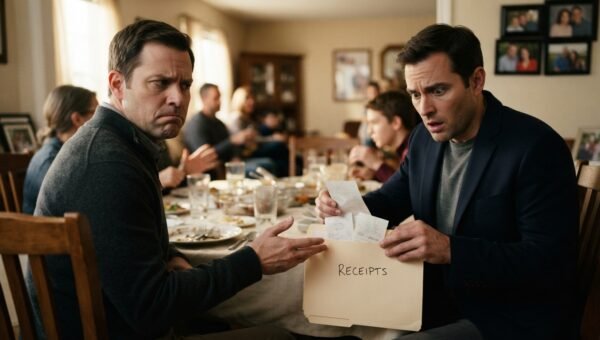
I tried to defend myself for about three weeks. I gathered receipts showing where I was during the days leading up to the service. I offered to let Brenda look through my entire house. None of it made a dent. They had already decided what kind of person I was. Defending myself only made me sound guilty to people who had already made up their minds, so I stopped answering the family group chat and went back to work.
Then, on a Thursday afternoon in mid-November, my desk phone rang.
The caller ID showed an unfamiliar local number. When I answered, a man with a gravelly, measured voice introduced himself as Arthur Miller, the owner of Miller’s Coin and Jewelry Exchange on Route 4.
“Am I speaking with Laura Vance?” he asked.
“Yes,” I said, confused. “Can I help you?”
“I’m calling about a transaction that took place here two days ago,” Arthur said. “A woman came in and sold a vintage platinum bracelet set with small round diamonds.
She presented an old driver’s license with your name on it, signed your name on the purchase slip, and took twenty-four hundred dollars in cash. But when my clerk filed the paperwork yesterday afternoon, she noticed the woman left behind her state employee ID badge by accident. The badge says Laura Vance, but the photo on it doesn’t match the face on my store’s front counter security camera.”
My hand tightened around the receiver. “Mr. Miller, I haven’t been in a pawnshop in my life. And I haven’t lost my state employee badge.”
“Well, somebody had one,” he said quietly. “And she signed your name. If this wasn’t you, ma’am, you need to see this footage before I file a stolen property report with the county sheriff.”
I gave him my personal email address. Two minutes later, my phone pinged with a notification.
I opened the attached still frame. The camera angle looked down over the glass counter. The woman standing there had her back half-turned, but the profile was unmistakable. She was wearing my heavy olive-green winter coat, the wool one with the oversized tortoiseshell buttons that Brenda had borrowed from my hall closet the day of Mom’s funeral because she said she was freezing.
Resting on the glass counter right beside her purse was a small blue pocket notebook with frayed cloth edges.
The air left my chest. It was Mom’s personal ledger, the one with handwritten dates and serial numbers that I had found hidden behind the bottom drawer of Mom’s dresser six years earlier, right after reading the very first page.
PART 2
I had tucked that blue notebook behind the drawer runner years ago because reading that first page had made me feel like an intruder in my own family’s history.
Back in the spring of 2018, Mom had a brief scare with pneumonia. While she was resting, she asked me to look in her cedar chest for an old insurance policy. When I couldn’t find it there, I checked the bottom of her walnut dresser. Tucked beneath the paper drawer liner was that cloth-bound notebook. On page one, in our late father’s sharp, deliberate script, was a dated list of every major purchase he had ever made for Mom: the 1974 wedding set, the 1982 anniversary necklace, and the 1989 grandmother’s bracelet. Next to each item, Dad had written the jeweler’s name, the appraisal value, and the insurance policy number. Beneath the list, in Mom’s shaky handwriting from years later, was a note: “If Brenda’s debts get out of hand again, consult Robert at the credit union before anything is sold.”
I never mentioned the book to Mom. I didn’t want her to know I had seen her private shame about Brenda’s financial trouble. Brenda had spent her twenties and thirties bouncing between payday loans and unpaid credit cards, and Mom had quietly bailed her out more times than she ever admitted to me. I had slipped the notebook back behind the cedar runner where no one would accidentally stumble on it.
Now, looking at the security photo Arthur Miller sent to my email, I realized Brenda hadn’t just taken the jewelry. She had searched the house until she found Dad’s appraisals, taken my old coat so the cameras would capture my clothing, and used an expired duplicate of my state employee ID card that I had tossed in Mom’s spare junk drawer years ago when I lost my original purse.
“Mr. Miller,” I said, keeping my voice steady. “That woman is my sister, Brenda. The coat she is wearing belongs to me, and the jewelry she sold you belonged to our late mother.”
There was a long pause on the other end of the line. “Are you going to press charges, Ms. Vance?”
“I want to retrieve my mother’s bracelet first,” I said. “And I want to see the paperwork she signed.”
“The bracelet is held under our mandatory thirty-day hold for secondhand jewelry,” Arthur said. “State law says if the property is reported stolen, the police take possession until ownership is established. If you come down here with your legal ID, you can inspect the item and the receipt. But if your name was used to commit identity fraud and sell stolen goods across my counter, I have to protect my business.”
“I’ll be there in thirty minutes,” I said.
I left work early and drove straight down Route 4 to the strip mall where Miller’s shop sat between a dry cleaner and a diner. The bell above the door jingled as I walked inside. Arthur Miller was a man in his late sixties with wire-rimmed glasses and silver hair. He looked up from a repair bench, took one look at my face, and reached for a manila folder on the shelf behind him.
“You look like the photo on the real badge,” Arthur said, placing the folder on the counter. “Not the woman who stood here on Tuesday.”
He opened the folder. Inside was the yellow transaction slip. In the signature box, someone had scribbled “Laura Vance” in hurried, slanted lettering. Brenda had tried to copy my signature, but she had added a flourish to the capital L that I never used. Beside the receipt was the small blue notebook. Brenda had accidentally left it behind on the counter when she shoved the envelope of cash into her handbag.
“Did she sell anything else?” I asked.
“Just the diamond bracelet,” Arthur said, pulling a velvet tray from the safe behind him.
There it was. Grandma’s platinum filigree bracelet, sparkling under the fluorescent lights.
“She claimed she had inherited it outright and needed quick cash for a home repair,” Arthur explained. “She brought this notebook to show the original jeweler’s mark from 1989 so I wouldn’t question the authenticity. When I offered twenty-four hundred dollars, she took it without even trying to negotiate. That was my first red flag. People selling family heirlooms usually hesitate. She just wanted the bills.”
“Where are the other pieces?” I asked, opening the blue notebook.
Inside the back cover, Brenda had made her own notes in blue ballpoint pen. Next to the three-stone anniversary ring, she had written: “Midwest Gold, $1,800.” Next to the emerald pendant: “Pawn World, $950.” Next to the gold chains: “Cash for Gold kiosk, $620.”
She had systematically sold Mom’s life away over the course of four days, spreading the pieces across county lines so no single shop owner would raise an alarm. She had only used my identity at Miller’s shop because Route 4 was inside my township, where she knew my name might carry some local credibility if someone asked questions.
“I need a copy of this video footage and the signed transaction receipt, Mr. Miller,” I said.
“I can provide that,” he said. “On one condition. You take this evidence to your sister and give her twenty-four hours to bring back the twenty-four hundred dollars to redeem this bracelet, or you take it to the sheriff’s department. Because if this transaction remains on my books as an identity theft fraud case by Monday morning, I am required by law to file the police report myself.”
“Give me until tomorrow night,” I said.
I took the copies, put the blue notebook into my purse, and walked out to my car. My hands were shaking, not from fear, but from the sudden, sharp clarity of knowing that the lie had finally run out of room.
PART 3
I didn’t call Brenda. I didn’t send an angry text message.
Instead, I drove over to Aunt Clara’s house on Oak Street. Clara was Mom’s older sister, the matriarch who had led the chorus of accusations against me. When I pulled into her driveway, I saw Brenda’s silver sedan parked near the garage. Brenda was there, likely having coffee and playing the grieving, wronged daughter.
I walked up the front steps, opened the screen door, and knocked once on the inner wooden door before turning the handle and walking into the living room.
Aunt Clara was sitting on the floral sofa with a teacup in her hand. Brenda was sitting opposite her in the armchair, wearing my green winter coat draped over the back of the chair. The moment Brenda saw me, her face hardened.
“Laura,” Clara said, setting her cup down with a sharp clatter on the saucer. “I thought I told you that until you make things right with your sister about Mom’s jewelry, we have nothing to talk about.”
“I’m here to make things right,” I said calmly.
Brenda stood up, gathering her purse. “I’m not doing this. Clara, she’s just here to start another screaming match. I told you, she won’t admit what she did.”
“Sit down, Brenda,” I said. My voice was quiet, but it had an edge that made her stop in her tracks.
I unzipped my shoulder bag and pulled out the manila folder Arthur Miller had given me. I laid three things on Aunt Clara’s coffee table: the high-resolution printed still from the pawnshop security camera, the yellow transaction slip showing my forged signature, and the small blue cloth notebook.
Aunt Clara frowned, leaning forward to pick up the photograph. “What is this?”
“Look closely at the coat,” I said. “And look at the woman standing at the counter of Miller’s Coin and Jewelry Exchange on Route 4 two days ago.”
Aunt Clara squinted through her bifocals. Her eyes shifted from the photograph to the olive-green coat hanging over the back of Brenda’s chair. The tortoiseshell buttons were unmistakable. Then she looked at the face on the page. Even from a side angle, the jawline, the hairstyle, and the reading glasses belonged entirely to Brenda.
“Brenda?” Clara whispered, her voice dropping. “What were you doing at a pawnshop?”
“She didn’t just visit the pawnshop,” I said. I pointed to the yellow receipt. “She took twenty-four hundred dollars in cash for Grandma’s diamond bracelet. And to make sure nobody could trace it back to her if the estate was audited, she gave them an old copy of my state ID and forged my name on the legal bill of sale.”
Brenda’s face lost every ounce of its color. She backed up against the mantelpiece. “That’s not… you don’t know what you’re talking about.”
“Open the notebook, Aunt Clara,” I said.
Clara’s trembling fingers opened the blue book. She looked at our father’s handwriting on the first page, and then she turned to the back cover where Brenda had logged every single pawnshop, every city, and every dollar amount she had collected for Mom’s anniversary ring, the emerald pendant, and the chains. Total cash received: five thousand seven hundred and seventy dollars.
“You took them,” Aunt Clara said, looking up at Brenda. The accusation in her voice was thick and heavy. “You took your mother’s things before the dirt was even settled on her grave.”
“I was behind on my mortgage!” Brenda cried out, her voice suddenly shrill and desperate. “They were going to start foreclosure proceedings on the house, Clara! Mom knew I was struggling. She always said she would help me! Laura had a stable state job and retirement savings. She didn’t need the money! Mom would have wanted me to save my house!”
“Mom promised we would split them evenly,” I said. “And you let the entire family call me a thief for a month.”
“I was going to buy them back!” Brenda sobbed, tears spilling down her cheeks now. “I thought once my tax return came in January, I’d go back to the shops and redeem the tickets. Nobody had to know!”
“You didn’t pawn them, Brenda,” I said, pointing at the slip. “You sold them outright. You signed a permanent transfer of ownership. And you used my name to commit a felony.”
The room went completely silent. Outside, a delivery truck rumbled down the street.
Brenda looked at me with wide, terrified eyes. “Are you going to send me to jail?”
“Arthur Miller has given you until five o’clock tomorrow evening to bring twenty-four hundred dollars in cash to his counter to buy Grandma’s bracelet back before he files the fraud report with the sheriff,” I said. “As for the rest of the pieces, you are going to take every dime you made from those other three shops, go buy back whatever hasn’t been melted down yet, and bring them to my house. If you don’t, I hand this entire folder to the police.”
ENDING
Brenda didn’t have the twenty-four hundred dollars. She had already spent eighteen hundred of it paying down delinquent credit card balances and catching up on two months of car payments.
Aunt Clara ended up taking the money out of her own emergency savings to pay Arthur Miller. She didn’t do it to protect Brenda from consequences; she did it because she couldn’t bear the thought of our grandmother’s bracelet sitting in a pawnshop display case on a state highway.
The next afternoon, Aunt Clara and I went to the shop together. Arthur accepted the cash, signed the release forms, and handed me the small velvet box. Aunt Clara stood out on the sidewalk afterward, holding her purse tightly against her stomach.
“Laura,” she said, looking down at the pavement. “I don’t know what to say to you. I should have asked questions. I should have known you would never do something like that.”
“You should have,” I agreed quietly.
I didn’t offer her a quick forgiveness, and I didn’t tell her it was okay. It wasn’t okay. A month of cruel text messages, locked doors, and family whispers don’t vanish just because the truth finally turns up on a piece of paper. Clara nodded slowly, understanding the boundary I was setting, and got into her car without another word.
Brenda managed to recover Mom’s gold chains and the emerald pendant from the other shops by taking out a high-interest personal loan that Aunt Clara refused to co-sign. The three-stone diamond ring had already been sold to a wholesaler in Chicago and was gone for good. Brenda brought the two recovered pieces to my kitchen on a Sunday morning. She tried to apologize, standing awkwardly by the entryway, but there was nothing left between us to rebuild. I took the velvet pouches, checked the contents, and handed her back my green winter coat.
“Don’t come back here, Brenda,” I told her.
She walked down my front steps, got into her car, and drove away. We haven’t spoken since that morning.
Cousin David sent a long message three days later apologizing for taking sides, and the family group chat suddenly went quiet, but I removed myself from it anyway. You learn a lot about people when a crisis hits, but you learn even more about them by how quickly they choose to believe the worst about you.
Mom’s antique filigree bracelet sits on my dresser now, right next to the small blue notebook. Sometimes in the evenings, I open the drawer and run my thumb over the worn cloth cover and my father’s neat handwriting on that first page. The jewelry was never really about the gold or the stones. It was about trust, and once that is traded away for a handful of paper bills, there isn’t a shop in the world that can sell it back to you.