PART 1
The soup had not even cooled in the bowls before my daughter-in-law Amber stood up, pointed her finger across the table, and screamed that I was trying to kill her baby.
There were twenty-two women in my son Greg’s backyard, holding small porcelain spoons and paper napkins with yellow ribbons. I had spent four hours that morning in their kitchen making a roasted butternut squash soup Amber had specifically requested two weeks earlier.
I had brought my own Dutch oven from home because she said hers was too small.
“Do not touch it!” Amber shouted, her voice shaking so hard her water glass rattled on the linen runner. “She put something in it. I saw her hovering by the stove with her purse open. Call nine-one-one right now!”
My hands stayed resting on the edge of the cedar picnic table. For three years, ever since Greg married her, Amber had treated every meal I cooked, every sweater I bought, and every birthday card I sent as an unspoken insult. If I offered to weed her flowerbeds, she told Greg I was calling her lazy. If I brought over a casserole after she had the flu, she left it on the porch until raccoons tore into the foil. But this was different. This was broad daylight in front of her mother, her sisters, and Greg’s coworkers’ wives.
Greg came running out of the garage with grease on his forearms from fixing the lawnmower. “Amber, what are you talking about? Mom made the soup you asked for.”
“She hates that this baby is coming!” Amber sobbed, clutching her stomach and dropping down onto the wooden bench. “She wants me out of your life. Search her purse, Greg. Don’t let her leave. If anyone takes a single bite, we could lose the baby.”
Nobody touched their spoons. Two of her friends immediately stood up and backed away toward the patio slider. I didn’t yell. I didn’t raise my voice. When a person reaches sixty-four, they learn that screaming only makes guilty people look justified and innocent people look unhinged.
“Call the police, Greg,” I said quietly. “Go ahead and call them. And call an ambulance so they can take a sample of this pot right now.”
Amber looked startled for half a second, her tears pausing at the corner of her jaw, but then she leaned harder into her sister’s shoulder. “See?
She’s trying to act calm so we look crazy. Check her tote bag. She had pills in her pocket this morning.”
Two patrol officers arrived eleven minutes later, followed by an EMS supervisor in a county utility vehicle. By then, the backyard was dead silent except for the wind chimes under the eaves. Amber met Officer Miller at the wooden gate, sobbing that I had slipped powder into the food to cause a miscarriage. She insisted that my leather tote bag on the entryway bench be searched immediately.
I unzipped it myself and dumped everything onto the dining table: my wallet, my reading glasses, a pack of mints, my blood pressure prescription, and my car keys. There were no loose powders, no strange bottles, and nothing out of order.
“We have to take a sample of the food if an allegation of contamination has been made,” Officer Miller told us, looking embarrassed to be standing in a yard full of baby shower gifts wrapped in pastel tissue.
The paramedics took two plastic specimen containers. One went into the forty-quart pot on the stove, which was still lukewarm.
The second went into the floral bowl sitting directly in front of the head of the table, where the guest-of-honor banner hung from the patio trellis.
We all waited in the living room for nearly forty minutes while Officer Miller took statements and another unit ran field tests with the county HazMat kit down at the local station three miles away. Amber sat on the sofa, drinking bottled water from a sealed cap her sister brought from the pantry, repeating that she knew I had always resented her.
Then the phone rang on Officer Miller’s hip.
He stepped into the kitchen to answer it, spoke for two minutes, and walked back into the living room. His face had completely changed.
“The field screening and the preliminary test from the clinic lab came back,” Miller said, looking between Amber and me. “There is nothing in the pot on the stove. The batch is completely clean.”
Greg let out a long breath. “I told you, Amber. It was a panic attack. She didn’t do anything.”
“Wait,” Officer Miller said, raising one hand. “The individual bowl from the table tested positive for heavy traces of crushed temazepam. That’s a prescription sleeping sedative. But it wasn’t taken from the pot.”
Amber let out a high wail. “I told you! She dosed my bowl! She gave it directly to me!”
Miller looked down at his yellow notepad, then back up at the room. “Ma’am, that bowl didn’t come from your place setting. The floral bowl with the sedative was taken from the chair on the north corner. The place card at that seat had your mother-in-law’s name on it.”
PART 2
The room went completely still. Amber stopped crying so fast it sounded like someone had flipped a breaker in the wall.
“What did you say?” Greg asked, stepping between his wife and the officer.
“The sample collected with the sedative came from the seat at the corner of the table,” Officer Miller repeated. His partner, Officer Diaz, was standing by the patio slider with the evidence log on a clipboard. “We tagged the bowls by seat number. Seat twelve had the sedative. Seat twelve was set for Evelyn.”
Evelyn is my name.
Amber’s face went from blotchy red to the color of wet drywall. She didn’t look at Greg. She didn’t look at her mother sitting across the room. Her eyes darted straight to the cedar table outside through the glass.
“That’s a mistake,” Amber said quickly, her voice dropping from a theatrical scream to a flat, hurried mumble. “Someone must have moved the bowls while we were waiting for you to get here. The wind was blowing. The napkins blew all over.”
“Nobody went outside after we arrived, ma’am,” Officer Diaz said from the door. “My partner and I secured the food line the minute we walked through the gate.”
I looked at Amber. My stomach felt hollow, but my head was clearer than it had been all morning. “Why would I put sleeping pills in my own soup, Amber?”
“To frame me!” she spat out, grabbing Greg’s wrist. “She knew I’d get upset, so she put it there to make me look paranoid. She’s been trying to turn you against me since our wedding day.”
Greg didn’t pull his hand away, but his fingers went slack. He looked at Amber, then at the wooden table outside, then at me. Greg is thirty-four years old. He works as a county surveyor, spends his weekends fixing old outboards, and has spent his whole life trying to keep women from fighting around him. His father had a vicious temper, and whenever things got tense, Greg’s habit was always to smooth it over, apologize for things he didn’t do, and pretend tomorrow was a clean slate.
“Amber,” Greg whispered. “Mom has never taken temazepam in her life. She takes lisinopril for her blood pressure. You know that. She keeps it in the kitchen cabinet by the mugs when she stays over.”
“Well, maybe she bought it online!” Amber snapped. Her eyes were darting around the living room now, looking at her friends, but none of them were nodding with her anymore. Two of the women from her book club had already gathered their purses from the entryway bench and slipped quietly out the front door.
That was when eight-year-old Toby walked into the kitchen from the hallway.
Toby is Amber’s son from her first marriage. He is a quiet boy who usually stays in his bedroom with his Lego sets whenever adults start raising their voices. He was holding an oversized faux-leather tote bag with gold buckles, dragging the bottom across the linoleum because the straps were too long for him.
“Mom,” Toby said, holding up a small square of heavy cream cardstock. “This was in your zipper pocket with your hair ties. Is this why everyone is mad?”
PART 3
Amber lunged off the couch so fast she tripped over the fringe of the area rug. “Toby! Put that down right now! Go back to your room!”
Officer Miller moved faster. He stepped right into the walkway between the living room and the kitchen, putting his broad frame between Amber and the boy. “Hold on, son. What do you have there?”
“Don’t touch his things!” Amber yelled, her voice pitching up into that shrill, desperate frequency again. “He’s an eight-year-old child! You don’t have a warrant to search my son!”
“I’m not searching him, ma’am,” Miller said evenly. He crouched down to Toby’s eye level. “What did you find, buddy?”
Toby looked scared, his chin trembling, but he held the card out toward the officer. “It has Grandma’s name on it. But Mommy had a gold marker yesterday and made a new one.”
Miller took the card by the edges. I stood up from the armchair and walked over to where Greg was frozen near the kitchen island.
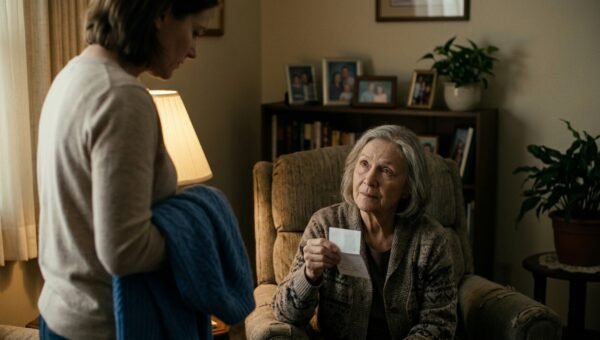
It was one of the shower place cards, decorated with little pressed bluebells along the top edge. In printed calligraphy, my name, *Evelyn*, was written across the center. But across my name, someone had drawn two thick black lines with a ballpoint pen. Tucked right behind it in Toby’s hand was a second, identical card. On that one, written in Amber’s distinct rounded handwriting with a metallic gold paint pen, was the word *Amber*.
“Let me see that bag, ma’am,” Miller said, standing back up.
“No,” Amber whispered. She backed up against the wall, her hands flat against the drywall behind her. “You can’t do that.”
“Your son brought the property into an open police investigation,” Officer Diaz said, coming across the room with a pair of latex gloves.
Inside the small zippered interior pocket of the purse, right next to a tube of lip balm and two hairpins, was an amber plastic prescription bottle. The label was half-scraped off with a fingernail, but the clinic name and the drug were still clear: *Temazepam 30mg, prescribed to Amber Miller, filled six months ago.*
Inside the bottle were four whole capsules and a noticeable layer of white powder where two capsules had been emptied and crushed.
Greg stood over the island, his face completely drained of blood. “Amber. What did you do?”
She didn’t answer him. She slid down the wall until she was sitting on the baseboard, pulling her knees up to her chest, glaring at the floor.
The story didn’t come out in a neat courtroom confession. It came out in ugly, jagged pieces over the next hour while Greg sat at the kitchen table with his head in his hands and Officer Miller wrote in his notebook.
Amber hadn’t wanted to kill anyone, and she hadn’t wanted to lose the baby. What she had wanted was to have me arrested in front of thirty people and removed from their lives permanently.
She had planned it the night before. She knew I was bringing my butternut squash soup because she had begged me for it. Her plan had been simple: cross my name off the head-table card, put my seat at the end where nobody was paying attention, slip the powder into the bowl meant for my original seat, and then scream that she had caught me tampering with the food before anyone took a bite.
She had calculated that if she caused a scene, claimed she saw me hovering, and police found medication in the soup, Greg would finally have no choice. She would get an emergency protective order, I would be banned from their home, and she would never have to share Greg or the new baby with his mother again.
The only thing she had overlooked was Toby.
The morning of the shower, before anyone arrived, Toby had seen the seating cards on the table. He loved sitting next to me at family dinners because I always brought colored pencils and let him tell me about his school projects. When he saw my card placed on the far, drafty corner near the hose reel, he thought someone had made a mistake. He had taken my card and moved it back to the head of the table, swapping the two bowls so his favorite place was next to his mother.
Amber hadn’t checked the names again when she carried out the warm bread rolls. She had simply assumed the bowl sitting at the end of the table was the one she had doctored.
When she screamed, she had pointed at her own place setting, believing she was saving herself from a setup she had orchestrated. But the poisoned bowl had been sitting right in front of me the whole time. If Toby hadn’t swapped the cards, or if we had sat down and eaten before she started screaming, I would have swallowed sixty milligrams of a heavy sedative on an empty stomach. At sixty-four, with my blood pressure medications, the paramedics told Greg later that it could have stopped my heart.
ENDING
The police didn’t haul Amber out in handcuffs that afternoon because she was seven months pregnant and started hyperventilating until her hands curled into claws. But they filed a felony report for reckless endangerment and tampering with consumer products, and the county prosecutor’s office opened a formal case on Monday morning.
Greg packed two duffel bags that night while Amber was at the hospital being monitored for high blood pressure. He brought Toby to my house at nine o’clock.
The boy was quiet on the drive over, still clutching his plastic tub of Legos. When I opened the front door, Greg didn’t say a word. He just leaned his forehead against the doorframe and let out a single, shuddering breath that sounded like it took five years of his life with it.
“She told me you were trying to control us, Mom,” Greg said, his voice raw. “Every week for three years. She said you looked down on her family, that you judged her parenting, that you wanted to run our house. I kept telling myself she was just insecure. I thought if I gave her enough space, she’d see you were just being my mom.”
“I know,” I told him.
He stayed on my spare bed that night, and Toby slept in the room that used to be Greg’s when he was in high school.
The baby, a little girl named Nora, was born six weeks later by scheduled C-section. Amber’s attorney negotiated a deferred plea agreement that included mandatory psychiatric evaluation, three years of supervised probation, and a strict no-contact order protecting me. Greg filed for legal separation three days after the baby came home from the nursery.
People ask me sometimes if I hate her. Hate requires an amount of energy I simply don’t have left to waste on a woman who would risk my life to win an argument in her own head. What I feel is an enormous, quiet stillness.
Yesterday was Sunday. Greg came over with both kids to help me prune the hydrangeas along my south fence. Nora was asleep in her stroller under the shade of the pear tree, and Toby was sitting on the porch steps, drawing race cars on the back of old junk mail with a green marker.
Around noon, Greg came into the kitchen to wash his hands at the sink. He looked out the window at his son, then turned to the stove where a pot of chicken broth was simmering for lunch.
He stood there for a minute, watching the steam rise against the white subway tile, before he picked up a wooden spoon from the ceramic crock by the burner.
“Smells good, Mom,” he said.
He didn’t ask what was in it. He just pulled three bowls down from the cabinet, took them out to the porch table, and set one down in front of each chair.