PART 1
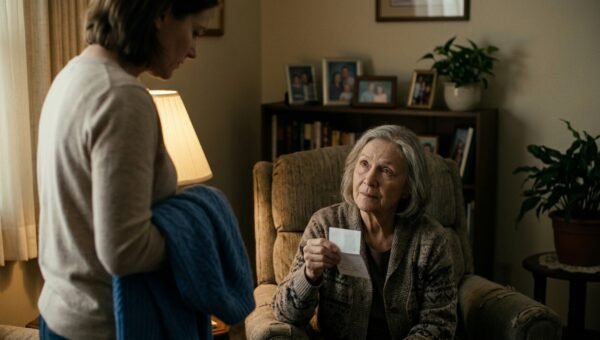
The smell of rubbing alcohol and peppermint tea stayed in my hair for three days after Martha passed. I was fifty-eight years old, my knees were stiff from sleeping in the vinyl recliner beside her bed at hospice, and the wash machine in her basement was still running the heavy cotton blanket she had used during her last chills.
I was down in the cellar transferring that blanket into the dryer when I heard the kitchen screen door slam upstairs. Then heavy boots hit the linoleum.
It was Greg and Kevin, my husband David’s younger brothers. Martha had taken her last breath at six that morning, and it was barely three in the afternoon.
“David around?” Greg called out before he even took off his coat. He was forty-eight, an independent contractor who always seemed to drive a brand-new truck while claiming he was two bad weeks away from bankruptcy. Behind him came Kevin, fifty, carrying a stack of flat cardboard moving boxes he must have picked up at the hardware store on the way over.
“He went to the funeral home to sign the cremation permit,” I said, coming up the narrow basement stairs with my hands still damp. “He should be back in an hour. We haven’t even picked out the prayer cards yet.”
Kevin didn’t look at me. He set the boxes on Martha’s small kitchen table, right beside her salt shakers and her plastic weekly pill organizer. “Well, we figured we ought to start sorting through things while the light is good.
No sense letting it sit around. The place needs to be cleared out if we’re going to put it on the market by spring.”
I stood there by the refrigerator, feeling hollow. For twelve years, I had managed Martha’s care. When her heart trouble started and her rheumatoid arthritis flared so badly she could barely hold a fork, David and I took over the burden. David worked long hours at the county road department, so the daily legwork fell on me. But the real weight had been the money.
Martha’s late husband had left her a small widow’s pension and the house on Elm Street, fully paid off. Her monthly income was just under twelve hundred dollars. That covered her property taxes, heat, electricity, and basic groceries. It did not cover her medical care. When the Medicare Part D coverage gap hit every summer, her prescriptions soared to four hundred, sometimes five hundred dollars a month.
She took blood thinners, specialized anti-inflammatory injections, and three separate heart medications.
Twelve years ago, David had sat his brothers down in this very kitchen to ask for help. He told them Martha’s medicine was running six thousand dollars a year out of pocket.
Greg had leaned back, shaken his head, and said, “Man, you know construction dries up in November. I’ve got two truck payments and kid braces. I can’t commit to a monthly nut.”
Kevin had shrugged and said, “My shop’s barely breaking even. You and Sarah don’t have kids. You’ve got the extra cash flow.”
So I stepped in. I was an administrative assistant at the local school district. I didn’t make a fortune, but I had savings, and I loved Martha. She was a gentle, quiet woman who apologized every time you handed her a glass of water. When David felt ashamed that his family was failing his mother, I told him, “Don’t worry about it.
She’s your mother, and she needs to live. I will cover the pharmacy.”
I paid for it out of my personal paycheck account every single month. I drove to the local independent pharmacy on 4th Street, handed over my debit card, and brought the brown paper sacks back to her house. When Greg or Kevin dropped by on holidays, they ate Martha’s roast beef, praised her garden, kissed her cheek, and left without ever asking how the pills in her cabinet got bought.
Now, six hours after she died, Kevin was already pulling open the corner hutch.
“Hey,” I said, stepping forward. “Kevin, please. David wanted us to go through her personal things together as a family. Just wait for your brother.”
Kevin held up a hand without turning around. “Sarah, with all due respect, we know where things belong. Mom always said our kids should get the dining room set.”
Greg had walked into Martha’s small front bedroom. I heard the scrape of her wooden jewelry box sliding across the dresser. My stomach dropped. That jewelry box held Martha’s modest treasures: a thin gold chain her grandmother gave her, a sterling silver locket with David’s baby picture, and her mother’s small diamond cocktail ring. Martha had told me three years ago, while I was rubbing lotion into her swollen hands, that she wanted me to have the locket because nobody else ever sat with her long enough to hear the stories behind it.
I walked to the bedroom doorway. Greg was already thumbing through the velvet compartments, pulling out the small gold chain and dropping it into his front jeans pocket.
“Greg,” I said, my voice shaking. “Martha talked about that locket. She wanted to leave it to me.”
Greg stopped. He looked at me with flat, cold eyes, his hand resting on the dresser.
“Sarah, you’ve been real helpful, and we appreciate it,” he said, using that patronizing tone people use when they want to put you in your place. “David told us you ran errands for her. But this stuff has been in our family for seventy years. Blood family only. You understand how it is. It wouldn’t be right for family heirlooms to leave the family.”
“Blood family only?” I whispered. “I paid for her life every month for twelve years while you bought a new camper.”
“Nobody forced you to do that,” Greg said, shutting the jewelry box with a sharp click. “That was between you and David. But the house and what’s inside belongs to her sons. We’re keeping things where they belong.”
I looked at him, then down the hallway at Kevin folding open a cardboard box. Neither of them felt an ounce of shame. They saw a woman whose body was barely cold, and they saw inventory.
I didn’t scream. I didn’t cry in front of them. I grabbed my purse from the counter, walked out to my car, and drove home.
When David came through our front door that evening, exhausted and gray-faced from the funeral arrangements, I told him what happened. He sat on our sofa with his head in his hands. He was a good man, but he had spent his whole life walking on eggshells around his brothers’ tempers to keep the peace.
“They’re wrong, Sarah,” he said quietly. “They’re dead wrong. But Mom’s gone. If I start a war over a dining table and some old silver right now, it’s going to tear the whole family apart at the funeral.”
“They took the locket, David,” I said. “They told me I wasn’t family.”
He reached out and held my hand, but he didn’t offer to go get it back. I knew then that as far as the estate was concerned, I was completely invisible. I had spent thousands of dollars, wiped her counters, cleaned her sheets, and when the curtain fell, I was just an outsider who had done some free chores.
The funeral was on a Tuesday. It was polite, stiff, and miserable. Greg wore a dark suit and gave a moving speech about Martha’s devotion to her three boys. People nodded, dabbed their eyes, and shook his hand. I sat in the second row, holding David’s arm, feeling like a ghost.
Three days after the burial, on a Friday afternoon, my cell phone rang while I was sitting at my desk at the school.
The caller ID showed the local pharmacy on 4th Street.
I answered, expecting a routine automated notification about a refill that had been canceled too late.
“Sarah?” It was Jim, the head pharmacist who had owned the shop for thirty years. His voice was unusually cautious. “Sarah, do you have a few minutes this afternoon? I need you to come by the counter.”
“Jim, if it’s about Martha’s account balance, David can handle that from the estate,” I said tiredly. “Or if there’s a leftover bottle, you can just destroy it. She’s gone.”
“No, Sarah, it’s not a balance,” Jim said, lowering his voice slightly. “It’s an envelope. Martha had her neighbor drop off a sealed manila packet here about three weeks before she went into the hospital. She had strict instructions taped to the front: only to be handed directly to you in person after her services were over. Nobody else.”
My heart gave a strange, hard thud against my ribs. “What is it, Jim?”
“I don’t know what’s inside,” he replied. “It’s sealed with masking tape, and your name is written across the front in her handwriting. She told me to make sure neither of the other boys knew it existed.”
PART 2
I left work twenty minutes early. My hands gripped the steering wheel so tightly my knuckles turned white.
When I walked into the 4th Street Pharmacy, the bell above the door chimed with that familiar little tin rattle. For twelve years, I had walked past those aisles of heating pads, greeting cards, and throat lozenges. Jim was standing behind the raised counter in his white coat. When he saw me, he nodded, wiped his hands on a paper towel, and stepped down from the platform.
He led me into the small consultation room near the back where they gave flu shots. He had a thick, legal-sized manila envelope sitting on the small desk.
“She was clear as day about this, Sarah,” Jim said quietly, resting his hand on the paper. “Mrs. Miller called me from her kitchen about a month ago. Her neighbor brought this in the next morning. She told me, ‘Jim, do not give this to David, and do not give this to Greg or Kevin. You hand it to Sarah, and you wait until she has laid me in the ground.’ I promised her I would.”
“Did she tell you what it was?” I asked.
“She just said it was an overdue invoice,” Jim said with a faint, knowing half-smile. He squeezed my shoulder and walked out, closing the door behind him to give me privacy.
My fingers trembled as I pulled the masking tape off the flap.
Inside was a heavy stack of papers, all held together by thick rubber bands. I pulled the bundle out.
The top layer was a thick stack of small, stapled paper pharmacy slips. My receipts. Hundreds of them. Every single credit card receipt from the last twelve years, organized chronologically by year and held in separate bundles with paper clips. On the back of each receipt, in Martha’s shaky, deliberate cursive, she had noted the date, the medication name, and the exact amount charged to my personal card.
Beneath the receipts was a single sheet of pale blue stationery. It had her handwriting in dark blue ballpoint pen, dated forty days before her death:
*Sarah,*
*I know my boys. I know who carries the load, and I know who shows up only when it is time to take. You never once complained to me about the cost of my medicine, but I watched you look at the totals every month. I know what you gave up to keep me out of pain and keep me in my own home.*
*My boys think this house belongs to them because their father built it. But a house belongs to the person who keeps the roof from leaking and the hearth warm.*
*Look at the bottom document. Take it to Arthur Henderson on Court Street. Do not let Greg or Kevin intimidate you. David loves you, but he was always too afraid of conflict to protect what is fair. This is my business, not his.*
*Thank you for being my daughter.*
*Love, Martha*
Tears blurred my eyes so badly I couldn’t read for a full minute. I pressed her letter to my face. It smelled faintly of the rosewater soap she always kept in her linen closet.
I reached back into the manila envelope and pulled out the final document.
It was a legal form, stapled to a formal title deed. Across the top, in crisp legal typewriting, it read: **PROMISSORY NOTE AND FIRST MORTGAGE DEED OF TRUST.**
Beneath it was a second paper: **QUITCLAIM DEED UPON DEFAULT.**
I sat down on the vinyl chair in that tiny flu-shot room and began to read through the legalese.
Ten years ago, right after her first severe stroke, Martha had taken a cab downtown to Arthur Henderson’s office, an old estate attorney who had been friends with her husband. She had executed a formal, recorded promissory note securing a private personal loan against the property at 414 Elm Street.
The borrower was Martha Miller. The designated creditor and lienholder was Sarah Miller.
The terms were clear, simple, and mercilessly precise:
For all verified medical, pharmaceutical, and living expenses advanced by Sarah Miller on behalf of Martha Miller, a rolling lien was placed against the equity of the real property. Martha had logged every single pharmacy receipt into an attached schedule, updated with Arthur Henderson’s office every two years.
Beside the final total on the last notarized page, dated just two months ago, Arthur Henderson had stamped the official seal.
The total advanced by me over twelve years: **$64,820.00**.
Attached to the mortgage was a recorded clause: Upon the death of the borrower, the full balance of the lien became due and payable within sixty days. If the estate failed to satisfy the lien in cash, full fee-simple title to 414 Elm Street would immediately transfer to the lienholder, Sarah Miller, via the executed Quitclaim Deed held in escrow by the attorney.
Beside the total, in her own handwriting, Martha had penned one clear instruction at the foot of the notarized cover sheet:
*To the Executor: If my sons pay Sarah her sixty-four thousand eight hundred and twenty dollars within sixty days, they may divide the remaining value of the home. If they refuse to pay her back for keeping me alive, the house is hers alone. She may sell it or burn it down, but they will not touch a single brick.*
My breath caught in my throat. The house was an older three-bedroom ranch, but in our town’s current real estate market, it was worth easily $210,000.
I put everything back into the envelope, tucked it firmly under my arm, and walked out to my car.
When I reached our house, David was sitting at the kitchen table with three opened legal pads. His eyes were red-rimmed. Greg had sent him a barrage of text messages all afternoon demanding that they hire a local liquidator to auction off the furniture by next weekend.
“Sarah,” David sighed, looking up as the screen door shut. “I know you’re mad about how the boys acted, but Greg says if we don’t get the house cleaned out now, we’ll miss the spring buyer rush. He wants us to sign an agreement with a realtor on Monday.”
I didn’t argue. I didn’t raise my voice. I pulled out a chair, sat down across from him, and slid the manila envelope across the wood.
“What’s this?” he asked, frowning.
“Read it, David,” I said. “Start with your mother’s letter, then look at the legal papers.”
He opened the flap, took out the blue stationery, and started reading. By the time he reached the third line, his mouth parted. He stopped, looked at me, then looked back at the paper. When he unfolded the notarized mortgage and saw Arthur Henderson’s signature and the $64,820 balance, he collapsed back against the wooden chair as if all the air had been kicked out of his lungs.
“My God,” he whispered. “She recorded a mortgage against the house? Mom did this ten years ago?”
“She did,” I said. “Because she knew your brothers wouldn’t pay a dime, and she knew you wouldn’t have the stomach to demand it. She didn’t want charity, David. She wanted a record.”
He sat in absolute silence for five minutes, turning over the stacks of pharmacy receipts. He saw the dates: months when we had skipped our anniversary dinner, months when I had taken extra overtime monitoring study hall just to cover the four-hundred-dollar co-pays.
“What are we going to do?” David asked, his voice shaking.
“We aren’t going to do anything,” I said firmly. “You are going to call your brothers and tell them they need to come to this kitchen tomorrow morning at nine o’clock. Don’t tell them why. Just tell them it’s about the house.”
PART 3
The next morning, Greg arrived first, carrying a yellow legal pad and wearing his work boots. Kevin walked in two minutes later with a travel mug of coffee.
“Look,” Greg said before he even sat down, pulling a chair out at our kitchen table. “I already spoke to Miller Realty. If we put five thousand into new carpeting and paint, we can list it for two-fifteen. Divided three ways, after commission, that’s roughly sixty-five grand apiece. That clears out my truck loan.”
“I could use seventy,” Kevin chimed in, leaning against our kitchen counter. “Sarah, you got any more of that drip coffee?”
I didn’t answer him. I sat at the head of the table. In front of me was a neat stack of photocopies I had made at the school library that morning.
David sat to my right, completely quiet, looking down at his coffee cup.
“What’s the hold up, Dave?” Greg asked, tapping his pen on the pad. “Let’s get the listing agreement signed so we can get the dumpster in the driveway by Tuesday.”
“There isn’t going to be a dumpster on Tuesday,” I said evenly.
Greg chuckled, an irritating, dismissive sound. “Sarah, we already had this talk. You’re David’s wife, and we’re grateful for you running Mom around to her appointments. But the deed to that house has Miller on it. This is an estate matter between the brothers.”
“You’re right about one thing, Greg,” I said, sliding the first copy across the table directly in front of his yellow pad. “It is an estate matter. Read that.”
Greg glanced down, annoyed, but as his eyes hit the words *Mortgage Deed of Trust* and *Sarah Miller, Creditor*, his smirk vanished.
“What the hell is this?” he muttered.
Kevin walked over and leaned over Greg’s shoulder to look. “What is that, Dave? Is this a joke?”
“It’s not a joke,” David said, his voice stronger than I had heard it in weeks. “It’s a recorded lien. Mom went to Arthur Henderson ten years ago. Sarah covered every prescription, every co-pay, every medical bill out of her own paycheck for twelve years because neither of you would give Mom a single dollar. Mom recorded a formal mortgage against the house to secure the debt.”
“Bull,” Greg snapped, his face turning an ugly mottled red. “You can’t just slap a lien on somebody’s house! Mom had dementia toward the end! You manipulated her!”
“The note was executed ten years ago, Greg,” I said, leaning forward so he had to look me in the eye. “She was completely sharp. Arthur Henderson had her evaluated by her primary doctor before she signed it to ensure testamentary capacity. It’s filed at the county courthouse. It has been there for a decade.”
I slid the second paper over. The certified total.
“The outstanding debt is sixty-four thousand eight hundred and twenty dollars,” I continued. “According to the terms of the mortgage, the estate has sixty days from the date of her death to satisfy that debt in full, in cash. If the debt is paid, the remaining value of the house can be split among her three sons.”
Kevin’s jaw dropped. “Sixty-four grand? Are you out of your mind? Where the hell are we supposed to get sixty-four thousand dollars in sixty days?”
“You said you had two truck payments and kid braces, Greg,” I said softly. “And Kevin, you said your shop was just breaking even. But between the two of you, you’ll need to come up with about forty-three thousand dollars to buy out your share of the debt, plus David’s share, if you want to keep the house to sell it.”
Greg slammed his hand down on the table, rattling the coffee cups. “This is extortion! We’re her flesh and blood! You were just her daughter-in-law!”
“And you were her flesh and blood who wouldn’t spend forty dollars on her insulin,” I said, not flinching an inch. “You walked into her bedroom while her blankets were still in the dryer and pocketed her grandmother’s necklace. You told me the jewelry was blood family only. Well, Greg, the debts are blood family too.”
“We’ll take you to court,” Kevin yelled, his voice cracking. “We’ll get a lawyer! We’ll contest the whole damn thing!”
“Go right ahead,” David said, standing up from his chair. He stood at his full six-foot-two height, towering over his younger brother. “Arthur Henderson holds the original in escrow along with the signed quitclaim deed. If you hire a lawyer, you’ll spend ten thousand dollars to be told the exact same thing: the lien is valid, it predates any other claim, and Sarah has the receipts. Every single one of them. For twelve years.”
The kitchen fell dead quiet. The refrigerator hummed in the background.
Greg looked down at the paper. His hands were shaking now, not from grief, but from pure fury at being outmaneuvered by a woman he had dismissed as an unpaid errand girl.
“If we can’t pay the sixty-four grand?” Greg asked through gritted teeth.
“Then the quitclaim deed transfers the title of 414 Elm Street directly to me on the sixty-first day,” I said. “The house becomes mine. Entirely mine. Not David’s, not yours, not Kevin’s. And I will do whatever I want with it.”
Kevin looked at Greg, his face pale. “Greg, I don’t have twenty thousand dollars sitting in an account. You know I don’t.”
“Shut up, Kevin,” Greg hissed. He grabbed his legal pad, shoved his chair back so hard it screeched against the floor, and glared at David. “You’re letting her do this to your own brothers? After everything Mom meant to us?”
“Mom is the one who did it, Greg,” David said calmly. “Because she knew you’d rob her blind before she was even cold.”
Greg turned and stormed out the back door, slamming it so hard the glass pane rattled. Kevin hesitated for five seconds, looking between David and the papers on the table, before he turned and followed his brother out into the yard.
ENDING
The sixty days expired on a rainy Tuesday in late November.
Neither Greg nor Kevin ever called Arthur Henderson’s office. Greg went to see two different probate attorneys in the county seat, and both told him the exact same thing: a properly recorded mortgage securing documented third-party medical advances is ironclad. If he wanted to contest it, he would have to prove fraud or undue influence ten years prior, against a well-respected local attorney, while owing back interest. Neither brother had the money to start a legal war, let alone the sixty-four thousand dollars to settle the lien.
On the sixty-first day, David and I drove down to the county clerk’s office with Arthur Henderson.
The paperwork took less than twenty minutes. The clerk stamped the quitclaim deed, recorded the transfer, and handed me the official receipt.
The house at 414 Elm Street was officially in my name.
We didn’t call a liquidator. On the following Saturday, David and I went over with a set of new locks.
We spent two weeks going through his mother’s things with the patience and respect she deserved. We packed her hand-knitted afghans, her photo albums, and her kitchen dishes into clean boxes to donate to the women’s shelter in the next town. David found his father’s old tackle box in the garage and wept quietly on the workbench, and I stood beside him with my arms around his shoulders, giving him the space his brothers had tried to steal.
Three days before we listed the house, a small parcel arrived in our mailbox, addressed to me in Kevin’s scrawled handwriting.
Inside was a padded envelope containing the small sterling silver locket with David’s baby picture. There was no note. No apology. Just the locket. Kevin had apparently realized that Greg had bullied him into a corner that gained him nothing, and this was his cowardly, silent attempt at clearing his conscience.
I took the chain, fastened it around my neck, and looked at myself in Martha’s hall mirror. It sat right over my collarbone, cool and steady.
We put the house on the market the second week of December. Because the market was tight, we had three offers within forty-eight hours. It sold for $218,000 in cash to a young couple expecting their first child.
After paying the closing costs and Arthur Henderson’s legal fees, the net proceeds came to a little over $201,000.
I sat down with David at our kitchen table, the same table where his brothers had tried to carve up the estate like vultures. I took out our checkbook.
First, I wrote a check to our joint savings account for $64,820. That was the money I had earned, saved, and spent to keep Martha safe and medicated. It went straight into our retirement fund, replacing every dime I had sacrificed over those long twelve years.
Then, I looked at the remaining balance: roughly $136,000.
David looked at the bank statement, then at me. “Sarah, Mom gave that to you. She wanted you to have it.”
“She wanted me to be protected, David,” I said gently. “And she wanted what was fair.”
I took the remaining funds and split them. I put half into an investment account for our future. The other half, sixty-eight thousand dollars, I handed to David in his personal name.
“That was your third of your parents’ home,” I told him. “You earned that by loving your mother, by sitting with her, and by being a good son. Your brothers chose their path when they decided that taking care of her wasn’t worth their money.”
Greg and Kevin have not spoken to us since the closing. They didn’t show up for Thanksgiving, and they didn’t send a card for Christmas. Word got back to us through David’s cousins that Greg tells everyone in town that I stole his childhood home and turned his brother against him.
David doesn’t lose sleep over it anymore. Last Sunday, while we were cleaning out the hall closet, he stopped and looked at the framed picture of Martha that now sits on our mantelpiece. In the photo, she’s sitting on her front porch, smiling in the afternoon sun, her hair neatly combed, wearing a pale blue cardigan I bought her for her seventy-fifth birthday.
David reached out and touched the frame.
“She was smarter than all of us, wasn’t she?” he said quietly.
“She wasn’t just smart, David,” I said, feeling the cool weight of the silver locket resting against my chest. “She was just. She knew that family isn’t who shares your blood. It’s who stays by your bed when the bills come due.”