PART 1
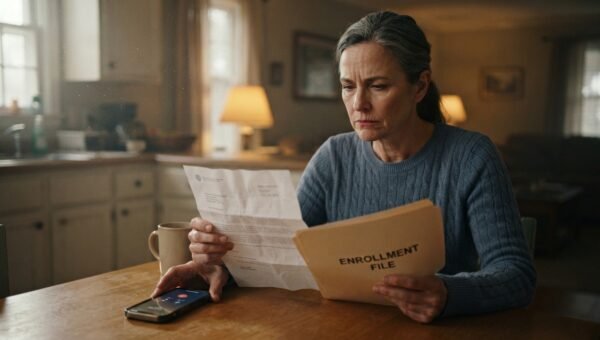
The hospital waiting room smelled like cold vinyl and floor wax, that sharp, sterile odor that gets right behind your eyes and stays there. I sat on the edge of the blue chair, pressing my palms into my knees to stop them from shaking. My canvas purse was clutched so tight my knuckles looked like chalk.
Mark was supposed to be sitting right beside me. He had promised all week.
When the doctor called me back for the core needle biopsy, Mark kissed my forehead in the parking deck, brushed a stray gray hair behind my ear, and said he was deeply sorry. He swore an important client had flown in from Chicago at the eleventh hour and needed him at the office immediately. He told me he would be waiting in the lobby the second it was over to drive me home. I had nodded, swallowed the tight knot in my throat, and told him business was business.
Once I was inside the examination room, the nurse practitioner, a kind woman with silver hair pulled back into a neat clip, checked my chart on her tablet. She tapped the screen a few times, frowned, and looked up at me over her half-moon glasses.
“Should we call your spouse, Mark, to come back into the recovery area when we are finished?” she asked, her voice gentle.
I shook my head, feeling a dull ache behind my eyes. “He had to run back to his office.
An emergency client meeting. But he will be waiting downstairs in the main lobby.”
The nurse tapped her screen again, her stylus clicking softly against the glass. A strange, puzzled expression crossed her face. “That is odd. The notes from your intake last month list your primary contact as Mark, but the emergency notification protocol updated yesterday afternoon to a different number, and the chart lists a different spouse. Let me just confirm your details to make sure billing hasn’t crossed your file with another patient.”
I smiled faintly, thinking it was just typical medical office bureaucratic confusion. “My name is Martha Vance. My date of birth is June twelfth, nineteen sixty-eight. Address is on Elm Street.”
The nurse stopped tapping. She looked down at the tablet, then slowly back up at me. The warmth in her eyes shifted into something cautious, almost defensive. “Mrs. Vance, are you certain? Because the man who has accompanied you to your last three oncology consultations, signed your procedural consent forms, and paid your remaining co-pays in cash at the front desk… he introduced himself as Mark. And he listed his wife as a woman named Chloe.”
The fluorescent lights overhead seemed to hum louder, a high, piercing vibration that drowned out the sound of the air vents. My chest tightened until I could barely draw breath.
“No,” I whispered, the word scraping against my throat. “Mark is my husband. He is tall, with graying temples. He drives a dark blue sedan. He sat right there in the waiting room with me for my ultrasound two weeks ago.”
“Honey,” the nurse said, her voice dropping to a low, careful register. “The man who brings you here drives a silver SUV. He wears a baseball cap pulled low and a blue surgical mask every time he walks through our doors. He never takes the mask off, not even at the front desk. The receptionists thought he was just being cautious about his health.”
My hands began to tremble so violently I had to grab the edges of the paper-lined examination table to steady myself. “A mask? In the lobby?”
“Yes,” the nurse replied softly. “And he is not downstairs. He dropped you off twenty minutes ago, signed the digital check-in terminal at the kiosk near the entrance, and drove away. We have him on the security cameras every single time.”
They performed the biopsy anyway. I lay there staring at the acoustic tile ceiling while the cold pressure and the sterile sting of the local anesthetic did their work, my mind racing through a maze of impossible shapes. When it was over, the nurse handed me an ice pack and told me to sit for ten minutes. Instead, I stood up, pulled my cardigan tight around my shoulders, and walked straight out to the security office near the main exit.
The security guard, a heavy-set man in a navy uniform named Carl who recognized me from my previous visits, looked sympathetic when I asked to see the lobby footage from twenty-five minutes prior. He pulled up the camera feed without hesitation, tapping his mouse to rewind the digital recording.
“Here he is,” Carl said, pointing a thick finger at the monitor. “Drops you off right at the automatic sliding doors every time.”
I leaned in close, my breath fogging the corner of the monitor. A silver SUV pulled up to the curb. The passenger door opened, and I stepped out, clutching my purse. The driver’s door opened next. A man stepped out to retrieve a light jacket I had left on the back seat. He wore a dark baseball cap pulled low over his forehead and a pale blue medical mask covering the lower half of his face. He moved with a slight, awkward hitch in his left leg, favoring his hip as he rounded the back of the car.
I gripped the edge of the security desk. My knees buckled slightly, and Carl reached out to steady my elbow.
I did not recognize the man’s face because of the mask and the cap. But I knew that uneven, dragging stride better than I knew my own reflection.
It was my younger brother, David.
David, who had not spoken a single word to me in seven years. Not since our parents died and we stood on opposite sides of the open grave, refusing to look at each other as the rain poured down.
PART 2
I walked out of the hospital into the blinding September sunlight, the paper bag with my ice pack clutched against my stomach like a shield. My fingers were shaking so badly I dropped my phone twice on the concrete before I managed to unlock the screen.
I did not call Mark. My thumb hovered over his contact photo, that smiling portrait from our anniversary dinner last year, but a cold sickness in my stomach stopped me. Instead, I pressed my brother’s number. The same number that had sat blocked in my phone directory for nearly a decade, until curiosity and shock unblocked it three weeks ago when I first noticed small discrepancies in Mark’s schedule.
It rang three times. Then a raspy, guarded voice answered.
“Yeah?”
“David,” I said, my voice shaking so hard the syllables blurred together. “I just saw the security footage from the clinic.”
Silence hummed over the phone line, thick and heavy. I could hear the distant sound of traffic in the background on his end, horns honking, a low city rumble.
“You shouldn’t have gone to security, Martha,” David said quietly. There was no surprise in his tone. No stutter. Just a heavy, exhausted resignation.
“You have been driving me to my cancer appointments,” I said, the words tasting like ash in my mouth. “You have been signing my consent forms. You wore a mask and a hat so the staff would not realize I was being brought in by a stranger. Why? Where is Mark?”
“Mark isn’t coming,” David said, his voice dropping to a harsh whisper. “David told you the lump wasn’t new, didn’t he? Ask him why he has been receiving your scan results for four years…”
The line went dead with a sharp click.
I stood on the sidewalk outside the sliding glass doors of the clinic, cars whizzing past on the asphalt, while the words echoed in my head like a gunshot. *David told you the lump wasn’t new… Ask him why he has been receiving your scan results for four years…*
My breath hitched. David had said *him*. He hadn’t meant himself. He had slipped up, or he had meant someone else entirely. Or perhaps David was working with Mark. Or perhaps Mark had been hiding something far darker than an ordinary office affair.
I called an Uber instead of waiting for a husband who was never going to show up. During the fifteen-minute drive home, my mind raced through every medical file, every doctor’s visit, and every conversation about my health over the past four years. I remembered the routine mammograms. The clean bills of health Mark always brought home from his “annual insurance check-ins” at his downtown corporate office. The specific radiologist reports he insisted on filing away in his private home office safe because he “understood medical paperwork better than I did.”
When the car pulled up to our brick colonial house on Elm Street, Mark’s dark blue sedan was parked neatly in the driveway.
I paid the driver, walked up the brick walkway, and pushed open the front door. The house smelled faintly of brewed coffee and lemon polish. Mark was sitting at the kitchen island, scrolling through numbers on his laptop, wearing his crisp white button-down shirt with the sleeves rolled up to his forearms.
“You’re back early,” Mark said, not looking up immediately. “How did it go? Did the doctor say everything was clear?”
I did not take off my cardigan. I did not put down my purse. I walked straight across the hardwood floor and stood on the other side of the kitchen island, looking down at him.
“I went to the security office at the clinic, Mark,” I said. My voice was eerily calm, the terrifying quiet before a storm.
Mark’s fingers froze on the trackpad. Slowly, he raised his head. The color had already begun to drain from his face, leaving his skin a pale, sickly gray.
“What are you talking about, Martha?” he asked, trying to force a reassuring smile that didn’t reach his eyes. “You know I had that client meeting with the Chicago group. I told you—”
“You didn’t have a client meeting,” I interrupted, my voice sharp as broken glass. “You hired my brother. You paid David to put on a mask and a hat and drive me to my biopsies for the last three weeks, didn’t you?”
Mark stood up so fast his leather chair scraped loudly against the floorboards. “Martha, that is insane. Why would I—”
“Because you didn’t want to sit in that waiting room while the doctors told me the truth,” I shouted, the dam finally breaking. “You didn’t want to answer questions about why my medical history didn’t match the chart you set up under another name. David told me on the phone just now. He told me to ask you why you’ve been receiving my scan results for four years!”
Mark stared at me, his mouth slightly open. The last vestige of his composure crumbled away. He dropped back down into his chair, pressing both hands over his face, his broad shoulders shaking.
“I didn’t want to hurt you,” he choked out, his voice muffled behind his palms. “God help me, Martha, I didn’t want you to worry.”
PART 3
“Worry about what, Mark?” I demanded, slamming my canvas bag onto the counter. “Start talking right now, or I swear to God I will call the police and have you dragged out of this house.”
Mark lowered his hands. His eyes were red-rimmed and desperate. He reached across the counter toward my arm, but I jerked back as if he were burning hot.
“Four years ago,” Mark whispered, looking down at the polished granite countertop. “After your routine mammogram at the regional diagnostic center… the radiologist found a tiny, non-invasive cluster of atypical cells. Stage zero. Completely treatable, but…”
“But what?” I whispered, my heart hammering against my ribs like a trapped bird.
“The insurance company denied our supplemental coverage claim that same week because of the pre-existing clause on the new policy I had just switched us to,” Mark said, his voice trembling. “If it went on your permanent medical record as an active oncological observation before the policy lock-in period ended, our premiums would have skyrocketed by four hundred percent. We would have lost the house, Martha. Everything we built.”
“So you hid it?” I asked, horror washing over me in cold waves. “You intercepted my mail?”
“I changed the notification address on the patient portal to a secure digital forwarding box downtown,” Mark confessed, his voice breaking. “I talked to Dr. Hayes. He agreed to let me handle the monitoring privately, to keep an eye on the growth through low-dose scans at a private clinic across state lines where we paid cash. I hired David—yes, I tracked down your brother and paid him five hundred dollars a week to drive you to those appointments—because I couldn’t leave my job without raising suspicion, and I needed someone who looked like family to sign off on the intake forms.”
“You paid David?” I asked, the absurdity and betrayal twisting together into something grotesque. “My own brother, who hasn’t spoken to me in seven years, agreed to smuggle me to cancer appointments behind my back?”
“He needed the money for his back surgery,” Mark whispered. “And he wanted to see if you were okay. He watched you from behind that mask every single time, Martha. He hated every second of it, just like I did.”
“And the lump?” I asked, my voice dropping to a fragile whisper. “The one they biopsied today?”
Mark closed his eyes, a single tear escaping down his cheek. “It changed last month. The private scans showed it was no longer dormant. I tried to schedule the removal secretly with our private physician, but the hospital flagged the imaging overlap when you went in for that routine checkup three weeks ago. That’s why the clinic called you today. That’s why the charade fell apart.”
I stood there in the quiet kitchen, surrounded by the life we had built together over twenty-five years, feeling as though the floor had turned to glass and shattered beneath my feet. He hadn’t been having an affair. He hadn’t abandoned me because of a client. He had turned my own body, my own health, and my estranged brother into a guarded corporate secret to protect a bank account.
ENDING
The biopsy results came back three days later. It was malignant, just as I had already known in my bones it would be, but it was caught early enough to treat aggressively.
I did not let Mark drive me to the oncology consultation this time. I called a local taxi service, and when I walked through the clinic doors, I walked alone. The receptionist looked up with a sympathetic smile, her eyes filled with genuine kindness instead of confusion over masked drivers and forged names.
When I returned home that evening, Mark’s side of the walk-in closet was half-empty. He had packed two suitcases and moved into an extended-stay suite downtown, leaving behind a signed separation agreement and a check for the medical retainers.
David came by the house on a rainy Thursday afternoon two weeks after my surgery. He didn’t knock on the front door; he just stood by the driveway near the mailbox, his hands shoved deep into the pockets of his jacket, hesitating the way people do when they are standing on the edge of a frozen pond.
I watched him through the living room window for a long moment. Then I unlocked the front door, pushed it open, and stepped out onto the porch.
“Hey, Martha,” David said quietly, looking down at his boots.
“Hey, David,” I replied, pulling my cardigan tighter against the autumn chill.
We didn’t hug. We didn’t erase seven years of silence with a single sentence. But he walked up the two porch steps, took a seat in the white wooden rocking chair by the door, and waited with me while the afternoon shadows stretched across the lawn. For the first time in four years, nobody was hiding behind a mask, and the truth, however painful it was to carry, finally belonged to me alone.