PART 1
My husband, David, sat across from me at our kitchen table on a Tuesday night and asked for what he called a simple separation. We had been married twenty-eight years. He did not raise his voice. He did not look angry. He just pushed his mug to the middle of the wood and said we had drifted, that twenty-eight years was a long run, and that he wanted to take some time apart before things turned bitter between us.
I asked him the only question that made sense to me. I asked if there was another woman.
David looked me straight in the eye and said no. He swore on our daughter Sarah’s life that nobody else was involved. He said he simply wanted quiet, and that he would take care of finding a small place nearby so we wouldn’t have to sell the house right away.
Three weeks later, he was mostly packed. He was staying late at the high school where he taught biology, supposedly grading papers and clearing out his personal items. I went down to the basement to find an extra box for his winter coats. On the corner of his workbench, sitting right next to an open roll of packing tape, was a folded copy of a rental application for a two-bedroom townhouse four miles away.
I picked it up to see how much rent he was planning to pay.
On the first page, in his neat handwriting, he had checked the box for single father. Under household occupants, he had listed Sarah. She was thirty years old, working as an accountant across town, and living in her own condo that she bought three years ago. Right next to her name, David had written one word in the box marked relationship: Dependent.
My hands shook as I folded the paper. I was furious. I thought David was trying to pull some cheap tax trick, or maybe using Sarah’s solid credit score and income history to qualify for a lease he couldn’t afford on his own teacher’s salary. I walked straight up the stairs, grabbed my phone from the counter, and called Sarah.
When she picked up, I didn’t even ask how her day was. I told her David was applying for an apartment, claiming she lived with him, and calling her his dependent.
I asked her why on earth she would let her father use her name for a lease application behind my back.
Sarah went completely silent on the other end of the line. The background noise of her office keyboard stopped.
“Sarah?” I said. “Did you hear me?”
Her voice came back small and tight. “Mom, he didn’t tell you?”
Before I could demand an answer, Sarah told me she was leaving work early and driving straight to our house. Forty minutes later, her car pulled into the driveway. She walked through the back door carrying a thick tan medical folder under her arm. Right behind her was David. He had followed her car in from the highway. When he walked through the kitchen door, he looked utterly defeated, his shoulders slumped in a way I had never seen in nearly three decades of marriage.
Sarah set the folder on the kitchen table, right where David had placed his coffee cup three weeks earlier. She looked at her father, then at me.
“Dad isn’t trying to scam an apartment, Mom,” Sarah said quietly. “Show her, Dad. Or I will.”
David didn’t move. He leaned back against the counter and looked at the floor tiles. Sarah opened the folder. The top document had the letterhead of a regional neurological institute.
The separation had nothing to do with another woman, and it had nothing to do with falling out of love. Two months earlier, David had received a confirmed diagnosis of early-onset frontotemporal dementia. He had decided on his own that I shouldn’t have to spend the next ten years watching him lose his mind, changing his clothes, and turning into a shell of the man I loved. He had gone to Sarah in secret, told her the truth, and asked her to help him rent a small place so she could oversee his care when the symptoms worsened, without burdening me.
I stood there by the table, staring at the clinical summary. The room felt completely still. But Sarah wasn’t finished. She reached past the first three doctor’s letters and turned the folder to a loose, blue-lined page hidden underneath the clinic receipts, a page David had clearly kept hidden even from her.
PART 2
Sarah pulled the paper out and stared at it with her brow furrowed. “Dad, what is this?”
David took a quick step forward, his hand reaching out, but Sarah had already stepped back toward me. It was not a doctor’s chart. It was a handwritten legal worksheet dated six weeks prior, stamped by a private attorney downtown, along with a carbon copy of a financial withdrawal slip.
I took the sheet from Sarah’s hands. David had gone to a lawyer to draft a postnuptial property agreement and an irrevocable trust. The worksheet outlined our entire financial life: the equity in our home, our joint savings account, and his state teacher pension. But across the bottom of the page, David had written out explicit instructions to the attorney.
He was assigning the entirety of our $310,000 home equity directly to me, along with seventy percent of his monthly pension benefits. In exchange, he had liquidated his personal deferred-compensation account, taking out an early lump sum of $48,000, and moved it into an independent care account.
Beside that $48,000 figure, in his tight, familiar script, David had written two lines:
“Keep clear of Martha’s assets. Do not allow memory facility costs or future state liens to touch the house or her retirement.”
I looked up at him. “David, what did you do?”
His voice cracked. “My father died of this, Martha. You remember what it did to my mother. She spent six years wiping his chin while the nursing home took every single cent they had saved. By the time he passed, she had to sell the house just to pay the Medicaid spend-down penalties. She lived on eight hundred dollars a month in a tiny duplex until she died.”
He rubbed both hands over his face. He had lost weight over the last two months, something I had chalked up to stress at work.
“I saw the cognitive tests,” David said, his voice barely above a whisper. “The doctor said the language lapses will start within eighteen months. Then the behavioral changes. I’m not going to let you spend your retirement changing my diapers and watching our savings disappear. I made a promise to protect you when we were twenty-four years old. I’m keeping it.”
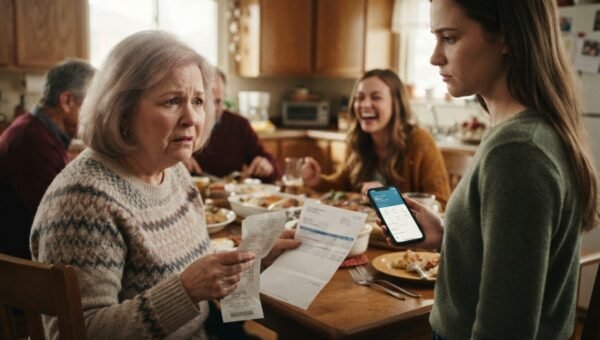
Sarah sat down hard on the kitchen chair, her hands trembling. “You told me you were just moving out so you could adjust to the medications, Dad. You told me you and Mom were just taking space so she wouldn’t worry while we figured out the specialist appointments. You lied to me, too.”
“I had to list you on the lease, Sarah,” David whispered. “The management company wouldn’t approve a tenant with my diagnosis history without a co-signer and a primary local contact. I put you as dependent because the legal packet required a secondary household name to link the care fund. I was going to tell you about the money next week.”
“You weren’t going to tell either of us,” I said, holding the paper tightly. “You were going to walk out that door, pretend you didn’t love me anymore, let me hate you for leaving, and then fade away in a rented apartment while Sarah carried the whole secret alone.”
PART 3
David did not answer. He just leaned his head back against our kitchen cabinets, closing his eyes. That silence gave me the full picture. He had planned to make himself the villain. He thought if I was angry at him for leaving after twenty-eight years, it would hurt less when he started to forget who I was. He thought pride and distance could protect me from grief.
“Look at me, David,” I said.
He opened his eyes. They were red and tired.
“You spent twenty-eight years being my partner,” I told him, keeping my voice steady even though my throat burned. “You coached Sarah’s softball teams. You stayed up with me through my mother’s chemotherapy. You built that deck out back with your own hands. And now you think you get to decide by yourself how our marriage ends?”
“Martha, you don’t know what it looks like,” he pleaded. “You don’t understand how ugly it gets.”
“I don’t care how ugly it gets,” I said. “We said in sickness and in health in front of a church full of people. We didn’t add a clause that says unless the medical bills get complicated.”
I took the blue-lined worksheet, along with the rental application I had brought up from the basement, and laid them flat on the kitchen table.
Sarah looked between the two of us. She wiped her eyes with the back of her sleeve, then reached across the table and put her hand over mine. “Mom is right, Dad. When you came to my office last month, I thought you were just scared. I thought you were talking to doctors and getting a second opinion. I never would have signed anything if I knew you were trying to cut Mom out of your life.”
“I called the attorney on the worksheet,” I said, pointing to the business card stapled to the corner. “Tomorrow morning, the three of us are going down to that office. We are canceling this postnuptial agreement. We are setting up a proper medical power of attorney, and we are going to talk to an elder-law specialist who knows how to protect a family without tearing it in half.”
David shook his head slightly, but the fight had drained out of him. “I didn’t want you to carry this, Martha.”
“You don’t get to protect me from loving you,” I said. “That is not your decision to make.”
ENDING
We sat at the kitchen table until past ten that night, reading through every page in the neurologist’s folder. There were test results, MRI scans, and appointment slips for specialists at the university hospital three hours away. Sarah called her office to take the rest of the week off.
The next morning at nine o’clock, the three of us walked into the attorney’s office downtown. We revoked the separation draft. Instead, we signed durable powers of attorney for both healthcare and finances, naming myself as primary and Sarah as alternate. We placed David’s liquidated savings into a joint medical trust designed to cover his future in-home aides, keeping our house and pension protected under state spousal allowance rules without any need for false pretenses or divorce filings.
On Friday afternoon, David and I drove over to the rental office where he had submitted the townhouse application. He walked in, asked for the property manager, and withdrew the application in person. When the woman behind the desk asked if he wanted his deposit check returned by mail, David told her he would take it by hand.
When we got back home, we went down to the basement together. We took the three cardboard boxes he had packed with his winter coats and his old college biology texts, carried them back up the stairs, and put everything back in the bedroom closet where it belonged.
We know what lies ahead of us. The doctor said the changes might come slow, or they might come fast. But tonight, David is sitting in his usual chair in the living room, grading his students’ quizzes under the floor lamp. The rental papers are gone, the kitchen table is clear, and whatever comes next, we will face it together in the house we built.