PART 1
For four years straight, my sister’s husband treated me like his personal holiday errand runner.
“You’re single, Maggie, you have time,” Greg would say, holding out car keys or tossing a crinkled grocery list across the kitchen counter before I even took off my winter coat.
Every single holiday was the same script. If it was Easter, he had forgotten the honey-baked ham glaze across town. If it was Fourth of July, he needed three bags of crushed ice and a special brand of barbecue rub from a specialty store twenty-five minutes away.
If it was Thanksgiving, it was heavy cream, extra butter, and bakery rolls because he swore the ones my sister baked looked flat.
My sister, Clara, never argued with him. She would just look down at the cutting board, wiping her hands on her apron, and say quietly, “Maggie, please. Just to keep the peace.”
So I did it. I swallowed my pride, took his cash, and sat in holiday traffic for an hour or two while the rest of the family sat around the television drinking warm cider. I told myself I was doing it for Clara. She had two boys under ten, a demanding job at the county clerk’s office, and an exhaustion in her eyes that had been growing deeper every year of their marriage.
This Thanksgiving, I hit my limit.
I was turning fifty-one in two weeks. I had spent half my adult life making things easy for men who did not appreciate me, starting with my ex-husband who left me for his dental hygienist twelve years ago. I decided I was done playing the reliable, doormat sister.
I arrived at Greg and Clara’s house at four in the afternoon, two hours late on purpose. I carried one store-bought pumpkin pie in a cardboard box. No side dishes, no prep help, and no apologies.
When I walked through the door, Greg looked at his watch and shook his head. “Well, look who finally showed up. We ran out of ice forty minutes ago, Maggie. Grab your keys.”
I set the pie on the counter and looked him dead in the eye. “My keys are staying in my purse, Greg. If you need ice, the gas station on Route 4 is open. You have two working legs.”
His face flushed dark red. Clara quickly jumped in, saying the drinks were cold enough in the garage cooler anyway. Greg spent the rest of dinner ignoring me, making loud comments to his brother about people who live alone so long they forget how family works.
I ate my turkey, helped my nephews cut their meat, and counted the minutes until I could leave without making Clara cry.
At eight o’clock, I said my goodbyes. Clara followed me out into the chilly driveway, shivering in her wool cardigan. She walked me all the way to the driver’s side of my sedan.
“I’m sorry he talked to you like that,” she whispered, looking back toward the brightly lit front porch.
“Clara, you don’t have to apologize for him. But I won’t let him treat me like a maid anymore.”
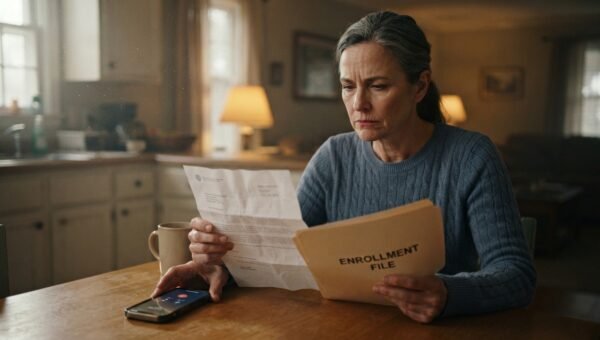
She didn’t get defensive like I expected. Instead, she reached into her cardigan pocket and slipped a thick white envelope into my coat pocket. Her fingers were trembling.
“Don’t open this here,” she said, her voice tight and barely audible over the wind in the bare maple trees. “Go home first. Lock your door.”
Before I could ask her what was going on, the front door opened and Greg yelled out into the dark, asking where the extra coffee mugs were.
Clara backed away instantly, offered a strained smile, and hurried up the walkway.
I drove the twenty minutes back to my small bungalow with my heart thumping against my ribs. As soon as I got inside, I locked the deadbolt, took off my coat, and pulled out the envelope.
Inside was a stack of paper. There were dozens of credit card statements with yellow highlighter over cash withdrawals, printed hotel receipts from the motor lodge out near the interstate, and three handwritten pages listing dates going back four years.
Every single date on that list was a holiday.
Thanksgiving 2022. Christmas Eve 2022. Memorial Day 2023. Labor Day 2023. Thanksgiving 2023. New Year’s Day 2024.
Next to each date was an exact time stamp. Thanksgiving 2023: 1:15 PM to 2:45 PM. Memorial Day: 3:00 PM to 4:30 PM.
Those were the exact windows when Greg had sent me out on wild-goose errands. Every time he gave me a frantic list of groceries or begged me to drive across the county for missing ingredients, he wasn’t sitting on the sofa watching football. He had left the house. Or someone had come to him.
Taped to the bottom of the last page was a yellow sticky note in Clara’s neat cursive.
It read: “Tell me whether you remember seeing the same car outside each time.”
I read the note twice. A gray Dodge sedan with a dented rear bumper. I had seen that car parked down at the end of their cul-de-sac at least three different times when I pulled back into the driveway with bags of groceries. Back then, I thought it belonged to a neighbor having guests over.
I stared at the paperwork on my kitchen table, realizing Greg had used my willingness to help as his cover story. He made me the family joke so he could slip away unnoticed.
I picked up my phone to call Clara, ready to tell her everything I remembered. But before I could dial, my phone buzzed on the counter. It was a text message from an unknown number.
The text read: “Look at the back of the hotel receipt from last Christmas. Check who signed for the room deposit.”
PART 2
I set the phone down next to the envelope. The kitchen was completely quiet except for the hum of the refrigerator.
I picked up the hotel receipt from December 24 of last year. It was from the Pinewood Lodge, a two-story motel tucked behind the truck stop off Highway 12. On the front, it showed a room charge of $140 paid with cash, plus a $50 key deposit.
I flipped the paper over.
There was a faded carbon copy slip stapled to the back, stamped by the front desk clerk. Printed along the bottom line in blue ballpoint ink was a name and a signature.
The printed name didn’t say Greg. It didn’t say a strange woman’s name, either.
It said Brenda Miller.
Brenda was our mother’s younger sister. My aunt Brenda.
I pulled my reading glasses off my collar and held the slip right under the pendant light above my kitchen island. The handwriting was unmistakable. Brenda wrote with an old-fashioned backslant, crossing her capital T’s with a heavy downward hook. She had written my birthday cards that way for thirty years.
My stomach dropped into a hard, cold knot.
Aunt Brenda lived four miles from Clara and Greg. She was sixty-four, widowed, and constantly complaining that her late husband had left her with nothing but a mortgaged duplex and a small pension. Every family dinner, Brenda would sit in the corner chair, sighing about the cost of heating oil and how hard it was to manage alone. Whenever Greg started picking on me about being single and running errands, Brenda was always the first one to laugh. “Let the girl help,” Brenda would chime in. “She doesn’t have a family to look after.”
I stared at the slip until my eyes burned. Why was Brenda signing for a motel room on Christmas Eve while the rest of us were waiting for Greg to come back from getting firewood?
My phone buzzed again. The unknown number: “Call me. It’s Clara. I’m using a burner phone from my work bag.”
I dialed the number immediately. Clara answered on the first ring, her breath shallow.
“Did you look at it?” she asked.
“Clara, what is Aunt Brenda’s name doing on a motel receipt from Christmas Eve?”
There was a long silence on the line. I could hear cars passing in the background. She was parked somewhere down the road from her house.
“It’s not an affair, Maggie,” Clara said, her voice shaking. “I thought it was an affair at first. That’s why I started pulling the bank statements six months ago. Greg kept taking out four hundred dollars in cash every holiday, right around noon. I thought he was seeing someone on the side while you were at the grocery store.”
“If it’s not an affair, what is it?”
“It’s money,” Clara said. “Mom’s money.”
Our mother had passed away three years ago after a long battle with dementia. She had lived in an assisted living facility that cost nearly six thousand dollars a month. When she died, Aunt Brenda was the executor of the estate because our mother had named her back in 1998, before Clara and I were even married. Brenda had told us there was nothing left. She said the nursing home care and medical bills had eaten through the entire sale of Mom’s house, leaving only about four thousand dollars, which was split between Clara, Brenda, and me.
“Brenda didn’t spend it all on the nursing home,” Clara said, her voice dropping to a whisper. “Mom had an annuity account that paid out after she passed. Eighty-four thousand dollars. Brenda hid the distribution paperwork from probate. And Greg found out about it two years ago when he helped Brenda clean out her basement.”
The pieces started shifting in my head. “Greg found the papers?”
“He found the bank stubs,” Clara said. “And instead of telling us, instead of telling me, his own wife, he went to Brenda and made a deal. He told her he wouldn’t turn her in to the probate court if she paid him a cut. Every holiday, he demanded a cash installment. Four hundred or five hundred dollars at a time, plus whatever else he could squeeze out of her.”
“The errands,” I said, the words tasting like copper in my mouth.
“He made you leave so Brenda could pull up to the corner or meet him at the motel without anyone noticing,” Clara said. “He used your errands as his timer. If you were gone for forty-five minutes, he had forty-five minutes to collect his payoff. And he made fun of you the whole time to keep everyone looking at you instead of him.”
“How long have you known this, Clara?”
“I found the cash hidden in his toolbox three weeks ago. Eight thousand dollars in envelopes. Then I went to the county records office where I work and pulled the original deed and annuity filings on Mom’s estate. It took me two weeks of quiet digging during lunch breaks. Brenda didn’t just steal from us, Maggie. She stole Mom’s final savings, and my husband has been blackmailing her for two years using our holidays as his drop-off routine.”
Clara started crying softly. “I couldn’t tell you at the house. He watches my phone. He checks the mileage on my car. I had to wait until Thanksgiving was over.”
“Where is he right now?” I asked.
“He’s asleep on the couch,” she said. “He thinks everything is fine. He thinks we’re just going to keep doing this forever.”
I looked at the receipts spread across my counter. All those holidays. All those cold parking lots, standing in line at grocery stores on Thanksgiving and Christmas, hurrying back so Greg wouldn’t make another joke at my expense while my sister carried the roast to the table.
“What do you want to do, Clara?” I asked.
“I called an estate attorney on Tuesday,” she said, her voice steadying. “The attorney said if we go to Brenda together with the bank copies and the motel receipt, she will crumble. But I need you with me, Maggie. I can’t do this alone.”
“I’ll be at your house at eight tomorrow morning,” I said. “Don’t say a word to Greg tonight.”
PART 3
The next morning, the sun came up pale and sharp over the frost on my windshield.
I arrived at Clara’s house at ten minutes before eight. Greg’s pickup truck wasn’t in the driveway. He had left early for a deer hunting trip up north with his co-workers, a trip he took every year the day after Thanksgiving. He had packed his bags the night before, completely oblivious to what was sitting in the envelope in my purse.
Clara came out the front door wearing a heavy gray sweater and dark jeans. Her face was pale, with dark circles under her eyes, but her jaw was set. She got into my passenger seat without a word and pointed down the road.
“Brenda usually has her coffee around eight-thirty,” Clara said. “Her car is in the driveway. I checked on my way back from the store.”
The drive to Aunt Brenda’s duplex took seven minutes. Neither of us turned on the radio.
Brenda’s duplex sat at the end of a quiet street lined with old oaks. In the driveway sat the gray Dodge sedan with the dented bumper. Seeing it parked there in broad daylight, surrounded by dead leaves, made my chest tighten. I had seen that exact bumper through the rear-view mirror of my car three different times over the last two years, idling near Clara’s street corner while I waited at the stop sign with frozen pies or bags of ice.
We walked up the concrete steps and Clara knocked firmly on the storm door.
A moment later, the curtain moved. The deadbolt clicked open, and Aunt Brenda stood in the doorway wearing a pink quilted bathrobe, holding a ceramic mug. When she saw both of us standing there together on a Friday morning, her hand hesitated on the latch.
“Clara? Maggie?” she said, forcing a nervous smile. “What are you two doing out so early? Did somebody leave a dish at the house yesterday?”
“We need to talk to you, Aunt Brenda,” Clara said evenly. “Inside.”
Brenda looked past us toward the driveway, checking to see if Greg was in the car. Seeing only my empty sedan, her smile vanished. She stepped back and held the door open.
The living room smelled like stale menthol cigarettes and lavender air freshener. A gas heater was humming in the corner. We didn’t sit down. Clara walked straight to the small dining table, unzipped her shoulder bag, and laid the paperwork out in three neat piles.
On the left: the county probate records showing the closed estate.
In the middle: the annuity statement showing the $84,000 disbursement that never went through probate.
On the right: the Pinewood Lodge deposit receipt with Brenda’s signature on the back, along with the list of bank withdrawals matching every major holiday for twenty-four months.
Brenda stood by the kitchen counter, clutching her coffee mug with both hands. “I don’t know what this is supposed to be.”
“You know exactly what it is,” Clara said. Her voice wasn’t loud, but it was hard as stone. “You kept Mom’s annuity money. You told Maggie and me there was nothing left after the nursing home bills. And when Greg caught you two years ago, you started paying him off so he wouldn’t report you to the court.”
Brenda’s face turned a dull, grayish color. She looked at the signed motel slip and her throat moved as she swallowed.
“Greg told me he’d ruin me,” Brenda whispered, her eyes darting between us. “He said he’d go to the county prosecutor. He said I’d lose the duplex. He started demanding cash every few months. Holidays were the only time he could get away without you asking questions, Clara. He told me to meet him at the motel or sit by the park until Maggie went to the store.”
“You let him talk about Maggie like she was dirt,” Clara said, taking a step toward her. “You sat at my Thanksgiving table yesterday and laughed when he made jokes about her being alone, while the two of you were trading Mom’s stolen money in parking lots.”
“I was scared!” Brenda cried out, her voice cracking. “I spent part of that money paying off my own credit cards after your uncle died! I didn’t have the cash to pay it all back into the estate! Greg said he would keep quiet if I gave him two hundred here, four hundred there. He bled me dry, Clara. He took over twelve thousand dollars from me!”
“You didn’t get bled dry,” I spoke up, my voice steady. “You stole eighty-four thousand dollars that Mom meant for her daughters. You stole from the sister who trusted you to handle her affairs when she couldn’t remember her own name anymore.”
Brenda sank into an armchair by the window, burying her face in her hands. She began to sob, the loud, gasping kind of crying that comes when there are no lies left to tell.
“What are you going to do?” Brenda asked through her fingers. “Are you calling the police?”
Clara pulled a legal document from her bag. It was a formal retainer and an accounting demand drafted by an estate attorney.
“Here is what happens,” Clara said. “You are going to sign over the remaining balance of Mom’s annuity account today. Whatever money is left goes into a trust for Maggie and me. For the rest of the eighty-four thousand that you and Greg spent, you are going to take out a reverse mortgage on this duplex or a bank loan to repay it in full. If you don’t agree to the accounting by Monday morning at nine, my attorney files the fraud petition with the county probate judge.”
Brenda looked up, her eyes red and swollen. “And Greg? What about Greg?”
Clara looked out the window at the gray Dodge sedan in the driveway.
“Greg has his own papers waiting for him,” Clara said.
ENDING
We left Brenda’s house forty minutes later with Brenda’s signed agreement to meet Clara’s attorney on Monday morning. She signed without another argument. She knew she had no choice.
When we got back to Clara’s house, the kitchen was still quiet. The pumpkin pie I had brought the day before was sitting on the counter, half-eaten under plastic wrap.
Clara walked straight down the hallway into the master bedroom. I followed her. She pulled a large plastic storage tote from the top of the closet, set it on the bed, and began packing Greg’s clothes into it. Jeans, flannel shirts, hunting jackets, boots.
In his nightstand drawer, inside an old leather shaving kit, Clara found the remaining cash: thirty-two hundred-dollar bills wrapped in a rubber band, sitting right next to an extra set of keys.
She took the money out and laid it on the dresser.
“He’ll be back Sunday evening,” Clara said, taping the lid onto the tote. “My brother is coming over tomorrow with a truck to help me move the rest of his tools into the garage. When Greg pulls into the driveway, the locks will be changed. The divorce papers and the court notice will be taped to the garage door.”
“Are you going to be okay?” I asked, putting my hand on her shoulder.
Clara paused, holding a stack of shirts in her arms. For the first time in four years, the tension around her eyes looked different. She wasn’t carrying that heavy, hopeless exhaustion anymore. She looked tired, but she looked awake.
“I spent ten years trying to keep the peace for a man who didn’t care about anything except what he could take,” she said. “I’m done keeping his peace.”
The following months were messy and slow, the way legal fights always are.
Brenda secured a home equity loan against her duplex to repay forty-one thousand dollars back into Mom’s restored estate account. Her credit was ruined, and she stopped coming to family gatherings altogether. Nobody called to ask why.
Greg tried everything when he came home that Sunday. He banged on the front door, called my phone six times screaming that I had poisoned his wife against him, and threatened to take Clara to court for custody. But when Clara’s lawyer sent him the audit records, the motel receipts, and a formal notice that the county prosecutor was reviewing the extortion evidence, Greg went quiet. He signed the separation agreement four months later. He ended up with his pickup truck, his hunting gear, and an order to pay child support based on his actual wages.
Last week was Memorial Day.
It was the first holiday our family had hosted since everything came out. Clara held the cookout in her backyard. Her boys ran around the lawn catching fireflies in the grass, and my brother brought a case of soda and a portable grill.
Around two in the afternoon, my nephew ran into the kitchen and announced that they were almost out of hamburger buns.
I stood up from the patio chair and reached for my purse out of pure habit. “I can run to the corner store,” I offered.
Clara looked up from the patio table where she was slicing tomatoes. She put the knife down, walked over, and gently took the car keys out of my hand, dropping them back into my bag.
“Sit down, Maggie,” Clara said, smiling at me in the warm afternoon sun. “Nobody is sending you for groceries today. We have plenty of food.”
I sat back down in the white lawn chair, watching the boys run through the sprinkler, and let the ice melt in my cup.