PART 1
At thirty-nine, you start to believe that real love just passed you by while you were busy keeping your head down. I had been through two long relationships that ended in slow, exhausting heartbreak. My thirties were nearly gone, my mother had passed away four years earlier, and most of my life revolved around working as an office coordinator for a dental practice and checking in on my dad every weekend.
Then Steve walked into our lives.
Steve was forty-eight, almost ten years older than me, and an old friend of my father, Frank. They had known each other back when they both worked in regional freight logistics, though Steve had moved away for a decade to run a distribution firm two states over. When he came back to our town after his own quiet divorce, he stopped by my dad’s house on a Sunday afternoon while I was there making a pot of chicken noodle soup.
The moment Steve walked through the screen door, took off his work boots, and smiled at me, I felt an unexpected warmth that I had not felt in years. He was solid, soft-spoken, and respectful. He did not talk over people. When my dad stumbled while carrying a heavy box of tools to the garage, Steve was already right there, taking the weight without making a fuss about it.
We started dating two weeks later. He took me to quiet family-owned diners, listened to me talk about my mother, and never pushed me for anything. My father was thrilled. For the first time in years, Dad looked relaxed, repeatedly telling me over Sunday dinners, “A guy like Steve knows what commitment means, Nora. He’s steady. You won’t ever have to worry about where you stand.”
Six months after that first visit, Steve proposed by the lake behind my dad’s house. It was simple, tender, and exactly what I thought I needed.
Our wedding took place in late October. It was modest and sweet, held in the small chapel where my parents had married thirty years earlier. I wore the ivory lace dress I had kept pinned on a board for years, wondering if I would ever actually have a reason to buy it. My dad had tears in his eyes when he put my hand into Steve’s.
After the small reception dinner at an Italian restaurant downtown, Steve drove us back to his house. It was a lovely, well-kept four-bedroom colonial sitting on two acres at the edge of town. As we stepped into the front foyer, Steve carried my small overnight bag up the stairs, smiled warmly, and kissed my forehead.
“Take your time, sweetheart,” he whispered. “I’ll go downstairs, pour us some sparkling cider, and put on some soft music.”
I smiled, feeling completely safe. I went into the master bathroom, hung my wedding dress carefully behind the door, unpinned my hair, and washed off my makeup. I put on a soft satin robe, breathing in the quiet calm of what was supposed to be the start of our new life together.
When I stepped out of the bathroom and walked back into our bedroom, my heart stopped cold.
Steve was not downstairs getting cider. He was standing by the mahogany dresser at the foot of our bed, holding my black leather handbag open.
In his hands was the thick manila envelope my father had handed me right before we left the reception.
Spread out across the bedspread were my dad’s personal papers: the deed to my father’s paid-off house, his bank statements, and a folded power-of-attorney form that did not have my dad’s handwriting on it.
Steve looked up, his face devoid of the gentle warmth he had shown me all day. His hands did not even shake as he looked right at me.
PART 2
I stood frozen in the doorway, clutching the lapels of my robe. The house was dead quiet except for the hum of the heating vent near the window.
“Steve?” My voice was barely a whisper. “What are you doing with my bag?”
He did not jump or try to hide what he had in his hands. He calmly set the folder down on the mattress, smoothed out the corner of the papers, and looked at me as if I were an employee who had walked into his office without knocking.
“Nora,” he said, keeping his voice low and level. “Frank gave you these papers before we left. He told you they were for safekeeping. I needed to see what he actually signed over.”
“My father gave me his private documents because his health has been declining,” I said, taking two steps toward the bed, my heart hammering against my ribs. “He asked me to put them in your home safe tomorrow morning. Why are you digging through my purse on our wedding night?”
“Because your father owes forty-two thousand dollars to a private creditor, Nora,” Steve replied bluntly. “And that creditor is a holding company owned by my business partner.”
The room seemed to tilt. “What are you talking about?”
“Two years ago, your father tried to help a neighbor invest in a machine shop startup,” Steve said, crossing his arms. “The shop went under. Frank signed a personal guarantee. He didn’t want to tell you because he was ashamed, and he didn’t want to lose the house. When I came back to town, I bought out that debt note to keep the collectors off his back.”
I stared at him, trying to reconcile the generous, gentle man from two hours ago with the stranger standing in front of me. “You bought my father’s debt? Why didn’t either of you tell me?”
“Because you would have panicked and tried to sell your mother’s jewelry or empty your retirement account,” Steve said, his tone chillingly practical. “This was the clean way. We get married. We consolidate the properties. You have power of attorney over Frank’s affairs, which means tomorrow you sign the paperwork placing his house into a family trust that I manage. The debt disappears, your father stays in his house for the rest of his life, and our combined assets secure a low-interest commercial loan I need for my distribution hub.”
“You married me to secure collateral?” The words tasted like ash in my mouth. “Did my dad know this was why you proposed to me?”
Steve hesitated for half a second. That tiny pause told me everything.
“Frank knows we care about each other,” Steve answered carefully. “He knows I have the resources to protect him. He didn’t ask questions about the exact mechanics, because he trusted me to handle it like a son-in-law.”
“You lied to him,” I said, tears finally stinging my eyes. “And you lied to me.”
“I gave you a home, Nora,” Steve said, stepping closer, his voice dropping into that soothing register he had used on our first date. “I treat you well. I will take care of you and your father. But this family needs leadership, and we need this house tied up before the lien hits the county records on the first of next month. Get some sleep. In the morning, you’ll see this is the only logical move.”
He turned, left the bedroom, and walked downstairs. A few minutes later, I heard the guest room door click shut down the hall.
PART 3
I did not sleep a single minute. I sat on the edge of the bed in the dark, watching the headlights sweep across the ceiling as cars passed on the highway half a mile away.
Every memory of the last six months replayed in my mind like a movie I had completely misunderstood. Steve offering to handle Dad’s lawn care. Steve asking casual questions about whether Dad had a mortgage left. Steve asking if Dad had updated his will after Mom died. It had not been devotion. It had been due diligence.
At five in the morning, while the house was still completely gray and quiet, I slipped out of my robe and pulled on jeans and a sweater. I packed my small bag. I gathered my father’s documents from the bed, along with the unsigned power-of-attorney paper Steve had drafted. I placed my wedding band on the dresser next to the lamp, picked up my car keys, and walked out the back door to my sedan.
I drove straight to my father’s house across town.
When I unlocked his front door at six-fifteen, the smell of stale coffee hit me. Dad was already sitting at the kitchen table in his flannel shirt, staring into an empty mug. When he saw me walk through the door carrying my bag, the color drained completely from his face.
“Nora?” he asked, his hands trembling against the tabletop. “What are you doing here? Did something happen to Steve?”
I set the papers down right between us on the yellow laminate table.
“Dad, did you borrow forty-two thousand dollars for an investment two years ago?”
Dad flinched as if I had hit him. He dropped his head into his rough, calloused hands, his shoulders shaking.
“I wanted to leave you something, Nora,” he sobbed quietly. “Mom’s medical bills took almost half the savings. I thought if I put money into that repair shop, I’d make twenty thousand on the return and replace what was gone. When it went under, the debt was real. I couldn’t bear the thought of telling you I lost the money.”
“And Steve?” I asked, pulling out a chair and sitting beside him. “What did Steve tell you?”
“Steve told me he took over the loan to keep it quiet,” Dad said, wiping his face with a paper napkin. “He said you two fell in love on your own, but that once you were married, family looks out for family. He told me he’d take care of the paperwork so you and I wouldn’t ever have to worry about foreclosure.”
“Dad, he didn’t tell you the whole story,” I said gently. I showed him the document Steve had drafted. “He drafted this to put this house into a trust in his name alone so he could use it as collateral for his business loans. If his warehouse fails, your house gets taken by the bank, not him. He didn’t marry me out of love, Dad. He married me so he could legally control everything without you realizing you gave it away.”
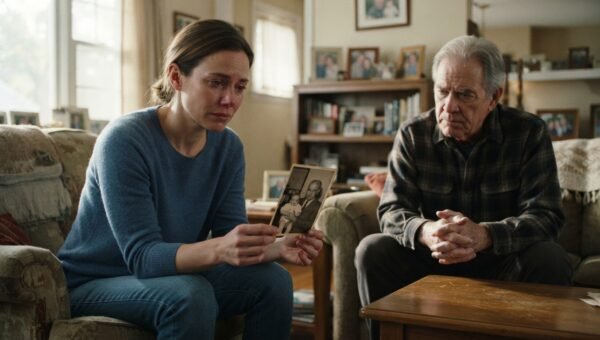
Dad looked down at the paper, reading the fine print in his faded bifocals. A look of profound betrayal settled onto his lined face.
“I gave my daughter away to a man who saw us like a repossession,” Dad whispered.
“No,” I said firmly, reaching over and covering his shaking hand with mine. “You didn’t give me away. And we are not giving him this house.”
By nine that morning, I had called an estate and consumer attorney named Marcus Vance, whose office was located two blocks from the dental clinic where I worked. By ten-thirty, Dad and I were sitting across from him in his conference room.
Marcus looked over the promissory note Steve held, the property title, and the unsigned trust documents.
“Here is the truth,” Marcus said, leaning back. “Your father does owe the forty-two thousand dollars to the holding entity. Steve does own that note legally. But Steve does not have a lien filed against this property yet. And he cannot touch this house unless Frank voluntarily pledges it or Steve sues him in civil court and wins a judgment, which takes twelve to eighteen months.”
“What are our options?” I asked.
“You pay him off cleanly,” Marcus said. “You take away every single shred of leverage he has over you.”
ENDING
I did not have forty-two thousand dollars in liquid cash. But I had twenty-eight thousand in my personal savings, accumulated over fifteen years of steady work, and my father had fourteen thousand left in his modest credit union account.
Paying it meant draining almost every safety net we had between us. It meant no new car, no vacations, and tight grocery budgets for the next three years. But it meant our dignity remained our own.
At two o’clock that afternoon, Marcus Vance accompanied me to Steve’s office at his distribution center.
When Steve saw me walk in with an attorney, his confident expression vanished. He stood up from his desk, his voice sharp. “Nora, this is absurd. We are husband and wife. You do not bring a lawyer into a family discussion.”
“We are not a family, Steve,” I said, setting Marcus’s legal letter on his desk alongside two official cashier’s checks totaling the exact payoff balance plus accumulated statutory interest. “Here is the full satisfaction of the debt note. Marcus has prepared the release of claim. You will sign it right now in front of the notary downstairs in this building, or Marcus will file a formal complaint with the state licensing board for predatory lending practices against an elderly dependent.”
Steve looked at the two cashier’s checks. He realized in an instant that his leverage had evaporated. He had expected an emotional, broken woman begging for reassurance; instead, he was facing a closed financial transaction.
“You’re making a huge mistake, Nora,” he said coldly as he picked up his pen. “You threw away a comfortable life over paperwork.”
“No,” I said, looking him dead in the eye. “I threw away a liar to keep my father safe.”
He signed the release documents. Ten days later, my attorney filed the petition for a full marriage annulment on the grounds of fraudulent inducement. Because the marriage was never consummated and had lasted less than twenty-four hours, the legal process moved quickly through the county court.
Six months have passed since that October morning.
My father and I still live in our town, in the small brick house my mother loved. It was hard to see our bank accounts down to nearly nothing, but every Friday after work, I stop by Dad’s kitchen. We make dinner together, we review the grocery receipts, and we breathe the clean air of people who do not owe a single soul a dime.
I turned forty last month. There was no big party, no expensive gift, and no man across the table. But when my dad handed me a slice of bakery cake and told me he was proud of the daughter he raised, I knew that walking out of that house in the dark was the best decision I will ever make in my life.