PART 1
My son David called me from Chicago three weeks before Mom died and said work was just running him into the ground. He said he had mandatory project deadlines, sixty-hour weeks, and simply could not get away for the five-hour drive to Ohio.
“I’ll come the minute things ease up, Mom,” he told me over the phone. “Give Grandma a kiss for me. Tell her I love her.”
I was sitting in the corner armchair of Mom’s hospice bedroom when he said that. The room smelled of rubbing alcohol and peppermint tea. Mom was down to eighty-two pounds, sleeping twenty hours a day, her breathing shallow and dry. I looked at her sunken cheeks and felt a bitter spike of anger right in my chest. David was twenty-six. He had vacation days. He had weekends. I had spent eight months bathing my mother, managing her morphine drops, and washing her sheets, and my only son couldn’t spare thirty-six hours to say goodbye to the woman who bought him his first car.
“She doesn’t have a minute, David,” I said, keeping my voice down so Mom wouldn’t stir. “If you don’t come now, you won’t see her.”
“I know,” he choked out. “I’m trying, Mom. I really am.”
He didn’t come.
Mom passed away on a Tuesday morning with only me holding her hand.
When David arrived for the service four days later, he looked terrible. His dark suit hung loose on his shoulders, and his eyes were bloodshot. During the memorial at Saint Jude’s, he sat in the front pew and cried so hard his shoulders shook continuously. While people were filing past the casket, he leaned over Mom’s still face, pressed his forehead to her folded hands, and kept saying the exact same sentence over and over: “I should’ve gone. I should’ve just gone.”
Relatives came up to him, patting his back and offering soft words about how hard grief hits young people. I stood five feet away and didn’t comfort him. A part of me, cold and exhausted from months of nursing, felt that he earned every bit of that pain. I thought letting him carry that guilt was fair. It was the only honest consequence for choosing an office over a dying grandmother.
The following Monday, I went back to Mom’s small yellow house on Maple Street to pack up her clothes and clear out her bedroom. The silence in the house was heavy. Her quilt was still rumpled where the nurses had folded it down.
I started with the bedside table. In the bottom drawer, under her leather prayer book and an old pair of reading glasses, I found a stack of six cream-colored greeting cards. They were all stamped, sealed, and addressed to David’s apartment in Chicago. The dates on the postmarks ran across the last four months of Mom’s life, but none of them had ever been mailed.
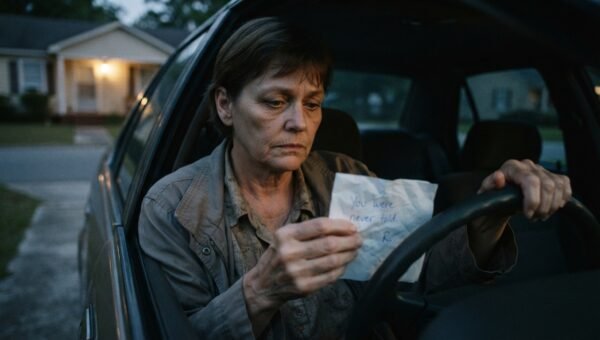
I picked them up, confused. Then I saw the seventh envelope resting right beneath them. It was a plain white business envelope, and on the front, written in blue ballpoint ink, was my name: *For Sarah.*
The handwriting was unmistakably mine. The slant of the letters, the rounded loop on the *S*, the way the *h* at the end trailed off.
But I had no memory of ever holding that envelope, let alone writing my own name across it.
PART 2
I carried the stack over to the edge of Mom’s bed and sat down. My hands were shaking enough that the paper rattled.
I looked at the six unopened cards first. They were get-well and thinking-of-you cards, the kind you buy in packs at the pharmacy. Every single one had David’s full name and Chicago address written in Mom’s shaky, arthritic cursive. A fifty-cent flag stamp was pasted crookedly on the corner of each envelope. Why had she addressed them to him, stamped them, and then tucked them away in a drawer?
I set the cards aside and opened the white envelope with my handwriting on it. Inside was a single folded sheet of Mom’s personal stationery, with her little bluebird logo at the top. The letter wasn’t in my handwriting at all. It was written in Mom’s spidery, uneven script, written during the final weeks when her grip was slipping.
*Sarah,* the note read.
*I took this envelope off your desk from the bills you had sorted. I needed something with your name on it so you would be the only one to open it.*
*I know you are angry with David. I hear it in your voice every time you tell me he couldn’t make the trip. You think he abandoned me. He didn’t, Sarah. I made him promise to stay in Chicago. I begged him.*
*I could not bear for that boy to remember me like this. He still remembers me baking strawberry pies and driving him to Little League. When the hospice nurse brought the hospital bed into my room in October, I knew how it was going to end. I didn’t want him sitting by this bed watching me rot. A boy shouldn’t have that image burned into his mind for the rest of his life.*
*He wanted to come. He bought a bus ticket back in November and another train ticket in January. I told him if he walked through that door, I would not look at him. I told him it would break my heart worse than the cancer. He respected my wish because he loves me.*
*Do not punish him for honoring an old woman’s pride.*
I read the page three times without moving. The room felt completely still around me. The anger that had been sitting behind my ribs for weeks suddenly felt like lead. I had judged my son. I had stood in the church lobby and watched him weep, telling myself he deserved every tear because he had been too selfish to show up.
Then my eyes dropped to the final paragraph at the bottom of the page, and the ground slipped out from under me completely.
*He didn’t obey me completely, though. That boy has your stubborn streak. He made a deal with me. If he couldn’t come in person, I had to answer the phone. He called me every single night at nine o’clock after you went home to sleep. Every single night, Sarah. For three months.*
PART 3
I dropped the paper onto the quilt and stared at the rotary phone on Mom’s nightstand.
For the last three months of her life, my routine had been rigid. I would spend the day at Mom’s, fix her dinner, give her the evening sponge bath, administer her eight o’clock medication, and tuck her in. By eight-thirty, I was so bone-tired I could barely keep my eyes open. I would drive three miles home to my own house, sleep like a dead person, and return at seven the next morning to start over.
Every night when I left, Mom was drowsy from the pills. Or so I had thought.
I pulled out my cell phone and opened my account app to check Mom’s landline records. It took me ten minutes to log into the carrier portal and pull up the call history for December, January, and February.
There they were. Long, unbroken lists of incoming calls.
Every night at 9:02 PM. 9:04 PM. 9:01 PM. Calls lasting twenty minutes, forty minutes, sometimes an hour. On February 14th, the call lasted seventy-four minutes. On the night before she slipped into her final coma, there was an incoming call from David’s Chicago cell number at 9:00 PM that lasted five minutes.
David hadn’t been working late. He hadn’t been ignoring her. While I was home sleeping, convinced that I was carrying the entire emotional weight of Mom’s death alone, my twenty-six-year-old son was sitting on his floor in Chicago, listening to his grandmother’s labored breathing over a static-filled phone line.
And Mom had hidden it from me because she knew I would have overruled her pride. I would have demanded David come home anyway.
The six stamped cards in the drawer suddenly made sense. Mom had bought them, written her love to him, and stamped them, intending to send them after each hard conversation. But sending mail was proof of contact. If I had seen outgoing letters to David, I would have asked questions. So she had hoarded them in her drawer, keeping their secret pact safe.
The memory of the funeral hit me like a physical blow. When David had cried over her casket, repeating, *I should’ve gone, I should’ve just gone,* he wasn’t crying because he had neglected her. He was crying because he had obeyed her. He had listened to an old woman’s dying wish instead of his own heart, and now she was gone, and he was left holding the agony of that obedience all by himself.
I didn’t wait. I shoved the letter into my purse, gathered the six envelopes, walked out to my car, and drove straight to David’s apartment in Chicago.
ENDING
It was a little after six in the evening when I pulled up outside David’s brick apartment building on the north side. The drive had taken just over four hours, and I hadn’t turned the radio on once.
I buzzed his apartment from the lobby. When his voice came over the speaker, scratchy and tired, I said, “David, it’s Mom. Let me up.”
When he opened the door, he looked even worse than he had at the funeral. He was wearing an old grey sweatshirt and sweatpants. His kitchen counter was piled with unopened mail and half-empty takeout boxes. The apartment smelled of stale coffee. He looked at me with immediate dread in his eyes, bracing himself for another lecture or another disappointed sigh.
“Mom? What happened? Is something wrong with Grandma’s house?”
“No,” I said.
I walked into his small living room, set my purse on the table, and pulled out the six stamped cards and Mom’s letter. I laid them out in a neat line on his coffee table.
David froze the second he saw the handwriting. His eyes fixed on the cream-colored envelopes, then on the bluebird stationery. His throat moved, but no sound came out.
“She kept them in her nightstand,” I said gently. “She left a note for me. She told me about the nine o’clock calls.”
David dropped his head into both hands. His shoulders caved inward, and a ragged, broken sound came out of his chest.
“She begged me, Mom,” he whispered, his voice cracking wide open. “She made me swear on the Bible. She said if I came, she wouldn’t look at me. She said she wanted me to remember her laughing on the porch. I wanted to get on the train so bad. Every single night I sat by that phone and heard her voice getting weaker and weaker, and I felt like a coward.”
“You weren’t a coward,” I said.
I sat down next to him on the couch, reached over, and pulled him in against my shoulder. It was the first time I had held my son like that since he was a little boy.
“I was the one who was wrong,” I told him, looking down at his dark hair. “I was angry with you because I was tired, and I judged you without knowing the truth. You gave her exactly what she asked for, even when it broke your heart to do it. You don’t have to carry that guilt anymore, David. It’s over.”
We stayed on that couch for a long time while the evening light faded from the window. Later, David opened the six envelopes one by one. Each card had just a sentence or two inside: *Thank you for the laugh tonight,* or *My boy was so sweet on the phone,* or *I am proud of the man you became.*
Before I left Chicago two days later, I took the final note Mom had written to me and tucked it inside my own Bible. I didn’t need the guilt, and neither did David. But I wanted the reminder of what real love looks like when it isn’t trying to be seen.