The gravy boat was chipped right on the pour spout, a little crescent moon of white porcelain missing where Arthur had dropped it back in nineteen-eighty-four, and I was running my thumb over that rough edge while he told the table about the shortcut he took through town. He did that with everything. If I mentioned the weather, he checked his phone to see if my clouds were accurate. If I salted the roast beef, he reached for the grinder before the platter even touched the linen.
After three decades of it, you stop hearing the noise. It just becomes the hum of the refrigerator or the creak of the floorboards in the hall, something background and gray that you live around because the alternative is making a fuss, and making a fuss was never my way. I just kept my eyes on my water glass and listened to the ice shift.
We had lived in that house on Elm Street for thirty-two years. Arthur chose the lot because it had two oak trees in the front yard that gave what he called respectable shade, though they dropped acorns every autumn that clogged the gutters until my knees hurt from climbing the ladder. He liked things in order. He liked his coffee at seven sharp, his shirts pressed with a crisp line down the sleeve, and his wife quiet enough to blend into the wallpaper. Our son, Martin, had turned out much the same way, though Martin had less patience and more ambition, working some regional management job for an industrial supply firm where he talked about logistics and margins like people were numbers on a spreadsheet.
They sat across from each other now, cutting their pot roast with the same synchronized, rhythmic scrape of steel against ceramic.
Chloe was the only one who didn’t keep time with them. She was sixteen, all elbows and dark hair that she kept tucked behind one ear, and she spent most of the meal pushing her carrots around with the side of her fork. I didn’t think she was paying attention to us at all. We were just the boring old people at the end of the table, the background furniture of her weekend visit from college. Arthur was in the middle of explaining why the city council was mishangling the paving budget on Fourth Street when Chloe stopped her fork dead against the rim of her plate. The kitchen was quiet except for the hum of the refrigerator.
“Grandpa,” she said, her voice entirely flat and clear. “Why do you talk to Grandma like she’s your employee?”
The silence that followed wasn’t the comfortable kind. It was the sharp, jagged sort that makes your ears ring.
Arthur stopped mid-sentence, his knife hovering an inch above his meat. He gave that little dry cough he used whenever a waiter got his order wrong, the one meant to signal that a mistake had been made and he was being very patient about correcting it. Martin looked up from his plate with a frown, his eyebrows pulling together over his nose like he was trying to solve an algebra problem that didn’t have an answer. Nobody said anything for a second, and honestly that felt worse than the shouting we never did in that house. Arthur finally gave a short, dismissing huff and reached for his water.
“Eat your carrots, Chloe,” Arthur said, his voice dropping into that tone he used when he wanted a subject closed forever. “You’re spending too much time in those literature seminars. People start looking for drama where there’s just regular life.”
I kept my thumb on the chipped porcelain of the gravy boat.
I should have said something then, or maybe I should have laughed to smooth it over the way I had ten thousand times before, but my throat felt dry as dust. Martin muttered something about kids these days having too much free time to invent grievances, and then the conversation lurched forward again, clumsy and heavy like a wagon with a flat tire. Nobody looked at me. To them, I was just the scenery that had somehow sparked a brief, annoying flare. But the air in the room had changed, and my skin felt too tight for my bones.
Dinner ended the way all our family dinners ended, with the men moving into the den to talk about property taxes while I cleared the plates. Chloe didn’t go with them. She stayed in the kitchen, helping me stack the heavy stoneware into the dishwasher with quick, jerky movements. When she reached for the last salad plate, she stepped close to me, her shoulder pressing against mine. She smelled like laundry detergent and peppermint gum. She wrapped her arms around my waist in a sudden, fierce hug that almost knocked the breath out of my lungs, and before I could even lift my hands to pat her back, something thin and folded was pressed hard into my palm.
“Read it in the bathroom,” she whispered against my collarbone, her voice shaking just enough to make my stomach drop. “Don’t leave it on the counter. Read it now.”
Before I could ask her what she meant, she pulled back, grabbed her denim jacket from the back of the chair, and called out to her father that she needed to get back to her dorm before her study group started. I watched from the kitchen window as her old sedan backed down the driveway, the taillights cutting red arcs through the gathering dusk. My hand was closed tight around the piece of paper in my apron pocket. It felt like a small, dry leaf, crinkling slightly against my palm every time my fingers twitched.
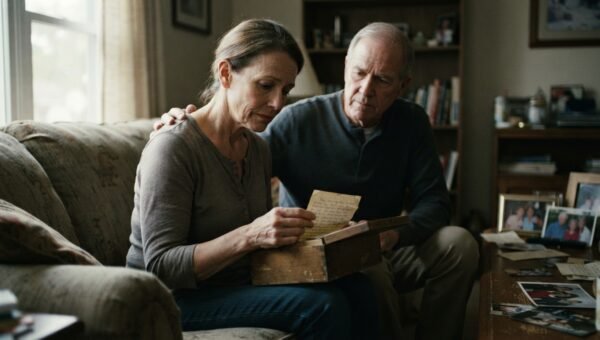
I walked down the dim hallway toward the guest bathroom, my knees aching the way they always did when the damp weather started rolling in from the river. The house was too quiet. Through the closed door of the den, I could hear the low murmur of Arthur’s voice and the occasional dry laugh from Martin as they talked about some municipal bond issue. I locked the bathroom door behind me, sitting down hard on the edge of the closed toilet lid because my legs didn’t feel quite strong enough to hold me up. I pulled the paper out of my pocket. It was three sheets of lined notebook paper, torn out of a spiral binder with little ragged paper curls along the edge, covered in Chloe’s neat, hurried handwriting. The title at the top was underlined twice in black ink. The Strongest Person I Know.
I didn’t expect it to be about me. You don’t live thirty years being corrected on your pronunciation and your salt intake without learning how to make yourself small, how to assume you’re the background noise in everyone else’s grand production. But the first paragraph didn’t talk about my cooking or my quietness. It talked about the way I kept going after my mother passed, the way I ran the household books down to the last penny while Arthur handled the public face of everything, and how I had built a life out of patience that other people mistook for weakness. I read through the second page, my eyes stinging slightly from the fluorescent light over the sink, wondering why Chloe had looked so angry when she handed it to me.
Then I hit the final paragraph.
The words didn’t make sense at first. My brain sort of stopped working for a second, the way it does when you look at a math problem and realize the numbers are all in a language you don’t speak. Chloe wrote about an afternoon three weeks earlier when she had been dropped off early from track practice and let herself in through the side door while the house was empty. She went upstairs to fetch her phone charger from the guest room, and she heard voices coming from Arthur’s study down the hall. The door had been cracked an inch. She thought it was television at first, but then she heard Martin’s voice talking about inventory and square footage, and Arthur talking about how the transition needed to happen before the winter rains started so I wouldn’t make a fuss about the garden. They were discussing selling the house on Elm Street. They were discussing putting me into the Oaks, that sprawling beige facility out on the highway where the residents sat in vinyl armchairs around a television that stayed on all day with the sound turned down low.
“She won’t even notice the change once the routine is set,” Arthur had told Martin, according to Chloe’s neat, block-lettered paragraphs. “Her memory isn’t what it was with the small details anyway. We can tell her the upkeep became too much for the property tax assessment.”
I sat on the edge of that white porcelain tub for what might have been twenty minutes, staring at the blue lines on the paper until they started to blur together into thin, wavering ribbons. My thumb kept catching on the rough edge of the torn paper. Thirty years. Thirty-one winters of scraping frost off the windshield of that old station wagon, thirty-one summers of canning tomatoes in the hot kitchen while Arthur complained about the vinegar smell. They weren’t just talking about moving furniture. They were talking about erasing me because it was tidier for their schedule, because an old woman who forgot where she put her reading glasses was just an administrative inconvenience to be filed away in a facility with a parking lot full of sedans.
Through the bathroom door, I heard Arthur’s heavy footsteps coming down the hall toward the den.
“Clara?” his voice called out, muffled by the hollow-core door between us. “Are you still in there? Martin’s heading out, and we need to talk about the garage door springs before it gets dark.”
I stood up slowly, folding the paper into a tight square and shoving it deep down into the pocket of my cardigan. My hands weren’t shaking anymore. That was the funny thing about being hit with something so cold; after the initial drop, the blood just settles back where it belongs and leaves you feeling hollowed out and sharp as a nail. I unlocked the door and stepped out into the hallway, where Arthur was standing with his keys already jingling in his hand, his forehead creased with that familiar little look of mild annoyance that meant I was taking longer than he preferred.
“You’re always spending half the evening in the bathroom,” Arthur said, turning toward the front door where Martin was already waiting on the porch. “Come on, the light’s going fast, and I want to show Martin where that gutter is pulling away from the fascia.”
“I’m coming, Arthur,” I said. My voice sounded entirely normal, just the way it always did, quiet and flat and agreeable. “Go ahead. I’ll be right out.”
He didn’t notice the difference. He never did. He just turned his back and walked down the steps toward the driveway, his shoulders squared in that gray fleece vest I had bought him for his birthday two years ago. I watched him go, standing there in the dark hallway for a long moment while the porch light cast a pale yellow square across the floorboards. The blueprint of my entire life for the last thirty years was sitting right there in my pocket, drawn up by two men who didn’t even think I was in the room to hear them plotting my exit.
The next morning, the house was quiet by eight o’clock. Arthur had left for his Tuesday morning coffee club down at the diner with the other retired men who liked to sit in the corner booth and talk about how the town was going to ruin. Martin had gone back to his office across the county line by seven-thirty, leaving behind a coffee mug with a ring of dark sludge at the bottom. I didn’t wash the mug. I didn’t even clear the breakfast plates from the counter. I walked straight down the hall to Arthur’s study, a room he kept locked whenever he went out of town but usually left unlatched during the day because he never imagined anyone would have a reason to look inside his desk.
The door swung open with a dry little click. The study smelled the way it always did, like stale pipe tobacco he hadn’t smoked in five years and lemon oil on the mahogany furniture. I walked over to the heavy oak roll-top desk that his father had left him. The middle drawer was unlocked. I pulled it open, sliding my fingers past the stapler and the rolls of stamps until I reached the back where the leather-bound ledger always sat. Tucked underneath the ledger was a thick manila envelope from a company called Green Field Senior Living Solutions.
I pulled it out into the daylight. The tab was written in Arthur’s sharp, sloping handwriting: Clara / Transition Logistics. Inside were three color brochures with glossy photographs of smiling seniors playing bingo in carpeted community rooms, a floor plan of a two-bedroom assisted living unit overlooking the parking lot, and a preliminary contract with Arthur’s signature already scrawled on the signature line under the heading of primary guardian and power of attorney. There was also a printout of an email chain between Arthur and Martin dated three weeks back. Martin had written: “Keep it simple, Dad. If we tell her the county is re-zoning the street, she won’t question the timeline.” Arthur had replied: “Agreed. October fifteenth is the target before the weather turns.”
October fifteenth. That was three weeks away. They had already picked out the room with the view of the asphalt and the dumpsters.
I didn’t cry. You don’t have room for tears when you’re looking at the paperwork for your own eviction. I took the manila folder out of the desk, walked into the kitchen, and laid it right in the center of the oak table where Arthur liked to spread out his tax forms. Then I sat down in my usual chair, the one with the sagging springs that I had never asked him to fix, and I waited for him to come home from his coffee.
It took him an hour. I heard his Buick pull into the driveway at ten-fifteen, the gravel crunching under the tires with that familiar, heavy grind. He came through the side door carrying his canvas tote bag from the hardware store, stamping his boots on the mat even though the morning was dry and clear. He stopped the moment he stepped into the kitchen. He didn’t look at my face first; he looked at the brown manila folder sitting on the table between the salt shaker and the napkin holder.
“What’s this doing out, Clara?” he asked, his voice dropping into that low, level register he used when he was trying to manage a situation that wasn’t going according to plan. “That’s private paperwork for the estate planning.”
“It’s not estate planning, Arthur,” I said. My voice didn’t shake. It was strange how steady you can be when you realize there’s nothing left to lose. “It’s an eviction notice for a seventy-two-year-old woman who still owns half of this deed.”
Arthur stopped by the kitchen island, his hand still resting on the strap of his tote bag. His face didn’t go white the way it does in stories; he just pulled his chin in, his skin turning a dull, mottled red around his collar. He looked at the folder, then at me, and for the first time in thirty years, I saw something in his eyes that wasn’t condescension or annoyance. It was sheer, unadorned confusion, like a man who had dropped a glass and couldn’t understand why the floor had gotten in the way.
“Don’t be dramatic, Clara,” he said, and even then, even with the brochures staring him right in the face, he couldn’t help himself. “Martin and I looked at the numbers. The roof is going to need twenty thousand dollars in repairs by next spring, and the stairs are getting dangerous for you with your knees. We found a place that handles all the maintenance so you don’t have to worry about managing the property tax assessment.”
“You found a place for me,” I said, standing up from the chair. I didn’t raise my voice. I didn’t need to. “Without telling me. Without asking me if I wanted to leave the house where I raised my son and planted my garden. You and Martin decided I was finished.”
“We were looking out for your safety,” Arthur said, taking a step forward with his hand raised in that familiar, dismissive gesture he used whenever he wanted to wave away an argument. “You’ve always been too sensitive about these practical matters. You don’t understand the legal structure of the transition.”
“I understand it well enough,” I said, reaching into my apron pocket and pulling out the folded notebook paper Chloe had given me. I laid it right on top of the brochures. “And Chloe understands it too. She heard you talking in the study three weeks ago about how I wouldn’t make a fuss if you moved me out while I was visiting my sister.”
The name hung in the kitchen like a dropped stone. Arthur stared at the lined notebook paper, his jaw working slightly as he realized the slip wasn’t just a child’s misunderstanding, it was the whole machine laid bare. He opened his mouth to say something, probably to blame Chloe or call her a silly teenager again, but the words didn’t come out. He looked at the table, then out the window at the oak trees in the front yard, and for a long, silent second, the thirty years of habits between us just dissolved into nothing at all.
“I’m not going to the Oaks, Arthur,” I said, looking right at him until he finally had to look back at me. “And if you and Martin want to sell this house, you’ll have to find another place to live first, because my name is on the front of that deed, and I am not signing any transition agreement.”
He didn’t yell. Arthur was never a man for shouting; he was a man for silence and small corrections, and when those didn’t work, he simply ran out of vocabulary. He dropped his tote bag onto the floor with a heavy thud, walked over to the counter without another word, and poured himself a cup of lukewarm coffee from the pot I had brewed an hour earlier. He didn’t ask me for cream. He didn’t tell me I used too much sugar. He just stood there looking out into the backyard while the morning sun caught the edges of the chipped gravy boat on the counter.
That was three weeks ago. Martin came by the following Saturday to talk about legal options, but he didn’t stay long after I handed him a copy of the deed and the business card of the lawyer I had visited on Thursday afternoon down on Main Street. He left without looking at me, his car spitting gravel down the drive the same way Arthur’s used to when things didn’t go his way. The house is quiet now, but it’s a different kind of quiet. It doesn’t feel gray anymore. It feels like the space you get when you finally clear out an old closet you haven’t opened since nineteen-ninety.
This afternoon, Chloe came over after her history seminar. We didn’t talk about her father or Arthur, who was sitting out on the back porch with his crossword puzzle and a cold glass of lemonade he had poured for himself. We sat at the kitchen table drinking peppermint tea out of the good china cups, the ones Arthur always said were too delicate for everyday use. In the center of the mantelpiece in the living room, right where anyone coming through the front door could see it, I placed a framed copy of Chloe’s essay, protected behind a clean sheet of glass that caught the afternoon light. I stand a little taller when I walk past it now, feeling the floorboards solid beneath my feet in a house that finally belongs to nobody but myself.