PART 1
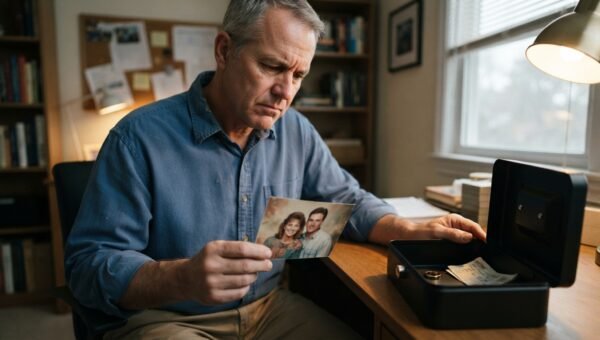
My wife said she needed space and moved into her mother’s house after twenty-two years together. She packed three suitcases of clothes, her makeup bag, and every single photo album we owned, but she left her wedding ring sitting flat on the cherry wood dresser.
I didn’t chase her down the driveway. When a marriage of twenty-two years goes quiet, it doesn’t happen overnight. It happens across a decade of polite dinners, separate television shows, and conversations that never go deeper than whether the gutters need cleaning.
By the time Sarah said she was suffocating, I had already spent three years feeling like a ghost in my own hallway. So when her taillights disappeared down our road, I just picked up the ring, put it in the top drawer under my socks, and locked the front door.
A week later, our twenty-four-year-old daughter, Chloe, came over to help me sort out the household bills. We spread six months of bank statements across the kitchen table. I had always handled the mortgage and the car notes, while Sarah managed the daily checking account and the groceries from her part-time bookkeeping work.
Chloe was going down the debit column with a yellow highlighter when her pen stopped.
“Dad,” she said, tapping the paper. “What is this?”
I leaned over her shoulder with my reading glasses on. It was an automatic monthly draft for $165. The description on the statement simply said “Oak & Main Unit 308.”
The charge had cleared on the third of every month for at least five years. That was nearly ten thousand dollars quietly slipping out of our household funds. It was a small enough number each month to disappear between the grocery trips and electric bills, but over sixty months, it was deliberate.
“Did Mom rent a storage unit?” Chloe asked, frowning. “Did she keep furniture from Grandma’s old place?”
“She never mentioned renting storage,” I told her.
The address was only twenty minutes away, right in the older commercial strip downtown. I told Chloe to finish her coffee and stay at the house. My first thought was simple and ugly: she had been stashing money, or maybe she had boxed up half our shared life years ago in preparation to leave me.
I drove downtown expecting a row of rusted roll-up garage doors behind a chain-link fence. Instead, the GPS brought me to a brick two-story building on the corner of Oak and Main.
The ground floor was a flower shop called Wildflower Lane, smelling heavily of damp soil and cut roses. To the left of the flower coolers was a narrow wooden door with brass mailboxes. Unit 308 was listed on the third floor under the name “S. Miller.”
I climbed the narrow stairs, my knees aching on the wood treads. At the end of the hall, Unit 308 had frosted glass on the top half of the door. Before I could even raise my knuckle to knock, the latch clicked.
The door swung open. A tall man in his late fifties with gray hair, wire-rimmed glasses, and a canvas apron smudged with charcoal stood in the doorway. He looked at my face, paused for just a second, and then a slow, gentle smile broke across his face.
“You must be her husband,” he said.
I gripped my car keys in my pocket. “Who are you?”
“I’m David. I own the building and teach the open studio sessions,” he said, stepping back to pull the door wide. “She said you’d come eventually.”
He didn’t wait for me to answer. He turned and pointed toward the back wall.
The room had tall industrial windows letting in the afternoon light. It smelled of linseed oil, turpentine, and dry paper. And there, pinned in tight, neat rows from the baseboard right up to the ceiling molding, was an entire wall covered in charcoal sketches, watercolors, and oil paintings of me.
PART 2
There were dozens of them.
Some were rough pencil sketches on torn newsprint, no larger than a postcard. Others were large, stretched canvases worked in heavy layers of oil. In one sketch, I was asleep on the living room recliner with a folded newspaper slipping off my chest. In a watercolor beside it, I was standing in the backyard under the old maple tree, holding a garden hose with my back turned, my shoulders hunched against the evening chill. There was a charcoal drawing of my hands gripping the steering wheel of our pickup truck, showing the scarred knuckle on my left thumb from a table saw accident fifteen years ago.
I walked toward that wall like a man walking through a dream.
“She started coming here five years ago,” David said quietly from the doorway, keeping his hands tucked in his apron pockets. “Just two evenings a week at first. Then every Tuesday and Thursday morning after she dropped off the invoices for the dental clinic.”
“Sarah doesn’t paint,” I said. My voice sounded thin, strange in my own ears. “She worked in accounting. She takes care of the house.”
“She painted before she met you, didn’t she?” David asked gently.
I stopped in front of a small canvas near the center. It was done in muted blues and grays. It showed me sitting at our kitchen table late at night, bathed only in the cold glow of an open laptop, rubbing my temples with both hands. I remembered that exact night. It was four years ago, right after the machine shop where I worked laid off forty people and I took a fifteen percent pay cut to keep my pension. I hadn’t said a word to her about how terrified I was. I had stayed up until two in the morning recalculating our mortgage payments on a spreadsheet.
I thought I had been alone in the dark. But she had been watching from the hallway.
“Why would she keep this here?” I asked David. “Why didn’t she bring them home?”
David walked over to a metal work table in the corner and pulled out a plain brown accordion folder. He laid it flat on the table and rested his palm on top of it.
“About three years ago, Sarah asked me to hold on to this lease if anything ever happened to her,” David said. “She told me she couldn’t paint at home because whenever you saw her with a sketchbook, you looked at her like she was wasting time while the bills were piling up. But she told me something else, too. She said she was losing you, piece by piece, and drawing you was the only way she knew how to pay attention to who you used to be.”
I looked back at the sketches. In the earliest ones from five years back, my face had sharp, angry lines around the mouth. I was always working, always looking away, always distracted. But in the drawings from this past winter, the lines were softer. Sadder. In one drawing, I was sitting on the edge of our bed, staring down at my boots. Underneath the paper, written in Sarah’s small, neat cursive, were the words: *He hasn’t looked me in the eye since October.*
“Two weeks ago, she came in and cleaned out her brushes,” David continued. “She paid the rent through the end of next month. She told me she was tired of loving a man who lived like a tenant in his own house. She left this folder for you. She said if you noticed the bank draft, you’d come looking for your money. And if you didn’t notice, then she’d know you really stopped looking a long time ago.”
PART 3
I took the accordion folder from the table. My fingers were shaking, just enough that the cardboard flap rattled against the brass clasp.
Inside were not legal papers or bank statements. There were twelve handwritten letters, each tucked inside an unsealed envelope marked with a month and a year, spanning the last three years. On top of the letters was a small, worn leather receipt book from 2002, the year we bought our house.
I sat down on a wooden stool in the middle of the studio and opened the letter marked *November 2023*.
*Tom,* her handwriting read. *You didn’t ask where I was tonight. You assumed I was at the grocery store because the milk was low. I sat in my car in the grocery parking lot for forty minutes just to see if you would call to ask if I was safe in the rain. You didn’t. When I came home, you took the gallon of milk from my hands, put it in the fridge, and asked if the mail had come. You aren’t mean to me. That’s the hardest part. You’re just gone. We survive our lives together, but nobody is living them. I rent this room because here, when I paint you, I can remember the boy who used to build wooden birdhouses for my mother and laugh until his ribs hurt.*
I opened another envelope, dated six months later.
*I know about the pay cut from 2022. I found the adjusted tax form in the file cabinet two years ago. You carried that entire burden on your back without telling me because you thought your only job was to be the rock that doesn’t crack. But rocks don’t talk, Tom. Rocks don’t hold hands in bed. You turned yourself into stone so nothing could hurt our family, but you crushed us under the weight of it anyway.*
Every word hit with the brutal, undeniable force of the truth.
For ten years, since the plant started downsizing and my brother passed away, I had treated life like a military siege. I woke up at five, worked nine hours, came home, checked the locks, checked the furnace, checked the bank accounts, and kept my mouth shut. I thought being a good husband meant being an immovable wall. If I didn’t complain, if the bills got paid, if the roof didn’t leak, I was doing my duty. I had completely forgotten that a marriage doesn’t survive on duty. It starves on it.
She hadn’t taken the photo albums out of spite when she left for her mother’s. She had taken them because they were the only evidence left that we had once loved each other out loud.
“Does she know I’m here?” I asked David, clearing my throat.
“I texted her the minute you walked up the stairs,” David said simply. “She’s sitting in her car across the street.”
ENDING
I walked to the tall studio window and looked down through the glass.
Parked at the curb across from the flower shop was Sarah’s silver sedan. She was sitting in the driver’s seat, her hands resting at ten and two on the steering wheel, staring up at the third-floor windows.
I didn’t pack up the paintings. I didn’t take the folder. I tucked her letters back inside the cardboard cover, left them on David’s table, and walked down the creaking wooden stairs. The bell above the flower shop door chimed as I pushed out into the afternoon air.
The street was quiet except for the hum of traffic a block away. I walked across the asphalt toward her car. When she saw me coming, she didn’t roll down the window, and she didn’t turn the key in the ignition to pull away. She just watched me through the windshield. Her face looked worn, the skin around her eyes tight with the kind of exhaustion that sleep doesn’t fix.
I reached into my jacket pocket. I pulled out her plain gold wedding band, the one I had hidden in my sock drawer a week ago, and held it in the open palm of my hand.
I tapped gently on the glass. Sarah unlocked the door and pushed it open, but she stayed in her seat.
“Did you find your money?” she asked. Her voice wasn’t angry. It was just tired.
“I found the paintings,” I said.
A tear tracked slowly down her cheek, catching the gray afternoon light, but she didn’t wipe it away. “They took five years, Tom.”
“I know,” I said. My throat felt tight, but I forced the words out plainly, looking directly into her eyes without looking down at the pavement. “You spent five years watching me turn into a stranger. And you paid a hundred and sixty-five dollars a month just to keep proof that I was still in there somewhere.”
She looked at her ring sitting in my palm, then up at my face.
“I don’t know how to fix twenty-two years in an afternoon,” I told her. “And I’m not going to tell you that I’ll suddenly become a different man by tomorrow morning. But I’m tired of being stone, Sarah. I don’t want to live like a ghost in that house anymore.”
She didn’t take the ring from my hand. Instead, she reached out, took my wrist, and pulled my hand down into her lap, resting her fingers over mine.
“Get in the car, Tom,” she said softly. “Let’s go get a cup of coffee and talk.”
I closed the passenger door, sat beside my wife, and for the first time in ten years, I didn’t think about the bills. I just listened.