PART 1
For five years, I kept a pair of yellow knitted booties wrapped in tissue paper inside my nightstand drawer. They were meant for my daughter, Clara. She died four days before my due date, and my husband, Greg, looked at me across the hospital bed and told me it happened because I would not sit still.
He said I carried too many laundry baskets up the stairs. He said I stayed at my bookkeeping job three weeks too long.
He packed his bags two weeks after the funeral and moved right back into the colonial house he used to share with his ex-wife, Brenda. When people at church asked what happened, he told them he simply could not be around the woman who lost his child.
I took every word of it into my chest. I quit my job, took a quiet desk position at a small lumber yard, and spent five years convinced that my body had failed the one person who depended on me. I stopped going to baby showers. I stopped visiting friends who had strollers in their entryways. Whenever an ache settled into my ribs, I thought of those four final days.
Then on a Tuesday afternoon in November, Greg died of a massive heart attack in Brenda’s driveway while unloading bags of mulch. He was fifty-two.
My sister called to tell me. She said Brenda was already planning the service for Saturday.
I told my sister I would not go. Greg and I had not spoken a single sentence since the divorce was finalized in 2021, and I had no right to sit in Brenda’s church.
At seven o’clock that evening, four hours after Greg was pronounced dead at the county hospital, my front doorbell rang.
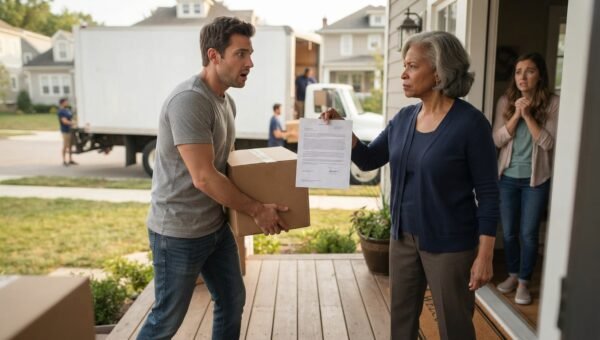
I pulled open the door. Brenda was standing on my porch in the cold drizzle, wearing an oversized gray cardigan, her face swollen from crying. She held a thick brown accordion folder against her stomach with both arms.
“Brenda?” I said, holding the edge of the storm door. “What are you doing here?”
She looked down at the concrete step, her breath coming in quick, shallow shivers. She did not ask to come inside. She just reached out one trembling hand, held out the folder, and said, “The real reason Clara died was sitting in his filing cabinet the whole time.”
PART 2
I stared at the damp paper folder in Brenda’s hands. The wind whipped rain across the porch railing, wetting the cuffs of my sleeves.
“Take it, Sarah,” Brenda said, her voice cracking. “Please. I couldn’t sit in that house tonight knowing you still thought it was you.”
I stepped back and unlatched the screen. She followed me into the warm kitchen, leaving wet shoe marks across the linoleum. Neither of us sat down. She laid the folder on the kitchen table between the salt shaker and my mail basket.
Five years ago, on a Thursday morning four days before my delivery date, I had gone to the clinic for a routine non-stress test and blood work. Greg had dropped me off, said he had an errand at the hardware store, and promised to pick me up an hour later. The nurse took my blood pressure, drew three vials, and told me they would call if the liver panels showed anything unusual because my ankles had been swelling.
By three that afternoon, I had started feeling a heavy, dull ache under my right ribs. When I told Greg, he told me it was just late-term heartburn. He gave me two antacid tablets and told me to lay down in the dark. At five, when I told him Clara had not kicked since lunch, he got angry. He said first-time mothers work themselves into hysterics and that going to the hospital would only cost five hundred dollars we did not have. He told me to close my eyes.
By Friday morning, Clara was gone. The doctors at the hospital said her heart had stopped hours before we arrived, caused by a placental abruption linked to sudden, severe preeclampsia.
Standing in my kitchen five years later, Brenda pulled the folder open. Her fingers were shaking so hard she dropped the plastic tab onto the floor.
“Greg didn’t go to the hardware store that Thursday,” Brenda said, wiping her face with the sleeve of her cardigan. “He came to my house. He had been coming by for three months, asking if we could try again. He said he had made a terrible mistake marrying a woman who was about to tie him down with another infant.”
“Brenda, stop,” I said. My throat felt completely dry.
“No, listen to me,” she cried. “The obstetrician’s clinic called his cell phone at two-fifteen that Thursday afternoon. The lab had flagged critical blood results. The doctor told Greg directly that your platelets were crashing, your enzymes were dangerous, and you had to be admitted to labor and delivery within the hour to deliver by emergency C-section.”
She pulled out a stapled packet of paper. It was an official phone log from the county medical group, printed on clinic letterhead, alongside a folded yellow legal pad covered in Greg’s narrow handwriting.
PART 3
I looked down at the yellow paper. Greg’s handwriting was unmistakable. He always drew a sharp, crooked bar across his capital Ts.
At the top of the sheet, he had written: *Dr. Miller, 2:18 PM. Platelets 42,000. Enzymes high. Abruption risk. Go to L&D immediately.*
Below that, he had written out three columns of numbers. He had listed my car loan, his credit card balance, and the child support amount he still owed Brenda for their teenage son. At the very bottom of the page, underlined twice, was a single calculation: *Family plan deductible: $6,800 out of pocket. Daycare: $1,400/month.*
“He sat at my dining room table when that call came in,” Brenda whispered. “I heard him talking to the clinic nurse. When he hung up, he told me the doctor said everything was fine. He said you were just resting. He stayed on my couch until four-thirty because he was trying to convince me to take him back before the baby was born.”
“He came home at four-thirty,” I said. The words came out barely above a whisper. “He brought me two antacids.”
“He knew,” Brenda said, tears dripping off her chin. “He knew what the doctor said. But he was terrified of the money, and he didn’t want the life he had built with you. When the hospital told you both on Friday morning that the baby had passed, he realized what he had done. Instead of admitting he ignored an urgent medical order for four hours, he turned on you.”
“Why did he keep this?” I asked, my fingers resting on the yellow legal pad.
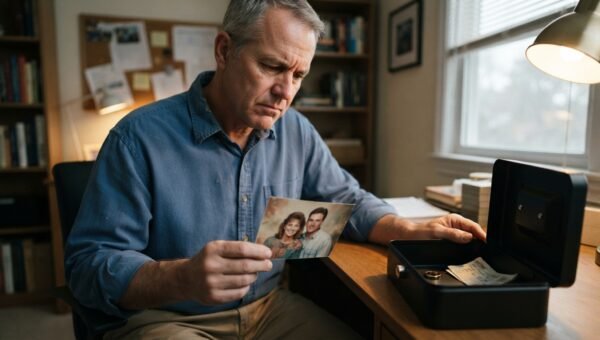
“Because he was paranoid the doctor was going to report him,” Brenda said. “The clinic called three more times that afternoon, but he had turned his phone off. He requested the clinic’s phone logs through a records request a month later to see if they had documented exactly what they told him on the phone. Then he hid them in his steel strongbox under our floorboards.”
Brenda sat down heavily on one of my wooden kitchen chairs. She put her face in her hands and wept.
“He got sick last month,” Brenda said. “The doctor told him his arteries were blocked, and he started having nightmares. Three nights ago, he told me where the box was. He said if anything happened to him, I had to burn it so nobody would ever know he let his own daughter die to save his pride.”
She looked up at me, her eyes bloodshot and swollen. “I couldn’t do it, Sarah. When the coroner took him away this afternoon, I went straight to that floorboard. I took the folder and drove here. I couldn’t let you spend another year thinking you killed your little girl.”
ENDING
Brenda stayed in my kitchen until nearly nine that evening. We did not hug, and we did not become friends. There was too much damage between our two houses for that. But she sat quietly while I read through every page: the hospital admission notes, the clinic call log timestamped at 2:18 PM, and the note Greg had written while sitting at her kitchen table.
When she stood up to leave, she told me she would pay for Clara’s headstone to be updated if I wanted to add Clara’s middle name, which Greg had refused to pay for back then. I told her no. That was something I wanted to take care of myself.
After Brenda drove away, I locked the front door. The house was completely quiet.
I walked into my bedroom, pulled open the bottom drawer of the nightstand, and took out the yellow knitted booties. For five years, every time I held them, I felt a heavy, sickening shame in the pit of my stomach. I had spent half a decade believing that my body had been too weak, that my choices had ruined my family, that I had failed as a mother before I even had the chance to start.
I held the soft yarn against my fingers. The pain was still there, sharp and real, but the shame was gone.
Clara had not died because I carried laundry baskets up the stairs. She had not died because I worked an extra week at my desk. She died because a selfish, frightened man made a monstrous choice and spent the rest of his life making sure I took the blame for it.
The next morning, I took the folder and drove down to the county cemetery. The rain had stopped, and the early sun was cutting through the bare oak trees. I knelt in the wet grass by the small granite marker that read *Clara*.
I laid the yellow booties on the stone, stood up, and took my first deep breath in five years.