PART 1
For four Sundays in a row, my husband, David, found an excuse to skip dinner at our daughter’s house.
Our granddaughter, Chloe, is seven. Every Sunday evening since she was in a high chair, our family routine had been sacred. We would drive twenty minutes across town to our daughter Megan’s place, eat roast chicken or pot roast around five o’clock, and stay until bath time. David had never missed one unless he was in bed with the flu.
Then, right around the start of August, he stopped coming.
“My eyes are just shot by evening, Ruth,” he told me that first week, rubbing the bridge of his nose near the reading glasses he kept on a lanyard. “Headlights on the bypass have this terrible halo lately. You go ahead. Tell Chloe her papa loves her, and bring me a plate.”
I bought it that night. David is sixty-eight, and his night vision really had gotten worse over the last year. But when he used the exact same line the second Sunday, and then the third, an uneasy feeling settled in my stomach. A man who loves his granddaughter does not sit on the recliner watching baseball reruns four weeks in a row while the rest of his family eats without him.
On the fourth Sunday, I kissed his forehead at four-fifteen, told him Megan made his favorite lemon bars, and backed my sedan out of our garage.
I made it two blocks down our street before I pulled over by the curb, put the car in park, and opened the family location app on my phone.
We had installed it two years ago when David took a fall in the yard and broke his wrist. It was supposed to be for emergencies. I had never once opened it to check up on him.
My finger shook a little against the glass screen.
The little blue dot labeled “David’s Phone” was already moving. He was not in the recliner. He had backed his truck out of the driveway the minute my taillights turned the corner.
I watched the blue dot crawl east along the state route, far away from Megan’s neighborhood. It turned down Miller Avenue, drifted past the old brick warehouses, and finally came to a complete stop in the gravel parking lot of Grace Lutheran Church on the south side of town.
We are not Lutheran. We have never set foot inside Grace Lutheran in the forty-one years we have lived here.
I sat there with my hazard lights blinking, staring at that screen.
A woman my age thinks of the worst things first. When an older husband suddenly starts dressing in clean slacks, lying about his eyesight, and disappearing into quiet parking lots on Sunday evenings, the mind immediately goes to another woman. It made me feel sick to my stomach.
I turned my car around, drove straight to Megan’s house, pasted on a smile, and ate dinner with my daughter and granddaughter. I told Megan her father’s eyes were bothering him again. The lie tasted like chalk in my mouth.
I spent that entire week waiting. I watched how David washed his coffee mug, how he set his phone face down on the kitchen counter, and how he avoided looking me directly in the eyes whenever Megan’s name came up. He was quieter than usual, distracted, like a man carrying an anvil in his chest.
The following Sunday, I did not head toward Megan’s.
I told David I had to leave early to help Megan peel potatoes.
I drove three streets over, parked behind the community garden fence, and waited. Exactly twelve minutes later, David’s dark blue pickup truck rolled past.
I let two cars get between us and followed him across town. The sun was sitting low over the trees, casting long shadows across the asphalt. He drove slowly, staying right at the speed limit, until he pulled into the near-empty lot beside Grace Lutheran.
I parked across the street behind a dry cleaner’s van and kept my engine running.
A silver sedan pulled in three minutes later. A woman got out. She had short gray hair, wore an ordinary beige cardigan, and looked to be right around our age. She did not hug him. She did not kiss him. She walked up to his driver’s side window, handed him a thick manila folder through the open glass, spoke for less than twenty seconds, and got right back into her car.
She drove away without looking back.
David did not start his truck. Instead, he got out, tucked the folder under his arm, and walked up the stone steps into the side door of the church.
I crossed the street on foot. The heavy oak door was unlocked, opening into a quiet, dim vestibule that smelled of old hymnals, floor wax, and damp stone. I peeked around the interior double doors into the sanctuary.
The church was empty except for him.
David was sitting alone in the third pew from the back, underneath a stained-glass window of the Good Shepherd. The manila folder lay open across his knees. His shoulders were shaking so hard that I could hear his muffled, ragged sobs echoing off the high wooden rafters. In forty-one years of marriage, through the death of both my parents and the terrifying night our daughter was born six weeks early, I had never seen my husband cry like that.
PART 2
I did not walk down that aisle.
Something in the way his head hung between his hands told me that if I cornered him in that pew, whatever wall he had put up would turn into stone. I slipped back through the heavy doors, walked across the street to my car, and drove home with both hands gripping the wheel so tight my knuckles ached.
I sat at our kitchen table with the overhead light off.
At seven-fifteen, the gravel in our driveway crunched under his tires. I heard his keys rattle in the side lock, the click of the brass latch, and his heavy work shoes scuffing against the braided rug by the door.
“Ruth?” he called out, his voice sounding thick and tired. “You home already?”
He walked into the kitchen, saw me sitting there in the dark, and stopped dead. He had washed his face before driving back, but his eyes were bloodshot and swollen. In his left hand, he held the manila folder, clutching it against his thigh like he wanted to hide it behind his trousers.
“I didn’t go to Megan’s tonight, David,” I said. My voice was steady, but my chest felt completely hollow. “I followed you.”
He didn’t move. He didn’t blink.
“I saw the silver car,” I continued, looking right at the paper tucked against his leg. “I saw that woman hand you that folder. And I followed you inside the church. I watched you sitting in that pew crying your eyes out. If there is another woman, or if you have gotten us into some kind of trouble, you need to tell me right now. I deserve that much after forty years.”
David closed his eyes. A long, shuddering breath escaped his chest, rattling in his throat.
“There isn’t another woman, Ruthie,” he whispered. “I swear on my mother’s soul, there is no other woman.”
“Then what is in that folder?”
He stood there in the middle of our kitchen for what felt like five minutes, looking down at the linoleum. Finally, he pulled out the wooden chair across from me, sat down, and slid the manila folder across the table until it touched my fingertips.
His hands were trembling.
“Just open it,” he said softly. “Look at the top sheet.”
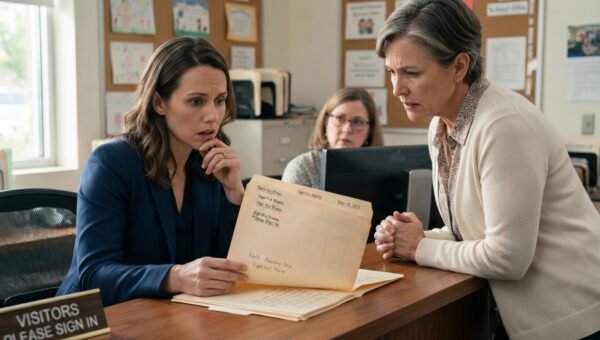
I pulled back the cardboard cover. Inside were several stapled packets, yellowed photostat copies, and a certified document with an embossed county seal from a courthouse in Pennsylvania.
Right at the top was an adoption record dated October 14, 1974.
The biological mother’s name was redacted with heavy black ink, but the infant girl’s original birth name was listed clearly under the hospital certificate section.
*Cassidy Lynn.*
The room seemed to go completely silent.
My breath caught in my throat. I couldn’t pull my eyes away from those two words.
“Cassidy,” I whispered, the name catching against my teeth.
Every family has a story they tell around kitchen tables until it becomes part of the furniture. In my family, the story was about my father. When I was born in the spring of 1954, my mother had fallen desperately in love with the name Cassidy. She had written it on the nursery announcements and picked out a little wooden plaque with the initial C. But while she was still heavily sedated from a complicated delivery, my father had filled out the birth registry himself and named me Ruth, after his own mother who had passed away that winter.
My mother had teased him about it for thirty years until the day she died. *Your father stole my favorite name,* she used to tell me with a gentle laugh. *I swore if God ever gave me another girl, she was going to be my little Cassidy. But you were the only one who came along.*
My mother had never had another baby. Not one that came home with us, anyway.
I looked up from the paper, my heart pounding a hard, erratic rhythm against my ribs. David was watching me, his eyes full of fresh tears, his chin quivering.
“David,” I said, my voice barely above a rasp. “Why do you have an adoption paper with this name from 1974? I was twenty years old in 1974. I was already living in my own apartment.”
David reached out across the table, covering both of my cold hands with his warm, calloused ones.
“I wasn’t hiding an affair, Ruthie,” he whispered, his voice breaking on the words. “I was looking for your sister.”
PART 3
The word hung in the air between us like an electric wire.
“My sister?” I repeated, pulling one hand back. “David, what are you talking about? My mother had a hysterectomy when I was eight years old. She couldn’t have children.”
“Not your mother,” David said gently. “Your father.”
He reached over, turned the top page, and pointed to a court petition stapled underneath.
It was a voluntary relinquishment of parental rights filed in Crawford County, Pennsylvania, fifty miles north of where my parents had lived. Below the mother’s blacked-out name was the legal signature of the father who had agreed to pay the medical fees and surrender all claims to the infant.
The handwriting was unmistakable. It was the sharp, slanted script of my father, Arthur Miller, right down to the looping tail on the final *r*.
“How did you find this?” I asked, my fingers tracing the ink of my father’s dead hand. “Why were you even looking?”
“Do you remember back in June, when we cleared out your dad’s old metal filing cabinet in the basement?” David asked.
I nodded slowly. My father had passed away nine years ago, and his old gray desk had sat in our basement corner untouched until we decided to waterproof the walls.
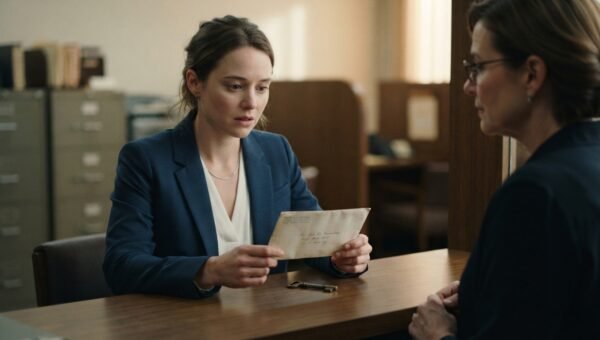
“You took the tax receipts upstairs,” David said, “and I broke the lock on the bottom drawer that was rusted shut. Underneath the false cardboard bottom, there was a small locked tin box. I didn’t want to upset you if it was just old debt notices, so I took it out to my workbench. Inside, there were three letters from a lawyer in Meadville from the fall of 1974, along with two canceled cashier’s checks for five hundred dollars each.”
David wiped his face with the back of his sleeve.
“Your dad had an affair with a clerk from the supply company he managed back in 1973,” David explained quietly. “She got pregnant. When she told him, he paid for her to stay at a maternity home two counties over so your mother would never find out. The baby was born in October of 1974. Your father paid the hospital bill, signed the papers, and when the caseworker asked him what name the mother had given the child, your father told them to write down Cassidy Lynn.”
“Why that name?” I asked, a knot tightening in my throat.
“Because in the margin of one of the letters,” David said, his voice dropping to a whisper, “your father wrote a note in pencil that he never mailed. It said: *I couldn’t give my wife the baby she always prayed for, so I gave this one her name.* It was his guilt, Ruth. He carried that guilt until the day he died.”
I stared down at the yellowed copy. In 1974, I had been a newlywed, busy with my first secretarial job, coming over to my parents’ house every Sunday for pot roast just like Megan does now. My father had carved the roast, kissed my cheek, and asked about my car’s alternator, all while a baby girl carrying my mother’s dream name was being handed over to strangers two hours north.
“The woman in the parking lot,” I said, looking up. “Who was she?”
“Her name is Evelyn Krause,” David answered. “She’s an independent adoption intermediary and genealogist. I hired her in July after I read that pencil note. I gave her the case number from the lawyer’s letter. I used my own savings from selling my old bass boat so the money wouldn’t come out of our household account. I didn’t want you to know unless there was an actual person on the other end of the search. I couldn’t bear the thought of breaking your heart over a ghost.”
“And that folder?”
“Evelyn found her last Thursday,” David said, fresh tears spilling down his cheeks. “She was adopted by an elementary school teacher and a postal worker in Erie. Her adoptive parents named her Claire. She’s fifty-one years old, Ruthie. She lives two towns over, right in Boardman. She’s a high school librarian. She has two boys. And she’s been searching for her biological family for fifteen years.”
David reached into the back pocket of the folder and pulled out a single photograph printed on glossy paper.
He laid it down between us.
The woman in the picture was standing in front of a shelf of library books, wearing small oval spectacles. She had my mother’s wide, warm smile, and the exact same crooked left incisor that I see every single morning when I brush my teeth in the mirror.
ENDING
We sat at that kitchen table until three in the morning.
David made a pot of coffee at midnight, and we went through every single sheet in Evelyn Krause’s folder. There were school records, a photocopy of Claire’s wedding announcement from 1998, and a handwritten letter addressed simply to *Whoever is looking for me.*
Claire had written the letter three years ago, leaving it in the state reunion registry in case anyone ever petitioned for the sealed file.
*I had a wonderful life with the parents who raised me,* she had written in neat, round cursive. *I don’t need money, and I don’t harbor any anger. I just want to know if I have someone’s eyes, or if anyone out there ever wondered what became of me.*
I read that paragraph four times. Every time I read it, I touched the photo of her face, seeing my mother’s chin and my father’s straight brown hair staring back at me from behind those library books.
“Why the church, David?” I asked him quietly as the kitchen clock struck two. “Why did you go inside?”
David looked down at his coffee mug, turning it slowly between his rough palms.
“Evelyn told me she was going to have the contact information ready this evening,” he said. “When she handed me that file through the car window, she told me Claire was alive, healthy, and waiting by her phone. I took the folder into that church because I was terrified, Ruth. For two months, I kept thinking I was doing the right thing for you. But sitting in that pew, looking at that picture, I panicked. I thought: what if I just ruined forty years of good memories about her father? What if I brought a stranger into our lives and broke my wife’s heart?”
He looked across the table at me, his eyes pleading for understanding.
“I sat in that pew and prayed to God that you would forgive me for meddling where an old man had no business,” he whispered.
I didn’t answer with words. I stood up, walked around the table, and pulled his gray head against my chest. He wrapped his arms around my waist and held on like a man who had finally made it back to shore after a long storm at sea.
“You didn’t ruin anything, David,” I told him, kissing the top of his head. “You brought my sister home.”
Two weeks later, on a bright Sunday afternoon in late September, our front doorbell rang at exactly four o’clock.
Chloe was sitting on our living room rug, building a tall tower out of wooden blocks. Megan was in the kitchen helping me slice fresh apples for a pie, looking out the window every two minutes with nervous anticipation.
David walked to the front door, paused with his hand on the brass knob, and looked back over his shoulder at me. I gave him a small nod.
When he pulled the door open, the woman from the photograph was standing on our front porch. She wore a dark blue cardigan and held a tin of homemade snickerdoodles in both hands. Her fingers were shaking just as hard as mine had shaken over my phone three weeks ago.
She looked past David, straight into the living room, and our eyes met.
There was no speech. There was no big dramatic scene. She just stepped over the threshold, set the cookie tin down on the hall table, and walked right into my open arms. When we hugged, I could feel the exact same sharp shoulder blades that my mother had, and the faint, sweet scent of lavender soap.
“Hello, Ruth,” she whispered against my neck, her voice catching on the words.
“Hello, Claire,” I said, holding her tight.
Behind us, David quietly closed the front door, walked over to the rug, and sat down beside our granddaughter to help her finish her tower.