PART 1
At sixty-seven, after forty-four years of marriage, I discovered my husband had been hiding the same secret since our first date. It was not another woman, and it was not money. I found out because Daniel left a blue spiral workbook under the passenger seat of his truck.
I was looking for my sunglasses. We were getting ready to drive over to our daughter Sarah’s place for dinner, and the afternoon glare was bad.
I reached into the narrow gap between the seat and the console, felt thick paper, and pulled it out thinking it was an old road atlas or an invoice from the lumberyard.
Across the first page, written in careful blue pen that clearly belonged to a teacher, were two lines:
DANIEL BROOKS, AGE 68. READING LEVEL 4.
GOAL: READ TO ELI WITHOUT HELP.
Eli was our seven-year-old grandson.
I sat there on the gravel driveway with the truck door hanging open, staring at those words until the blue ink started to blur. Level 4 meant fourth grade. It meant nine-year-old books with large print and short sentences.
In about five seconds, forty-four years of ordinary life reorganized itself in my head.
I remembered our very first date at the diner near the state line back in 1980. He sat across from me in his clean flannel shirt, looked at the greasy laminated menu for two seconds, and slid it across the formica. “You pick for us, Linda,” he said with that easy grin. “Everything on here is good, and you have better taste than I do.”
I thought it was romantic. I thought he was easygoing.
Then came the decades that followed. Whenever a restaurant waiter handed us menus, Daniel would look up and say, “My eyes are tired from the shop lights. What looks good to you?” Whenever the mail came with insurance renewals or tax assessments, he tossed them on the kitchen desk and said, “You have the neat handwriting, honey. You handle the checks.”
When our daughters, Sarah and Becky, brought home permission slips, field trip forms, or report cards, Daniel always said, “Show your mother. She keeps track of the school business.”
On birthdays, he would bring home a card he bought at the pharmacy, hand it to me with a pen, and say, “Write something sweet from both of us. My hands are too stiff from turning wrenches.”
I never questioned a single one of those moments. Not once. I had spent half a century believing Daniel was just a quiet man who hated paperwork and trusted me with the household details.
The screen door on the porch creaked. Boots hit the wood steps.
Daniel walked down the path carrying a basket of late tomatoes from the garden to take to Sarah. When he saw me sitting on the running board of the truck with the blue book resting open across my knees, his boots stopped dead in the gravel.
The basket slipped an inch in his grip, and a yellow tomato rolled into the grass.
He did not try to make an excuse. He did not ask what I was doing in his truck. His shoulders, which had always looked broad and unbreakable to me, suddenly sank into his chest.
“Linda,” he whispered, his voice thin and dry. “Please don’t look at me differently.”
I looked at my husband. He had built the deck on our house with his own hands. He had run a small machine repair shop for thirty years and never cheated a customer out of a dime.
He could listen to an engine idle from twenty feet away and tell you which cylinder was misfiring.
Yet standing in the afternoon sun, holding that basket of tomatoes, he looked terrified. He looked like a small boy waiting to be sent to the principal’s office.
I stood up from the truck. My hands were shaking, not from anger, but from the sudden weight of everything I had never seen.
“Daniel,” I said. “Where did this come from?”
PART 2
He set the tomato basket on the hood of the truck. His hands were dark with grease around the cuticles, the way they had been every day since I met him.
“Tuesdays,” he said quietly. He would not meet my eyes. “The county literacy council over in Oak Creek. They meet in the church basement behind the library from six to eight.”
Every Tuesday night for the last five months, Daniel had told me he was going over to the high school garage to help our friend Joe rebuild an old tractor engine. He had come home smelling like cheap church coffee, but I never thought twice about it.
“Why Oak Creek?” I asked. Oak Creek was thirty miles away, two towns over.
“Because nobody there knows who Daniel Brooks is,” he said. The words came out hard, like he was forcing them past glass in his throat. “I couldn’t walk into our town library, Linda. The ladies at the front desk went to school with our girls. I couldn’t sit there with a fourth-grade spelling sheet where somebody might see me.”
“How long?” I asked. “Daniel, how long have you been living like this?”
He finally looked at me. His eyes were red around the rims. “Always. Since the fifth grade.”
We did not go to Sarah’s house right away. I called our daughter and told her Daniel had a small water leak under the kitchen sink to patch, and that we would come by tomorrow instead. Sarah told me not to worry, gave love to her dad, and hung up.
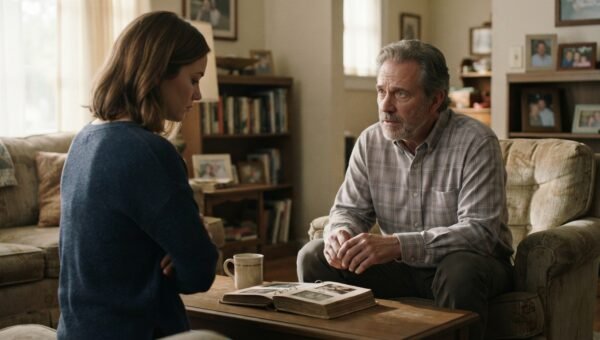
Daniel sat down at our kitchen table. The late sun cut across the yellow laminate table where we had eaten breakfast together for forty years.
He told me about growing up on his family’s farm in the late fifties. His father had taken ill when Daniel was ten, and from that spring forward, Daniel worked twelve-hour days in the fields. When he went to school in the winter, he was dirty, exhausted, and behind everyone else.
“The teacher had forty kids in one room,” Daniel said. “If you sat in the back row and kept your mouth shut, she left you alone. In high school, the shop teacher knew I could weld and fix the tractor, so he gave me passing marks just to keep me around the garage. By the time I walked out of that building at seventeen, I could read street signs, price tags, and tool labels. That was about it.”
“Why didn’t you ever tell me?” My voice broke. That was the part that hurt the most. “We stood in front of a preacher. We raised two babies. We buried your mother. How could you keep that from me for forty-four years?”
“Because you were smart,” Daniel said simply. “You worked at the bank. You read three paperbacks a week on the porch. The first night I took you out, you talked about college classes and books you loved. I went home that night and sat on my bed, terrified you would find out I was a fool.”
“You are not a fool,” I said sharply.
“A man who can’t read his own mortgage papers feels like one,” he answered. “Every single day. When the girls were little and wanted bedtime stories, I learned to make up tales about farm dogs and foxes so they wouldn’t ask me to read what was printed on the page. But then Eli came along.”
He stopped talking. He rubbed his rough knuckles against the table.
“What happened with Eli?” I asked.
PART 3
“Two months ago,” Daniel said, his voice dropping so low I had to lean across the table to hear him. “You went to the grocery store, and Sarah dropped Eli off early. The boy brought a book from school about space rockets. He climbed right up into my lap, handed it to me, and said, ‘Read the part about the moon, Grandpa.'”
Daniel took a ragged breath.
“I looked at the page,” he whispered. “The letters just swam around. There were long words I didn’t know how to sound out. I told him my glasses were in the workshop and made up a story about rockets from my head. But Eli stopped me. He pointed his little finger at the page and said, ‘Grandpa, that’s not what the words say. Look, this letter says Apollo.’ He looked up at me like he was confused. Like he was wondering why his grandfather couldn’t read a boy’s schoolbook.”
Daniel wiped his face with the back of his hand.
“I sat there in that recliner after you came home,” he said, “and I swore to God I would not let that boy grow up thinking his grandfather was too lazy or too stupid to read him a story. I looked up the phone number for the adult reading center on the bulletin board at the feed store. It took me three weeks just to get the courage to dial the number.”
I looked at the blue workbook between us on the table.
I reached out and opened it. Inside were columns of words written in pencil with heavy, labored strokes. Words like *engine*, *promise*, *weather*, *bridge*, and *mountain*. Next to some of the words were red checkmarks. Next to others were small notes from a volunteer named Mrs. Higgins: *Good sound on the vowel. Keep practicing.*
My husband had worked forty hours a week turning heavy wrenches, come home tired to the bone, and then driven sixty miles round-trip on dark country roads just to sit in a basement folding chair and practice sounding out syllables with an eight-year-old’s pencil.
Not for money. Not for a job. Just so he could read a twenty-page picture book to our grandson without his voice shaking.
I thought about all the times I had sighed with mild impatience when he asked me to look over a printed letter from the bank. I thought about the time I teased him in front of our neighbors because he ordered the exact same chicken dinner at every restaurant we visited. He had not ordered the chicken because it was his favorite; he ordered it because he knew that word by heart.
The shame he had carried was an enormous, quiet house he had lived in by himself for over sixty years.
I stood up from my chair and walked around the table.
Daniel kept his head down, still bracing for whatever pity or disappointment he expected to see on my face.
I pulled up a chair right beside him, sat down, and pulled the blue workbook in front of both of us.
“Linda,” he said, pulling back slightly. “You don’t have to.”
“Daniel,” I said, keeping my voice firm and steady, “you have carried this alone since you were ten years old. That ends at this table today.”
ENDING
We did not go to Sarah’s house until Sunday afternoon.
For three days, we sat at the kitchen table after supper. We did not talk about forty-four years of missed conversations or the forms I had signed for him. We just opened the blue workbook.
His large, calloused fingers looked huge holding the yellow pencil. When he struggled over a word like *different* or *together*, I did not jump in to say it for him. I waited, the way the teacher in Oak Creek had taught him, until he broke the pieces apart and put them back together in his own voice.
On Sunday, Eli met us at Sarah’s front gate holding a green library book about sea turtles.
“Grandpa!” Eli yelled, running across the lawn. “Look what I got at school on Friday!”
Daniel looked at the cover. Then he looked over at me. His jaw was tight, but his eyes were clear.
We sat out on Sarah’s back porch while the coffee brewed inside. Daniel sat down in the wooden rocker and pulled Eli up onto his knee. The boy laid the green book flat across Daniel’s denim thighs and flipped open to the first chapter.
“Read the big turtle part, Grandpa,” Eli said, leaning his small head against Daniel’s chest.
Daniel put his heavy forefinger down on the first line of black text. His finger had a scar across the knuckle from an engine belt he repaired in 1994.
He took one steady breath.
“The… green… turtle,” Daniel read, his voice slow, deep, and deliberate, “swims… across… the… deep… ocean… to… find… the… sand.”
Eli turned his face up to look at his grandfather, entirely satisfied, and turned the page with his small thumb.
I stood by the screen door with my hands wrapped around a warm mug, watching the two of them rock slowly in the afternoon shade. My husband never looked back toward the door to see if I was watching. He did not need to. For the first time in forty-four years, he was not hiding from anyone.