PART 1
When my son announced he was leaving the family construction business to become a paramedic, his father called it a waste of everything we had built. I understood why my husband was angry. Tom had spent thirty years building Miller & Son Framing from a rusted trailer and an eight-foot level into three full crews and a county-wide reputation. He had taught our boy the trade from the time Jesse was old enough to carry two-by-fours without dragging them in the dirt.
For five years, Tom had kept a pristine set of keys to the heavy three-quarter-ton company truck in the top drawer of his roll-top desk, waiting for the day Jesse’s name went above his on the business license.
When Jesse sat us down at our oak kitchen table on a Sunday evening and said he had passed his entrance exams for county emergency medical services, Tom did not shout. He set his coffee mug down so hard the ring of dark liquid sloshed onto our placemat. He told Jesse that swinging a hammer put bread on the table, paid off mortgages, and built something a man could touch with his hands. He called spending sixty hours a week inside an ambulance for twenty dollars an hour a fool’s errand that threw away three decades of sweat.
I sat between them, my hands flat against my apron, watching thirty years of my husband’s plans crack right down the center.
I begged Jesse to wait thirty days before turning in his formal resignation or signing the county contract. I thought time would soften Tom. I thought thirty dinners together would give them room to talk like men who loved each other.
I was wrong. For the entire month of October, my husband stopped speaking to our only child.
They worked on the same job sites out near the creek. They poured concrete together in the morning frost. Tom would point at a header or gesture toward a load of trusses with his chin, but he never said good morning, and he never asked Jesse to stay for lunch. When Jesse walked through the back door in the evening, smelling of pine sawdust and motor oil, Tom would fold his newspaper, push his chair back, and walk out to the barn until he saw our son’s bedroom light go dark.
The thirty days ran out on a Tuesday. Jesse packed his uniform pants and steel-toed boots into an old canvas duffel bag.
Tom had already left the house at five in the morning, taking the work van instead of his beloved truck.
On the morning of Jesse’s very first station ride-along, I drove him into town in my four-door sedan. The sky was the color of zinc, heavy with the threat of winter sleet. Jesse sat in the passenger seat, picking at the stitching on his knee, his jaw set tight. We pulled into the gravel visitor lot outside Station 4 just as the bay doors rolled up.
Jesse had barely shut the car door when gravel crunched behind us. Tom’s dark blue heavy-duty truck pulled up to the curb, idling loud and steady in the quiet morning air. Tom stepped down from the cab in his worn chore coat, his knuckles chapped red from thirty years in the wind. In his right hand, the brass ring of the company truck keys dangled against his leg.
“You forgot something,” Tom said. His voice was rough, like gravel scraping across tin.
Jesse stopped with one hand on his duffel bag. A faint look of relief crossed his face, and he reached out his hand to take the keys, assuming his father had finally come around to give him a ride or make peace.
Tom did not let go. He held the key ring tight in his closed fist, letting the brass bite into his palm. He looked Jesse dead in the eyes, stepped into his path, and asked him one question about the accident we never discuss:
“Are you doing this because you think I was too weak to die on that slab, or because you still can’t stand looking at my hands?”
PART 2
The gravel lot went dead quiet except for the diesel engine purring behind Tom’s boots. A shift captain in dark navy trousers walked past the engine bay with a clipboard, glanced at us, and kept walking.
Jesse’s hand stayed frozen in midair. The relief in his face vanished, replaced by an exhaustion so deep it made him look ten years older than twenty-five.
“That was four years ago, Dad,” Jesse said. His voice stayed low, almost gentle, the way he used to speak to frightened dogs when he was a boy.
“Four years,” Tom said, his grip still white on the brass ring. “And you haven’t looked at a framing nailer the same way since. You think I don’t notice? You think your mother doesn’t hear you walking the hallway at three in the morning when the wind hits the siding?”
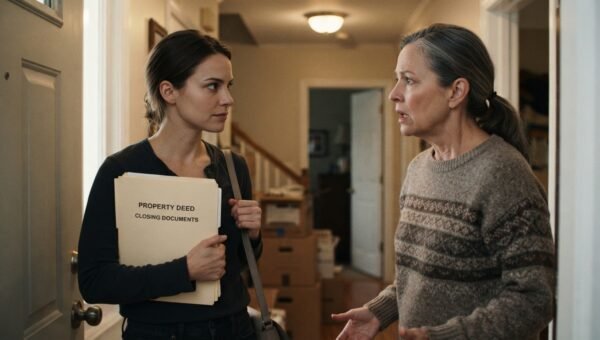
I stepped out of the car onto the wet gravel, the cold air cutting straight through my cardigan. “Tom, don’t do this here,” I said. “He has to report inside in ten minutes.”
Neither of them looked at me. The wall between them had been building for forty-eight months, and now every stone was visible in the cold morning light.
Nobody in our county ever brought up the Miller warehouse job. The official report from the state safety inspector said a temporary truss bracket sheared under wind load on an unfinished commercial roof out on Route 9. The lumber came down in a single second, eighty feet of green Douglas fir timber collapsing straight onto the foundation.
I was at the grocery store when the call came. By the time I reached the regional trauma unit forty miles away, Tom was already in surgery having two titanium rods placed into his right leg. What nobody outside our house knew was what happened during the forty-five minutes before the county fire truck found the unmarked access road.
Tom had been pinned beneath two thousand pounds of joists. A jagged length of galvanized metal flashing had sliced into his inner thigh, opening an artery while he lay wedged between a concrete footer and two tons of dead weight. The other two crew members had panicked and run toward the highway to wave down traffic.
Jesse had stayed.
Jesse had crawled into a crawlspace barely twenty inches high, with timber groaning over his back, and tied off his own heavy leather work belt around Tom’s leg. He used a foot-long steel pry bar from his pouch to twist that leather into a makeshift tourniquet, tightening it until his own fingers blistered and bled. For three-quarters of an hour in freezing November mud, Jesse held that bar in place with his chest pressed against Tom’s ribs, talking to his father about fishing trips, about roof pitches, about how we needed a new stove, just to keep Tom’s eyes open while blood soaked through the knees of Jesse’s jeans.
When the trauma surgeon finally came out to talk to me in the waiting room, his green scrubs were spattered with dark red. He looked at my nineteen-year-old son sitting in a vinyl chair with stained hands and said words I wrote down on an envelope in my purse that very night: “If that boy had let go of that bar for ninety seconds, your husband would have arrived here in a black bag.”
Tom came home eight weeks later with a severe limp and four new prescription bottles. The day he walked back into the shop, he threw the twisted leather belt into the trash bin behind the shed. He ordered Jesse never to mention the collapsed truss, never to tell the sub-contractors what happened on the slab, and never to bring up the forty-five minutes in the mud. Tom wanted everyone to believe he had jumped clear and merely broken a bone.
Jesse obeyed him. But the following month, Jesse quietly enrolled in an evening first-aid course at the community college. Then he signed up for an emergency responder certification on weekends, paying the $680 tuition out of his own drywall money without telling his father.
Standing in the parking lot outside Station 4, Tom didn’t drop the keys. He stepped closer to Jesse, his shoulders square.
“You built four houses with me after that winter,” Tom said. “You laid subfloor in the rain. You never complained once. I thought you put it behind you. I thought you were staying because the business meant something to you.”
Jesse looked down at the keys hanging between them. “The business meant something to you, Dad. What happened under that truss meant something to me.”
PART 3
Tom’s jaw tightened. “I gave you thirty percent of the partnership on paper last Christmas. I had the lawyer draw up the transfer for the yard and the shop. You’re throwing away forty years of equity to work thirty-six-hour shifts for county wages.”
“I am not throwing anything away,” Jesse said.
“You’re running,” Tom snapped, his voice rising just enough to turn the head of a young firefighter checking the hoses on Engine 4. “You saw an old man nearly bleed out on a dirty floor and you convinced yourself the whole trade is a death trap. You think because you pulled me out, you’re responsible for saving every stranger who wraps their car around a telephone pole.”
“No,” Jesse said. For the first time in thirty days, his voice wasn’t quiet. It was steady, firm, and carried the weight of four years of silence. “I don’t think framing is a death trap, Dad. And I’m not running. I spent forty-five minutes holding a steel bar in your leg while you begged me to tell Mom you were sorry about the roof insurance. Do you remember that? You told me you were sorry you hadn’t signed the updated policy.”
Tom flinched. The cold wind caught his gray hair, blowing it across his forehead. He had never admitted to me that he remembered anything from that morning under the timber.
“You looked me in the eye and told me you were going to die on a bed of wet gravel,” Jesse said. “And the only thing that kept you breathing wasn’t the three-quarter-ton truck you bought me. It wasn’t the lumber yard, and it wasn’t the twenty-thousand-dollar contract we had with Miller. It was a fifteen-dollar leather belt and someone who knew enough not to let you slip into shock.”
Jesse took a breath, his chest rising against his dark station shirt.
“Every time I picked up a hammer after that day, Dad, I didn’t see rafters. I saw forty minutes of waiting for an ambulance that didn’t know where the road turned off. I stayed four years because you couldn’t walk up a ladder without your knee buckling, and I wasn’t going to leave you on a job site alone until your leg healed. Your leg is healed now. The business is solvent. You have two good foremen. But I am not staying on a roof just to prove to you that you didn’t almost die.”
Tom didn’t move. The company truck keys hung between them, cold and heavy in the gray morning.
For thirty days, I had believed Tom was simply stubborn, clinging to an old dream of a father-and-son sign hanging over our office door. But looking at Tom’s face now, watching the way his eyes darted from Jesse’s uniform collar down to the boots Jesse had bought with his own money, I finally understood my husband’s real fear.
Tom wasn’t angry because Jesse was leaving the business. Tom was terrified because Jesse was stepping into a world where Tom had no power to protect him. On a construction site, Tom could check the scaffolding himself. He could inspect every cable, every harness, every load limit. Inside an ambulance running eighty miles an hour down two-lane county highways, Tom could do nothing.
I walked over and placed my hand on Tom’s arm, right over the thick canvas of his coat. His muscles were rigid as cured oak.
“Tom,” I said softly. “Look at him. He isn’t nineteen anymore.”
Tom looked down at his own boots, where the sawdust from thirty years seemed permanently embedded in the creases of the leather. Slowly, his fingers loosened. The keys didn’t fall. He turned his wrist over, opening his calloused palm.
“These aren’t the keys to the shop truck,” Tom said quietly.
Jesse paused, his eyes narrowing as he looked down at the brass ring.
There were two keys on the ring. One was for the heavy F-250 idling behind them. The other was a small, silver padlock key with a blue plastic tag attached to it.
ENDING
“The blue key is for the steel job box in the back of the bed,” Tom said, his voice dropping so low I had to lean in against the wind to hear him. “I went down to the supply house in Marion on Friday. There’s a three-hundred-piece trauma kit in there. Industrial grade. Heavy shears, burn blankets, tourniquets that don’t need a pry bar to tighten them down.”
Jesse stared at his father. His throat moved as he swallowed, but he couldn’t find a word.
“You’re driving the truck,” Tom said, not looking at Jesse’s face now, but staring fixedly at the side mirror of the ambulance sitting inside the bay. “The county station has parking in the rear. You aren’t leaving an eighty-pound pack in the trunk of your mother’s front-wheel-drive car when the snow hits the gap. If you’re going to do this job, you do it with eight cylinders and four-wheel drive, or you don’t do it at all.”
Tom pushed the keys forward until the cold brass touched the palm of Jesse’s hand.
Jesse closed his fingers around them. The tension that had held my son’s shoulders high for an entire month seemed to leave him all at once. He took half a step forward, hesitating for a fraction of a second, before wrapping his arms around his father’s thick coat.
Tom didn’t return the hug right away. His hands hovered at his sides for two beats, stiff with thirty years of pride, before his right arm came up and clamped hard across Jesse’s back. He gave him two rough, heavy pats, the exact same way he used to check the alignment on a plumb post, and then stepped back.
“Go on inside,” Tom muttered, pulling his coat collar up against his neck. “Your shift started two minutes ago. I don’t pay county taxes for paramedics who show up late.”
Jesse grabbed his canvas duffel from my passenger seat. He didn’t say goodbye, but as he reached the side door of Station 4, he turned back once, held the key ring up in the gray morning light, and gave his father a single nod.
Tom watched the heavy metal door latch shut behind him.
We stood together on the gravel for a long time after the door closed, listening to the diesel engine rumble against the cold wind. Tom reached into his pocket, pulled out his work gloves, and smoothed the leather over his scarred knuckles.
“He’s going to be good at it, Tom,” I said, slipping my arm through his.
Tom turned his head toward the empty parking space beside my car, where his truck sat waiting for our son’s first shift to end.
“He was already good at it four years ago,” Tom said. Then he opened the passenger door of my sedan, climbed inside, and waited for me to drive him home.