PART 1
My mother-in-law, Evelyn, hated my flower garden from the day David and I put in the first raised bed.
“You’re wasting good dirt on things you can’t eat,” she told me every June for fourteen years. She would stand on our back concrete slab with her purse tucked tight under her elbow, squinting out at my English tea roses, my purple salvia, and the tidy cedar fence David had built behind them. “If you had any practical sense, Clara, you’d rip this out and put in cabbage.
Or potatoes. Potatoes don’t die just because you forgot to water them for two days.”
I never argued with her back then. David always gave me that gentle nudge with his elbow, the one that meant, Let her talk, Clara. It doesn’t cost us a dime to let her complain.
Then David died in November.
It was a sudden heart attack while he was clearing wet leaves off the front walk. One minute he was fifty-six and setting a shovel against the porch rail, and the next minute I was a widow sitting alone in an empty three-bedroom ranch. The funeral expenses, the quiet house, and the sheer exhaustion of waking up to cold sheets took everything out of me. I barely had the energy to brew a pot of coffee in the morning, let alone fight Evelyn.
She waited exactly two months after we buried her son.
By the second week of January, she was driving over to the house every three days.
She did not bring casseroles or offer to help sort through David’s coats in the hall closet. Instead, she brought spiral notebooks filled with real estate listings clipped from the Sunday paper.
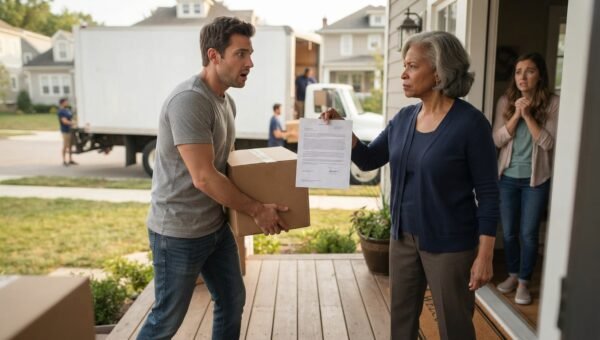
“You can’t maintain this place alone,” Evelyn said, tapping a manicured fingernail against my kitchen table. “A woman pushing sixty has no business raking half an acre or replacing water heaters. David paid for this house with his own blood and sweat. He was my boy, Clara. It breaks my heart to see his hard-earned equity sit here rotting away while you mope in the living room.”
“David and I paid the mortgage together, Evelyn,” I said quietly, holding my mug with both hands just to keep them from trembling. “I worked thirty years at the county clerk’s records desk. My paycheck went into the exact same checking account his did.”
She gave me that thin, dismissive smile she usually saved for store clerks who wouldn’t honor expired coupons. “You helped with groceries, dear.
David was the backbone. Now that he’s gone, the sensible thing is to liquidate before the roof needs work. We sell the house, pay off what’s left, split the proceeds fairly, and you take a nice, manageable one-bedroom apartment over by the bypass.”
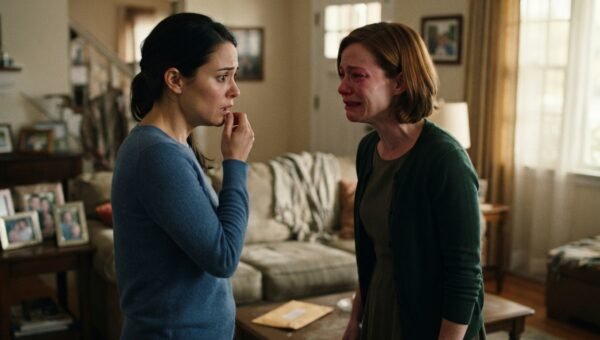
I was too tired to explain to her that David had left the house solely to me in his will. I was too tired to tell her that I had pruned those roses through miscarriages, layoffs, and the long, terrible winter David’s father died. Every time she raised her voice, a dull, heavy ache settled behind my eyes. I just wanted the noise to stop.
So when she called a local real estate agent and booked an evaluation for the following Tuesday morning, I didn’t cancel it. I just sat at the table and let it happen.
The agent was a woman named Brenda Higgins, a brisk, practical woman in her fifties who wore sensible mud boots and carried an extendable fiberglass measuring tape.
Evelyn arrived twenty minutes early, wearing her good wool coat and carrying her legal pad like she was the executor of an empire.
“We want an honest appraisal,” Evelyn announced to Brenda before the poor woman had even unzipped her jacket. “The interior is dated, but the lot is prime. If Clara clears out that ridiculous rose patch out back, a developer could easily drop a modern patio addition back there.”
Brenda nodded politely, took notes on the furnace and the kitchen cabinets, and then stepped out the sliding glass door into the chilly backyard. Evelyn marched right behind her, pointing out imaginary flaws in the siding and complaining about the moss on the roof shingles.
I stood by the edge of the rose bed, wrapping my cardigan tight against the damp morning air. The bushes were bare and thorny, pruned back for the cold months, waiting for spring.
Brenda pulled her tape measure toward the rear cedar fence. She paused near the back corner, right where my favorite climbing rose wrapped around the post. She nudged a pile of damp oak leaves with the toe of her boot, frowned, and crouched down.
“What is it?” Evelyn called out from the patio slab. “Termites in the pickets? I told David those untreated posts were a mistake.”
Brenda didn’t answer right away. She scraped a flat metal trowel against something hard in the frozen dirt. A dull clink echoed across the yard.
“No,” Brenda said, standing up and wiping her leather work glove on her jeans. “It’s an iron survey pin. An official county monument.” She turned around, looking past the wooden fence toward the thick brush and old pine trees that ran toward the municipal drainage ditch. “Mrs. Miller, did you know your property line doesn’t end at this fence? It extends roughly forty feet into the tree line.”
I stared at her. “No. The fence was here when David and I moved in twenty-two years ago. We always assumed the woods were township land.”
“They aren’t,” Brenda said, pulling out her tablet computer. “Let me pull the county GIS parcel map right now. You might be sitting on more acreage than your original listing indicated.”
Beside me, Evelyn went dead silent. The constant, cutting commentary she had kept up for two hours vanished entirely.
Brenda tapped her screen, zoomed in on the neighborhood plat, and tilted the tablet toward the light. “Here it is. Parcel 408-A. It was recorded twelve years ago as a lot consolidation.”
Evelyn took two fast steps across the dead grass. Her face was tight, her eyes fixed directly on the glowing screen before Brenda even turned it our way.
“That’s not township land,” Evelyn whispered, her voice suddenly high and thin. “That’s parcel seventy-two.”
I looked at my mother-in-law. She hadn’t looked at the county deed. She hadn’t seen the paperwork in our filing cabinet. Yet she had named the exact historical parcel number before Brenda had even zoomed in on the survey stamp.
PART 2
Brenda looked up from her screen, surprised. “Actually, Mrs. Miller, you’re right about the historical designation. Prior to 2014, that back strip was listed as Parcel 72 on the old township tax rolls. How did you know that off the top of your head?”
Evelyn pulled her hands back into her coat pockets. Her knuckles were bunched so hard the fabric strained. “I grew up in this county,” she said, her voice dropping into that stiff, haughty tone she used whenever she was cornered. “Everyone who has lived here more than thirty years knows the layout of the old Henderson farm subdivision. It was common knowledge.”
“Except this was never part of the Henderson subdivision,” Brenda remarked, tapping through the public deeds database. “It was an unplatted easement strip owned by the county drainage authority. In May of 2014, it was sold at an administrative quiet-title auction for $14,200. And it was deeded directly to Clara Miller. Sole owner.”
Brenda turned the tablet toward me.
There it was on the county screen. My name, clear as day. Clara Louise Miller. Not David. Not David and Clara Miller as joint tenants with right of survivorship. Just my name, recorded on June 4, 2014.
“That’s impossible,” Evelyn snapped, stepping between me and the agent. “David handled all the family property. Clara never bought an inch of land in her life. David wouldn’t have spent fourteen thousand dollars without telling his own family. The boy didn’t have secrets.”
“It’s right here in the county recorder’s index, ma’am,” Brenda said gently, sensing the friction. “Document number 2014-R-08912. It’s a recorded warranty deed. It belongs to Clara.”
Evelyn’s face mottled with red. “Then it was an illegal transfer. David bought it with marital funds, which means half of it belongs to his estate, and as his surviving mother, if there’s no proper probate inventory, I have a right to inspect the estate accounts. I have an attorney on retainer in town. Mr. Henderson knows the whole family history.”
I stood on the dead winter lawn, looking at the forty feet of brush behind my rose bed. Twelve years ago. That was the summer David spent three weekends down in the basement sorting through old metal lockboxes after his father died. It was also the exact summer Evelyn had suddenly demanded David cosign a bridge loan for her younger son, Greg.
“Brenda,” I said, my voice steady for the first time in two months. “I think we’re done with the walk-through today. I’m not putting the house on the market.”
“Clara, you don’t make that decision unilaterally,” Evelyn said, turning on me. “We came here to settle this. You’re emotional, you’re tired, and you’re letting some clerical error on a computer screen confuse you. We are selling.”
“You don’t own a single brick in this house, Evelyn,” I told her. “And according to the county, you don’t own the dirt behind it either. I need you to leave my yard.”
She stared at me like I had slapped her. For fourteen years, I had kept the peace. I had served her pot roast on Sundays, ignored her snide remarks about my kitchen curtains, and smiled while she claimed her son had bought every good thing in my life. Seeing me stand tall on the back lawn shook her, but she didn’t apologize.
“You’ll hear from my lawyer by Friday,” she hissed. She turned on her heel, her boots squelching in the soft turf, and marched out through the side gate without looking back.
Brenda gave me a sympathetic look. “Do you want me to print these documents for you, Mrs. Miller? My office is only five minutes away.”
“No,” I said. “I worked at the county records desk for thirty years, Brenda. I know exactly where the original microfilm reels and ledger books are kept.”
PART 3
I drove to the county administration building the next morning at eight sharp.
Walking back into the records office felt like stepping into an old coat. The smell of paper dust, ozone from the copiers, and warm radiator heat hadn’t changed since I retired four years earlier. Donna, who took over my desk, hugged me tight and offered her condolences about David.
“I need to pull an archive packet, Donna,” I told her. “Parcel 408-A, formerly Parcel 72. Document 2014-R-08912. And I need the probate filings from 2013 for Arthur Miller.”
Arthur was David’s father. When Arthur passed away in late 2013, Evelyn had handled the funeral and told everyone Arthur left behind nothing but credit card bills and a mortgaged-to-the-hilt split-level. David had been devastated, believing his father had struggled in secret for years.
Donna brought me the digital scans within twenty minutes.
I sat at the corner research table and laid the records side by side.
The truth did not take a forensic auditor to unravel. It was laid out in plain black ink on certified county forms.
When Arthur Miller died, he owned three small outlying parcels along the creek bed, purchased in the late 1970s for pennies on the dollar. One of them was Parcel 72, the wooded strip directly touching the back boundary of our property. Arthur’s handwritten holographic will, filed in probate court in 2013, had left Parcel 72 to David, and the other two commercial parcels to Evelyn.
Evelyn had concealed the will.
She had petitioned the probate judge as Arthur’s sole administrator, claiming there was no will and that Arthur’s estate was insolvent. But Parcel 72 had an outstanding tax lien of $1,400 attached to it from unpaid drainage assessments. Instead of paying the lien to keep the land, Evelyn had deliberately allowed Parcel 72 to go to county tax forfeiture.
Her plan was obvious from the follow-up filings: she had formed a limited liability company, Green Valley Properties, registered to her home address, and intended to buy the parcel back at the county tax auction for pennies on the dollar, wiping out the old title trail and keeping the land for herself. She knew the township was planning a municipal sewer expansion through that corridor, which would make that narrow strip of right-of-way worth ten times its assessed value to any developer wanting access to the main road.
David had found out.
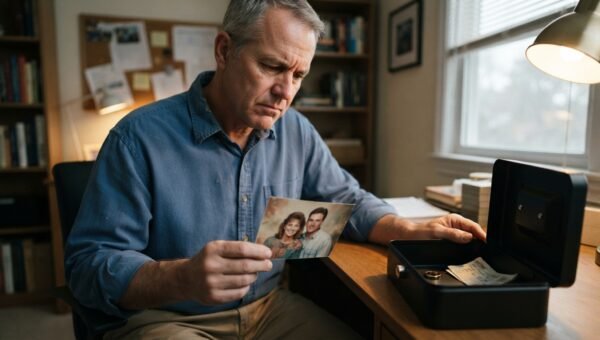
In the lockbox down in our basement, David had found a copy of his father’s true handwritten wishes. He had confronted Evelyn in May of 2014.
I found the canceled cashier’s check tucked in the back of the auditor’s archive packet. The check was for $14,200, drawn from David’s separate personal savings, the money his grandmother had left him as a boy. David hadn’t used marital funds. He had used his own private inheritance to outbid Evelyn’s shell company at the county steps, paying off every cent of Arthur’s back taxes and recording the deed exclusively in my name.
Attached to the recorder’s filing copy was a handwritten memo slip David had signed in front of the deputy clerk:
“To be deeded to Clara Louise Miller as her sole and separate property. To protect her garden, her home, and her peace from any future claims by my mother.”
David had never told me because he was ashamed of what his mother had tried to do to his father’s memory. He had swallowed the humiliation, bought the land to shield me, and moved the fence line thirty feet forward just to give me my roses without stirring up a family war while he was alive.
On Friday morning, Evelyn didn’t send a lawyer. She came herself.
She knocked on my back door at ten o’clock, holding an manila folder. When I opened the door, she tried to push past me into the kitchen, but I stood squarely in the frame.
“We need to talk reasonably, Clara,” she said, her voice sugary and strained. “I spoke with Greg. We realize you’re under stress. If you sign a quitclaim deed on that rear forty feet, I will drop all claims against the house and let you stay here rent-free for two full years.”
I took David’s certified auditor packet from the kitchen counter and held it out to her.
“Take it,” I said.
She frowned, pulled the copies from the envelope, and began to read. I watched her eyes move down the page. She saw the docket number. She saw the auction register. Then she saw the copy of David’s handwritten memo to the county clerk.
The thin, arrogant posture she had held for fourteen years simply collapsed. Her shoulders slumped into her coat. The paper trembled in her fingers.
“He told you,” she whispered.
“No,” I said. “David loved you enough to protect you from the shame of it while he was alive. He never said a word to me. He just protected me. He knew you’d come for this house the second he was in the ground, and he made sure you couldn’t touch it.”
“Clara, please,” she stammered, looking down at the concrete step. “Arthur’s medical bills were awful. I was trying to secure something for Greg’s future. You have no idea what it’s like to worry about money at my age.”
“You tried to steal from your own husband, you tried to cheat David, and then you spent two months trying to push his widow into a shoebox apartment so you could cash a check,” I told her. “The sewer authority called Brenda’s office yesterday afternoon when they saw the parcel flag. They need a permanent utility easement across that forty-foot strip. The county is offering forty-eight thousand dollars for the right-of-way.”
Evelyn’s mouth opened slightly. The exact dollar amount hung between us on the cold porch.
“That money will stay in my bank account,” I said. “And if you ever set foot on my property, park in my driveway, or call my phone again, I will walk these probate fraud documents down to the county prosecutor’s office. Arthur’s estate file is still open under administrative review. It won’t take them an afternoon to revoke your executorship.”
She didn’t argue. She didn’t threaten a lawsuit. She dropped the papers onto my porch table, turned around, and walked to her sedan with her head down, looking every single one of her seventy-four years.
ENDING
Evelyn never called again.
Greg called twice from Florida, trying to sound like a neutral mediator who just wanted family harmony, but I told him the exact same thing I told his mother. After that, the phone stayed quiet.
In late April, when the frost finally broke and the ground turned soft and dark, I hired a fencing contractor to tear down the old cedar pickets David had built. We moved the property line back forty feet, deep into the clearing under the pine trees, right where the original iron survey pin stood in the dirt.
The county paid the $48,000 easement fee in June. I used a portion of it to replace the house roof that Evelyn had insisted was rotting, paid off the modest balance remaining on the mortgage, and put the rest into a safe certificate of deposit at the credit union.
The rest of the summer was quiet.
I spent my mornings in the dirt, wearing David’s old leather work gloves that were three sizes too big for my hands. I doubled the size of the beds. I planted sweet peas, foxgloves, and three new rows of heirloom tea roses that caught the late afternoon sun coming through the pines.
Evelyn was right about one thing: you can’t eat flowers. They don’t fill your stomach, and they don’t keep you warm through a hard winter. But standing out there in the quiet evening, with the smell of damp earth and blooming petals drifting across the yard, I knew they did something far more important.
They reminded me that David had loved me enough to build a wall of quiet protection around my life before he left it. And every single rose blooming against the new fence belonged entirely to me.