PART 1
My husband, Greg, drove a 2021 Silverado that he washed every Saturday morning like it was a show truck. He was proud of that truck. But two weeks ago, on a plain Tuesday, he left the truck sitting in our driveway and took our 2011 Subaru Outback to work instead.
The Subaru had over one hundred and eighty thousand miles on it. The clear coat on the hood was peeling, the air conditioner rattled, and the back hatch only opened from the outside handle if you pulled it twice.
I only used it to haul potting soil, bags of mulch, and our old golden retriever to the vet.
When I asked him about it that evening, he wiped down the kitchen counter and said the truck’s front suspension was making a clicking sound over bumps. He said he didn’t want to rack up miles on it until he could get it on the lift at his friend Pete’s garage on the weekend. Greg was fifty-six, practical, and careful with money, so I didn’t question it.
Two days later, on Thursday morning, I needed to drop off three boxes of old winter coats at the church donation bin before work. The Subaru was already parked behind my sedan in the drive, and Greg had taken the train into town with a neighbor for a seminar, leaving both vehicles home. I grabbed the keys off the hook by the back door, unlocked the wagon, and pulled the back hatch twice to open it.
There was a black and gray Graco booster seat strapped securely into the back passenger seat.
It wasn’t tossed back there like junk. The seatbelt was threaded through the plastic guide, pulled tight, and clicked into the buckle. Our two children, Ben and Claire, are twenty-four and twenty-seven. Ben lives three states away in Denver, and Claire lives across town with her fiancé in an apartment that doesn’t allow pets, let alone children. We don’t have grandchildren.
I stared at that seat for a full minute before I touched it. The fabric was clean. There were a couple of dried cheerios crushed in the bottom cup holder and a small blue plastic hair clip wedged between the cushions.
When Greg came home that night around six, he tossed his jacket on the back of the kitchen chair and asked what smelled like garlic. I stayed by the stove, holding a wooden spoon, and said, “Greg, why is there a booster seat strapped into the Subaru?”
He didn’t hesitate. He let out a little laugh, shook his head, and reached into the fridge for a seltzer. “Oh, that. Mark from the plant asked if he could borrow the wagon Tuesday afternoon to pick up his twin girls and his sister’s kid from day care. His minivan blew an alternator in the lot at work. I forgot to take the extra seat out when he gave the keys back.”
Mark was his shift supervisor. I’d met him twice at summer company picnics. It sounded reasonable. It sounded completely ordinary. But Greg didn’t go out to the driveway to take the seat out that night. He left it right where it was.
On Saturday morning, I went out with a plastic grocery bag to clean the dog hair out of the wagon before running my errands. The booster seat was gone. Greg must have unbuckled it early while I was still in the shower and put it somewhere.
I bent down to vacuum the floor mats. Under the front passenger seat, tucked way back against the heater vent, my fingers brushed against something soft.
I pulled it out. It was a small pink knit mitten. It was tiny, meant for a three or four-year-old child.
Across the ribbed cuff, someone had cross-stitched three initials in pale lavender thread: E. M. H.
The stitching used a very specific three-thread split stitch with a tiny French knot resting at the base of the center letter. It was the exact monogram pattern my mother taught me when I was pregnant with Claire twenty-seven years ago. I had used that identical lettering on Claire’s receiving blankets, on Ben’s baby quilts, and on the small holiday stockings I kept packed away in the cedar chest upstairs.
Our daughter Claire’s middle name is Marie. Her initials before marriage were C. M. H.
The last name was ours. Hastings.
I knelt on the cold asphalt of our driveway with that mitten pressed against my palm. Greg didn’t know how to sew. Mark from the plant had never set foot in my house, and Mark’s last name was Keller.
On Monday, Greg left for his office at the regional water authority at seven in the morning. He took the Subaru again. He didn’t say a word about the truck’s clicking suspension, which was still sitting clean and parked near the garage door.
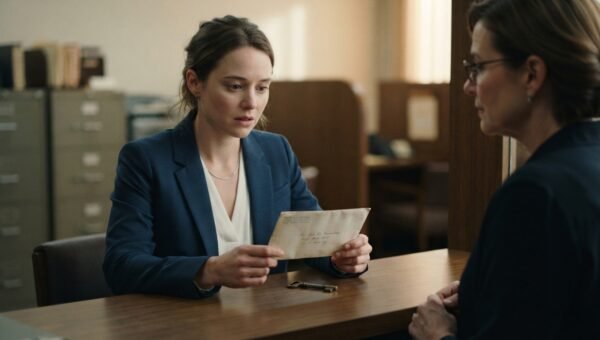
At eleven-thirty, I left my desk at the township library, got into my sedan, and drove across town to the industrial park where Greg worked. I parked across the two-lane road in the lot of a plumbing supply warehouse, behind a row of tall commercial vans. I turned off the engine and watched the glass front doors of his building.
The digital clock on my dashboard read 12:18 when the heavy glass door pushed open.
Greg came out first. He wasn’t wearing his hard hat or his safety vest. He had on his good brown corduroy jacket, the one he only wore to church or out to dinner on my birthday. In his right hand, he carried a little girl’s canvas lunch bag with a cartoon pony on the front. With his left hand, he was holding the fingers of a little girl who couldn’t have been more than four years old.
She wore a navy blue coat and had curls the exact color of Claire’s hair when she was small. She was skipping, trying to match his long strides.
As they reached the edge of the curb right across from my car, the little girl stopped to jump over a crack in the concrete. She glanced up, looking straight across the narrow street, right through my windshield. She grinned, pointed her free hand toward the sky, and tugged on Greg’s coat.
Her small voice carried across the pavement in the cold noon air.
“Look, Grandpa. The big crane is moving.”
PART 2
The word sat in the cold air between our cars.
Grandpa.
I watched through the glass as Greg looked down at her, smiled, and hoisted her up into his arms so she could see the yellow construction boom behind the warehouse. He tucked her navy coat around her legs with a practiced, familiar motion. He didn’t look around. He didn’t look nervous. He carried her straight to the passenger side of the old Subaru, opened the door, and set her carefully in the booster seat that he had supposedly returned to his coworker.
I sat with both hands gripping the steering wheel of my car. My foot stayed pressed against the brake pedal even though the transmission was in park.
I didn’t turn the key. I didn’t honk. I didn’t jump out and make a scene in the street outside his office. A woman who has been married for thirty-one years learns that when a foundation cracks, running toward it screaming only brings the house down on your head before you understand what gave way.
I watched him walk around to the driver’s side, get in, and back out of the spot. He drove west, toward the parkway.
I didn’t follow him. I drove back to the library, walked into the staff breakroom, and hung my coat on the peg. My hands were shaking so hard I couldn’t get the plastic lid onto my coffee cup, so I threw it in the trash and sat at my desk until five o’clock, checking out paperbacks and stamping due-date slips like an automaton.
Our daughter Claire was twenty-seven. She was an assistant manager at a medical billing office twenty minutes away. She and her fiancé, Marcus, had been together four years and were planning a wedding for next October. Our son Ben had moved to Colorado three years ago to work for the forestry service.
Neither of them had a child. At least, that was the story our family had lived inside for four years.
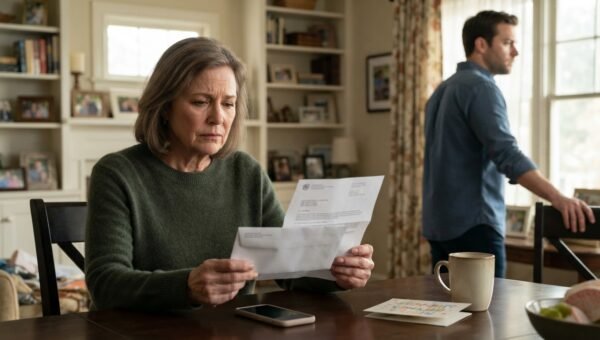
That evening, I got home at twenty past five. Greg’s truck was still in the drive, but the Subaru was parked in its usual spot. I walked through the kitchen door. The house was warm, smelling of roasted chicken. Greg was at the counter, slicing carrots with the heavy chef’s knife I bought him for our twenty-fifth anniversary.
“Hey, Beth,” he called out, not looking up from the cutting board. “Traffic on Route 4 was a mess. How was your day?”
“Fine,” I said. My voice sounded flat and thin.
I took off my boots, set my bag on the chair, and walked over to the island. I reached into my coat pocket, pulled out the little pink knit mitten with the lavender E.M.H. stitching, and set it on the cutting board right next to his diced carrots.
The knife stopped.
Greg looked down at the mitten. He didn’t flinch, and he didn’t ask what it was. The casual, easy posture he had carried into the room evaporated. His shoulders dropped an inch, and his jaw set tight.
“You took the wagon to work today,” I said quietly.
“Beth,” he started, his voice thick.
“Don’t tell me about Mark from the plant,” I said. “I sat across the street at twelve-eighteen. I saw her. She called you Grandpa, Greg. She’s four years old. Who is she?”
Greg set the knife down on the wood with a quiet click. He reached for a paper towel, dried his hands slowly, and leaned against the counter. He looked older than fifty-six. The lines around his eyes looked deep and gray under the kitchen fluorescent lights.
“Her name is Emma,” he said.
“Emma who?”
“Emma Hastings,” he replied. “She’s Ben’s daughter.”
The room seemed to shrink. Ben. Our quiet, gentle boy who called every Sunday at four in the afternoon, who sent pictures of mountain trails and pine trees, who had packed his car four years ago and moved a thousand miles away with barely two weeks of notice.
“Ben doesn’t have a child,” I whispered. “Ben lives in Fort Collins.”
“Ben lives in an apartment in Allentown,” Greg said, looking directly into my face. “He’s lived there for three years, Beth. Right off Airport Road. An hour north of here.”
The air went out of my lungs. “Why would you lie to me about where our son lives? Why would he lie to me?”
“Because of what you told him the night he left,” Greg said. His voice wasn’t angry. It was heavy, weighed down by years of carrying something alone. “You told him that if he threw his life away on a girl with a record and a baby on the way, he was dead to this family.”
“That was four years ago,” I said, my chest tightening until it hurt to draw a breath. “That was Sarah. She was nineteen, she had stolen prescription pads from her employer, and she was headed to county jail. He was twenty-three, Greg. He was going to throw away his whole future to cover her bail and pay her fines. I told him he was making a mistake.”
“You didn’t just tell him it was a mistake,” Greg said softly. “You told him you wouldn’t give him a single dime, you wouldn’t sign as a guarantor on an apartment, and you never wanted her name spoken in this kitchen. You told him if he walked out that door with her, he was on his own.”
“I was trying to protect him,” I said.
“Well, he heard you,” Greg said. “He took the job in Allentown because a buddy from school had a landscaping crew there. Sarah had the baby while she was in a diversion program. She stayed clean for fourteen months, Beth. Then she walked out when Emma was two and never came back. Ben has been raising that little girl by himself in a third-floor walkup, working sixty hours a week cutting grass and plowing commercial lots.”
I gripped the edge of the island. “And you knew? All this time, you knew?”
“I’ve been driving up there every Tuesday and Thursday for three years,” Greg said. “I watch Emma on my lunch break while Ben runs his equipment route. I pay her preschool tuition. I bought that booster seat with cash so you wouldn’t see it on the credit card statement.”
“Why did you keep this from me?” I cried out, the hurt breaking through my throat. “I’m his mother, Greg. I carried him. How could you let me believe he was in Colorado? How could you let me sit here every Sunday on the phone while you both lied to me?”
“Because every single time Ben brought up coming home,” Greg said, his eyes watering, “he asked me if you still felt the same way. And I couldn’t lie to him, Beth. Every time Sarah’s name came up, or anyone made a mistake in this town, you talked about them like they were trash. He was terrified you’d look at his daughter and see Sarah.”
He reached out and picked up the pink mitten. He turned it over in his rough, calloused fingers.
“Claire knows,” Greg added quietly. “Claire made the mitten for her third birthday. She took your old needlework hoop out of the attic to copy the stitch. The only person in this family who didn’t know was you.”
PART 3
The silence that followed was worse than any shouting.
Claire knew. My daughter, who sat at my dining room table every Sunday for pot roast, who let me look at bridal magazines with her, had been driving up to Allentown to hold her niece while I sat twenty miles away, completely shut out of my own children’s lives.
I didn’t scream. I didn’t smash a plate. I walked into the hallway, pulled my winter coat off the hook, and picked up my car keys.
“Where are you going?” Greg asked, stepping into the hall. There was fear in his face now, genuine fear that he had broken something that couldn’t be repaired.
“Give me the address,” I said.
“Beth, don’t just show up there. It’s late. He’s tired, the kid is probably having dinner—”
“Give me the address, Greg,” I said, looking him dead in the eye. “Or I call Claire right now and get it from her. You’ve had three years. I’m taking tonight.”
He looked at me for three long seconds, then pulled a small spiral notepad from his shirt pocket, tore off a page, and wrote down an address on Hanover Avenue in Allentown. Underneath it, he wrote: Apartment 3B. Buzzer is broken, knock hard.
The drive north on Route 309 took fifty-two minutes. It was raining, a cold November sleet that turned the windshield into a blur of red taillights. My mind kept replaying every Sunday phone call with Ben over the last three years.
*How’s the weather out there, Ben?*
*Oh, pretty cold, Mom. Mountains got some snow.*
*Are you eating enough?*
*Yeah, Mom. Plenty of soup.*
He hadn’t been looking at the Rockies. He had been looking out a third-floor window at a gravel parking lot and an auto body shop, holding a toddler on his lap while he lied to keep his dignity intact. And I had sat in my clean, warm house, proud of how independent my son had become, blind to the fact that my own stubborn pride had locked him out.
I found the building. It was a brick four-story structure with fire escapes running down the front and a row of commercial trash bins near the entrance. I climbed the dark, narrow stairwell to the third floor. The hallway smelled of fried onions and damp carpet.
Outside door 3B, I stopped.
Through the thin wood, I could hear a television playing a cartoon song. I heard a small, sharp giggle, followed by a man’s voice saying, “No more apple juice until you finish the noodles, kiddo.”
It was Ben’s voice. It wasn’t the distant, tinny voice through a speakerphone. It was my son, ten feet away from me.
I knocked.
The apartment went quiet. Footsteps approached the door. The deadbolt clicked, the chain rattled, and the door swung open.
Ben stood there in a gray hooded sweatshirt with grease stains on the sleeves and worn sweatpants. He had grown a short beard, threaded with a few gray hairs at the chin that I had never seen before. He held a dish towel in one hand.
He looked at me, and his face went completely still.
“Mom,” he said.
He didn’t move forward to hug me, and he didn’t step back to let me in. He stood in the doorway like a guard protecting a gate.
“Your father told me,” I said. My voice was steady, but my chin was trembling. “He told me everything.”
Ben looked down at the towel in his hands. He took a slow breath, his shoulders tightening just like his father’s had an hour earlier. “If you came here to tell me I made a mess of things, Mom, don’t bother. I already know. But I’m doing it on my own. I never asked you for a dime.”
From behind his legs, a small face peeked out.
She was wearing flannel pajama pants with yellow ducks and a faded long-sleeve shirt. She had large, dark brown eyes, exactly like Ben’s when he was a boy, and two wild curls pinned back with a green plastic barrette. She looked up at me with that fearless, open curiosity that only four-year-olds have.
“Are you the lady from the truck?” she asked.
Ben reached down instantly, resting his hand gently on the top of her head, pulling her slightly behind his leg. “Emma, go back by the TV for a minute, okay? Daddy is talking.”
“No,” I said.
I took one step forward, dropping my car keys into my coat pocket. I didn’t look at Ben; I looked down at the little girl. I reached into my bag and pulled out the single pink mitten.
“You dropped this under the passenger seat of the wagon,” I said softly, crouching down on the drafty linoleum of the hallway so I was at eye level with her. “I brought it back.”
Emma looked at the mitten, then looked at her father. “My mitten,” she said.
Ben stared at the piece of knit yarn in my hand. His eyes moved from the mitten to my face. The defensive wall in his posture didn’t fall immediately, but the tightness around his mouth gave way.
“You taught Claire that stitch,” he whispered.
“I did,” I said, looking up at him while tears finally spilled over my eyelashes. “And she did a good job on it. But the French knot on the H is a little loose. I should have shown her how to anchor the thread twice.”
Ben let out a jagged, ragged breath. He closed his eyes for a second, then stepped back from the door and pulled it open wide.
“Come inside, Mom,” he said. “It’s cold out there.”
ENDING
The apartment was tiny, barely four hundred square feet. The living room held a secondhand sofa with a faded slipcover, a low table covered in crayons and construction paper, and a neat stack of children’s books against the wall. There wasn’t a single luxury in the place, but it was clean. A small pot of buttered egg noodles sat on the electric stove.
I sat on the edge of the sofa while Emma showed me her three plastic ponies. She didn’t know I was her grandmother. To her, I was just the lady who had brought back her mitten. She climbed onto the cushion next to me without any hesitation, chattering about a gray squirrel she had seen outside the day care window.
Ben stood by the kitchen counter, leaning back against the sink with his arms crossed, watching us. He didn’t speak for a long time. He just watched my hands as I helped Emma line her ponies up on the coffee table.
Around eight o’clock, Ben carried Emma into the tiny adjoining bedroom to read her a book and tuck her in. When he came back out, he pulled two mugs from the cabinet, poured hot water over two tea bags, and set one in front of me.
We talked until midnight.
There was no sudden, tearful speech where all the pain vanished. Real life doesn’t work that way. I had to sit there and listen to him describe what it felt like to stand in our kitchen four years ago, terrified and ashamed, while the person who was supposed to love him unconditionally told him he was ruining his life. I had to hear how hard that first winter had been when Sarah disappeared, how he had worked fifteen-hour shifts in freezing rain with nobody to call because he was too proud to prove me right.
“I was wrong, Ben,” I told him, holding the warm mug between my palms. “I thought I was teaching you a lesson about responsibility. But I was just being cruel because I was scared for you, and because I wanted to control your choices.”
Ben looked at the surface of his tea. “I was angry at you for a long time, Mom. But mostly I was just embarrassed. I wanted to come back with my life in order. I didn’t want to come back as a failure.”
“You have a daughter who feels safe and loved,” I said, looking toward the dark bedroom doorway. “You worked two jobs to keep a roof over her head without taking a single handout. You didn’t fail at anything that matters.”
The next morning, I called in sick to the library.
Greg drove up to Allentown at nine in his Silverado. When he walked through the door and saw me sitting on the floor with Emma, helping her glue dried macaroni to a paper plate, he didn’t say a word. He just walked over, put his heavy hand on my shoulder, and squeezed it until my collarbone ached.
We didn’t magically move Ben back to our town the next week. Life has practical details that take time to untangle. Ben had contracts for his snowplow route through the end of February, and Emma had two months left in her preschool term.
Instead, on Saturday morning, I opened our cedar chest upstairs. I took out the baby quilts I had made twenty-four years ago, packed them into the back of my sedan, and drove north.
Two months ago, Ben signed a lease on a small two-bedroom rental house four blocks from our home. He works as a site foreman for an excavation company in town now, a job Greg helped him line up through an old friend from the water board.
Yesterday was Tuesday. Greg drove his new truck to work. The old Subaru sat in our driveway, the backseat properly outfitted with a brand-new high-back booster seat that I picked out and paid for myself.
At three in the afternoon, I walked down the street to the elementary school to pick Emma up from her half-day pre-K class. When she saw me waiting at the fence, she ran across the wood chips, her navy blue coat flapping open, waving a drawing of a lopsided house with a giant yellow sun.
She grabbed my hand, her small fingers warm inside that pink knit mitten.
“Look, Grandma,” she said, pointing toward the corner with her free hand. “The crossing guard has the big red sign.”
“I see it, sweetheart,” I said, tightening my grip just enough so she wouldn’t slip on the curb. “Let’s wait for the whistle.”