PART 1
The church hall smelled like burnt drip coffee and cheap carnations. I was sixty-two years old, sitting on a metal folding chair with Harold’s burial flag pressed flat across my knees. The wool was rough and stiff against my fingers. Harold had served four years in the Navy during Vietnam before spending thirty-four years maintaining water mains for the county. We had been married for thirty-eight years. When cancer took him in less than five months, my entire world turned quiet and hollow.
I had barely stood up from greeting the line of neighbors when my son, David, walked toward me with his wife, Courtney. David was thirty-four, an honest boy who worked long hours as a diesel mechanic and wore his heart right on his sleeve. Courtney was thirty-two, sharp, always dressed like she was headed somewhere better, and constantly checking her phone under the edge of dinner tables.
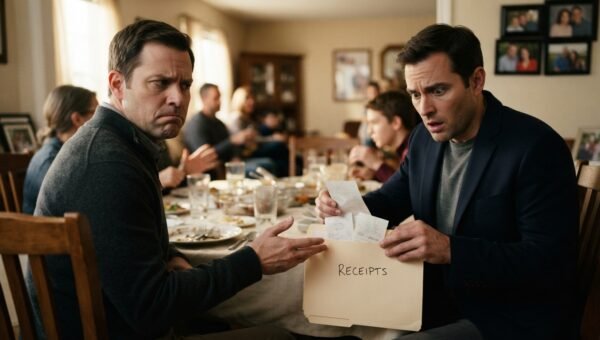
David looked exhausted, his tie pulled loose at the collar. Courtney, on the other hand, had color in her cheeks. Before David could even hand me a cup of water, Courtney tapped her spoon against a glass. The sound was thin, but in a room full of hushed mourners, it cut through everything.
She cleared her throat and smiled. She announced to Harold’s surviving sister, our old neighbors, and our pastor that she and David were expecting their first child.
A gasp went through the room, followed by awkward, hesitant clapping. Within thirty seconds, women who had been wiping tears were crowding around Courtney, touching her stomach and telling her what a blessing it was that life begins just as another life ends. People were smiling, hugging her, and whispering congratulations.
I sat there frozen, still clutching that heavy blue triangle of stars. David stayed beside me for a second, looking down at his shoes with a tight, apologetic grimace, before someone pulled him into a hug. I know people say grief makes folks do strange things. I know life goes on. But the timing felt wrong in my gut, like someone walking into a quiet house and turning on every fluorescent light without asking.
Two months crawled by. I learned how to sleep on only my side of the bed. I cooked smaller meals that left too many leftovers in plastic containers. David checked on me every Sunday afternoon, but Courtney was usually busy or feeling too nauseous to come along.
Then, exactly three months after the funeral, David called me on a Tuesday morning. He was sitting in his truck behind the repair shop, the engine rumbling in the background.
“Mom,” he said. His voice sounded thin, completely stripped of energy. “We had the detailed ultrasound this morning.”
“Is everything alright with the baby?” I asked, setting down my tea.
“Yeah. The baby has ten fingers and ten toes,” he said. Then he paused for a long time. “The doctor moved the due date back, Mom. Way back. Almost six full weeks earlier than what Courtney told me when she took that home test.”
My mind stalled. “Six weeks?”
“He said the measurements aren’t even close to what she estimated. He told us the baby was conceived right around the beginning of December.”
I sat in my kitchen, staring out the window at Harold’s tomato cages rotting in the late winter frost. Harold had spent the entire month of December in home hospice care. The hospital bed had been set up right in the middle of our living room. David had been working seventy hours a week covering night shifts at the garage, trying to save money for their house payments.
Courtney had stopped by our house twice a week during that time, claiming she wanted to bring Harold soup or sit with him so I could run to the pharmacy.
I didn’t say a single word about the math. I kept my voice steady. “What did Courtney say?”
“She got mad at the doctor,” David whispered. “She said ultrasound measurements are off all the time. She said first-time mothers measure big. But he looked at her like she was crazy, Mom. He said at this stage, bone length doesn’t lie by six weeks.”
Two days after that phone call, my doorbell rang. It was Courtney. She had brought a box of lemon cookies from the grocery store bakery. She walked into my kitchen, her small baby bump visible under an oversized knit sweater, and sat down at the table where Harold used to do the crossword.
She chatted about nursery colors for five minutes before leaning across the table. Her eyes were wide and remarkably calm.
“Beverly,” she said softly, “I need a small favor. The OBGYN wants a complete family genetic history because of some early markers on the blood screen. Do you still have Harold’s medical records from the hospice and the clinic?”
“What kind of markers?” I asked.
“Just standard hereditary stuff,” she replied smoothly, waving a manicured hand. “Heart conditions, rare blood disorders. They asked for his official records and any tissue or pathology releases from his oncologist. Can I just borrow the folder? I’ll bring it right back after I drop the copies off at the clinic.”
Harold had died of stage four pancreatic cancer. The oncologist had run dozens of specialized genetic panels before he passed, trying to see if he qualified for an experimental trial, and the lab had kept blood and tissue samples on file with our consent.
I looked at Courtney. She didn’t look nervous. She looked completely focused, the way people look when they are trying to solve an equation before anyone else sees the board.
“The folder is in Harold’s desk drawer,” I told her. “Take whatever the doctors need.”
She hugged me, thanked me three times, and left with Harold’s medical file under her arm.
Six days later, my landline rang at eight in the morning. The caller ID showed the county medical center where Harold had spent his final days.
“Mrs. Beverly Vance?” a woman asked. Her tone was strictly professional, with a sharp edge of administrative caution.
“Yes, speaking.”
“This is the patient records and pathology coordinator at St. Jude Regional. I’m calling to verify an authorization submitted yesterday under your late husband’s estate file. A release form was signed by Courtney Vance, requesting secondary access to Mr. Harold Vance’s preserved oncological tissue samples.”
“She said the doctor needed genetic markers for the baby,” I said, feeling an icy knot tighten in my throat.
“Mrs. Vance, this request wasn’t sent to our medical genetics lab,” the woman said plainly. “The destination listed on the chain-of-custody transfer form is an independent legal paternity testing facility in Chicago. Because Harold Vance’s estate lists you as the sole surviving legal representative and healthcare proxy, we cannot release biological material for non-clinical paternity comparison without your notarized signature. Did you authorize this?”
My breath caught entirely. Harold had been sixty-eight years old when he died. Courtney was thirty-two.
I didn’t answer the coordinator. I told her to put an immediate hold on the file and hung up. My hands were shaking so hard I could barely punch David’s cell phone number.
The phone rang twice. When David answered, his voice wasn’t surprised. It was cracked, broken, and barely louder than a breath.
“Mom,” he whispered, before I could even get the words out of my mouth. “Please don’t hang up on me.”
PART 2
“David,” I said, my voice shaking so hard the receiver rattled against my ear. “The hospital just called me. Your wife is trying to subpoena your father’s preserved tissue for a paternity test. Tell me what in God’s name is happening in your house.”
There was a heavy, suffocating silence on the other end. I could hear the faint sound of his work boots scraping against concrete. He was hiding in the storage bay at the garage.
“Mom, she didn’t sleep with Dad,” David choked out, the words bursting out of him like he had been holding them underwater. “It’s not Dad. It’s… oh God, Mom, please sit down.”
“I am sitting down, David. Speak plainly.”
“She told me on Sunday,” he sobbed, completely losing his composure. “When the doctor moved the date back, I wouldn’t drop it. I demanded to see her phone. We had a blowout fight that lasted until three in the morning. She finally confessed that she had been sleeping with someone else during the winter. But she swore to me that the man she was with was sixty-eight years old, drove a gray truck, and had cancer.”
The air left the kitchen. The refrigerator hummed against the silence.
Harold drove a ten-year-old blue sedan. He hadn’t driven a truck since 2011. But Harold’s younger brother, Kenneth, drove a gray Ford F-150. Kenneth was sixty-six, lived four miles down the county highway, and had been undergoing outpatient treatment for early-stage prostate cancer since last October.
“Kenneth,” I whispered.
“No, Mom, listen to me,” David pleaded, his voice climbing in panic. “Courtney told me it was Dad because she thought Dad was gone and nobody could ever check! She told me Dad gave her money from his savings to keep quiet while you were asleep in the back bedroom! That’s why she asked you for his records. She thought if she ran the lab against Dad’s tissue and it came back negative, she could come back and tell me the whole confession was a lie, that she made it up to hurt me, and that the baby was really mine!”
I stood up from the table. My knees felt entirely detached from my body.
“She lied to you about who she was with, David. But she didn’t lie about someone in this family.”
“She won’t give me the man’s name, Mom,” David cried. “She said if I push her, she’ll leave the state, take the baby, and put my name on the birth certificate anyway, and I’ll be stuck paying child support for a kid that might not even be mine. She said Dad’s dead, so Dad can’t fight it. That’s why she wanted the test. She wanted to prove to herself whether it was Dad or me.”
“It was never your father,” I said, cold fury settling over me like heavy iron. “Your father couldn’t leave that hospice bed by December, David. He could barely lift a spoon to his mouth. Your father loved you more than his own life.”
“Then who was it?” David wept. “Who was in our house?”
“Meet me at my house in twenty minutes,” I told him. “Do not call Courtney. Do not go home. Come to my kitchen.”
When David walked through the back door, he looked twenty pounds lighter than he had at Harold’s funeral. His eyes were sunken and bloodshot, his work shirt smudged with grease. He collapsed into Harold’s chair and buried his face in his hands.
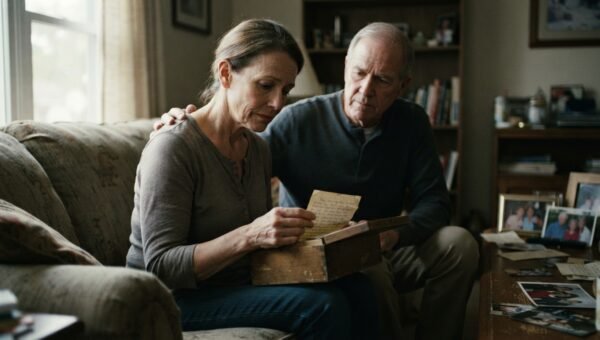
I didn’t offer him tea. I didn’t offer him comfort. I set Harold’s old wooden lockbox on the table and pulled out the legal estate binder.
“Courtney thought she was being clever,” I told my son. “She thought she could use a dead man as a ghost to hide behind. She knew if she named the real man, the whole county would tear her apart. But she doesn’t understand how probate and medical records work. Harold’s tissue belongs to his estate. That means it belongs to me.”
“What are you going to do?” David asked, looking up with terrified eyes.
“We are going to find out whose child she is carrying,” I said. “And then we are going to protect you.”
I picked up the telephone and called the hospital coordinator back. I told her I was coming in person with my son, that I held the power of personal representative for Harold Vance’s estate, and that I wanted an immediate meeting with the hospital’s legal risk officer.
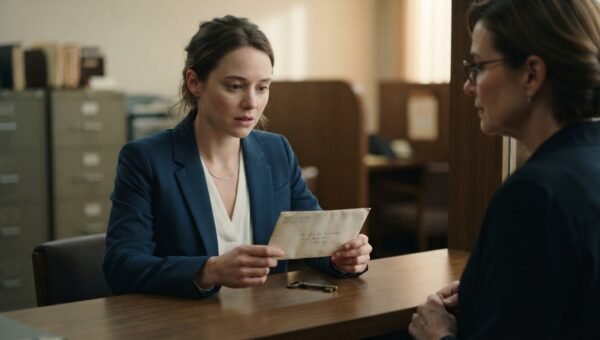
Twenty minutes later, David and I were sitting in a small, windowless conference room on the third floor of the medical center. A hospital attorney named Miller sat across from us with a thick gray folder.
“Mrs. Vance, we flagged this because the paperwork submitted by Courtney Vance had irregular legal authority,” Miller said, looking over his reading glasses. “She submitted a request claiming she was acting on behalf of the deceased’s legal heir. But your late husband’s directives clearly assign sole authority over anatomical specimens and medical history to you.”
“I want to see the paperwork she filed,” I said.
Miller slid a stapled packet across the mahogany table.
Courtney had filled out an application for a private laboratory in Illinois. In the section marked ‘Putative Father Information,’ she had hand-printed: *Harold Vance (Deceased) / Alternate Reference: Paternal Line Relative.*
My eyes locked onto those three words: *Paternal Line Relative.*
Courtney knew exactly what she was doing. She knew the child might not match Harold directly, but she had requested an extended Y-chromosome analysis. A Y-chromosome test doesn’t just show fatherhood; it traces the direct male bloodline. It looks for matching markers shared by brothers, fathers, and sons.
If the test came back showing a high probability of a paternal relationship, Courtney could tell David that the child belonged to his family bloodline, blur the lines between David and Kenneth, and force David to sign the birth certificate out of guilt and confusion.
“She wasn’t trying to rule Harold out,” I said to the attorney, my voice dropping so low David flinched. “She was trying to create an ambiguous match to keep David trapped.”
“Mom, what does that mean?” David asked, his hands trembling on the table.
“It means your uncle Kenneth has been coming to your house when you’re on night shifts,” I said.
David looked at me, his mouth slightly open, the color draining completely from his skin until he looked like paper. “Uncle Kenneth? Mom, no. He helped me rebuild my truck transmission last summer. He gave us five hundred dollars for our wedding.”
“Kenneth drove Harold’s old truck route for twenty years before he retired,” I said. “He knows your schedule at the garage better than anybody. And Kenneth’s wife, Brenda, hasn’t spoken a word to Courtney in six months.”
I turned to the hospital attorney. “If my son provides an official buccal swab right now, can your verified lab compare his DNA directly against Harold’s preserved baseline and determine once and for all if my son shares the exact paternal markers of this family?”
“Yes,” Miller said. “And more importantly, if Courtney Vance attempts to file for paternity or child support through the state after the birth, a court-ordered test between David and the infant will give a definitive yes or no within forty-eight hours. She cannot force an estate match if the surviving legal spouse denies the release.”
I took a pen from my purse. On the hospital’s refusal document, I wrote in large, firm strokes: *Request Denied. Immediate and permanent lock on all biological specimens belonging to Harold Vance.*
Then I looked at my son. “Now we go see your uncle.”
PART 3
We didn’t call ahead. I drove my sedan down the two-lane country road with David sitting in the passenger seat, staring straight out the windshield. His knuckles were white against his denim jeans.
Kenneth lived on a three-acre lot near the creek, in a brick ranch house with a wraparound gravel driveway. His gray F-150 was parked under the carport, right next to a small aluminum boat.
When I pulled up, Kenneth was outside on the porch in a flannel shirt, oiling a hedge trimmer. He was four years younger than Harold, with the same broad shoulders and the same graying widow’s peak, but his eyes were narrower, always shifting like he was waiting for an argument.
He set the trimmer down when he saw my car. He smiled, wiping his greasy hands on an old rag. “Beverly. David. What brings you two out on a Thursday?”
I didn’t wait for David to get out. I slammed my car door and walked straight up the wooden steps of his porch.
“Where is Brenda?” I asked.
Kenneth’s smile faded slightly, replaced by that cautious, guarded look he used whenever the family talked about money. “She’s in town at the grocery store. Why? What’s going on?”
David came up the steps behind me. He didn’t look like a scared boy anymore. The grief and shock had turned into a cold, trembling fury. He stood a full three inches taller than his uncle.
“Courtney tried to steal Dad’s cancer tissue from the hospital this morning,” David said, his voice flat and dead.
Kenneth didn’t blink, but the muscle along his right jawline jumped. He lowered the rag to his side. “What are you talking about, Dave? Why would Courtney do something like that?”
“She told David she slept with a man with cancer who drove a gray truck,” I said, stepping directly into his line of sight. “She tried to pin it on Harold because Harold is buried in the ground and can’t speak for himself. She thought if she ran a test against Harold’s DNA, she could manipulate the paternal line match to force David to raise your baby.”
Kenneth let out a short, harsh bark of a laugh, but it had no humor in it. “You’ve lost your mind, Beverly. You’re grieving Harold and you’re imagining things. I haven’t been near your house since the wake.”
“I didn’t say our house, Kenneth,” David said, stepping closer. “I said my house. The one you came to when I was working twelve-hour shifts on the highway equipment.”
Kenneth backed up half a step until his shoulders hit the porch railing. “Dave, you need to calm down. Courtney is a manipulative girl. Everyone knows she’s high-maintenance. If she’s cheating on you, that’s between you and her, but don’t you dare come on my property throwing filth like that.”
“Then let’s go to the clinic,” I said.
Kenneth stopped talking.
“Right now,” I said, pulling my keys from my pocket. “We’ll call Brenda on her cell phone, tell her to meet us at the lab downtown, and you and David can both take a certified swab. If you’re clean, I will sign Harold’s entire fishing property on the lake over to you by five o’clock today. Free and clear.”
Kenneth’s mouth tightened into a hard, ugly line. The easy, folksy demeanor he had worn his entire life dropped off him like wet clothes.
“She told me she was on the pill,” Kenneth said.
The porch went dead quiet. A blue jay called from the oak tree near the driveway.
David didn’t yell. He didn’t swing. He just looked at his father’s brother, and something inside him seemed to turn to stone.
“She came to my shop in December,” Kenneth muttered, looking down at his boots, refusing to meet David’s eyes. “She said you two were having problems. She said you were working all the time and Harold was dying and she felt alone. It happened twice, Dave. That was it. Twice in the back office. Then she called me in February saying she was pregnant and that she was going to tell Brenda if I didn’t give her ten thousand dollars for medical expenses.”
“Ten thousand dollars,” David repeated, his voice hollow.
“I gave it to her,” Kenneth whispered. “Out of the emergency savings. Brenda still doesn’t know. Then Courtney announced it at the funeral like a damn fool. I told her she was crazy. She told me she had it under control, that she was going to make sure the paperwork cleared David as the father so nobody would ever look at me.”
“She didn’t want to clear David,” I told Kenneth, disgust burning in my throat. “She wanted to test Harold’s DNA so she could prove the baby carried the Vance family Y-chromosome. If David ever doubted her later, she was going to show him a family-line match and tell him it proved he was the father, while holding the truth over your head to keep taking your money.”
Kenneth looked at me then, his eyes small and terrified. “Beverly, please. Brenda will leave me. Half the house is in her father’s name. You can’t tell Brenda.”
I looked at this man who had stood at my husband’s casket, who had hugged me while I wept, who had watched his own nephew grieve, all while paying hush money to the boy’s wife.
“Get in your truck, Kenneth,” David said softly.
“Dave…”
“Get in your truck, go find a lawyer, and tell Brenda yourself,” David said. “Because if my mother doesn’t call her in one hour, I will.”
ENDING
David didn’t go back to the house he shared with Courtney. He came home to my house.
He sat at the kitchen table while I called a divorce attorney who had handled estate matters for the county workers’ union for thirty years. By four that afternoon, David had filed for immediate legal separation, accompanied by an emergency petition for genetic testing to be performed immediately upon the child’s delivery, explicitly barring his name from the birth certificate until certified lab results were filed with the county court.
When Courtney found out, she didn’t cry. She drove to my house, screaming from the driveway, pounding on the front door, threatening to ruin David’s credit and take every dime he had.
I didn’t open the door. I walked to the front window, pulled back the lace curtain, and held up the yellow carbon copy of the hospital’s tissue refusal form. Beside it, I held up Harold’s old pocket tape recorder that Harold had used for his union meetings.
She stopped pounding. She looked at the recorder, looked at my face, and she knew. Kenneth had already broken. There was no secret left to trade.
She left forty minutes later with her mother in a rented pickup truck, taking her clothes and the furniture she had bought on David’s credit card.
The baby was born in late July, a boy. The court-ordered paternity test was executed within forty-eight hours of the birth. The results were conclusive: David was excluded with a zero percent probability. Kenneth Vance was identified as the biological father with a 99.9 percent certainty.
Brenda left Kenneth the week the test results arrived. She filed for divorce after thirty-one years of marriage, forcing the sale of the brick ranch house and the land by the creek. Kenneth now lives in a rented duplex on the south side of town, working past his retirement age to pay court-ordered child support and legal fees.
Courtney moved two counties over to live with her sister. She receives a state-administered check from Kenneth’s pension every month, but she has no hold over David. Not a single cent.
It took David a long time to heal. For the first six months, he lived in his old childhood bedroom. He went to work at dawn, came home in the dark, and spent his weekends out in Harold’s shed, restoring an old 1964 John Deere tractor Harold had never found the time to finish.
Some evenings, I would hear the engine turn over, coughing blue smoke into the twilight before settling into a steady, rhythmic idle.
We don’t talk about that funeral anymore. We don’t talk about Kenneth.
Last Sunday, David came into the kitchen after washing the grease from his arms. He stood near the front hallway where Harold’s folded flag sits inside a glass display case on the sideboard, right beside Harold’s retirement watch.
David reached out and rested his palm against the glass, letting his fingers linger on the wood.
“He would have protected me, wouldn’t he, Mom?” David asked quietly.
“He did protect you,” I told him, drying a plate at the sink. “He left us the truth, David. That was all we ever needed.”