PART 1
For twenty years, my husband, Greg, complained about the battered green metal toolbox sitting on the bottom shelf of our garage workbench. It had belonged to my dad, Arthur, who died of lung cancer two decades ago. The box was heavy, chipped to bare steel along the edges, and smelled permanently of penetrating oil and cedar sawdust.
Greg was an orderly man who kept his tools on magnetic strips and pegboards, labeled with blue painter’s tape.
Every spring cleaning, he would point at Dad’s box and ask the same question.
“Laura, why are we keeping this heap? You don’t use it. Half the sockets are missing, and it takes up three feet of bench space.”
“Because it’s Dad’s,” I always told him.
Dad hadn’t left much. He spent thirty-five years working maintenance at the county water authority, retired with a modest pension that barely covered his treatments, and died leaving me his 1994 pickup, an old recliner, and that heavy steel box.
Last Saturday, we finally began sorting out the garage so we could downsize toward retirement. Greg set a large cardboard box marked “Donation” right next to Dad’s toolbox. He didn’t yell or push. He just set it there and looked at me with tired eyes.
“Laura, please. We have to clear the floor. Let someone at Habitat for Humanity use the tools.”
I looked at the scuffed green lid. I felt guilty for being stubborn for so long.
We were fifty-six years old. We needed to let go of dead weight.
“All right,” I said quietly. “Let me just go through it one last time to make sure there’s no personal hardware I need.”
Greg gave me a small smile, kissed the top of my head, and went inside to make iced tea.
I pulled the box onto the concrete floor and opened the heavy brass latches. The top tray held mismatched wrenches and worn pliers. I set them into the donation box. Underneath was the deep bottom compartment where Dad kept heavy wood chisels and old wooden-handled screwdrivers.
As I lifted the bundle of screwdrivers, my fingers caught on the corner of the galvanized bottom plate. The metal shifted slightly. It wasn’t welded down. It had a small notch cut near the left seam, just big enough for a fingernail.
I pried it up. The sheet metal came loose with a dry pop.
Beneath it was a shallow false bottom, lined with dark green felt. Lying flat against the felt was an official cashier’s check from First Heritage Bank and a folded sheet of yellow legal pad paper.
I picked up the check. My hands felt cold.
The check was made out to Laura Jean Miller, my full legal name. The amount printed in crisp blue banking ink was $48,000. The date stamped across the top was October 14, 2004. Exactly seven days before Dad passed away in hospice care.
I unfolded the yellow paper. Dad’s block printing was unmistakable, written with the blunt ballpoint pens he used to take from the water department front desk.
“Laura,” the note read. “Do not cash this until you know your marriage is safe. If Greg ever makes you feel like you have no place to go, you take this and walk. Love, Dad.”
I stared at the words until they blurred. Dad had never said a harsh word about Greg to my face.
In the early 2000s, Greg and I had been struggling through business debt after his small electrical supply shop hit a dry patch, but I never thought Dad suspected anything worse.
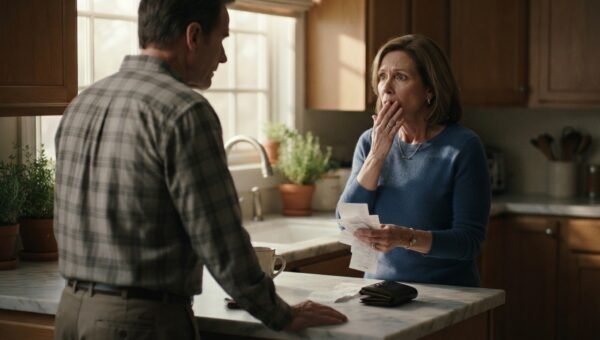
I picked up the check and the note, walked into the kitchen, and laid them both flat on the laminate island right next to the cutting board where Greg was slicing lemons.
“Look at this,” I said, expecting him to be hurt or angry that Dad had doubted him so deeply. “I found it under the screwdrivers.”
Greg wiped his hands on a dish towel and looked down. He saw the check, the dollar amount, and Dad’s handwriting. He didn’t yell. He didn’t gasp. He just stood very still, reading the note twice.
Then he looked at me, turned around without saying a word, and walked out the back door toward the detached shed behind our yard.
Five minutes later, he came back inside holding a faded blue plastic expanding file. He set it on the counter, unhooked the elastic band, and pulled out an old carbon-copy bank statement from First Heritage Bank, dated October 2004.
He pointed his thumb at a line on the middle of the page.
On October 14, 2004, exactly $48,000 had been deposited into Greg’s sole business checking account. The sender line was completely blank. But typed across the memo line in faded gray print was a single phrase:
“For Peanut’s Roof.”
My throat tightened. “Peanut” was the nickname my dad had given me when I was five years old. Nobody else in the world had ever called me that.
PART 2
I looked from the old paper statement to the cashier’s check sitting on the island. The dollar amounts were identical. The dates were identical down to the day.
“Greg,” I said, my voice barely above a whisper. “What is this?”
Greg pulled out a kitchen stool and sat down heavily. He looked older than his fifty-eight years, his shoulders rounded, his hands resting flat on his denim knees.
“I didn’t know Dad left a second check in that box, Laura,” he said. “I swear to God, I had no idea that was in the garage. If I had known, I would have handed it to you twenty years ago.”
“Then why did you want to throw the box away?” I asked. “Every single year you tried to get rid of it.”
“Because every time I looked at that green metal, I felt like a failure,” Greg answered quietly. “It reminded me of the worst two weeks of my entire life.”
I stared at him. “Start from the beginning. You told me back in 2004 that your brother loaned you the money to keep the store afloat.”
“I lied,” he said. “My brother was broke. Everyone was broke.”
He ran a hand over his face, leaving a streak of lemon scent in the air.
In the autumn of 2004, Greg’s electrical shop was forty-five days away from bankruptcy. We had taken out a second mortgage on our starter house on Maple Street. I had been working overtime as a dental receptionist, coming home exhausted, while Dad was deteriorating rapidly in the county hospice wing forty miles away.
Greg told me that on the morning of October 12, nine days before Dad died, Greg had driven to the hospice facility alone during his lunch hour. He hadn’t gone to ask for money. He had gone to sit with Dad so I could rest after working a double shift the night before.
“Dad was awake,” Greg said. “His voice was weak, but his head was clear. He looked at me and said, ‘Greg, you look like a man about to jump off a bridge. What’s wrong with the business?'”
Greg broke down in that hospital room. He admitted to Dad that suppliers had cut his credit line, that our home was on the line, and that he was terrified I was going to end up with no house, no savings, and a ruined future right when my father was dying.
“Dad didn’t get angry,” Greg said, his voice cracking slightly. “He just told me to bring him his legal pad from his bedside drawer. He wrote down the name of an attorney in town and told me to come back the next day at four in the afternoon.”
When Greg returned the following day, Dad handed him a cashier’s check for $48,000, drawn on his personal accounts.
“He told me it was his life savings,” Greg whispered. “He told me he had sold off his late brother’s half of the hunting cabin up north three months earlier, knowing his cancer was terminal. He said, ‘This money is to save Laura’s house. You pay off the second mortgage and the tax lien immediately. If you lose her home, Greg, I will haunt you from the dirt.'”
“Then why did he write that note?” I asked, pointing my finger at the yellow paper on the counter. “Why did he say not to use it until my marriage was safe? Why did he say to take it and walk?”
Greg looked up at me, his eyes wet.
“Because he didn’t give me the money in that toolbox, Laura,” Greg said. “He must have gone to the bank twice. Or he had the attorney prepare two checks.”
“That doesn’t make sense,” I said. “Dad never had ninety-six thousand dollars. His maintenance pension wasn’t big, and the hunting cabin only brought in forty-five thousand total after probate fees when his brother died. I saw the tax return for that sale.”
A strange, hollow silence settled over the kitchen.
If Dad had only received forty-five thousand dollars from the cabin, and had a few thousand in personal savings, where on earth had two separate forty-eight thousand dollar checks come from on the very same day?
PART 3
Greg didn’t try to defend himself or argue. Instead, he reached across the table, picked up the cashier’s check from the toolbox, and flipped it over.
On the back of the check, printed in small light-gray type along the bottom border, was a routing number and a sequential bank serial number ending in 4108.
Greg pulled his 2004 bank statement closer. On the deposit slip receipt stapled behind the statement, the check serial number for the deposit he received was printed: 4107.
They had been issued back-to-back at the teller window. Check 4107 and Check 4108.
“I need to call Warren,” I said.
Warren Hayes had been Dad’s lawyer and his high school friend. Warren had retired ten years ago, but he still lived on Elm Street, three blocks from the town square. He was seventy-nine years old, and he still answered his home phone on the second ring.
I didn’t wait for Greg to answer. I dialed Warren’s number. When he answered, his voice sounded thin and dry, but he remembered Dad immediately.
“Laura,” Warren said after I told him what I had found in the garage. “I wondered if you would ever find that sheet of metal. Arthur made me swear on a stack of Bibles that I would never speak of it unless you brought it to me.”
“Warren, please,” I said, gripping the phone tight against my ear. “Dad didn’t have ninety-six thousand dollars. Did he borrow it? Did he take out a loan against his life insurance?”
Warren let out a long, slow sigh that sounded like paper rustling over the receiver.
“Laura, sit down,” Warren said.
I didn’t sit. I leaned against the counter, watching Greg stare at the salt shaker between his hands.
“Your father didn’t borrow a dime,” Warren told me. “And there was never ninety-six thousand dollars. There was only forty-eight thousand.”
“Warren, I am holding a cashier’s check for forty-eight thousand dollars right now in my kitchen,” I said. “And Greg has a bank statement showing forty-eight thousand dollars deposited into his account twenty years ago. The check numbers are consecutive.”
“Arthur bought one check,” Warren said plainly. “Check forty-one zero seven. That was the real money. He took it straight from his account to save Greg’s business and keep you from losing that roof over your head.”
“Then what is this check in my hand?”
“It’s a voided duplicate,” Warren said. “Arthur had the teller print an administrative re-issue draft because he claimed he had spilled coffee across the first one. When the bank manager handed him the replacement, Arthur slipped both into his coat pocket before anyone noticed, paid the twenty-five dollar lost-instrument bond fee, and walked out.”
The kitchen went dead quiet.
“Why?” I asked. “Why would he do that?”
“Because Arthur was terrified,” Warren answered softly. “He knew he was dying in a matter of days. He loved you more than his own life, Laura. He saw Greg sinking, and he decided to bail him out with every penny he had left in this world. But Arthur was from that old depression-era school of men. He didn’t trust anyone completely when money was on the line. He thought, what if Greg takes this money, pays off his own debts, and leaves my girl with nothing five years down the road?”
I looked at the yellow note again.
“He couldn’t leave you another forty-eight thousand dollars,” Warren continued. “He didn’t have it. So he left you the illusion of an escape hatch. He put that voided draft in the bottom of his old toolbox, wrote that note, and hid it. He told me, ‘Warren, if Greg ever turns out to be a rat, Laura will find that box when she leaves. She’ll walk into the bank with that check. The bank will tell her it was cancelled twenty years ago, but she’ll realize her old man loved her enough to try and leave her an exit. It will give her the courage to stand on her own two feet.'”
I lowered the phone to the island. My eyes burned.
Dad hadn’t distrusted Greg out of malice. He had given Greg his real life savings to keep our home safe, and then, lying alone in a hospital bed with cancer eating through his lungs, he had engineered a fake safety net out of scrap metal, an invalid bank slip, and a piece of yellow paper, just so his daughter would never feel trapped if the man he trusted failed her.
I explained Warren’s words to Greg.
Greg didn’t look angry. He didn’t look relieved. He slowly covered his face with both hands, and his chest hitched once, twice, before he let out a jagged, silent sob.
ENDING
We didn’t donate the toolbox.
That afternoon, Greg carried it back to the garage, set it on the workbench, and wiped down the dark green enamel with a rag soaked in mineral spirits. He didn’t say anything for an hour. He just cleaned every inch of the metal, polished the brass latches until they gleamed, and placed Dad’s heavy wood chisels and screwdrivers back into the bottom compartment.
The cashier’s check and the yellow note are still in the house. I put them in an acid-free sleeve and filed them inside our fireproof safe alongside our mortgage deed and our marriage certificate.
On paper, the check is worth zero dollars. The bank teller told us on Monday morning what Warren had already made clear: Check 4108 was marked cancelled in their system before the sun went down on October 14, 2004. It cannot be negotiated, transferred, or claimed.
Yet every time I look at that blue slip of paper, I see the full measure of who my father was. He was a man who gave away everything he owned to keep his son-in-law from drowning, while simultaneously leaving a phantom life raft behind for his daughter, just in case.
Greg’s business survived that rough patch in 2004. We paid off the second mortgage on the Maple Street house four years later, and we’ve been debt-free for the last seven years. Greg never hid another financial difficulty from me. If a water heater failed or a supplier raised prices, we sat at the kitchen table together and looked at the numbers before bedtime.
Tonight, after dinner, I walked into the garage to get a jar of preserves from the pantry shelves. Greg was standing by the workbench with a cup of black coffee, his hand resting quietly on the worn green handle of Dad’s toolbox.
He didn’t move it to the floor. He didn’t mention donating it.
He just looked over his shoulder at me, gave me that familiar, quiet nod, and left the heavy steel box exactly where it belonged.