PART 1
My knees had never given me trouble until the arthritis finally forced the issue, and the orthopedic surgeon told me flatly that I needed a total knee replacement unless I wanted to spend my sixties in a wheelchair. At sixty-four, living alone in a drafty two-story house with steep wooden stairs, that wasn’t an option. My son, David, and his new wife, Chloe, insisted I come stay with them during my recovery.
Chloe had been all smiles and hospitality when they drove me home from the hospital, telling me not to worry about a single thing, that her newly remodeled kitchen was a dream to cook in, and that I just needed to focus on healing.
For the first three weeks, things were as smooth as they could be under the circumstances. I spent my days moving carefully between the guest room bed and the armchair in the living room, icing my swollen joint and working through the agonizing bending exercises the physical therapist prescribed. I brought very few personal items with me because space in their sleek, minimalist townhouse was tight. But there was one thing I refused to leave behind. It was my mother’s wooden recipe box.
My mother had passed away twelve years ago, and that box was the anchor of my entire childhood. It wasn’t fancy. It was made of simple pine that had darkened to the color of warm honey over decades of kitchen steam, with a faded decal of tulips on the lid that was half-peeled off.
Inside were hundreds of index cards and scraps of paper, all written in my mother’s neat, sloping cursive. Every single card carried a story. There were butter-stained notes for Sunday pot roast, flour-dusted measurements for apple pie, and little pieces of advice she had scribbled in the margins about how to tell when bread dough had risen enough or how to salvage a sauce that had separated.
Because the kitchen counter space was entirely marble and kept completely clear of clutter per Chloe’s strict aesthetic, I kept the recipe box on a small wooden stool right next to the pantry door, safely out of the way of foot traffic. Every time I looked at it, I felt a physical ache of comfort, as if my mother were sitting right across the room with her apron on, telling me everything was going to be fine.
The trouble started on a Tuesday afternoon when David was at work and Chloe was supposedly running errands.
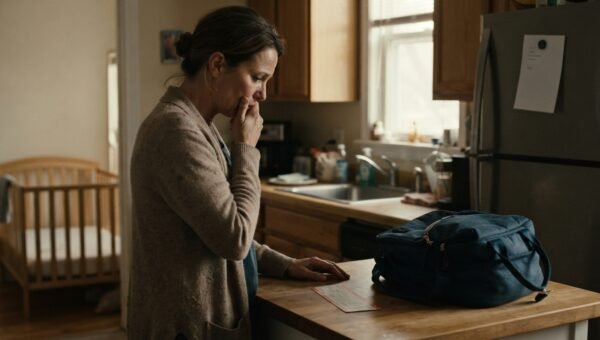
I had just returned home from my grueling physical therapy session, my leg throbbing and my spirit exhausted. I hobbled into the kitchen to grab a glass of water and reach for my pain medication.
I stopped dead in my tracks. The wooden stool by the pantry was bare.
My heart did a strange, heavy flip in my chest. I turned around, looking on the dining table, the kitchen island, and the counter by the coffee maker. Nothing. Panic, cold and sharp, flooded my veins. I called out Chloe’s name, but there was no answer.
When Chloe finally came home an hour later carrying a bag of organic groceries, I confronted her immediately, leaning heavily on my cane.
“Chloe, where is my mother’s recipe box? The wooden one from the stool?”
Chloe paused, setting the grocery bag on the marble island with a soft clatter. She didn’t look guilty; she looked mildly annoyed, as if I had asked her to explain a minor traffic delay.
“Oh, that old thing?” she said, brushing a lock of blonde hair behind her ear. “You mean the splintered wooden box with the peeling stickers?”
“Yes,” I said, my voice rising. “Where is it?”
“I threw it out, Helen,” she said, as casually as if she were talking about yesterday’s newspaper. “It was an absolute eyesore. It completely clashed with the neutral palette of the kitchen. I mean, we spent thousands on this remodel to give it a clean, modern look, and that battered old box sitting right out in the open looked like something you would find at a garage sale. I cleaned off the pantry shelf and tossed it into the recycling bin this morning while you were at therapy. Honestly, I thought you’d be glad to have the floor space back.”
The room seemed to tilt sideways. For a few seconds, I couldn’t breathe.
“You threw it out?” I whispered, the words catching in my dry throat. “That wasn’t just a box, Chloe. Those were my mother’s recipes. Her handwriting. Things that cannot be replaced.”
Chloe crossed her arms, her expression hardening instantly. “Well, you didn’t tell me it was a sacred artifact, Helen. It just looked like a mess of old, greasy paper and scraps of cardboard. Really, who keeps dirty paper from the nineteen-seventies? David can just buy you a nice new modern recipe organizer online, or better yet, you can put everything on an iPad app. It’s so much more sanitary.”
Just then, the front door opened, and David walked in, carrying his briefcase. He took one look at our flushed faces and froze.
“What’s going on?” he asked, looking between us.
“Your wife just threw away my mother’s recipe box,” I said, tears finally spilling hot and fast down my cheeks. “Everything my mother wrote down, gone.”
David looked at Chloe, then back at me, looking deeply uncomfortable. He rubbed the back of his neck, shifting his weight from one foot to the other. “Mom, look, I know you’re upset, and Chloe probably should have asked first, but… she’s right about the kitchen. It didn’t really fit in with their design style. And look on the bright side, it was just a bunch of old recipes. I’ll order you a brand-new leather-bound recipe book tonight, and we can sit down and type out some standard recipes from the internet. It’ll be fun.”
I stared at my son, realizing in that exact moment that he had no idea who I was anymore, or what my life had meant before he married into this sterile, modern world.
“It wasn’t about standard recipes, David,” I said, my voice shaking with a mixture of grief and pure fury. “It was about her hands. Her voice. You let her throw away my history.”
Without another word, I turned around, ignoring the sharp stab of pain in my healing knee, and made my way back to the guest room. I locked the door behind me and sat on the edge of the bed, shaking. They thought it was garbage. To them, it was just clutter to be swept away. But I knew the trash truck hadn’t come yet; pickup wasn’t until Wednesday morning. If the bins were still out by the curb, maybe, just maybe, I could get down there and find it before it was crushed forever.
PART 2
The sun hadn’t even fully cleared the horizon when I crept out of the guest room the next morning. My knee throbbed a fierce, angry protest with every step I took, but adrenaline and sheer desperation kept me moving. I grabbed my cane and slipped out the front door into the chilly morning air.
The large green municipal recycling bins were still lined up along the curb at the end of the driveway, waiting for the sanitation truck. The neighborhood was dead silent except for the distant hum of morning traffic on the highway.
My heart sank the moment I lifted the heavy plastic lid of the first bin. It was packed to the brim with flattened Amazon boxes, plastic milk jugs, shiny glossy magazines, and mailers. I swallowed hard, took a deep breath, and reached my hands down into the dark, cold cavity.
For nearly twenty minutes, I stood there on the pavement, pulling out bags and cardboard, stacking them neatly on the grass behind me. My fingers brushed against damp coffee grounds, crushed soda cans, and shredded office paper. My back ached, and sweat beaded on my forehead, but I kept digging. I checked the second bin, then the third. Nothing. Just household waste and packaging.
Desperation clawed at my throat. Had the box already been emptied? Had someone else taken it? Or worse, had Chloe put it deep at the bottom of a sealed trash bag instead of the recycling?
Just as I was about to give up, my hands aching and my knees trembling from the strain, a municipal recycling truck pulled slowly down the street, its yellow lights flashing. Panic surged through me. If the workers saw me rummaging through the bins, or worse, if they emptied them right now, everything would be lost.
A man in a high-visibility vest hopped down from the passenger side of the truck. He looked at me standing by the curb, surrounded by a pile of cardboard and plastic, leaning heavily on my cane with tear-streaked cheeks. He didn’t look angry; he looked concerned.
“Morning, ma’am,” he said, walking over. “You looking for something specific? We’re about to empty these.”
“Please,” I choked out, tears spilling over again. “My daughter-in-law accidentally threw out a wooden box yesterday morning. It had index cards in it. My mother’s recipes. It should be in one of these bins.”
The worker, whose nametag read Marcus, looked at the open bins, then back at the mess I had made on the grass. He didn’t hesitate. He rolled up his sleeves, grabbed a pair of thick leather gloves from his belt, and went right to work.
“Step back, ma’am, let me handle this,” he said kindly. “Let’s see what we’ve got down at the bottom.”
For almost forty-five minutes, Marcus and I tore through the remaining bags. He ripped open tied plastic sacks and sifted through soggy junk mail. I watched anxiously, praying to see the familiar honey-colored wood of the box or the faded tulip decal.
We never found the box.
As Marcus tossed aside the last flattened cereal carton at the very bottom of the final bin, he shook his head apologetically. “I’m so sorry, ma’am. There’s nothing else in here. It must have gotten crushed or thrown out earlier, or maybe it ended up in a different bin down the block.”
I stood there, completely numb, staring at the empty bottom of the plastic bin. The realization washed over me like freezing water. It was truly gone. My mother’s handwriting, the butter stains, the little marginal notes—all turned into trash and hauled away.
“Thank you, Marcus,” I whispered, my voice hollow. “I appreciate your help more than you know.”
He nodded sympathetically, tossed the last piece of cardboard back into the bin, and turned to walk toward his truck.
That was when I saw it.
PART 3
As Marcus had tossed the flattened cereal carton back toward the bin, the box caught the edge of the rim and flipped over, landing face-up on the grass near my feet. Stuck firmly to the back of the gray cardboard, held in place by a strip of clear packing tape that had fused it to the cereal box, was a single, thick index card.
My breath caught. I dropped my cane, ignoring the sharp pain as I half-fell, half-knelt onto the damp grass, and pulled at the card. It peeled away from the tape with a faint tearing sound.
I flipped it over.
There, looking up at me in the unmistakable, neat, sloping cursive of my mother, was a recipe for something called “Sunday Lemon Cake.” But it wasn’t the ingredients that made my hands shake so hard I could barely hold the paper.
Right across the bottom of the card, written in dark, heavy ink with an exclamation point at the end, was an address located just three towns over, followed by a sentence that made the blood freeze in my veins:
“For Ellen only, after I’m gone.”
I sat frozen on the grass for a long moment, the cool morning breeze chilling the sweat on my neck. Ellen. That was my name. But I had never seen this address before in my life. My mother had lived in her modest suburban home for forty years, and before that, her childhood home two states away. What was this third address? And why had she hidden this specific card away, taped to the back of something, as if waiting for the exact moment the box was destroyed and I was forced to look among the ruins?
My mind raced. My mother had always been a quiet woman, fiercely private, keeping secrets close to her chest. In her final years, she had grown increasingly protective of a small lockbox she kept in her closet, one that David and I had assumed contained only her insurance papers and meager savings after she passed.
I clutched the card tightly against my chest, pushed myself up from the grass using my cane, and limped back toward the house.
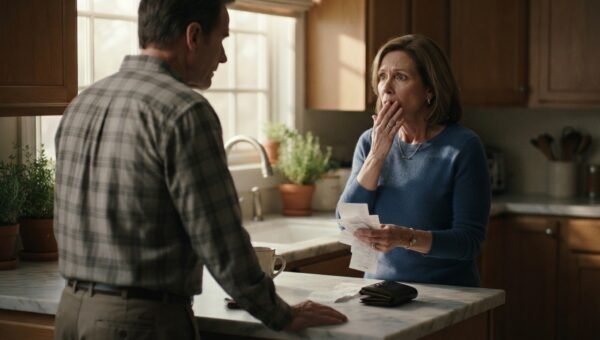
David was in the kitchen pouring himself a cup of coffee when I walked in, looking flushed and determined. He took one look at me and sighed, clearly expecting another argument about the trash.
“Mom, please, let it go,” David said, leaning against the counter. “I’ll order a replacement book today, I promise. Chloe feels bad about the misunderstanding, even if she didn’t mean to—”
“Quiet, David,” I said, my voice cutting through the room with a cold, absolute authority that made him stop dead in his tracks.
I placed the index card flat on the marble island right in front of him.
David blinked, looking down at the yellowed paper, then up at me. “What is this? A grocery list?”
“Look at the handwriting,” I said. “And look at the bottom.”
David squinted, leaning down. As his eyes tracked across my mother’s cursive, the color slowly drained from his face. He read the address, then read the final line out loud: “For Ellen only, after I’m gone.”
He looked up at me, his eyes wide and confused. “Mom… what is this? What address is this? I’ve never seen this handwriting before. Wait, yes I have. That’s Grandma’s writing. But what is this place?”
“I don’t know,” I said honestly. “And Chloe threw away the rest of the box before I could find any other cards like it. But this one survived because it was stuck to the bottom of a carton in the recycling bin. Your wife tried to erase my mother from my life, David, and instead, she handed me a mystery my mother kept from me my entire life.”
Just then, footsteps sounded on the stairs, and Chloe walked into the kitchen wearing a silk robe, holding her own mug. She took one look at our tense expressions and rolled her eyes.
“Are we still talking about that old box?” she asked, pouring coffee. “Helen, seriously, you’re making a mountain out of a molehill. It was trash.”
“It wasn’t trash, Chloe,” I said, looking straight into her eyes without a hint of fear or weakness. “It was a map.”
ENDING
We didn’t wait. Within the hour, despite the pain in my knee and Chloe’s protests that we were being ridiculous, David drove me out to the address on the card.
It wasn’t a business, and it wasn’t an abandoned lot. It was a modest, impeccably kept brick cottage tucked away on a quiet residential street in an older neighborhood three towns over, surrounded by blooming hydrangea bushes. A small wooden sign by the front door read: *The Martha House – Archive & Historical Preservation.*
When we stepped inside, greeted by the gentle scent of old paper and beeswax, an elderly woman with silver hair tied back in a neat bun looked up from her desk. She smiled warmly, but the moment her eyes locked onto my face, her smile faltered. She stood up so fast her chair scraped loudly against the linoleum floor.
“Good heavens,” the woman whispered, staring at me as if she were seeing a ghost. “You have Margaret’s eyes. You must be Ellen.”
I pulled the index card from my pocket and laid it gently on the desk. “I am. Can you tell me what this place is? And why my mother left this address for me?”
The woman walked around the desk, picked up the card, and traced her finger gently over my mother’s handwriting. A soft, knowing smile touched her lips.
“Your mother was a remarkable woman, Ellen,” the archivist said softly, gesturing for us to sit down in two armchairs by the window. “For over thirty years, long before she retired, she worked tirelessly behind the scenes to secure funding, documentation, and historical protection for displaced families and women left with nothing after domestic crises—women who had their lives, their property, and their histories erased by unfeeling relatives.”
David shifted uncomfortably in his seat beside me, glancing between the archivist and me.
“And this house?” David asked, his voice tighter than before.
“This house,” the archivist said, looking directly at David before turning back to me, “contains your mother’s personal files. Not just recipes, though she loved baking more than anything. It contains records, deeds, and legal protections she set up to ensure that vulnerable family members—mothers and daughters who trusted the wrong people—could never be locked out of their own legacies. She knew, somehow, that someone would try to take your history away one day, Ellen. She told me years ago that if her box was ever destroyed, the truth would find its way out through the one piece they couldn’t burn or throw away.”
I sat back in the armchair, the weight of the last twenty-four hours finally lifting from my shoulders. The grief over the lost recipe box didn’t vanish entirely, but it was replaced by something much stronger: a profound, burning wave of vindication and pride. My mother hadn’t just left me recipes for dinner. She had left me a blueprint for survival, hidden in plain sight among the flour and sugar.
When David and I drove back to the townhouse that afternoon, the silence in the car was heavy and thick. Chloe was waiting for us in the kitchen, arms crossed, ready to demand an apology for our absence.
Before she could open her mouth, David held up his hand, his expression pale, hardened, and resolute in a way I had never seen before.
“Chloe,” David said, his voice steady. “Pack your things. We’re going to talk about what you threw away, and then we’re going to help Mom move back into her house—on her terms, with her dignity fully intact.”
I didn’t say a word. I reached into my pocket, touched the rough edges of the single surviving index card, and smiled. My mother’s voice wasn’t gone. It was louder than ever.