PART 1
I stood by my mailbox in the freezing wind, holding a red construction paper envelope.
My six-year-old son, Toby, had printed my name across the front in wobbly green crayon. In the upper corner, his first-grade teacher, Mrs. Albright, had written a small note on school stationery: “Toby wanted this sent directly home today. Please read it tonight.”
I thought it was going to be sweet. At six, Toby lived for Legos, blue police cars, and the idea of getting a real two-wheel bicycle with handbrakes.
I smiled a little, walking up the porch steps, shaking the snow off my boots. I had just finished an eight-hour shift filing invoices at the county water board. I made $34,000 a year, and every single dime was accounted for three weeks before it ever hit my checking account. Rent on our duplex was $1,150. Toby’s after-school care took another $400. Food, heating oil, and an aging sedan took the rest. Christmas was always tight, but I had saved two twenty-dollar bills in an envelope behind the flour canister to buy him the Lego rescue station he had pointed out in the grocery store flyer.
Inside the warm hallway, I took off my coat and sat on the bench. I carefully unsealed the red paper.
Inside was a single page of lined school paper. Toby’s large, uneven handwriting filled the lines.
“Dear Santa,
I don’t want toys. I want my mom to stop crying at night.
I want the man who yells at her to go away. He broke the kitchen table. He says bad words. Mommy says it’s our secret. But I don’t like secrets.”
My breath stopped in my throat. My hands began to shake so hard that the paper rustled against my fingers.
I read the lines three times. Each word felt like a physical slap against my chest.
The man Toby wrote about was Greg. We had been dating for fourteen months, and four months ago, Greg had moved his clothes and his heavy oak dresser into our two-bedroom rental. At the time, it had felt like relief. He worked as a mechanic down on Route 4, and he promised he would help split the rent and keep the furnace going through the winter. He told me I worked too hard. He told me I was doing everything alone, and that Toby needed a strong presence in the house.
I wanted so badly to believe him. Being a single mother on thirty-four thousand dollars makes you tired down in your bones. You look at a leaky faucet or a grocery bill that came out twenty dollars over budget, and you feel entirely defenseless. So when Greg stepped in, paid half the heating deposit, and carried Toby on his shoulders at the fall fair, I thought I had finally found steady ground.
Then came the edge. It started with small criticisms about how I raised Toby, then how I cooked the pork chops, then how I spent money on fruit snacks instead of bulk oats. Then the drinking crept into the late evenings. Two weeks before Thanksgiving, after Toby was supposedly asleep in the back room, Greg had slammed his heavy work boot down during an argument over my car insurance bill and shoved our cheap laminate kitchen table so violently against the wall that one corner cracked clean off the particle board.
I had dropped to the floor, cleaning up spilled tea, sobbing into a dish towel. When Toby crept out of his bedroom, his eyes wide as saucers, I had forced a terrible, lying smile. I knelt down, wiped my face, and told him Mommy was just clumsy. I told him Greg was only trying to fix the leg. I told him, “It’s just our secret, honey. Big boys don’t worry about grown-up accidents.”
I thought I was shielding him. I thought if I kept my voice low and cried into my pillow after Greg fell asleep on the couch, Toby wouldn’t carry the weight.
My phone rang in my pocket. The sudden vibration made me flinch.
The caller ID showed the elementary school’s main line.
I pressed the screen and brought the phone to my ear. “Hello?”
“Mrs. Walker?” It was Mrs. Albright. Her voice was quiet, completely stripped of the bright, cheerful tone she used during parent-teacher conferences. “Did you receive the letter Toby wrote?”
“Yes,” I managed to say. My throat felt like sandpaper. “Mrs. Albright, I’m… I’m so sorry you had to read that. It was just an argument, an accident with a chair. It’s not what it sounds like.”
“Ellen,” she interrupted gently, using my first name for the first time since Toby entered her classroom. “I read the letter before I put it in the mail. As a teacher, I am a mandated reporter. I am legally required to file a report with child protective services by the end of the day.”
The floor seemed to drop out from beneath my boots. “Please,” I choked out. “Don’t do that. They’ll take him. I do everything for him. I swear to you, no one has laid a hand on Toby. Never.”
Mrs. Albright paused. The silence on the line stretched out, heavy and cold.
“I believe you love your son, Ellen,” she said softly. “And I know you haven’t hurt him. But when I asked Toby why he didn’t want any toys this year, he didn’t just mention the table. He said, ‘The man told me if I tell anyone, he’ll make Mommy go away and never come back.'”
PART 2
The room seemed to tilt around me.
“What did you say?” My voice was barely a whisper.
“Toby told me that yesterday morning during recess,” Mrs. Albright said, her voice steady but deeply sorrowful. “He was sitting alone by the fence. When I sat down with him, he told me he had to make sure Santa knew, because if he told a teacher or a police officer, Greg said you would disappear. Ellen, a six-year-old child should not be carrying terror like that in his chest.”
Tears spilled over my cheeks, hot and bitter, running down into the corners of my mouth. “Greg told him that?”
“Yes. And because an explicit threat was made to a child in the home, the school social worker has already contacted the county caseworker. Someone will be visiting your home tomorrow morning at nine o’clock. If they determine the environment is an immediate threat to Toby’s safety, they have the authority to place him in emergency foster care.”
Emergency foster care. The words hit me like a physical blow.
“Thank you for calling me, Mrs. Albright,” I said. My voice was suddenly clear, the shaking gone, replaced by a cold, desperate clarity.
“I called because I know how hard you work for him, Ellen,” she said quietly. “Toby comes to school clean, his homework is always done, and he loves you more than anything in this world. But you have less than twenty-four hours to show the county that his home is safe.”
“I understand,” I said, and hung up.
I stood up from the bench. I looked down at the letter in my hands.
For months, I had convinced myself that I stayed because I couldn’t afford to be alone. I had told myself that thirty-four thousand dollars wasn’t enough to survive on in this town, that having someone pay three hundred dollars toward groceries and five hundred toward rent was the only thing keeping a roof over our heads. I had swallowed Greg’s temper, his cold silences, his sudden bursts of fury, telling myself it was the price of survival. I had made excuses for the cracked table, the dent in the hallway drywall, the way Greg spoke to me like I was an employee who kept failing him.
I thought I was sacrificing my pride to give Toby a warm house.
Instead, I had allowed a bully to poison my son’s mind with fear. Greg had looked into my six-year-old boy’s face and threatened to erase his mother just to keep himself comfortable on our couch.
I looked at the clock on the kitchen wall. It was 4:15. Greg worked at the garage until 6:30. Toby was at the community center’s after-school program until 5:30.
I had one hour alone in the house.
I didn’t sit down. I didn’t cry. I went straight to the hall closet and pulled out two large plastic storage bins and my old canvas duffel bag.
I walked into the bedroom. Greg’s clothes hung in the closet, his steel-toed boots sat in the corner, and his heavy work coats were draped over the chair. I grabbed every single hanger, pulled his shirts and jackets down in armfuls, and shoved them into the plastic bins. I opened the dresser drawers and dumped his work jeans, his socks, his underwear, and his belts right on top.
I went into the bathroom. I swept his shaving kit, his hair clippers, his cologne, and his medicine into a cardboard box from the pantry.
I carried the bins and the box down the hallway, pushed open the front door, and hauled them out onto the covered porch. I stacked them neatly against the exterior railing, beneath the overhang so the falling snow wouldn’t ruin his clothes.
Then I walked back inside, took my keys from my purse, and walked over to our utility drawer. Two years ago, when I moved into the duplex, the landlord had given me a spare deadbolt cylinder after the previous tenant left. I had never bothered to install it because the existing lock worked fine.
I grabbed my Phillips-head screwdriver. My father had taught me how to work on basic household hardware when I was a teenager. My hands were completely steady now. I unscrewed the two long brass screws holding the interior deadbolt plate, slid the cylinder out, and fitted the new lock into the bore hole. I tightened the screws until they were flush against the wood, tested the new key from the inside, and listened to the heavy click of the bolt throwing home.
It was 5:10.
I put on my winter coat, locked the new door behind me, and drove three blocks down the street to the community center.
When Toby saw me walk through the double doors of the gymnasium, his face lit up. He was wearing his faded navy blue sweatshirt, his knees dusty from playing with wooden blocks on the rug. He grabbed his small backpack and ran across the gym floor, throwing his arms around my waist.
I dropped to my knees right there on the gym floor and wrapped my arms around him. I pressed my face into the crook of his neck, breathing in the scent of peanut butter, chalk dust, and little-boy sweat.
“Mommy?” he whispered, his small fingers catching in my hair. “Are you mad at me?”
“No, baby,” I said, pulling back to look directly into his brown eyes. “Why would I ever be mad at you?”
“My letter,” he whispered, looking down at his sneakers. “Mrs. Albright said she had to read it. I didn’t want to get you in trouble. I just… I wanted Santa to make him leave.”
“You did the bravest thing anyone has ever done,” I said, my voice thick. “You told the truth. And nobody is ever going to make Mommy go away. Do you hear me? Nobody.”
PART 3
We got home at 5:45. I brought Toby inside, turned on the heat, and set him up at the living room rug with his coloring books and his favorite blanket.
At 6:20, the glare of headlights swept across the living room window. A truck door slammed outside.
I heard Greg’s heavy boots crunching on the icy gravel of the driveway. Then I heard him stop on the porch. There was a long moment of quiet as he took in the plastic bins and the cardboard box stacked by the railing.
Then came the jiggle of a key in the lock. It didn’t turn.
He tried again, rattling the knob violently. Then he pounded his fist against the wood.
“Ellen! Open the door. The lock is jammed.”
I looked over at Toby. His small body had gone rigid on the floor, his crayon paused over the paper.
“Stay right here, honey,” I said quietly. “Keep coloring. It’s okay.”
I walked to the front door. I didn’t unlock the deadbolt. I pulled back the small brass viewing plate and spoke through the wood.
“The lock isn’t jammed, Greg. I changed it.”
There was a short silence. Then Greg’s voice came through, lower this time, tight with irritated authority. “What are you talking about? Open the door, Ellen. It’s twenty degrees out here. Stop playing games.”
“Your clothes are in the bins on the porch,” I said, my voice level and cold. “Your tools from the hall closet are in the box. Everything that belongs to you is packed.”
“Are you out of your mind?” His voice rose, sharp and angry. He kicked the base of the door with his work boot. “You can’t lock me out of my own house! My name isn’t on the lease, but I pay bills here. Open the damn door before I break it off the hinges.”
“You don’t own this house, Greg. The lease is entirely in my name. The utility bills are in my name. You are a guest, and you have no legal residency here.” I paused, letting the cold reality settle between us. “And if you touch that door again, I will dial 911.”
“For what? For an argument? The cops don’t care about a couple fighting!”
“They care about a grown man telling a six-year-old child that if he speaks up, his mother will disappear,” I said.
The silence on the other side of the door was instant.
“Who told you that?” he muttered, his voice losing its edge, shifting into a defensive, guilty mutter. “The kid is making stuff up. You know how he is. He exaggerates everything.”
“He wrote it in his letter to Santa, Greg. His teacher read it. The school social worker already filed a mandatory report with child protective services. There is a county caseworker coming to this door tomorrow morning at nine o’clock.”
I heard him shift his weight on the porch boards. The bravado had completely vanished from his voice. In our county, a child welfare investigation with local police involvement was the quickest way for a local mechanic to lose his standing at the shop.
“Ellen, listen,” he said, trying to soften his tone, trying to slip back into the reasonable voice he used when he wanted to smooth things over. “I was just trying to keep him from blabbing about the table. You know how people gossip in this town. I was angry, I said something stupid. I didn’t mean it like that. Let me inside so we can talk like adults.”
“No,” I said. “We will never talk again.”
“You can’t afford this place without me,” he said, the ugly spite returning to his voice. “You make thirty-four grand, Ellen. You can’t pay the rent and heat by yourself. You’ll be broke in two months.”
“Then I’ll be broke,” I said. “Take your bins, Greg. If you’re still on this porch in five minutes, the police will be here to escort you off.”
I closed the brass peep plate.
I stood in the entryway, watching the shadow beneath the door. For nearly two full minutes, he didn’t move. Then I heard him curse under his breath, drag the heavy plastic bins across the porch floor, and heave them into the bed of his pickup truck. The engine turned over, the transmission clunked into reverse, and the red taillights faded down the street.
ENDING
The house was completely still.
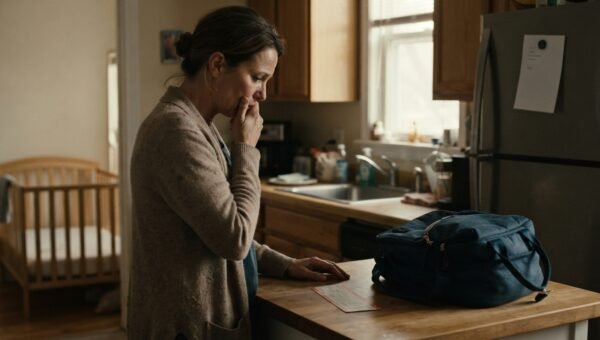
I walked into the kitchen. The cheap laminate table still had its cracked corner, the raw particle board exposed where Greg had shoved it two weeks before. I took a roll of wide gray duct tape from the utility drawer, pulled off three neat strips, and wrapped the damaged corner tight. It didn’t look pretty, but it was sturdy. It wasn’t going to fall.
The next morning at 8:55, a knock came at the door.
A woman in a navy wool coat and winter boots stood on the porch, carrying a brown leather folder.
“Mrs. Walker? I’m Sarah Miller from the Department of Child and Family Services.”
“Please come in,” I said.
She stepped inside, wiping her boots on the rug. The house was clean and warm. The kitchen smelled of oatmeal and cinnamon. On the kitchen counter, I had neatly laid out our lease agreement with only my name on the signature line, the receipt from the hardware store showing the new deadbolt purchased the night before, and my two most recent paystubs from the water board.
Ms. Miller sat down at the taped kitchen table. She looked at the papers, then looked at me.
“Mrs. Albright notified our intake office yesterday afternoon,” Ms. Miller said. “She explained what Toby disclosed at school.”
“He was telling the truth,” I said honestly. “I was foolish, Ms. Miller. I let myself believe that having another adult in the house to help with bills was worth putting up with anger. I thought I was hiding it from Toby. I thought if I kept quiet, my son wouldn’t be hurt. But Greg threatened my boy, and he threatened me through him.”
I pointed to the papers. “Greg was packed and off this property by 6:30 last night. The locks are changed. He has no key, he has no property here, and he is not allowed near my child. I don’t care if I have to work a second job cleaning offices at night. He will never step foot through that door again.”
Ms. Miller spent twenty minutes talking with Toby in the living room. Toby showed her his drawings, his blue police cars, and the new lock on the front door that Mommy had put on herself.
When she stood up to leave, she handed me her card.
“You did the right thing, Ellen,” she said softly at the door. “Many parents defend the partner. They make excuses until something terrible happens. You protected your child. We will keep an open file for thirty days for standard check-ins, but as long as that man remains out of your home, Toby is safe with you.”
After she left, the silence in the duplex felt different. It didn’t feel heavy or tense anymore. It felt clean.
That afternoon, after Toby went to sleep, I sat down at the taped kitchen table with my ledger.
Thirty-four thousand dollars a year meant approximately twenty-two hundred dollars a month after taxes. Rent was eleven-fifty. Child care was four hundred. Utilities were two hundred. That left four hundred and fifty dollars for groceries, gas, and emergencies. It was razor thin. There would be no restaurant meals, no store-bought coffee, and every gallon of heating oil would have to be measured carefully.
I might have to take weekend cleaning shifts at the medical clinic downtown. It would be hard. I would be tired.
But nobody was yelling in the kitchen. Nobody was breaking furniture. And nobody was making my little boy carry terrifying secrets in his heart.
I walked over to the flour canister, reached behind it, and pulled out the envelope with the two twenty-dollar bills. I had originally planned to save them for January’s electric bill.
Instead, I put on my coat and drove down to the local hardware store. I bought a small set of wooden shelf brackets, four screws, and a small pine board. That evening, Toby and I took off the broken laminate table leg, measured the pine board, and screwed a new, solid wooden support directly into the frame.
When we were done, Toby pushed down on the table with both hands. It didn’t wobble. It didn’t creak.
“Look, Mommy,” he said, smiling up at me. “It’s strong now.”
“Yes, baby,” I told him, smoothing down his hair. “It’s strong now.”