PART 1
My son’s wife told me in my own kitchen that I could no longer take seven-year-old Lily to Sunday service.
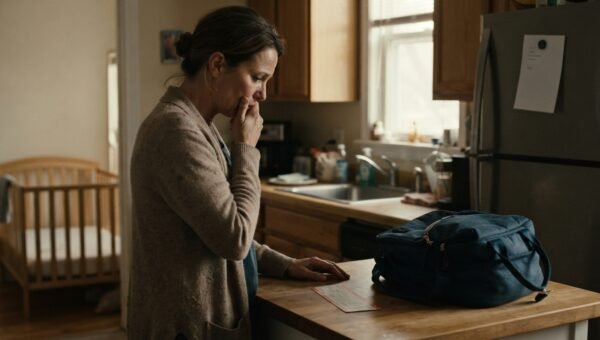
Brianna sat at my small kitchen table with her hands wrapped around an empty mug. She did not raise her voice. She said she and David had talked it over, and they wanted Lily to grow up without outside pressure so she could choose what she believed for herself later.
David stood over by the counter, looking down at his work boots. He was thirty-two then, a contractor with dirt permanently lined in the cracks of his knuckles, and he had stopped going to church when he was seventeen. I had never pushed him. I never made a show of my faith. Sunday school, the children’s choir, the ten-minute drive home with a box of cinnamon donuts on the front seat: that had been our quiet routine for three years.
“I don’t think it’s fair,” I said. “Lily loves the music. She likes seeing the other kids.”
“It’s about boundaries, Evelyn,” Brianna said. “We want her Sundays free. We’re asking you to respect that.”
I swallowed the knot in my throat and nodded. I did not want an argument that would cost me seeing my granddaughter altogether. If they wanted her Sundays open, I would give them Sundays. I stepped back.
Months went by. I saw Lily on occasional Saturdays, or for a couple of hours after school when David had a late job pouring concrete. I never mentioned the chapel. I never brought up the choir.
Then came a Saturday in late October.
David had dropped Lily off at my house while he ran across town to pick up lumber. We were sitting on the living room rug putting together a five-hundred-piece jigsaw puzzle of a harbor town. Lily was quiet for a long stretch, snapping blue water pieces into place, before she looked up at me with her head tilted.
“Grammy?” she asked.
“Yes, sweetie?”
“Why did we stop going to see the lady downstairs?”
I kept my hand on the cardboard puzzle edge. “What lady downstairs?”
“The lady at the church,” Lily said, like I was being silly for asking. “After we sang the songs, we always went down the little outside stairs to the basement apartment.
Remember? She gave me lemon cookies with the yellow sugar on top.”
The room seemed to go very flat.
“Lily,” I said gently, sitting back on my heels. “We never visited an apartment. We went straight from Sunday school to the bakery down on Fourth Street.”
“No,” Lily insisted, her forehead bunching up the way David’s used to when someone told him he was wrong. “We went to the door with the green paint chipping off. Every Sunday. She wore that fluffy red sweater and smelled like peppermint lotion, and you two would sit on the couch and talk about the hospital while I ate the cookies.”
My chest tightened. I knew our church building down to every coat of paint. Grace Fellowship was a single-level brick building constructed in the late 1970s. It had no basement. It had no outside stairs. It had never had an apartment.
“Honey, you’re dreaming that up,” I said, trying to smile. “Or maybe it was something from preschool?”
“It wasn’t preschool,” Lily said. She stood up, marched over to my purse on the console table, and pulled out my old phone.
It was an older Android model I had kept in my bag for two years before finally upgrading that summer, mostly because I hadn’t moved all my old pictures off it yet. “You took pictures of me on the stairs. You told me to smile by the iron railing.”
My hands shook a little as I unlocked the old screen and opened the gallery.
I scrolled backward past Thanksgiving dinners, school concerts, and garden photos from two years ago. Most of the church pictures were what I remembered: Lily in her denim jumper, Lily holding a paper palm branch on Palm Sunday.
Then I reached the photos from late March of that year.
There was a photo of Lily standing at the bottom of a concrete stairwell, holding a plastic container of lemon cookies, grinning up at the camera. Behind her was a weathered green door with a brass number 2 tacked crookedly to the wood.
I had never seen that door in my life.
I swiped again. The next photo was taken inside a small, dimly lit living room with low drop-ceiling tiles. On a faded brown sofa sat an elderly woman with silver hair pulled into a loose comb. She was wearing a thick red knit sweater. Her hands were spotted and resting on a black walking cane.
Next to her, sitting close on the worn brown cushions, with one arm wrapped around the old woman’s shoulders, was me.
I was smiling into the lens. My face looked completely calm, completely familiar, wearing the exact gray wool coat I wore to church every single winter.
I felt sick to my stomach. I turned the phone over in my palm, my mind scrambling to make sense of what I was looking at. I had zero memory of that room. None. I had never had lapses in memory. I managed my own bills, drove my own car, kept books for the local hardware shop three mornings a week.
Then I remembered the small plastic envelope of physical prints sitting in the sideboard drawer. Back in May, I had used the automated kiosk at the grocery store to print forty family pictures to put in an album.
I left Lily in the living room and walked into the dining area. My legs felt stiff. I opened the sideboard, pulled out the glossy envelope, and flipped through the stack until I found the 4×6 print of that basement room.
I turned the photograph over.
There, written in blue ballpoint ink, in my own unmistakable handwriting, was a single line:
*Mom, age 87.*
My mother died of cancer in the county hospital when I was twenty-three years old. I helped choose her casket. I attended her burial in 1982.
PART 2
I stood by the sideboard with the glossy photograph between my fingers. My handwriting was distinct. The capital M looped twice at the crest, the way Sister Mary Aloysius had made us write in fifth grade, and the ink had faded slightly where my wrist must have dragged across the paper.
I stared at the picture of the woman in the red sweater.
Her jawline was sharp. Her eyes were deep-set beneath thin gray brows, and she had an earlobe crease on the right side. My mother, Margaret, had died in room 314 of St. Joseph’s Infirmary forty-two years earlier. My father and I had buried her in St. Matthew’s Cemetery on an overcast Tuesday in October. I still possessed the death certificate in the fireproof lockbox under my bed.
“Grammy?” Lily called from the living room. “Did you find the cookies?”
“In a minute, honey,” I said. My voice sounded thin to my own ears.
I put the print in my pocket, walked back into the living room, and sat on the carpet beside my granddaughter. “Lily, think carefully for me. Where did we go? When we left the church, did we drive?”
“No,” Lily said, snapping another blue puzzle piece into place. “We walked behind the choir room, through the little gate into the alley. The house was right there. With the gray shingles.”
There was an alley behind Grace Fellowship. Beyond that narrow gravel lane sat four rental duplexes that had been built back in the early sixties. I knew the houses were there, but I had never paid attention to them. They were rentals managed by an agency out of the county seat.
“Did we talk to anyone else?” I asked.
“Just Uncle David once,” Lily said casually.
My chest went cold. “David went there?”
“He brought the medicine,” she said. “The little brown bottles from the drugstore. You gave him ten dollars for gas.”
A horn tapped twice outside in the driveway. It was David’s work truck, a rusted white Ford with ladders tied to the rack.
I stood up, helped Lily gather her jacket, and walked her out to the porch. David had left the engine idling. He stepped out, wiping his forehead with the sleeve of his flannel shirt. He had my late husband’s broad shoulders and the same tired stoop in his neck after a long day of lifting.
“Thanks, Mom,” he said, taking Lily’s backpack. “Brianna’s got dinner ready. You want some chicken to take home?”
“No, thank you,” I said. “David, can I ask you something?”
“Sure. What’s up?”
I took the photograph out of my pocket and held it out to him.
He didn’t take it from my hand right away. He just looked down at it. His face didn’t twist or show surprise. The looseness left his shoulders, and his mouth flattened into a hard, straight line.
“Where did you get that?” he asked.
“From the kiosk prints I made in May,” I said. “Lily was asking about the lady downstairs. She said you delivered medicine to her.”
David looked past me toward the street. He didn’t blink. “You shouldn’t be digging into that, Mom. Leave it alone.”
“David, look at me,” I said, stepping closer. “Lily says I took her there every Sunday. I have no memory of this room. I have no memory of this woman. And on the back of this print, I wrote that she was my mother. My mother died forty years ago. What is going on?”
“You don’t remember because you don’t want to remember,” he said. His voice wasn’t mean, but it was cold, the way people talk when they are trying to shut a door on a room they hate. “Brianna told you to stop going because the woman was getting confused. She kept calling Lily by a different name, and it was scaring her. Brianna said it wasn’t good for a seven-year-old.”
“What was her name, David?”
“Martha,” he said quietly. “Martha Coleman. That’s all you need to know. Don’t go over there.”
He put his hand on Lily’s shoulder, guided her into the cab of the truck, and closed the door. He didn’t say goodbye. He backed down my gravel drive, the tailpipe rattling, and turned toward the highway.
I did not go back inside to finish the puzzle. I went straight to my hallway closet, took my keys off the peg, and got into my sedan.
The drive to Grace Fellowship took seven minutes. The church parking lot was empty on a Saturday afternoon, the asphalt gray under the late autumn sun. I parked near the dumpster, walked around the back of the fellowship hall, and pushed open the chain-link gate leading to the gravel alley.
The third house was a gray-shingled duplex. On the north side, concrete steps cut down into the foundation, surrounded by a black iron handrail flaked with rust.
I walked down the steps. The green paint on the basement door was cracked exactly like the photo on my phone.
I knocked.
The sound was hollow against the wood. Nobody answered. I knocked again, louder this time, my knuckles hitting the weathered wood.
A voice came from behind the screen door of the upstairs unit.
“She ain’t there, Evelyn.”
I stepped back up the stairs. An elderly man in denim overalls was standing on the upper porch, leaning against a broom. I recognized him from the hardware store. It was Frank Miller, who used to work the lumber counter before he retired.
“Frank?” I said, shielding my eyes.
“She passed on Tuesday,” Frank said, shaking his head. “Ambulance came around sunrise. Landlord had a crew in there yesterday clearing out the furniture.”
My knees felt weak. I held onto the cold iron rail. “Who passed, Frank?”
Frank gave me a puzzled look, adjusting his cap. “Martha. Martha Gellar. Your sister.”
PART 3
The gravel under my shoes felt like it wasn’t holding me up.
“My sister?” I said. “Frank, I’m an only child. My parents were Margaret and Thomas Vance. We lived on Oak Street.”
Frank stopped sweeping. He looked at me for several seconds, his mouth working silently, before he walked to the edge of the porch.
“Evelyn,” he said, speaking slowly, like he was talking to someone who had taken a hard fall. “I knew your daddy. Thomas worked the mill with my brother. Everybody in this town over seventy knows about Martha. Your daddy put her in the state school over in Lincoln when she was five years old because she was born with the fits and the slow mind. Back in fifty-one, that’s what doctors told people to do.”
I stared at him. The wind came down the alley, rattling the dry leaves against the chain-link fence.
“That’s not true,” I whispered. “My mother never had another baby.”
“Your mama didn’t want to send her away,” Frank said quietly. “Thomas made her. When the state facility closed down in the nineties, Martha was moved into group housing out in the county. About four years ago, her health went bad, and your boy David found her. He brought her here so she could be close.”
“David brought her?”
“David paid the rent,” Frank said. “Seven hundred a month out of his own pocket. And every Sunday after service, you’d bring the little girl down here. You brought her beef stew and laundry detergent. You’d sit on that sofa and hold her hand for an hour.”
“I didn’t,” I said, my voice breaking. “Frank, I would remember that. I’m seventy-one years old, but my mind is clear. I would remember having a sister.”
Frank reached into the pocket of his overalls and pulled out a small brass key. “The landlord gave me this to let the painters in tomorrow. Go look for yourself. The furniture’s gone, but there’s a box by the kitchen sink the county worker left behind.”
He handed me the key.
My fingers were stiff as I unlocked the green basement door. The smell inside hit me first: damp concrete, peppermint soap, and the faint, sweet trace of lemon extract.
The apartment was stripped bare. The brown sofa was gone, leaving deep indentations in the brown carpet where its feet had rested. On the laminate counter next to the stainless steel sink sat a single cardboard banker’s box labeled with black marker: *Martha Gellar – Personal Effects.*
I opened the flaps.
Inside was the red knit sweater, folded neatly. Beneath it was a stack of paper folders from the State Department of Health and Human Services.
I opened the top folder.
There was a birth certificate from 1951. The child’s name was Martha Vance. The parents were listed as Thomas Vance and Margaret Vance, 412 Oak Street. Below it was a commitment order signed by a county judge in 1956, stating the child was severely developmentally delayed and prone to grand mal seizures, remanded to the Lincoln State Training School at parental request.
Beneath the court order was an envelope addressed to David. Inside were twelve rent receipts for $700 each, signed by the property manager.
And tucked under the receipts was a spiral notebook with a yellow cover.
I opened it. The handwriting inside was mine.
Page after page was filled with my own notes, written in blue ink, dated every Sunday for the past two years:
*March 12: Martha was having a good day. She recognized Lily right away. Lily gave her the drawing of the yellow cat. Martha ate two lemon cookies. Martha asked if Mama was coming. I told her Mama died a long time ago. She cried for ten minutes, then forgot.*
*April 9: Martha’s balance is getting worse. David picked up her seizure pills from Rite Aid. I paid him $10 for the gas. Martha kept calling me Margaret. Every time she looks at me, she thinks I’m our mother. It hurts so bad to hear her say it, but I didn’t correct her today. I just let her hold my sleeve.*
*June 4: I can feel my heart breaking every time I walk down these stairs. I don’t know how Daddy could have locked her away and never spoken her name. He erased her from our lives. I can’t bear looking at her face because she looks just like Mama. Sometimes I feel like I’m losing my own mind just sitting in this room.*
*July 16: Martha told Lily that I was her mama. Lily asked why Grammy was also a mama to an old lady. David says Brianna is worried. Brianna says this is too heavy for Lily. I think Brianna is right. I can hardly stand coming here myself.*
I dropped the notebook onto the counter.
The memory hit me not like a flash of light, but like a heavy stone dropping into deep water.
I remembered.
I remembered the smell of the damp linoleum. I remembered the heavy, suffocating ache in my chest every Sunday at noon when the church bells finished ringing and I had to walk into that dark apartment to sit beside a woman who looked like my mother’s ghost.
I remembered the sheer emotional exhaustion that had settled into my bones every single week. My father had lied to me for fifty years. He had raised me as an only child, built an altar of respectability in our small town, while thirty miles away, his firstborn daughter lived in an institution behind wire screens.
David had uncovered the record three years ago while doing genealogy research for his daughter’s baby book. He had found Martha living in a deteriorating group home and had moved her to the duplex. He had brought me to see her.
And after twenty months of watching my sister slowly die while mistaking me for the mother who had abandoned her, my mind had done something terrible: it had closed the door.
I hadn’t had amnesia from an illness. I had simply shut it out. Dissociated from it. I had let Brianna’s boundary about church become the excuse I desperately wanted to stop going down those stairs. When Brianna said Lily couldn’t go, I had used that rule to give myself permission to abandon Martha, too.
I had written *Mom, age 87* on the photograph because in Martha’s failing mind, and in the cruel mirror of her face, that was who she had become.
ENDING
I drove from the duplex straight to David’s house on the outskirts of town.
Brianna was on the front porch folding clean towels into a basket when I pulled into their driveway. When she saw my face, she set the laundry down. She didn’t look angry. She just looked tired.
David came out the front door a second later, wiping grease off his hands with a rag.
I walked up the porch steps and placed the yellow spiral notebook on the wooden railing between them.
“She died on Tuesday,” I said.
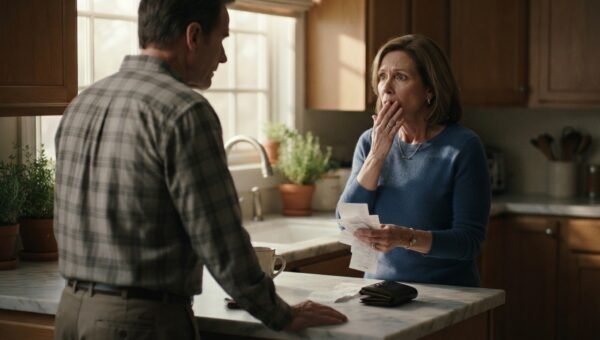
David looked down at the notebook. He took a slow breath, his chest rising and falling heavily. “I know. The funeral home called me from the county seat. I signed the papers yesterday.”
“Why didn’t you tell me?” I asked. My voice didn’t shake now. It was flat and hollow. “Why did you let me walk around for five months pretending she didn’t exist?”
David looked at Brianna, then back at me.
“Because you were falling apart, Mom,” he said quietly. “You don’t remember, but by August, you were weeping in your car after every visit. You couldn’t sleep. You kept calling me at two in the morning talking about Grandpa Thomas and how you couldn’t believe you had lived your whole life on a lie. You were getting sick from it.”
“David told me we had to step in,” Brianna said. Her voice was softer than I had ever heard it. “I made up the rule about church, Evelyn. Not because I didn’t want Lily to know God, but because you wouldn’t stop going to that basement unless someone forced you. You were carrying fifty years of your father’s guilt on your shoulders, and it was crushing you.”
“She was my sister,” I said.
“And you were there for her,” David said. He reached out and took my hands. His skin was rough and warm. “For two years, Mom, you gave her a family. She had never had a Christmas with people who knew her name until you bought that tree for her apartment. She didn’t die alone in a state ward. She died knowing she had a sister.”
“Where is she buried?” I asked.
“St. Matthew’s,” David said. “I bought a plot three rows behind Grandpa and Grandma. It was six hundred dollars for the opening, and I put the deposit down on the marker. It says *Martha Vance. Beloved Sister.*”
We stood on the porch in silence while the sun dipped behind the tall pines across the road. Lily came to the screen door with a half-eaten apple in her hand, looking out at us.
“Grammy?” she asked. “Are you staying for supper?”
I looked at my son. I looked at Brianna, who had taken the blame for keeping my granddaughter away from me just so I wouldn’t have to face the ghost of my father’s cruelty every Sunday morning.
“Yes, Lily,” I said, wiping the corners of my eyes with my sleeve. “I’m staying.”
We had dinner at their kitchen table: baked chicken, green beans from Brianna’s garden, and warm rolls. We didn’t talk about the yellow notebook. We didn’t talk about the state school or the dark basement apartment with the chipping green paint.
The next morning was Sunday.
I woke up at seven, put on my gray wool coat, and drove to St. Matthew’s Cemetery. The grass was covered in white frost that crunched under my black shoes.
I found the small fresh mound of dirt three rows back from where my parents lay under their polished granite headstone. A small temporary metal marker stood in the soil with Martha’s name printed on a white card.
I reached into my pocket and took out the plastic container of lemon cookies I had bought at the grocery store on my way over. I set it gently on the grass beside the marker.
“I’m sorry it took me so long to find you,” I said to the cold wind. “And I’m sorry I let myself forget.”
I stood there until the church bells down in the valley began to ring eight o’clock. Then I turned, walked back to my car, and drove over to David’s house to help Brianna get Lily ready for Sunday school.